At CEDIA Expo this month, Dirac announced that NAD's CI SA2-120 and CI S2 streaming modules have been certified for Dirac Live. Both are custom install parts that an integrator screws into a rack, so as news it is minor. But it sent me to the database to see how far Dirac has actually spread, and the answer turned out to be more interesting than the announcement.
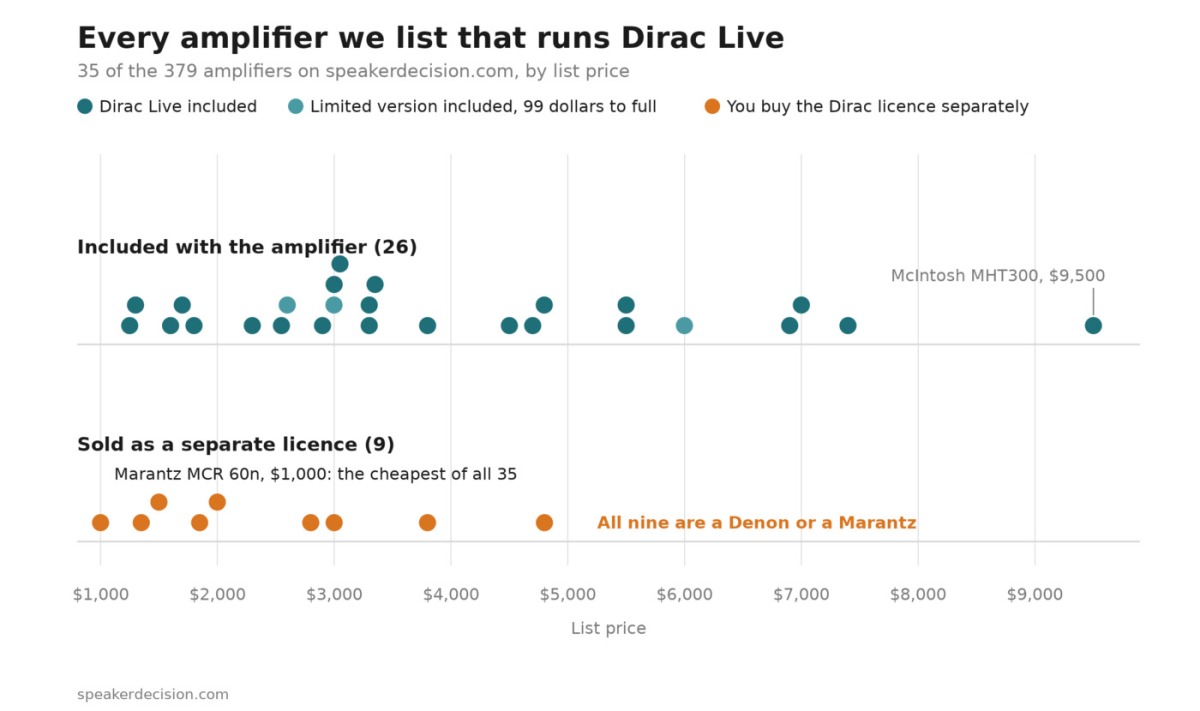 The 35 amplifiers we list that run Dirac Live, by price. The nine in orange sell you the licence separately.
We list 379 amplifiers. Thirty-five of them can run Dirac Live. That is where the simple version of the story ends, because on nine of those thirty-five, Dirac Live is not a feature of the amplifier. It is a licence you buy afterwards.
Quick facts
- 35 of our 379 amplifiers run Dirac Live. 26 include it, and on nine you buy the licence separately.
- All nine are a Denon or a Marantz. Every other brand that offers Dirac includes it in the price.
- Dirac's own pricing page puts Room Correction at 99 to 349 dollars, Bass Control at 299, and bundles at 549 to 899.
- The cheapest amplifier on the list is also one of the nine. The Marantz MCR 60n is 1,000 dollars, licence not included.
- Home cinema got there first. 24 of our 57 AV receivers run Dirac against 11 of 298 stereo amplifiers.
The nine that sell it to you afterwards
These nine amplifiers all ship with a room correction system already in the box. On most of them that is Audyssey. Dirac Live is offered on top, as a paid upgrade, and you buy it from Dirac rather than from the shop that sold you the amplifier.
| Amplifier | Price | What is already in the box |
|---|
| Marantz MCR 60n | 1,000 dollars | nothing, Dirac is the only option |
| Denon AVR-X2900H | 1,349 dollars | Audyssey MultEQ XT |
| Marantz Cinema 70s Series 2 | 1,500 dollars | Audyssey MultEQ XT |
| Denon AVR-X3900H | 1,849 dollars | Audyssey MultEQ XT32 |
| Marantz Cinema 60 Series 2 | 2,000 dollars | Audyssey MultEQ XT |
| Marantz Cinema 50 | 2,800 dollars | Audyssey MultEQ XT32 |
| Marantz Cinema 50 Series 2 | 3,000 dollars | Audyssey MultEQ XT32 |
| Denon AVR-X6800H | 3,799 dollars | Audyssey MultEQ XT32 |
| Marantz Cinema 30 | 4,800 dollars | Audyssey MultEQ XT32 |
Six Marantz, three Denon, and nothing else. Both brands sit under the same owner, so this is one company's pricing policy rather than an industry habit.
This is not a complaint about the amplifiers. It is a warning about the sticker. A 1,349 dollar receiver that needs a 349 dollar licence to do the thing you bought it for is a 1,698 dollar receiver, and no price comparison site will show you that.
How much the licence costs depends on which version you want. Dirac's own pricing page lists Room Correction at 99 to 349 dollars, with the cheaper end being a band limited version that only corrects the bass. Bass Control for multiple subwoofers is another 299. Bundles run 549 to 899. Individual makers set their own prices inside those bands, and some models do not support the add-ons at all.
The cheapest ways in
If you want Dirac Live and you want it included, there are three prices worth knowing.
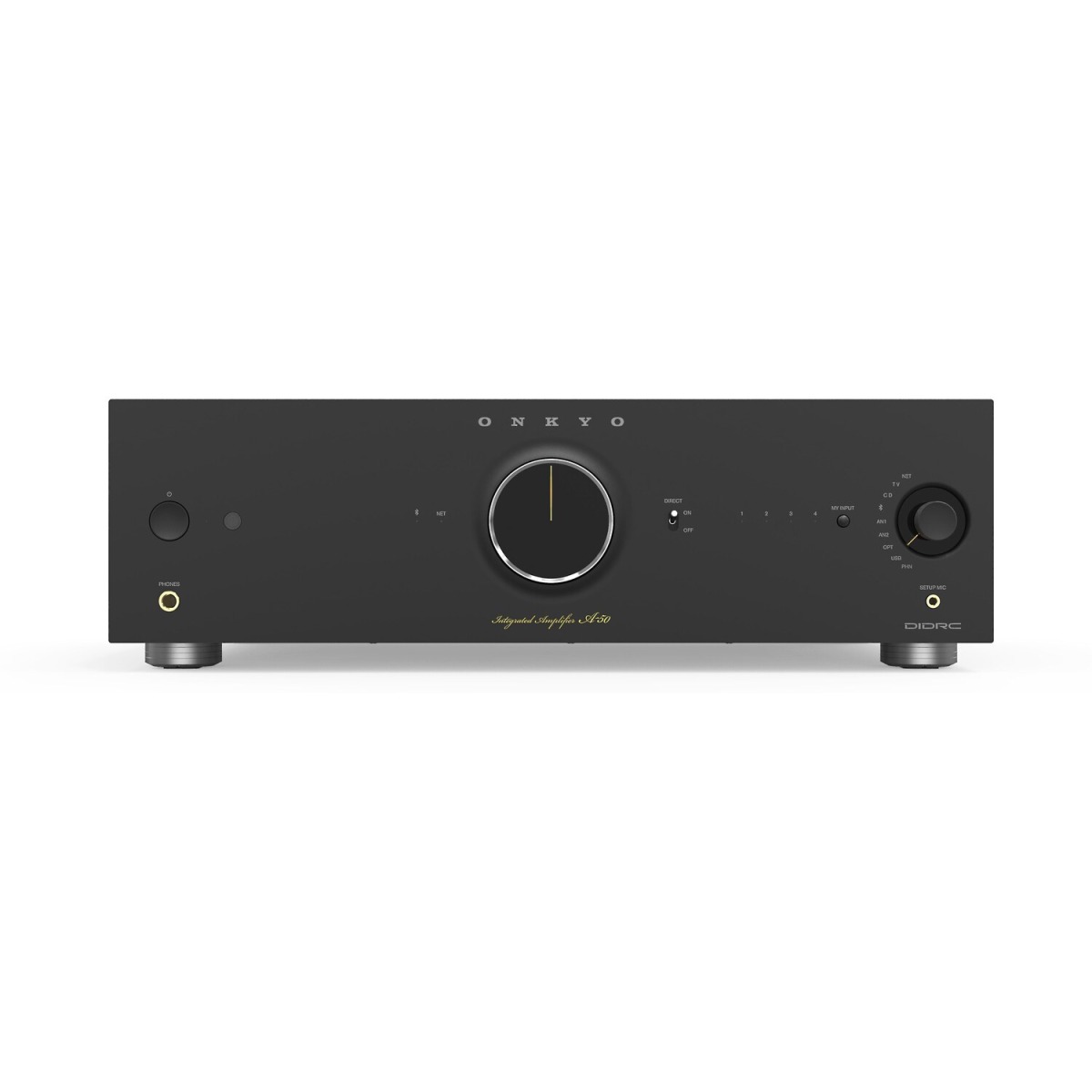 The Onkyo Icon A-50, 1,600 dollars, the cheapest stereo amplifier we list with Dirac Live included rather than sold on top
The cheapest of any kind is the Marantz MCR 60n at 1,000 dollars, but it is one of the nine, so the licence is on top. In home cinema, the cheapest with Dirac in the box is the Onkyo TX-RZ30 at 1,250 dollars, where Onkyo bundles it alongside its own AccuEQ. In stereo, it is the Onkyo Icon A-50 at 1,600 dollars.
Above those, the ladder is steep. The next stereo amplifier up is the NAD C 389 BluOS-D at 2,549, then the NAD C 399 BluOS-D at 2,599. The C 399 BluOS-D is one of three NAD models that include the limited version and charge 99 dollars to unlock full bandwidth, the other two being the M10 V2 and the M33. At the top of the whole list sits the McIntosh MHT300 at 9,500 dollars.
| FEATURE and SPECS COMPARISON | |  |  |  |  |
| Model | Marantz MCR 60n | Onkyo Icon A-50 | NAD C 389 BluOS-D | Arcam SA30 |
| Type | Integrated Amplifier | Integrated Amplifier | Integrated Amplifier | Integrated Amplifier |
| Amplifier Class | - | Class A/B | Class D | Class G |
| Power into 8 ohms | - | 110 watts | 130 watts | 130 watts |
| Power into 4 ohms | 65 watts | 180 watts | 130 watts | 200 watts |
| Minimum Impedance | 4 ohms | 4 ohms | 4 ohms | 4 ohms |
| THD | 0.1% at 1 kHz, 5 W, 4 ohms | 1% | 0.02% | 0.002% |
| Signal to Noise Ratio | 90 | 104 | 95 | 112 |
| Frequency Bandwidth | 10 Hz-40 kHz | 20 Hz-20 kHz | 20 Hz-20 kHz | 20 Hz-20 kHz |
| Built-in DAC | | | | |
| DAC | - | - | - | 32-bit ESS 9038K2M Sabre |
| Max Bit Depth | 32-bit | 32 | 32 | 24 |
| Max Sample Rate | 384 kHz | 768 | 384 | 192 |
| Analog Inputs | 1 | - | - | 4 |
| Phono Input | | | | |
| Phono Type | MM | - | - | MM,MC |
| Optical Digital Inputs | 1 | 2 | 2 | 2 |
| Coaxial Digital Inputs | No | 1 | 2 | 2 |
| USB Input | Yes | Yes | Yes | Yes |
| HDMI Input | Yes | 1 | 1 | Yes |
| HDMI ARC | eARC | | - | eARC |
| XLR Input | No | No | No | - |
| Preamp Outputs | Main pre-out (AUX assignable), Sub | Yes | Yes | Stereo RCA |
| Subwoofer Output | 1 | No | Dual | - |
| Headphone Output | Yes | 1/4 | 1/4 | 3.5mm |
| Bluetooth | Yes | Yes | Yes | No |
| Wi-Fi | Yes | 802.11ac | 802.11ac | 802.11ac |
| AirPlay 2 | | | | |
| Chromecast built-in | - | | | |
| Roon | Ready | Ready | Ready | Ready |
| BluOS | - | | | |
| HEOS | | | | |
| Room Correction | Opt. Dirac Live | Dirac Live | Dirac Live | Yes |
| Room Correction System | Dirac Live, as a paid upgrade | Dirac Live Room Correction Suite Stereo, Limited Bandwidth (20-500 Hz) included; the full-bandwidth | Dirac Live (Lite version included, can be upgraded to full for $99) | Dirac Live |
| Tone Controls | | - | - | - |
| Handheld Remote | | - | - | |
| Height | 111.8mm | 134.9mm | 101.6mm | 101.0mm |
| Width | 279.4mm | 435.0mm | 435.0mm | 434.0mm |
| Depth | 302.3mm | 355.0mm | 415.9mm | 377.0mm |
| Weight | 4.20kg | 13.00kg | 8.66kg | 12.00kg |
| MSRP | 1000 USD | 1600 USD | 2549 USD | 2699 USD |
| Check Current Price | Amazon, B&H Photo | Amazon, B&H Photo | Amazon, B&H Photo | Amazon, B&H Photo |
Home cinema solved this. Stereo mostly has not
Room correction has been normal in an AV receiver for twenty years. It is still unusual in a stereo amplifier, and the gap is wide. Of our 57 AV receivers, 24 run Dirac Live. Of our 298 stereo integrated amplifiers, 11 do.
The reason is not technical. A stereo amplifier that streams already has a processor in it, which is why the ones that offer Dirac are almost all network amplifiers: the NAD M33, the Arcam SA30, the JBL SA750. A classic two channel integrated with a volume knob and no network has nowhere to put it.
By brand, Arcam and Marantz lead with nine each, then NAD with seven, Onkyo with four and Denon with three. JBL, McIntosh and Integra have one each.
Where our own count is weak
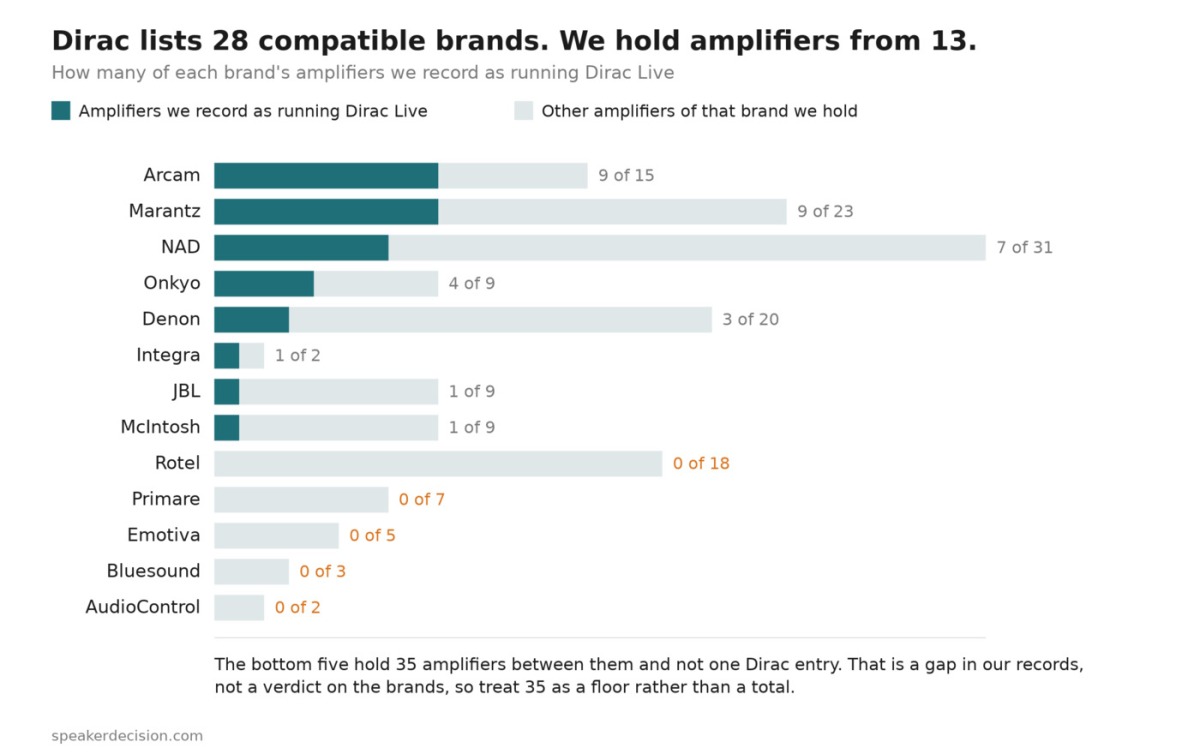 The 13 brands on Dirac's own compatibility list that we hold amplifiers from, and how many of each we record as running Dirac Live
Dirac publishes a list of 28 compatible brands. We hold amplifiers from 13 of them. And five of those 13 have no Dirac entry on any row: Rotel, Primare, Emotiva, Bluesound and AudioControl, which between them account for 35 amplifiers in our database.
That is almost certainly our gap rather than the truth about those brands. So read 35 as a floor, not a total. We are going back through those rows.
There is a second wrinkle worth being honest about. Denon's own Dirac Live page names five compatible receivers, and the AVR-X2900H and AVR-X3900H are not among them, even though both are widely sold as Dirac upgradeable and we list them that way. Denon's page appears to be a generation out of date. Before you buy an amplifier for Dirac specifically, check the current compatibility list rather than any single page, including ours.
What room correction will not fix for you
Dirac Live measures your room with a microphone and adjusts what the amplifier sends to your speakers. It is very good at the problems a room creates below a few hundred hertz, which is where most of them are, and it can tidy up a pair of speakers that are not placed symmetrically.
It cannot make a small room big. It cannot put bass where the room cancels it, because you cannot boost a null into existence. It will not repair a speaker that is genuinely poor, and it does nothing about reflections you would fix better with a rug and a bookcase. If you are choosing between spending 349 dollars on a licence and 349 dollars on getting the speakers off the wall and onto proper stands, take the stands first.
Onkyo Icon A-50 Key Specs
- 110W into 8 ohms, 180W into 4 ohms (Class A/B)
- Integrated Amplifier
- Minimum Impedance: 4 ohms
- 1% THD
- Signal to Noise Ratio: 104dB
- Frequency Bandwidth: 20 Hz-20 kHzHz
- Built-in DAC
- Max Bit Depth: 32
- Max Sample Rate: 768
- Phono Input
- 1 HDMI Input
- HDMI ARC
- 1/4 Headphone Output
- Bluetooth
- 802.11ac Wi-Fi
- Ready Roon Ready
- Dirac Live Room Correction
- Weight: 13.00 kg
- Dimensions (H x W x D): 134.9 x 435.0 x 355.0 mm
- Read the Review
Questions answered
Does Dirac Live cost extra?
It depends entirely on the amplifier. On 26 of the 35 amplifiers we list it is included in the price. On nine of them, all of which are a Denon or a Marantz, you buy a licence from Dirac afterwards. Dirac's pricing page lists Room Correction at 99 to 349 dollars depending on version and device.
What is the cheapest amplifier with Dirac Live?
The Marantz MCR 60n at 1,000 dollars, but the licence is extra. If you want it included, the cheapest home cinema receiver is the Onkyo TX-RZ30 at 1,250 dollars and the cheapest stereo amplifier is the Onkyo Icon A-50 at 1,600 dollars.
What is the difference between the cheap and expensive Dirac licences?
The cheaper option corrects a limited band, usually the bass, where room problems are worst. The full version corrects the whole frequency range. NAD ships the limited version on three of its models and charges 99 dollars to go to full. Bass Control, which co-optimises several subwoofers together, is a separate 299 dollar add-on and is not supported on every model.
Why do so few stereo amplifiers have room correction?
Because it needs a processor, and most stereo integrated amplifiers do not have one. Of our 298 stereo integrated amplifiers only 11 run Dirac Live, and nearly all of those are network amplifiers that were already doing digital work. AV receivers have had processing since the beginning, which is why 24 of our 57 run it.
Is our list of 35 complete?
No, and we would rather say so. Dirac names 28 compatible brands and we hold amplifiers from 13 of them, but five of those 13 have no Dirac record on any row at all. Treat 35 as the number we can stand behind today rather than the number that exists.
So here is the question I keep coming back to. If two receivers cost the same and one includes Dirac Live while the other sells it to you for another 349 dollars, is that a price difference you would actually notice on a shop page, or one you would only find out about after the box was open?