Denon's AVR-X2900H arrived in May 2026 at 1,349 dollars, replacing the X2800H. It is a 7.2 channel receiver with seven amplifier channels inside it.
Open Denon's own spec sheet and the power row gives you two figures for the same product. Most makers pick one and print it. Denon prints both, which turns out to be the most useful thing on the page.
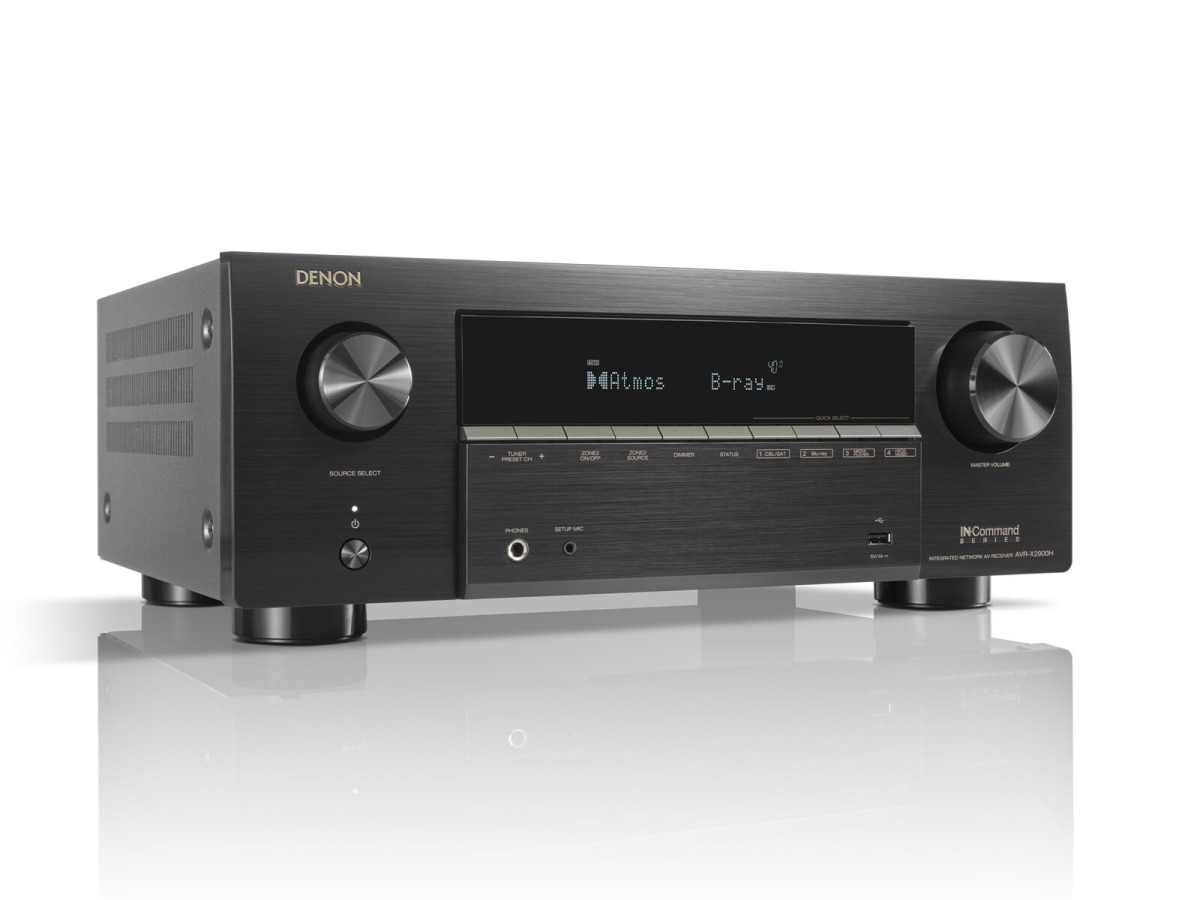 Denon AVR-X2900H 7.2 channel AV receiver, front three quarter view
Quick facts
- 95 watts is measured into 8 ohms, across the full 20Hz to 20kHz band, at 0.08% distortion, with two channels driven. That is a strict test.
- 125 watts is measured into 6 ohms, at 1kHz only, at 0.7% distortion, with two channels driven. Same box, easier conditions, 32% bigger number.
- Denon also publishes a third figure that almost nobody else does: over 70% of rated output with five channels driven. That is about 66 watts a channel, and it is the one worth reading.
- Only 5 of the 294 stereo amplifiers we list say how many channels were driven when the power was measured. Almost every maker leaves it out.
- The AVR-X2900H is now listed here, in the home theater receiver section we added this week. So are 56 others. Nothing below is measured by us: these are manufacturer specifications.
What actually changes between 95 and 125
Three things change at once, and each one on its own makes the number bigger.
The load. 8 ohms in the first figure, 6 ohms in the second. A lower impedance pulls more current, so the same amplifier delivers more watts into it. This is not the amplifier getting stronger. It is the speaker asking for more.
The bandwidth. The 95 watt figure holds across the whole audible range, 20Hz to 20kHz. The 125 watt figure is measured at 1kHz alone. Bass is where an amplifier struggles, so a single midrange tone is the friendliest test you can run.
The distortion allowed. 0.08% for the first number, 0.7% for the second. That is nearly nine times as much distortion permitted before the reading is taken.
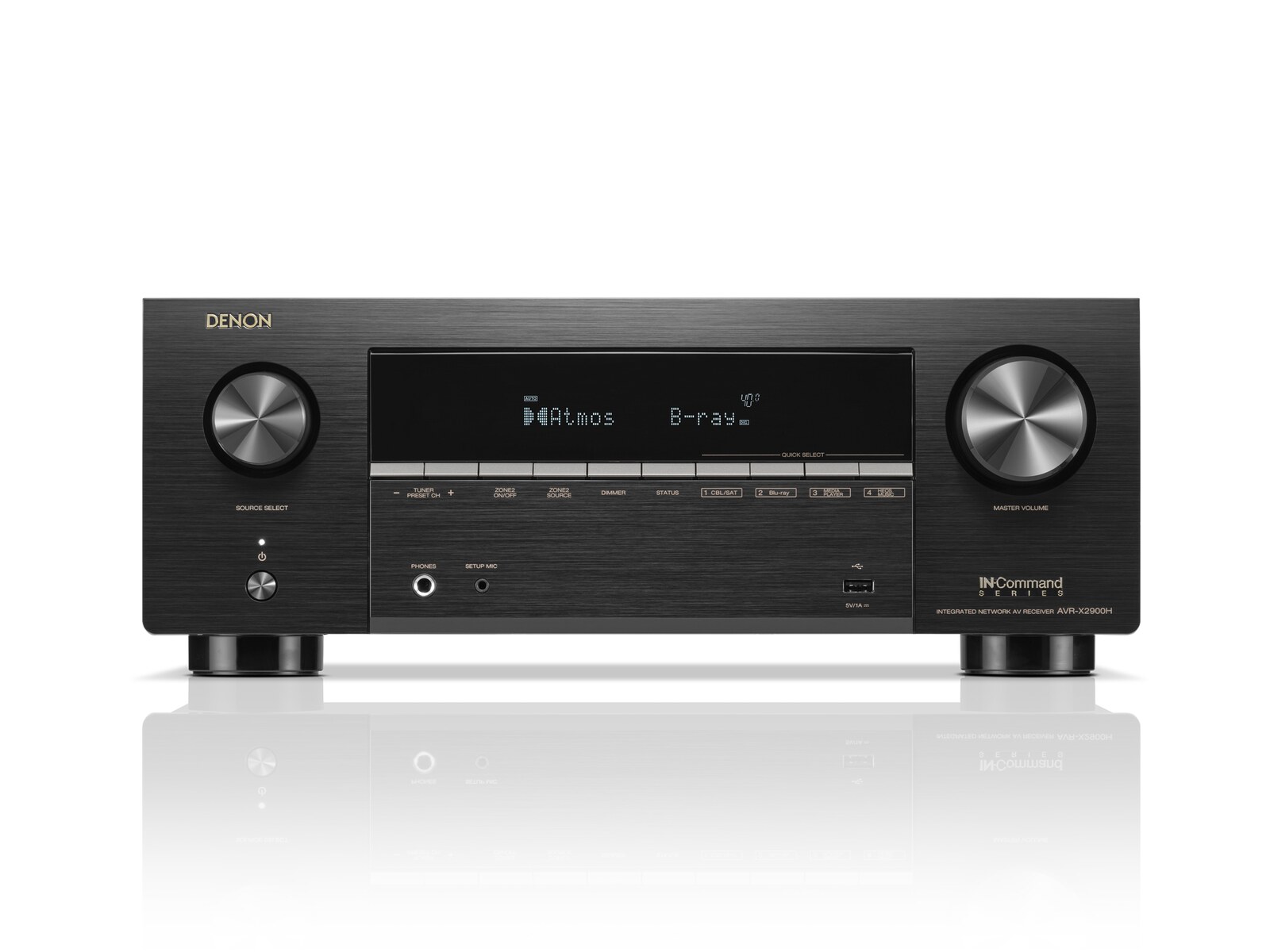 The AVR-X2900H has seven amplifier channels behind that panel. Both published power figures are measured with two of them running.
None of this is dishonest. Both figures are true under the conditions printed next to them. The problem is that the conditions are printed in small type and the number is printed on the box.
For what it is worth, our database records the way each maker states it. Of the 294 stereo amplifiers we hold, 284 publish an 8 ohm figure, 210 publish a 4 ohm figure, and just 15 publish a 6 ohm figure at all. Denon's own stereo amplifiers are in that majority: not one of the nine Denon stereo rows we list quotes a 6 ohm number. The 6 ohm rating turns up on the AV receiver.
The number Denon publishes that hardly anyone else
Here is the part that makes this receiver worth writing about rather than complaining about.
Both of those power figures are measured with two channels driven. This is a seven channel receiver. If you are watching a film, all seven are working at once, and they share one power supply and one transformer.
Denon prints a guarantee for that case: over 70% of rated output with up to five channels driven at the same time. 70% of 95 watts is 66.5 watts. So on Denon's own numbers, a five channel film soundtrack gets at least 66 watts a channel, not 95.
That is a genuinely useful disclosure, and it is rare. Across our 294 stereo amplifier rows, only five record how many channels were driven when the power was quoted. Everyone else simply does not say.
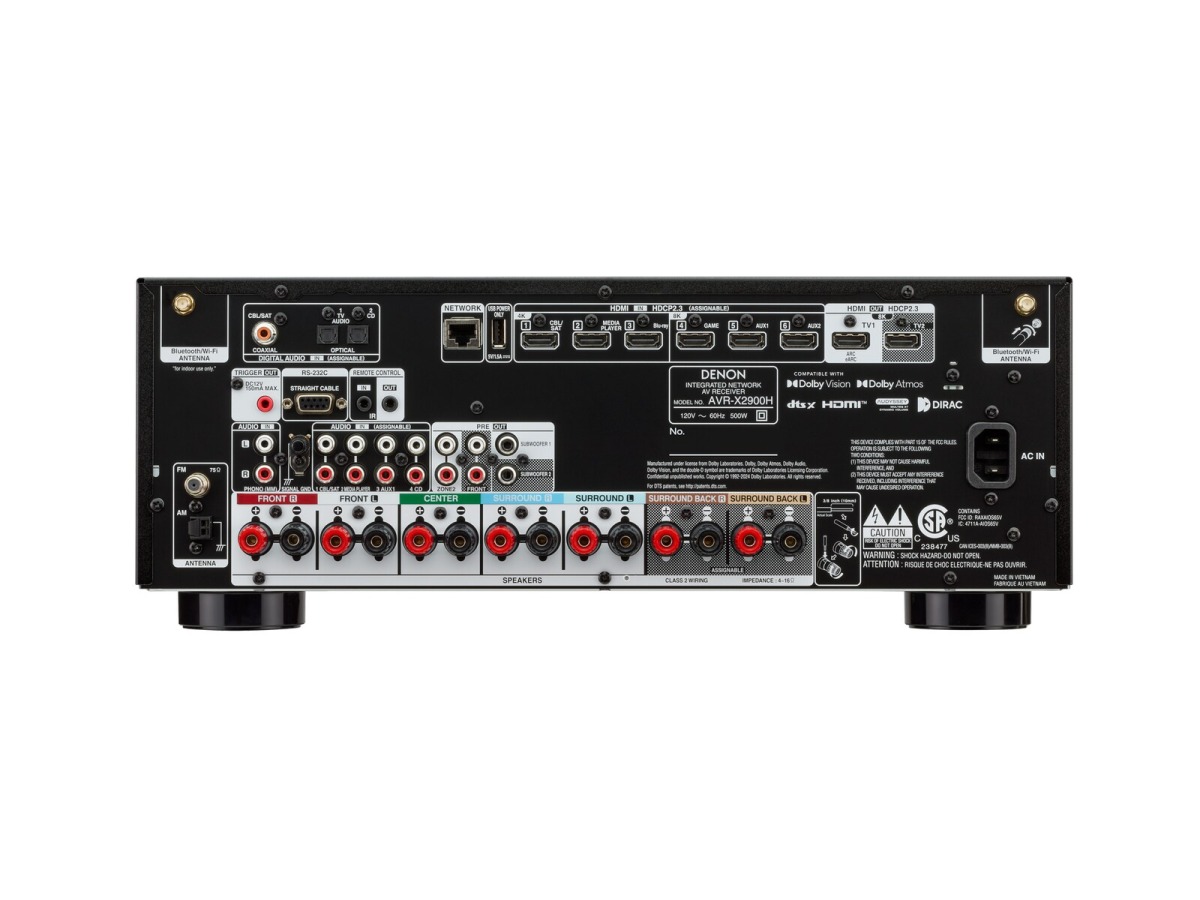 Denon AVR-X2900H rear panel, seven speaker channel pairs and the 500 watt mains rating
The rear panel carries a second sanity check. The receiver is rated to draw 500 watts from the wall. Seven channels at 95 watts each would be 665 watts of output, and no amplifier is more than 100% efficient, let alone a Class AB one. Those two numbers cannot describe the same moment. Music and film peaks are short and come out of the capacitors, so this is not a fault, but it does tell you that 95 times seven was never on offer.
What it costs per watt, next to Denon's own stereo amplifiers
We list nine Denon amplifiers, and the honest way to compare them is price divided by every watt the amplifier makes, not by the per channel figure. Otherwise a two channel amp and a five channel one are not being measured the same way.
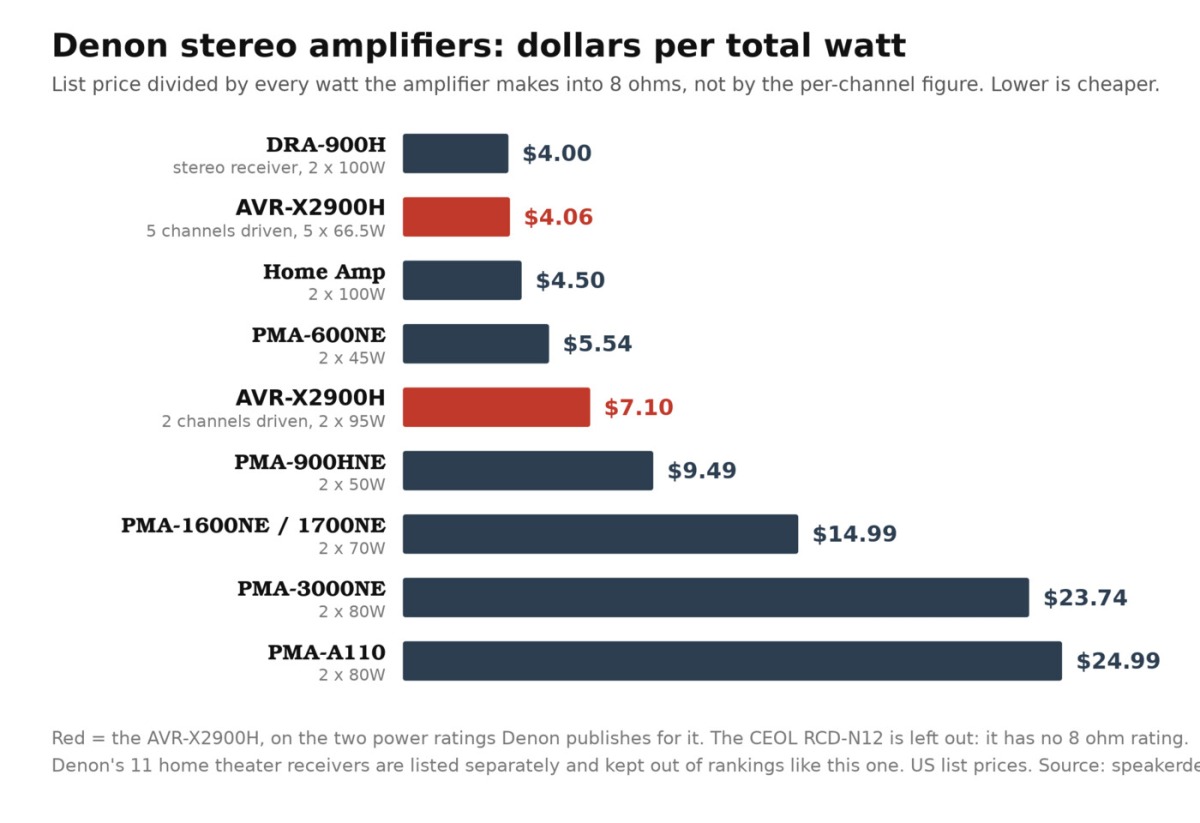 Denon stereo amplifiers, ranked by list price per total watt into 8 ohms
Read the two red bars. On the strict 95 watt rating with two channels driven, the AVR-X2900H is 7.10 dollars a watt. Count the five channels Denon guarantees and it falls to 4.06 dollars a watt. The basis you pick moves the answer by three dollars, which is the whole point of this article.
Either way it lands mid ladder rather than at the top. The DRA-900H stereo receiver is 4.00 dollars a watt, the Home Amp is 4.50 and the PMA-600NE is 5.54. Cheap watts are easy to buy at the bottom of a range.
The interesting comparison is at the other end.
The PMA-3000NE is 3,799 dollars and makes 80 watts a channel into 8 ohms, so 23.74 dollars a watt. That is 3.3 times what the receiver costs per watt on the strict rating, and 5.9 times on the five channel one.
Denon PMA-3000NE Key Specs
- 80W into 8 ohms, 160W into 4 ohms (Class A/B)
- Integrated Amplifier
- Minimum Impedance: 4 ohms
- 0.07% THD
- Signal to Noise Ratio: 110dB
- Frequency Bandwidth: 20 Hz-20 kHzHz
- Built-in DAC
- Phono Input
- 1/4 Headphone Output
- Weight: 25.05 kg
- Dimensions (H x W x D): 183.0 x 435.0 x 475.0 mm
- Read the Review
Nobody should read that as the integrated being poor value. You are buying a different thing: one transformer feeding two channels instead of seven, a much heavier power supply, no video section, no processing, and a design brief that starts and ends with stereo. Watts are the cheapest part of an amplifier to add and the least interesting thing about it.
Where it sits in the section we just added
We added a home theater receiver section to the site this week, and the AVR-X2900H has a page on it now. There are 57 receivers in it so far, from 11 brands. Denon has the most, with 11.
Here is the whole Denon ladder as we list it. The watts column is Denon's 8 ohm figure, which on every one of these is measured with two channels driven.
The X2900H is the step where the X-series starts. Below it the S-series gives you the same 7 channels for 600 dollars less and takes away the better room correction, and above it the X3900H adds two channels, 10 watts and Audyssey MultEQ XT32 for 500 dollars more.
Why these are not in our amplifier rankings
This is the part where the article and the website agree, and it is worth saying out loud.
Every power figure on those 57 receivers is a two channels driven figure. That is how the whole category is rated. So a 9 channel receiver at 105 watts would compute as 945 watts of total power, and it would beat every stereo amplifier we hold on dollars per watt, on a number nobody can actually get out of it.
So we keep them apart on purpose. Home theater receivers have their own route and their own section. They do not appear in the amplifier brand pages, the power band pages, the dollars per watt rankings or the amp and speaker matcher. The matcher reads a power figure as continuous output against a speaker's sensitivity and impedance, so letting a receiver in would have it recommending machines for speakers they cannot drive.
Every receiver page prints the qualifier next to the number, so the AVR-X2900H page reads 95 watts RMS into 8 ohms (2 channels driven) rather than just 95 watts. That is the whole argument of this article, turned into a rule the site follows.
Here are the three Denon amplifiers this article keeps putting next to each other.
| FEATURE and SPECS COMPARISON | |  |  |  |
| Model | Denon PMA-3000NE | Denon DRA-900H | Denon Home Amp |
| Type | Integrated Amplifier | Stereo Receiver | Integrated Amplifier |
| Amplifier Class | Class A/B | Class A/B | Class D |
| Power into 8 ohms | 80 watts | 100 watts | 100 watts |
| Power into 4 ohms | 160 watts | - | 125 watts |
| Minimum Impedance | 4 ohms | - | - |
| THD | 0.07% | 0.08% | - |
| Signal to Noise Ratio | 110 | - | - |
| Frequency Bandwidth | 20 Hz-20 kHz | 20 Hz-20 kHz | - |
| Built-in DAC | | | |
| Max Bit Depth | - | 32 | 24-bit |
| Max Sample Rate | - | 192kHz | 192 kHz |
| Analog Inputs | - | 2 | - |
| Phono Input | | | |
| Phono Type | - | MM | - |
| Optical Digital Inputs | 3 | 2 | - |
| Coaxial Digital Inputs | 1 | 1 | - |
| USB Input | Yes | Yes | - |
| HDMI Input | - | Yes | eARC |
| HDMI ARC | - | ARC | - |
| XLR Input | - | - | No |
| Preamp Outputs | Yes | Stereo RCA | - |
| Subwoofer Output | - | - | 1 |
| Headphone Output | 1/4 | - | - |
| Bluetooth | - | Yes | Built-in |
| Wi-Fi | - | Yes | 2.4, 5GHz |
| AirPlay 2 | | | |
| Roon | No | - | No |
| BluOS | | - | |
| HEOS | | | |
| Height | 183.0mm | 150.9mm | 88.0mm |
| Width | 435.0mm | 436.6mm | 218.0mm |
| Depth | 475.0mm | 369.8mm | 266.0mm |
| Weight | 25.05kg | 8.30kg | 2.00kg |
| MSRP | 3799 USD | 799 USD | 899 USD |
| Check Current Price | Amazon, B&H Photo | Amazon, B&H Photo | Amazon, B&H Photo |
A power rating is not a fact about an amplifier. It is a fact about a test. Denon printing 95 watts, 125 watts and a five channel guarantee for one receiver is not confusion, it is more information than almost anyone else gives you. The trap is reading only the biggest of the three.
The honest parts
Five things to know before this goes on a shortlist.
Room correction is Audyssey MultEQ XT, not XT32. You have to step up to the X3900H for XT32. Dirac Live is available but as a paid upgrade at 259 dollars for the band limited version or 349 for full bandwidth, and Dirac Bass Control and ART are not supported on this model at all. So a 1,349 dollar receiver can become a 1,698 dollar one before you have bought a speaker.
Bluetooth is SBC only. On a machine with AirPlay 2, HEOS and Roon Ready support that is a small thing, but it is there.
 Denon PMA-3000NE integrated amplifier, 80 watts a channel at 3,799 dollars
Preamp outputs cover the front two channels and a stereo zone two. If your plan is to add external power amplification later across the whole system, this is not the receiver for it.
Our listing does not carry the 125 watt figure. The AVR-X2900H page records the 95 watt rating, because that is the one measured across the full band and the one that can be compared with anything else. If you want the 6 ohm number, it is on Denon's spec sheet, and now also in the second bullet at the top of this article.
Our side by side comparison tool covers stereo amplifiers only for now, so you cannot yet line the AVR-X2900H up against another receiver column by column. The full spec list is on its page, and the whole section is at home theater receivers.
And none of these numbers are measured. They are manufacturer specifications, including the ones that make Denon look good. The full review at SoundStage Access is worth reading for the listening side, which is not what this article is about.
If you want to know which speakers this receiver will actually drive, its page has a speaker finder built into it that works from sensitivity, impedance and current delivery rather than from the number on the box.
Questions answered
So how many watts does the Denon AVR-X2900H really make?
95 watts per channel into 8 ohms across the full 20Hz to 20kHz band at 0.08% distortion, with two channels driven. That is the strictest figure Denon publishes and the one to compare against other amplifiers. The 125 watt figure is into 6 ohms, at 1kHz only, at 0.7% distortion.
What does the 70% guarantee mean in practice?
Denon guarantees over 70% of the rated output with up to five channels driven at the same time. 70% of 95 watts is 66.5 watts, so a five channel soundtrack gets at least that from each channel. Very few makers publish anything of the kind, which is why it is worth knowing about.
Why is a 6 ohm rating higher than an 8 ohm rating?
A lower impedance draws more current from the same amplifier, so more watts are delivered into it. The amplifier has not changed. Of the 294 stereo amplifiers we list, only 15 publish a 6 ohm figure at all, so it is not a number you can use to compare across brands.
Is the AVR-X2900H better value than a Denon stereo integrated?
On watts alone, yes, by a lot. It is 7.10 dollars per total watt on the strict rating against 23.74 for the PMA-3000NE. But watts are the cheapest thing to add. The integrated puts one power supply behind two channels instead of seven and leaves out the video and processing hardware entirely. They are different products that happen to share a brand.
Is the AVR-X2900H in your database?
Yes, since this week. It is at home-theater-receiver/Denon-AVR-X2900H, one of 57 receivers in the new section, alongside 10 other Denons. They are deliberately kept out of the amplifier rankings and the amp and speaker matcher, because their watts are quoted with two channels driven and would not mean the same thing there. Denon's stereo range is separate, on the Denon amplifier brand page.
When you last bought an amplifier or a receiver, did you check which load and which bandwidth the watts figure was measured under, or did you take the number on the front of the box?