If you own a Denon or Marantz receiver, a new message may already be on its screen. It points to a privacy notice from HARMAN, and it has an “Acknowledge” button and no visible way to say no. Headphonesty reported it on 18 November, after a Marantz owner showed the prompt in a video.
Here is why HARMAN is involved. HARMAN has been a wholly owned part of Samsung Electronics since 2017. On 23 September 2025 it completed its purchase of Sound United. That brought in Bowers & Wilkins, Denon, Marantz, Definitive Technology, Polk Audio, HEOS, Classé and Boston Acoustics.
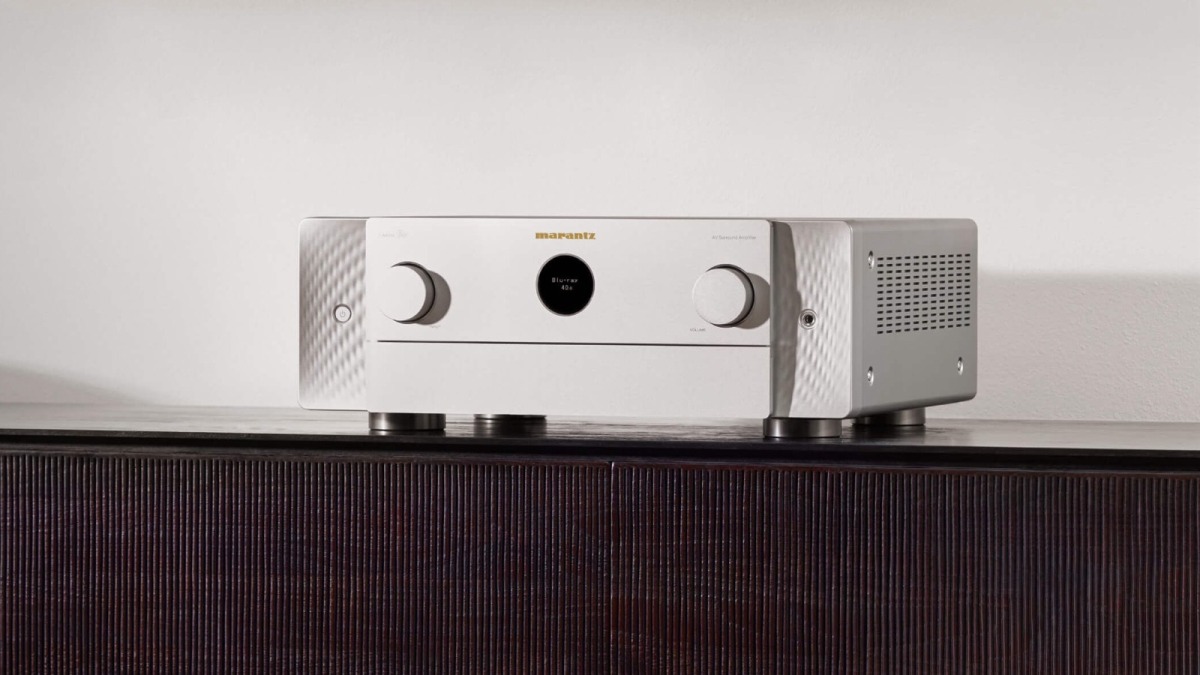 Marantz Cinema 50 AV receiver in silver, one of the HEOS network receivers now covered by HARMAN's privacy notice
Quick facts
- What changed. HARMAN’s privacy notice, dated 10 November 2026, now names Samsung Electronics and other Samsung companies as places your data can go, and South Korea as a country it can be sent to.
- Who it covers. The US terms of use for Denon, Marantz, Polk, Bowers & Wilkins and Definitive Technology are all HARMAN terms, and all point to that one notice.
- Our data. We list 226 products from those five brands. 34 of them can go online. The other 192 are passive speakers, subwoofers and amps with no network connection at all.
- What you can do. Ask HARMAN what it holds on you at privacy@harman.com, switch off usage reporting, or keep the box off your network.
What the notice actually says
I read HARMAN’s privacy notice on 19 November. It says “Last Updated: November 10, 2026”. Three parts matter to a hi-fi owner.
Samsung is named. HARMAN can share your personal data with “our parent company, Samsung Electronics Co., Ltd., and other Samsung group companies”. The reasons it gives are internal ones: shared services, reporting, audits and compliance. Headphonesty compared it with the April 2025 version, which spoke only of HARMAN affiliates and did not name Samsung.
South Korea is named. Your data may be stored in or sent to other countries, “including the United States and the Republic of Korea”. Samsung is based in Korea.
Advertising was already there. HARMAN can give your data to advertising networks, so they can show you HARMAN ads on other sites and apps. That was in the 2025 version too. So was the long list of data types that went around social media this week, including voiceprints and fingerprints. And the parts about immigration status and payroll are new because the notice now also covers HARMAN’s own staff. That does not mean your receiver collects any of it.
A notice says what a company is allowed to do. It does not tell you what a given receiver actually sends. Nobody has shown that yet.
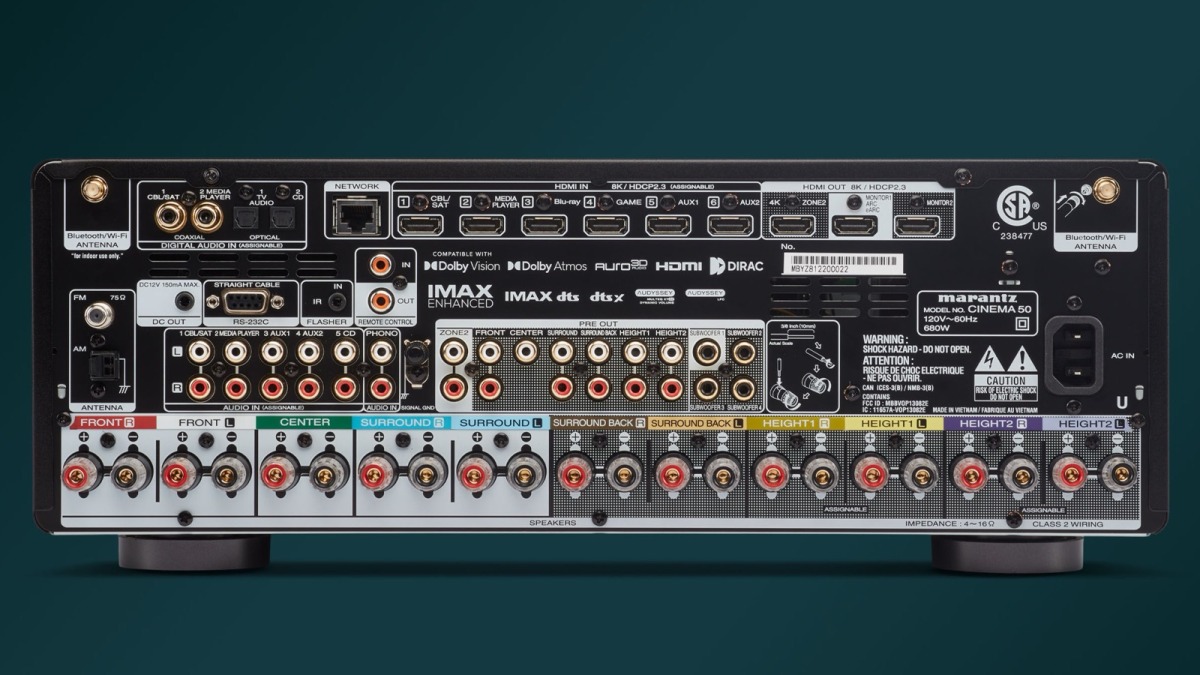 The back of the Marantz Cinema 50, with its network port and Wi-Fi antennas, the parts that make the privacy terms matter
The brand terms, checked one by one
Each brand has its own US terms of use page, but the text is the same, and each says the service is “owned and operated by Harman International Industries”. Here is the date each one showed on 19 November:
All five say the same blunt thing: “If you do not agree to these Terms, you may not access or use the Services.” They also send disputes to individual arbitration, with no class actions. HARMAN’s older brands already worked this way. The Revel and Arcam websites both link to the same HARMAN notice.
Which products this can touch: 34 of 226
A privacy notice only matters for a product that can send data. A passive speaker has a pair of binding posts and nothing else. So I went through every product we list from the five Sound United brands and sorted them.
 Bowers & Wilkins 703 S3: a passive floor-stander with binding posts and no network, like all 177 B&W, Polk and Definitive Technology speakers and subs we list
- Bowers & Wilkins, Polk and Definitive Technology speakers and subs: 177, none online. That is 60 B&W, 68 Polk and 49 Definitive Technology rows. All are passive speakers or subwoofers. A B&W 703 S3 or a Polk Reserve R200 cannot see a privacy notice, let alone send anything.
- Denon: 15 of 22 online. 10 of our 11 Denon AV receivers use HEOS. The odd one out is the AVR-S570BT, which has Bluetooth and no network. Of the stereo amps, 4 of 9 are networked, such as the Denon Home Amp. Bigger integrated amps like the PMA-1700NE have no network at all. One of the two soundbars, the Home Sound Bar 550, has Wi-Fi.
- Marantz: 16 of 23 online. All 9 Marantz AV receivers we list use HEOS, from the NR1510 to the Cinema 30. Of the 14 stereo amps, 7 are networked, including the PM7000N and Model 40n. The other 7, like the Model 30, are classic amps with no network.
- Polk soundbars: 3 of 4 online. The three MagniFi AX bars, such as the MagniFi Max AX, have Wi-Fi. The Signa S4 does not.
So 34 of the 226 products can connect, about 15 percent. Almost all of them are receivers and streaming amps. I checked each of the 20 Denon and Marantz receivers on the maker’s own US page, because our receiver data did not record HEOS yet.
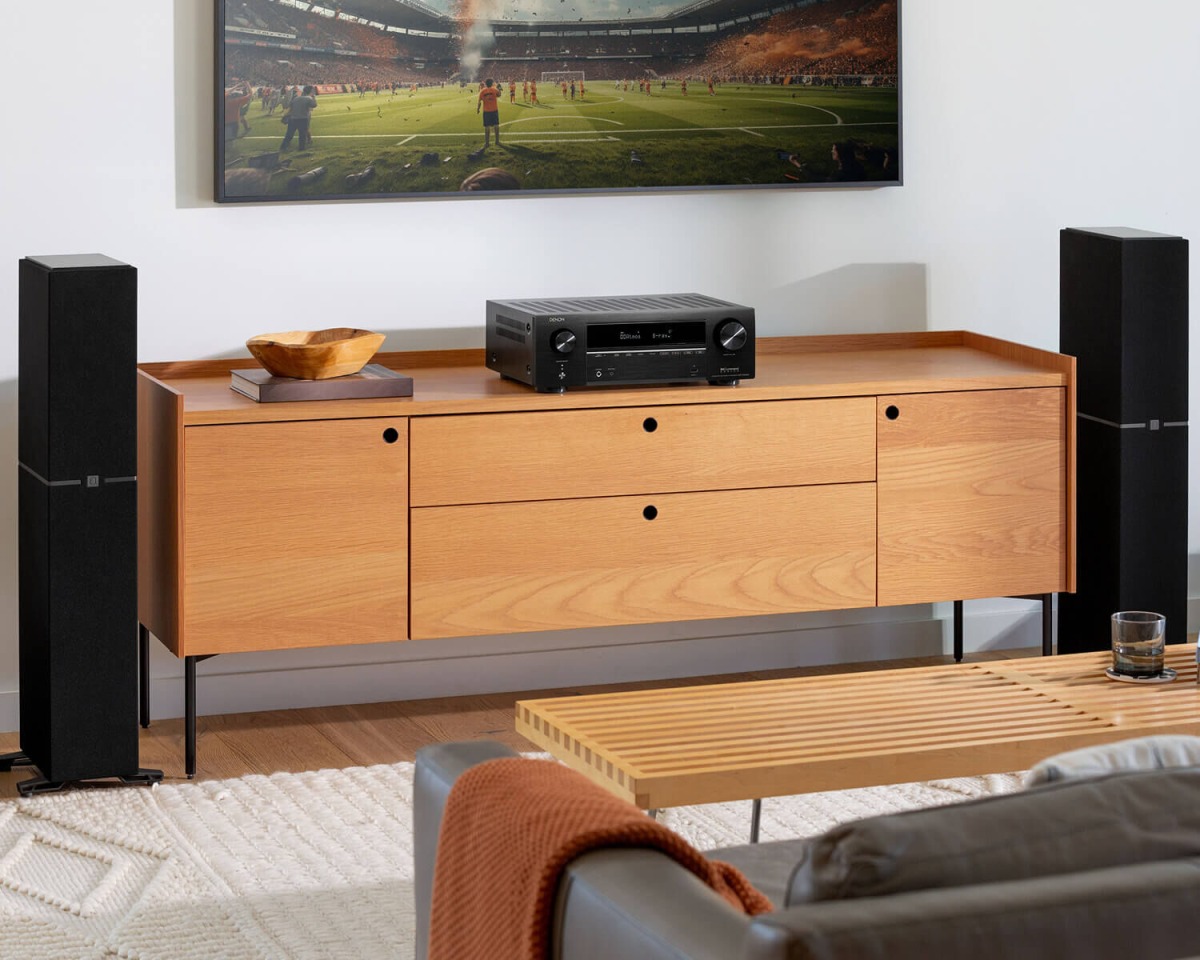 Denon AVR-X1800H between a pair of Definitive Technology towers: the receiver goes online, the speakers never do
If you count HARMAN’s older brands too (JBL, Revel, Arcam, Mark Levinson and Harman Kardon), the same notice covers 376 of the 2,146 speakers and amps we list. That is roughly one product in six.
The promise in the old manual
The Marantz Cinema 50 is the receiver in the story. Its online manual describes a setting that sends anonymous usage data, like your inputs, sound modes and speaker settings. The manual says “Marantz will never provide any information we collect to third parties.”
That line is about usage data only. And Samsung is HARMAN’s parent company, which a lawyer would not call a third party. So the promise and the new notice may not even contradict each other on paper. It still is not what most buyers took it to mean.
What you can do
- Turn off usage reporting. On the Cinema 50 the setting is in the General menu. Set it to No. On other HEOS models, look in the same menu.
- Ask HARMAN. Email privacy@harman.com and ask what it holds on you and whether it goes to Samsung. Depending on where you live, you can ask for a copy, or ask it to delete it.
- Keep it offline. A receiver plays discs, HDMI and analog sources without the internet. You lose HEOS streaming, voice control and firmware updates.
- Or skip the network entirely. A passive pair and an amp with no network, such as the PMA-1700NE or Model 30, never shows a prompt at all.
 Marantz Model 30: a $2,999 integrated amp with no network connection, so no prompt and nothing to send
What nobody knows yet
This is the weak point of the whole story, and it should be said plainly. Nobody has shown what a HEOS receiver actually sends to HARMAN. And nobody has shown what happens if you never press “Acknowledge”. HARMAN has not said whether streaming stops, whether updates stop, or whether nothing happens at all. The prompt itself comes from one owner’s report, which I have not seen for myself.
Until HARMAN answers, the honest summary is short. The passive speakers are not affected. The networked receivers, streaming amps and soundbars are, and the terms that govern them can change after you buy.
Would this change what you buy next, or does a receiver on your network not worry you?