Klipsch is back in high-end headphones. The Stratos HP-2 and HP-3 make their public debut at CanJam Dallas this weekend, 14 and 15 November. Klipsch showed them earlier this year as the Atlas HP-2 and HP-3, at CES in January and at High End Vienna in June. The name is new. The prices are final: $999.99 for the HP-2 and $1,199.99 for the HP-3. Both reach US shops and klipsch.com in December, and Europe in January 2027 (999 and 1,199 euros).
Speaker Decision is a speaker site, and we have no headphone pages. But Klipsch is the deepest brand in our database, with 109 of its speakers and subwoofers listed. These headphones are styled after the oldest of them, and they are built around a speaker idea. That is the reason they are here.
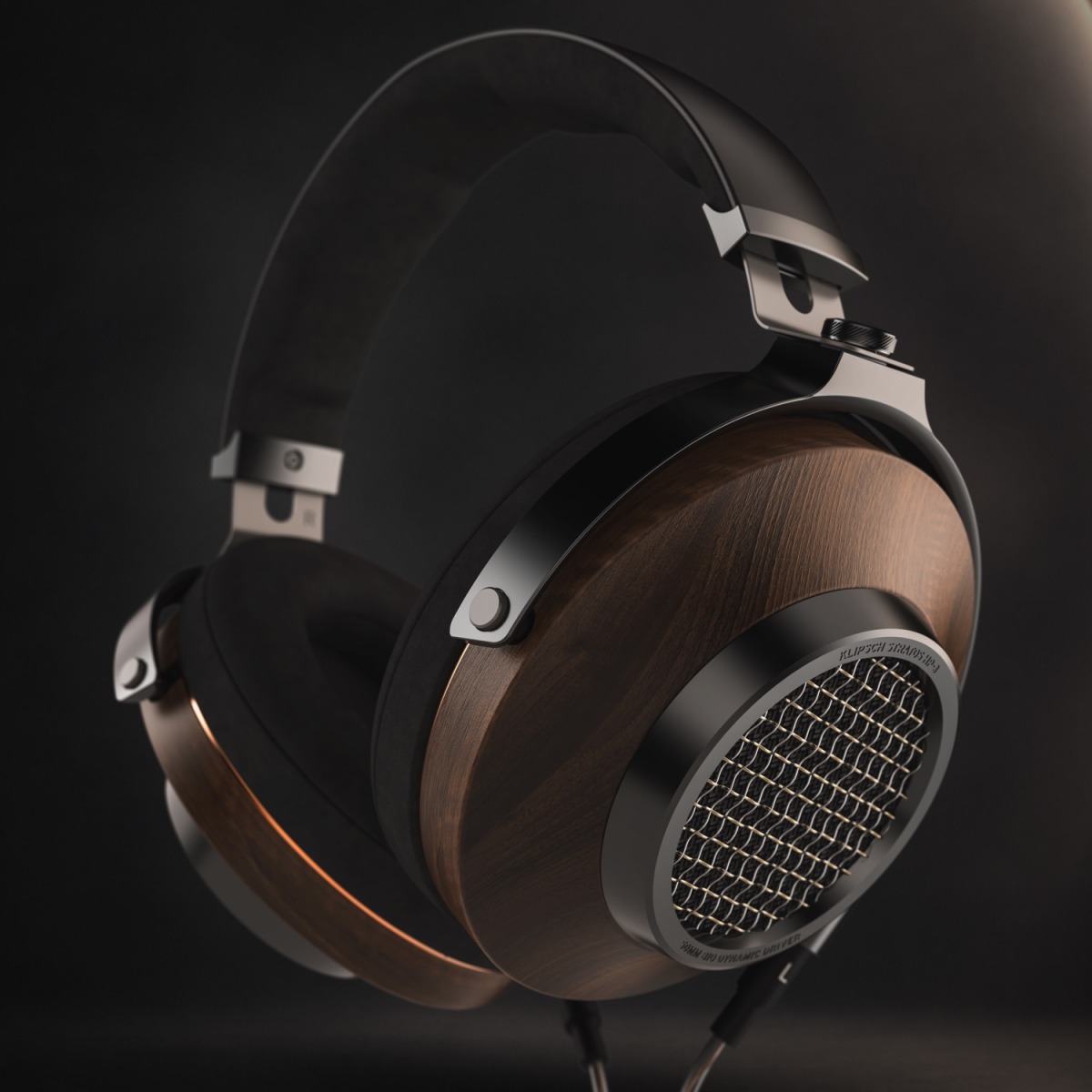 Klipsch Stratos HP-3 semi-open headphones with wood earcups and a metal grille
Quick facts
- HP-2, $999.99. Closed back. A 40 mm bio-cellulose woofer plus a 10 mm tweeter in each cup. 380 g.
- HP-3, $1,199.99. Semi-open back. A 50 mm bio-cellulose woofer plus a 10 mm tweeter. 458 g.
- Easy to drive. 32 and 24 ohms, 100 and 102 dB sensitivity. Klipsch says a phone will do.
- Two cables in the box. A 4.4 mm balanced cable and a 3.5 mm cable with a 6.35 mm adapter.
- The stand is extra. $149.99, also in December.
A tweeter and a woofer in each earcup
Most headphones use one driver per ear. That single cone has to play everything, from deep bass to the top treble. Klipsch splits the job in two, like a two-way speaker. A bio-cellulose cone handles bass and midrange. A separate 10 mm dome sits on the same axis and handles the treble.
Putting the tweeter on the woofer’s axis is called a coaxial layout. It is an old speaker trick. Both drivers seem to come from one point, so the sound should hold together. KEF has built its Uni-Q speakers around the same idea for decades. In a headphone it is rare.
The two models differ in two ways:
- HP-2: closed back, 40 mm woofer. The sealed cups keep outside noise out and your music in. Klipsch tuned it for deeper, firmer bass. It suits an office, a train, or a home studio.
- HP-3: semi-open back, 50 mm woofer. The perforated cups let air through. That usually sounds more open and more like speakers in a room, but people near you will hear it. It also gets a wider headband and Alcantara trim, and it is 78 g heavier.
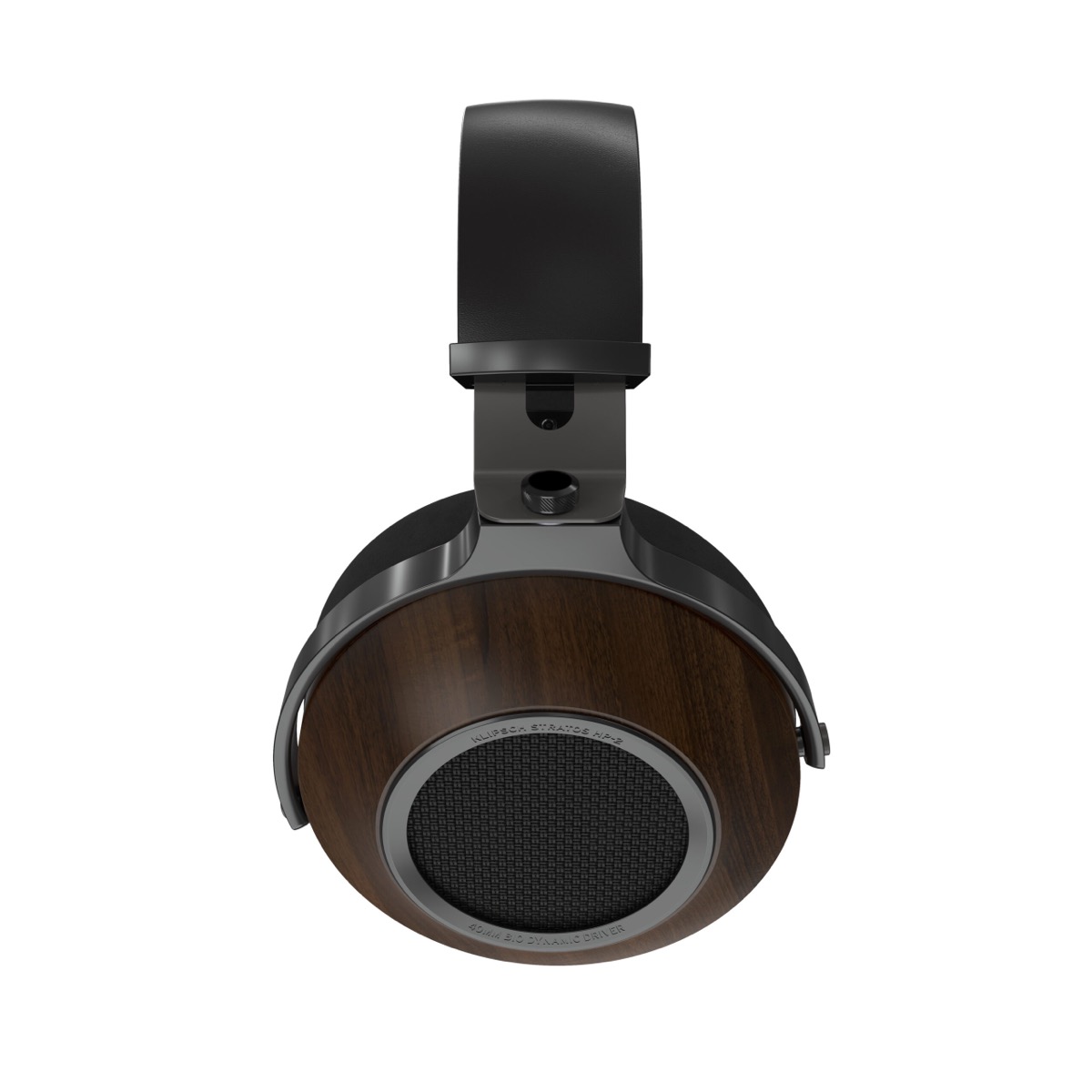 Klipsch Stratos HP-2 closed-back headphones seen from the side
What they borrow from Klipsch speakers
The look is pure Klipsch Heritage. The cups are stained sapele wood with copper rings. The grille cloth is the same Twitchell cloth Klipsch uses on its Heritage speakers. The finish is called Auburn. Set the HP-3 next to a Heritage Heresy IV ($3,198 a pair) or a Cornwall IV ($7,300) and the family is obvious.
The sound goals are borrowed too. Klipsch says the Stratos follow its usual rules: high efficiency, low distortion, full range. Efficiency is the Klipsch speaker trademark. The Heresy IV is rated at 99 dB and the Cornwall IV at 102 dB, so a few watts go a long way. The Stratos carry that over. At 100 and 102 dB, a phone or laptop output should drive them.
Here is a fun comparison. For the price of one HP-3, $1,199.99, you could buy a pair of Klipsch’s smallest Heritage speakers, the Heritage Rebellion, at $1,199 a pair. That is not a reason to pick one over the other. They do different jobs. But it shows where Klipsch has priced these: at the level of real hi-fi, not lifestyle headphones.
Klipsch Heritage Rebellion Passive Bookshelf Speaker Key Specs
- 2-way Bass Reflex Design
- 1 x 8" Paper Woofer
- 60-20k Hz Frequency Response
- Crossover Frequency at 715Hz
- 95 dB Sensitivity
- 8ohms Nominal Impedance
- Power Range: up to 200watts RMS
- Weight:31.99 lbs / 14.51 kg
- Dimensions (H x W x D): 19-1/8" x 12" x 9-3/4" / 485.0 x 305.0 x 247.0mm
- Read the Review
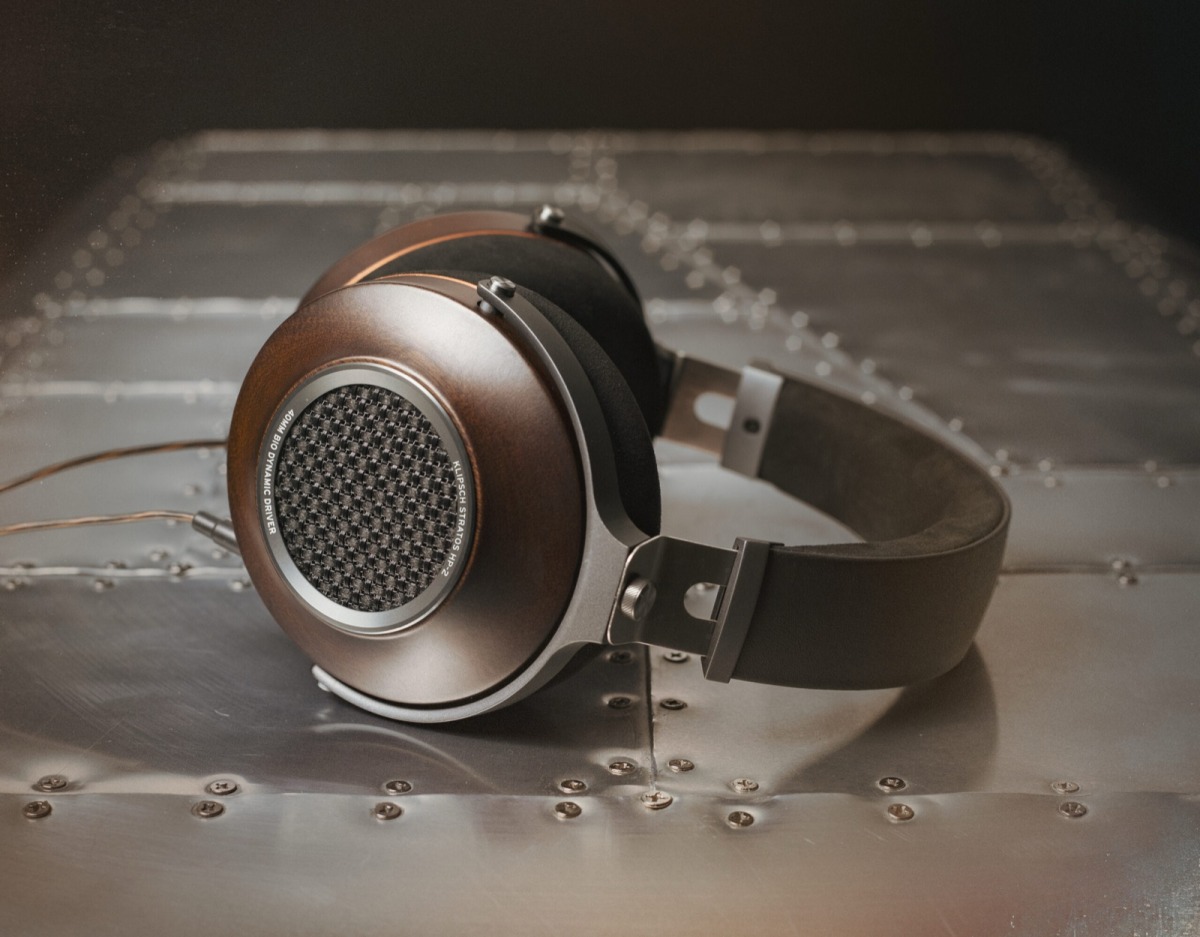 Klipsch Stratos headphones resting on a riveted metal table
Do you need a headphone amplifier?
Probably not. These are low-impedance, high-sensitivity headphones. Klipsch also rates them to handle 30 mW, which is not a lot. A good headphone amp can put out far more. The Schiit Magni Unity ($119) is rated at 2,500 mW into 32 ohms. So the question with the Stratos is clean, quiet power at low volume, not raw power. Keep the volume knob sensible.
If you want a desk amp anyway, the 4.4 mm balanced cable in the box is useful. You can plug it straight into an amp with a 4.4 mm output, without buying a third-party cable. We list 14 headphone amps on our headphone amplifier page, from the $119 Schiit to the $4,495 iFi iDSD Phantom. Two good starting points are the iFi ZEN CAN 3 ($229) and the iFi NEO iDSD 2 ($999).
Klipsch itself names the Onkyo HA-70 as a partner. It is a new headphone amp with two ESS DAC chips, and it is listed as coming soon. Onkyo and Klipsch share an owner, Gentex, so the suggestion is not neutral. We have not added the HA-70 yet, because there is no US price.
The catches: what Klipsch has not told us
No measurements yet. A coaxial driver in a headphone is unusual, and the claims are only claims. Two drivers need a crossover between them, and that is where things can go wrong. Until a reviewer measures a pair, nobody knows how well the tweeter and woofer blend.
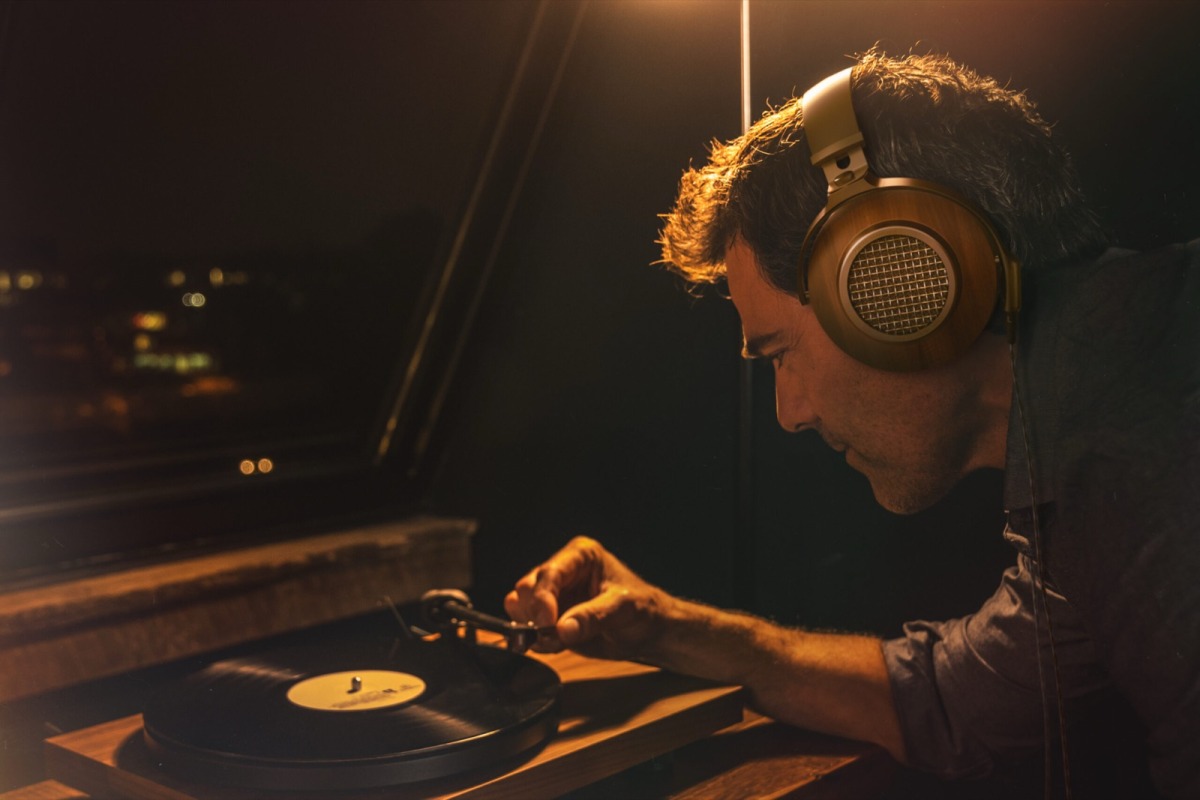 A listener wearing Klipsch Stratos HP-3 headphones while cueing a record
Gaps in the spec sheet. The sensitivity figures (100 and 102 dB) come without the reference, so you cannot tell if they are per milliwatt or per volt. The difference is large. The impedance is printed with no unit. And the HP-3’s frequency response is listed in the launch table as 16 Hz to 22 Hz. That must be a typo for 22 kHz. The HP-2 is listed as 15 Hz to 18 kHz at +/-5 dB.
The stand left the box. In June, Klipsch said the HP-3 would come with a headphone stand. It does not. The walnut stand is now a $149.99 extra, which takes the HP-3 to $1,349.98 with it.
Klipsch has been here before. Its earlier Heritage HP-3 also launched at $1,199, and it came with a stand but no balanced cable. Today klipsch.com sells only earbuds. The new ones look more serious, with two drivers per ear and a balanced cable in the box. But a brand with a short headphone track record is asking for a lot of money. The competition at this price includes Focal, Sennheiser, Audeze and HIFIMAN, who have done this for years.
The wireless one is not here. The HP-1, a wireless model with noise cancelling, was shown at CES too. Klipsch now says its final specs and price arrive in early 2027.
The Klipsch Stratos HP-2 ($999.99, closed) and HP-3 ($1,199.99, semi-open) are proper hi-fi headphones from a speaker maker, with a woofer and a coaxial tweeter in each cup and Heritage wood and copper on the outside. They are easy to drive and come with a balanced cable. The unknowns are the important ones: no measurements, missing units on the spec sheet, and a stand that is now extra. Wait for the first reviews before you put down $1,200.
Questions answered
How much are the Klipsch Stratos headphones?
$999.99 for the closed-back HP-2 and $1,199.99 for the semi-open HP-3 in the US. In Europe they are 999 and 1,199 euros. The optional walnut headphone stand is $149.99.
When can you buy the Klipsch Stratos HP-2 and HP-3?
In the US in December 2026, from Klipsch dealers and klipsch.com. Europe follows in January 2027. They make their public debut at CanJam Dallas on 14 and 15 November 2026.
What is the difference between the Stratos HP-2 and HP-3?
The HP-2 is closed back with a 40 mm woofer, tuned for deep bass and isolation, and weighs 380 g. The HP-3 is semi-open with a 50 mm woofer, aimed at a more open, speaker-like sound, and weighs 458 g. Both have a 10 mm coaxial tweeter.
Are Klipsch Stratos and Klipsch Atlas the same headphones?
Yes. Klipsch showed the HP-2 and HP-3 as the Atlas series at CES and High End Vienna in 2026, then renamed them Stratos for the final versions.
Do the Klipsch Stratos need a headphone amp?
No. At 24 and 32 ohms with 100 to 102 dB sensitivity, Klipsch says a phone can drive them. A desk amp with a 4.4 mm balanced output can use the balanced cable that comes in the box.
Would you buy headphones from a speaker company, or do you stick with the brands that only make headphones?