The most-read page on this site is a list of powered speakers with an HDMI input. People want their television to sound better, and they do not want another box or another remote. The amplifier version of that question has never been answered here, so this is it: 77 of the 307 stereo amplifiers we list have an HDMI socket. 226 do not.
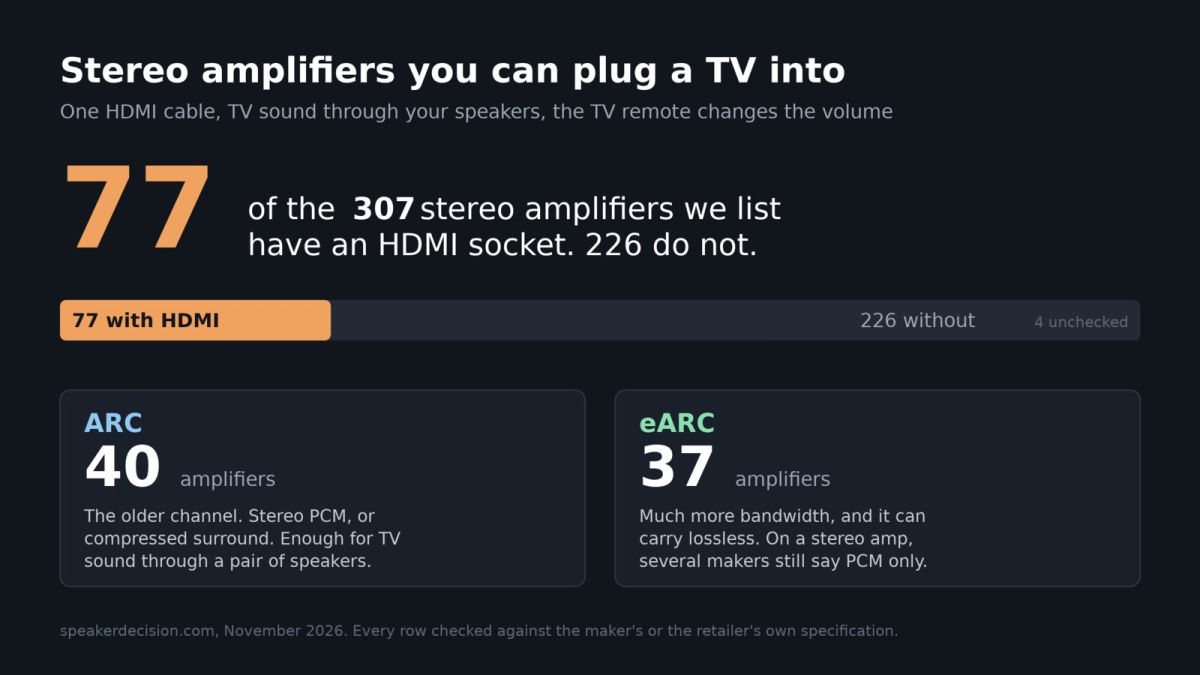 77 of the 307 stereo amplifiers we list have an HDMI socket, 40 with ARC and 37 with eARC
Before writing this I checked all 307 rows one at a time, because our own data was not good enough to count. More on that at the end, including the two amplifiers we were telling you had HDMI when they do not.
Quick facts: stereo amplifiers with HDMI
- 77 of 307. Four more rows could not be verified and are counted in neither total.
- 40 do ARC, 37 do eARC. Every one of the 37 is a 2021 model or later.
- $199 to $9,999. From the OSD Nero Stream ARC to the Naim Uniti Nova Power Edition.
- eARC costs no more. Median $2,000 for eARC against $1,999 for ARC.
- 24 brands of 59 make one. NAD alone accounts for 18.
What the socket actually does
An HDMI ARC socket on an amplifier turns the television into a source. One cable from the TV’s own ARC port to the amplifier, and the sound comes out of your speakers instead of the panel. The TV remote raises and lowers the volume, because the amplifier is listening on the HDMI control channel. No second remote, no optical cable, no lip-sync menu to fight.
That is a bigger deal than the spec sheet makes it look. An optical cable carries the audio but not the volume, so the TV keeps its own volume control pointed at speakers you are not using any more.
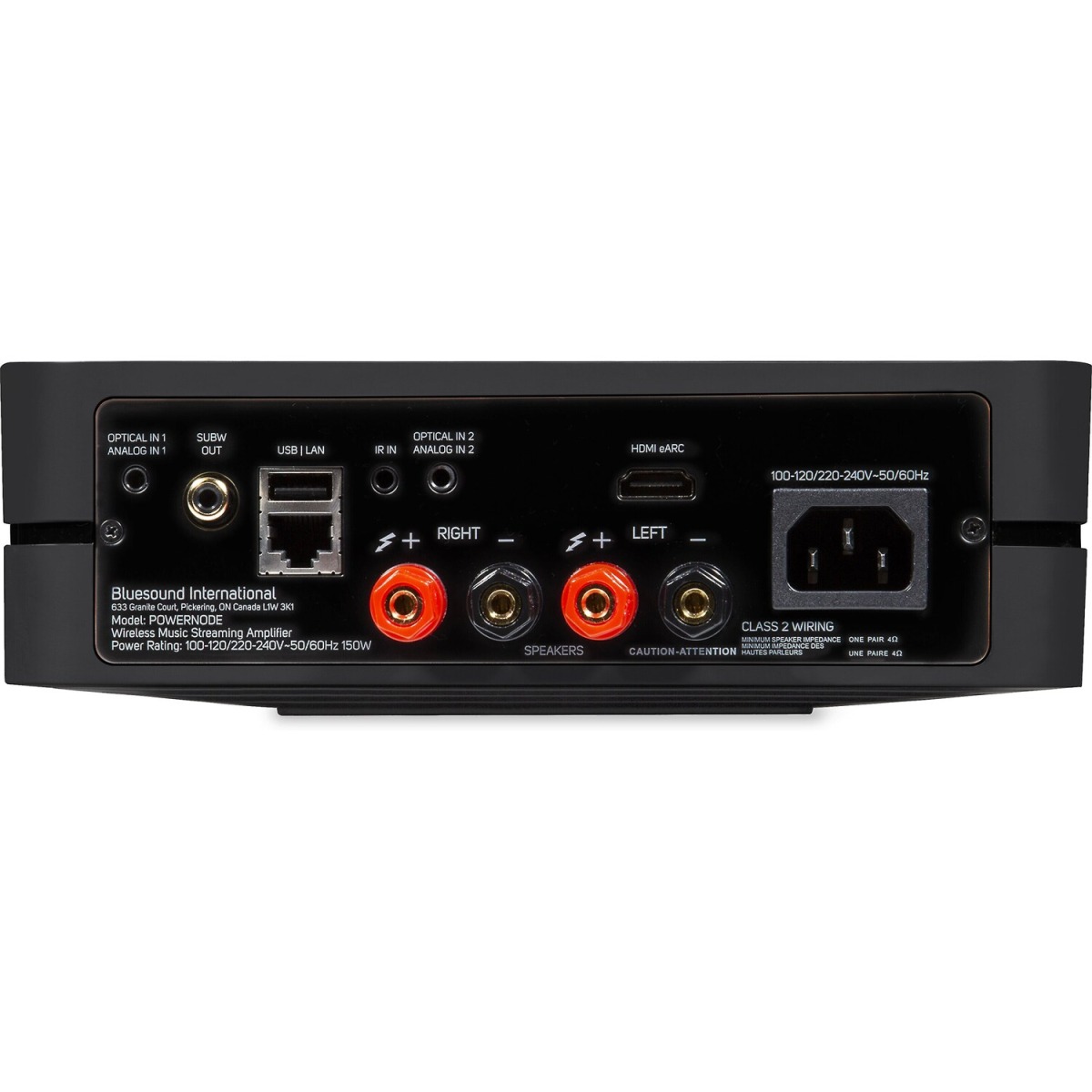 The back of a Bluesound POWERNODE, with the HDMI eARC socket among the connections
ARC against eARC, and why it matters less here than you think
ARC is the original Audio Return Channel. It carries stereo PCM, and compressed surround where the device supports it. eARC is the enhanced version from HDMI 2.1, with far more bandwidth, enough for uncompressed multichannel and lossless formats.
On a home cinema receiver that difference decides whether you get Dolby TrueHD or a compressed copy of it. On a stereo amplifier it very often decides nothing at all, because the amplifier has two channels and will fold anything you send it down to two anyway. Several makers say so on their own spec sheets. The NAD M33 V2 lists its eARC port as 2-channel PCM only. So does the Cambridge Audio EXA100. Advance Paris writes “PCM only” next to the eARC port on the NOVA A-i130 and A-i190.
So eARC on a stereo amplifier is mostly a bandwidth headroom and a futureproofing argument, not a sound quality one. If you are choosing between two amplifiers you otherwise like equally, take the eARC one. If eARC is the only reason you are paying more, you are probably paying for a number.
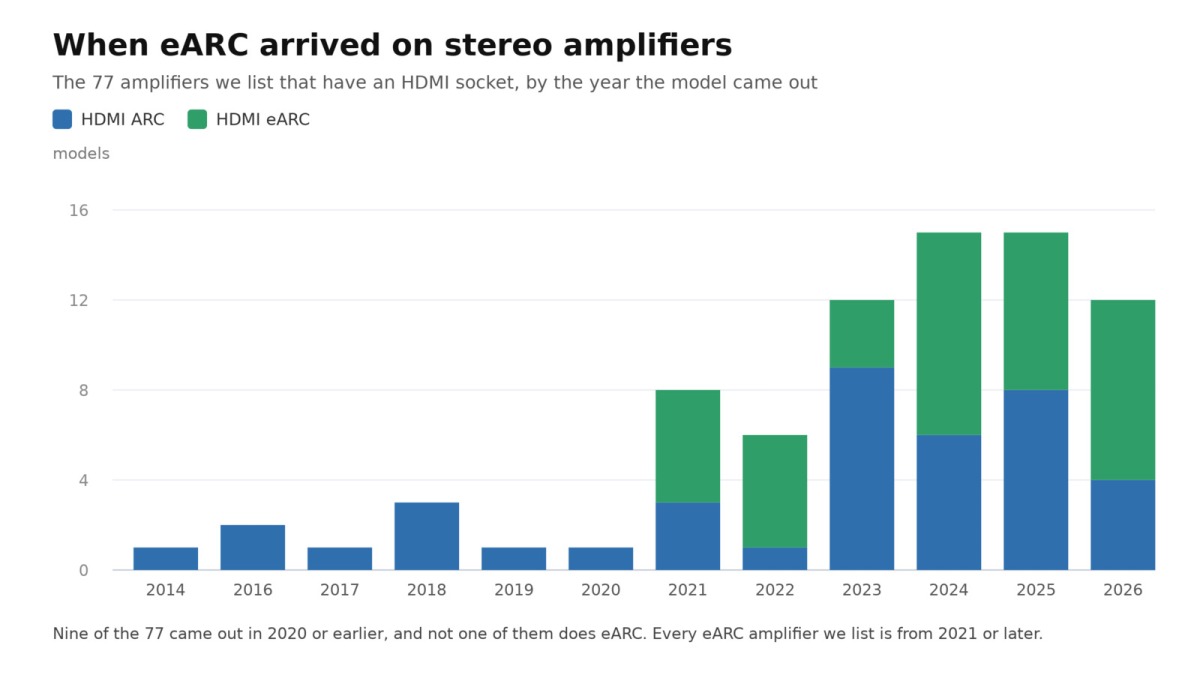 The 77 stereo amplifiers with HDMI by model year, showing when eARC arrived
The timing is clean. Nine of the 77 came out in 2020 or earlier, and not one does eARC. The first eARC amplifiers here are 2021 models, and from 2024 on eARC is the majority.
What it costs, and the number that surprised me
I expected eARC to be the premium tier. It is not.
- eARC: 37 amplifiers, $699 to $7,999, median $2,000.
- ARC: 40 amplifiers, $199 to $9,999, median $1,999.
One dollar apart. The cheapest eARC amplifier is the SVS Prime Wireless Pro SoundBase at $699, and the dearest HDMI amplifier of all, the $9,999 Naim, does plain ARC. eARC tracks the year a model was designed, not its price. Fourteen of the 77 are under $1,000, forty sit between $1,000 and $3,000, and twenty-two are $3,000 or more.
The cheap end
- WiiM Amp, $299, ARC. 60 watts into 8 ohms. The WiiM range is three amplifiers and all three do ARC, not eARC: the Amp Pro at $379 and the Amp Ultra at $549.
- Sonos Amp, $699, ARC. 125 watts, from 2018.
- Bluesound POWERNODE Edge, $849, eARC. Only 40 watts. The full POWERNODE at $949 doubles that, and all three Bluesound amplifiers we hold do eARC.
- Audiolab 7000A, $999, ARC. With the 6000A MkII at $1,099 it is one of two Audiolab amplifiers here, and they are the pair readers compare against each other most.
- Marantz Stereo 70s, $1,000, ARC. The odd one out.
The one that is not really a stereo amplifier
The Marantz Stereo 70s has six HDMI inputs and an HDMI output. Every other amplifier here has one socket, except two Advance Paris models with two. It is a slimline AV receiver wearing a stereo badge, and if you want a hub for a console, a disc player and a streaming stick, it is the only one on this list that does that job.
The other 74 expect your television to be the switch. That is usually fine, but it does mean the TV has to stay on to pass the sound through.
Who makes them
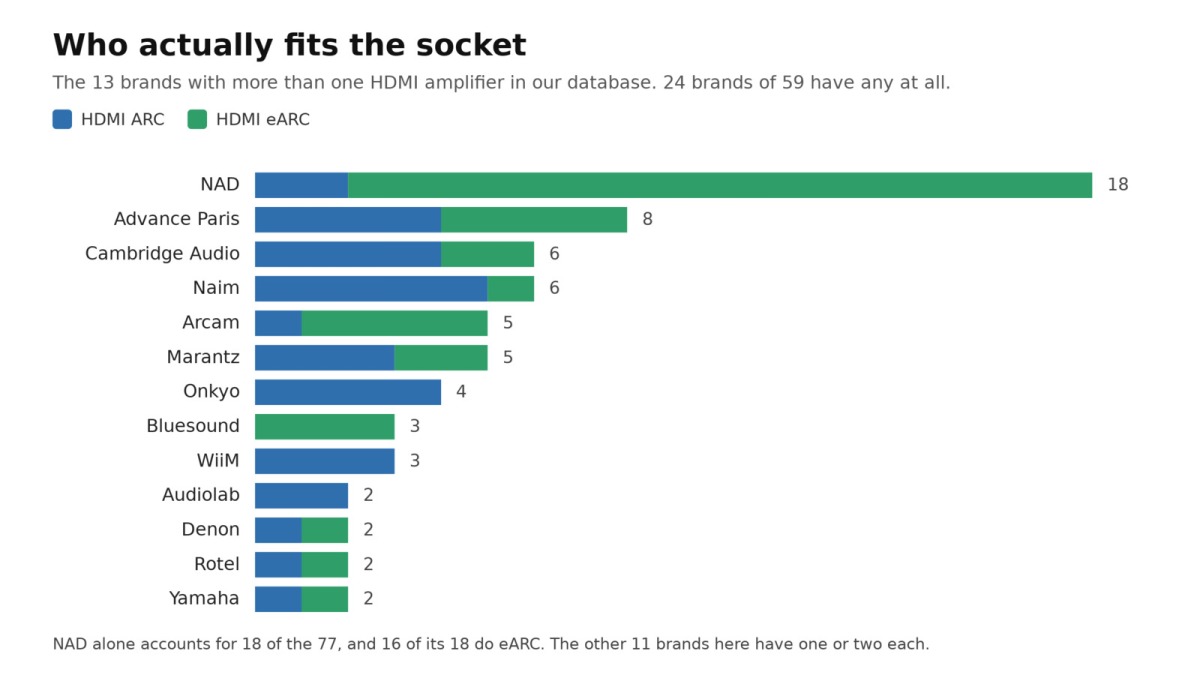 The 13 brands with more than one HDMI stereo amplifier in our database
NAD has 18 of the 77, nearly a quarter of the category on its own, and 16 of its 18 do eARC. That is not an accident: NAD has been fitting the socket since the D 3045 in 2018, and the C 3050 and C 399 are among the most compared amplifiers on this site.
After NAD the field thins fast. Advance Paris has eight, Cambridge Audio and Naim six each, Marantz and Arcam five. 35 of our 59 amplifier brands do not make a single stereo amplifier with HDMI.
What our own data got wrong
This is the uncomfortable part, and it is the reason the post took a week rather than an afternoon.
Our HDMI columns were a mess. One column held “Yes”, “No”, “1”, “2”, “eARC”, “ARC” and “0”, and 99 of 307 rows were blank, meaning nobody had ever recorded it. You cannot publish “77 of 307” when a third of the table is a shrug. So every blank row got checked against the maker’s own page or the retailer’s own specification, and the rows that already claimed HDMI were put back through the same check.
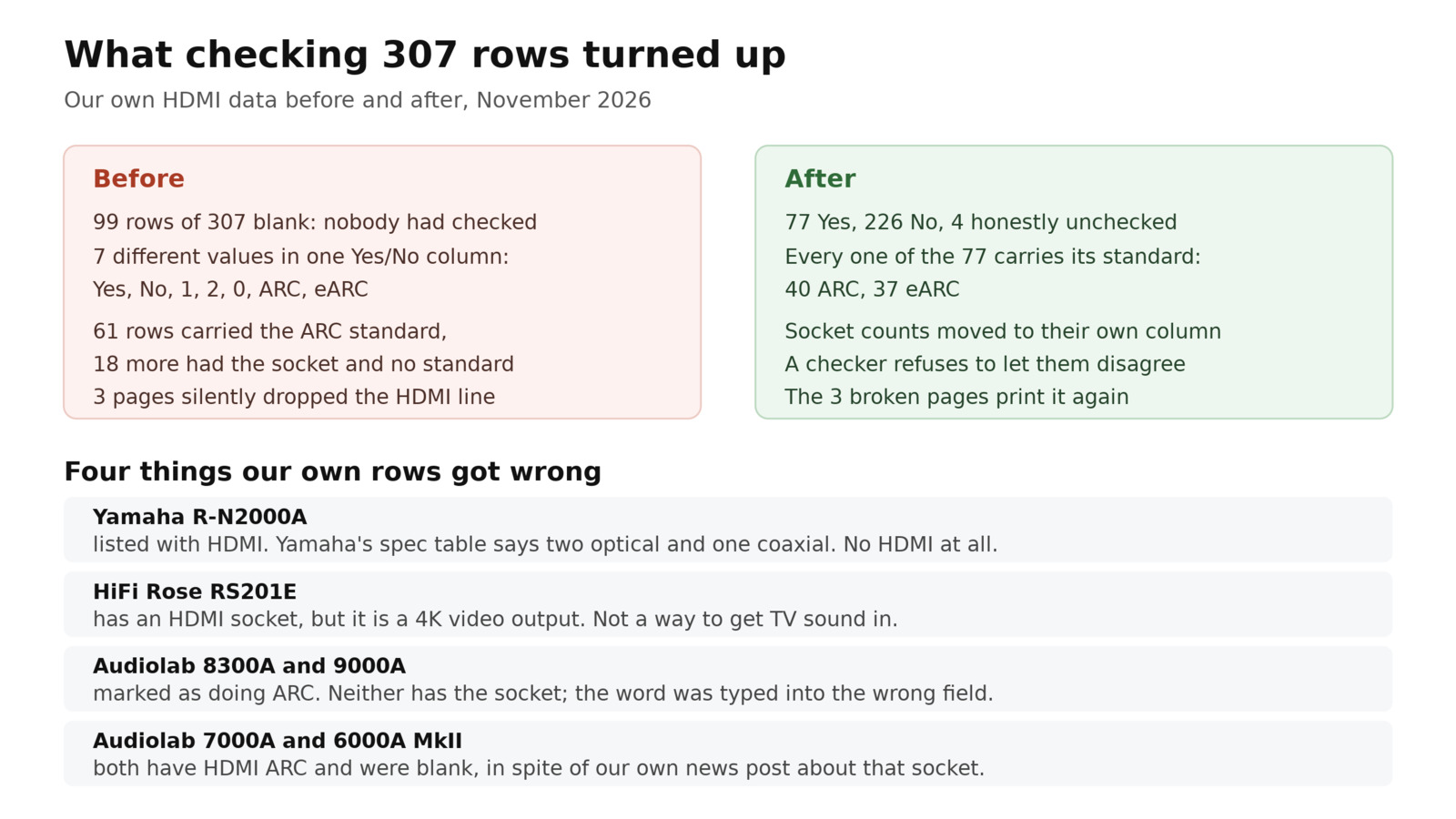 Our HDMI data before and after the check, and the four rows that were wrong
Four of them did not survive:
- The Yamaha R-N2000A was listed as having HDMI. It has none. Yamaha’s own spec table gives its digital inputs as two optical and one coaxial. The R-N1000A, $700 cheaper, is the Yamaha with the ARC socket.
- The HiFi Rose RS201E has an HDMI socket, but it sends video out. It is a 4K display output, not a way to get your television’s sound in. Useful, and not what anyone reading this list is looking for.
- Two Audiolab integrated amplifiers were marked as doing ARC and do not have the socket at all. Someone had typed a value into a field that should have stayed empty.
- Two NAD amplifiers get HDMI only from an optional plug-in module, which is not the same as having it, so they are counted as not having it.
Going the other way, the Audiolab 7000A and the 6000A MkII both have HDMI ARC and were sitting blank, which is faintly embarrassing given we wrote a news post about the 6000A MkII’s new HDMI ARC connection when it launched.
Three pages on this site were also quietly dropping the HDMI line from amplifiers whose value was stored as “1” instead of “Yes”. That is fixed. There is now a checker that refuses to let the four columns disagree with each other again, and four rows are still marked unchecked rather than guessed at, because the products are discontinued and every page that described them has gone.
You can browse the live list at amplifiers with an HDMI input, which now shows all 77.
Who should care, and who should not
Buy one if the television is half the reason for the system. One cable, one remote, no optical adapter. For a living room where the same speakers do music and TV, it is the single most useful feature on this page.
Three that come up most often here, at three prices: the NAD C 3050 with eARC, the Cambridge Audio Evo 150 with ARC, and the Audiolab 6000A MkII with ARC.
| FEATURE and SPECS COMPARISON | |  |  |  |
| Model | NAD C 3050 | Cambridge Audio Evo 150 | Audiolab 6000A MKII |
| Type | Integrated Amplifier | Integrated Amplifier | Integrated Amplifier |
| Amplifier Class | Class D | Class D | Class A/B |
| Power into 8 ohms | 100 watts | 150 watts | 50 watts |
| Power into 4 ohms | 100 watts | 250 watts | 75 watts |
| Minimum Impedance | 4 ohms | 4 ohms | 4 ohms |
| THD | 0.03% | - | 0.0004% |
| Signal to Noise Ratio | 95 | - | 110 |
| Frequency Bandwidth | 20 Hz-20 kHz | 20 Hz-20 kHz | 20 Hz-20 kHz |
| Built-in DAC | | | |
| DAC | - | ESS Sabre ES9018 K2M | ESS Sabre ES9038Q2M |
| Max Bit Depth | 32 | 32 | 24 |
| Max Sample Rate | 384 | 384 | 192 |
| Analog Inputs | - | 2 | 3 |
| Phono Input | | | |
| Phono Type | - | MM | MM |
| Optical Digital Inputs | 1 | 2 | 2 |
| Coaxial Digital Inputs | 1 | 1 | 2 |
| USB Input | Yes | Yes | Firmware only |
| HDMI Input | Yes | Yes | Yes |
| HDMI ARC | eARC | ARC | ARC |
| XLR Input | No | Yes | - |
| Preamp Outputs | Yes | Stereo RCA, Sub | Stereo RCA |
| Subwoofer Output | Single | 1 | - |
| Headphone Output | 1/4 | 3.5mm | 1/4 |
| Bluetooth | Yes | Yes | Yes |
| Wi-Fi | - | 802.11ac | 802.11ac |
| AirPlay 2 | | | |
| Chromecast built-in | | | |
| Roon | No | Ready | No |
| BluOS | | | |
| HEOS | | | |
| Room Correction | No | - | - |
| Handheld Remote | - | | |
| Height | 128.6mm | 89.0mm | 65.0mm |
| Width | 449.3mm | 320.0mm | 444.0mm |
| Depth | 363.5mm | 372.0mm | 299.0mm |
| Weight | 9.98kg | 5.31kg | 7.80kg |
| MSRP | 1899 USD | 3249 USD | 1099 USD |
| Check Current Price | Amazon, B&H Photo | Amazon, B&H Photo | Amazon, B&H Photo |
Do not pay extra for eARC on a two-channel amplifier. It costs no more on average, so take it when it comes free, but several makers restrict their own eARC ports to stereo PCM anyway.
Skip it if the amplifier is for music. 226 amplifiers here have no HDMI, and that list includes nearly everything above $10,000. You are not missing a sound quality feature, you are missing a convenience one.
If you want a real switch, there is one. Only the Marantz Stereo 70s takes more than a couple of HDMI sources.
We list 307 stereo amplifiers and 77 of them have an HDMI socket: 40 with ARC, 37 with eARC, from $199 to $9,999. eARC is a year-of-design thing, not a price thing, and on a two-channel amplifier it often buys nothing, because makers like NAD and Cambridge Audio restrict their own eARC ports to stereo PCM. NAD makes 18 of the 77. 35 of our 59 amplifier brands make none. Checking all this found four rows of our own that were wrong, including a Yamaha we had listed with HDMI that does not have it.
Questions answered
What does HDMI ARC on an amplifier do?
It lets your television send its sound to the amplifier down one HDMI cable, and lets the TV remote control the amplifier’s volume. You connect the TV’s ARC-labelled HDMI port to the amplifier’s HDMI port and nothing else.
Is eARC worth paying more for on a stereo amplifier?
Usually not. eARC carries far more data than ARC, which matters on a surround receiver, but a stereo amplifier has two channels. Several makers list their eARC ports as 2-channel PCM only, the NAD M33 V2 and the Cambridge Audio EXA100 among them. In our database eARC costs nothing extra anyway: the median is $2,000 against $1,999 for ARC.
What is the cheapest stereo amplifier with HDMI?
The OSD Nero Stream ARC at $199, then the WiiM Amp at $299. Both do ARC rather than eARC.
Which brand makes the most amplifiers with HDMI?
NAD, with 18 of the 77, and 16 of those do eARC. Advance Paris has eight, Cambridge Audio and Naim six each.
Can I plug a games console into a stereo amplifier with HDMI?
On nearly all of them, no. 74 of the 77 have a single HDMI socket meant for the television. The Marantz Stereo 70s is the exception with six HDMI inputs and an output, and two Advance Paris models take a second HDMI source.
How many stereo amplifiers do not have HDMI?
226 of the 307 we list, including almost everything above $10,000. Four more could not be verified either way.
Is HDMI on the list of things your next amplifier has to have, or is it the feature you would happily trade for a better phono stage?