The Evo 150 is a streaming integrated amplifier by Cambridge Audio that delivers 150 watts x 2 channels into 8 ohms and 250 watts x 2 channels into 4 ohms. It was released in April 2021. It is a 2-channel design using a Class D output stage. A minimum impedance of 4 ohms makes it compatible with a wide range of loudspeakers. It has a built-in DAC (ESS Sabre ES9018 K2M), so you can play digital sources directly with no separate DAC unit needed. It also has a phono input, so a turntable can connect straight to it. The Cambridge Audio Evo 150 has an MSRP of $3,249.
There are 10 Cambridge Audio amplifiers in our database. Below you can see the main specs of these amps.
Cambridge Audio Integrated Amplifier Series
Performance Specs
One of the most important factors when deciding on an integrated amplifier is its power ratings and compatibility with your speaker's impedance requirements. The Cambridge Audio Evo 150 is rated at 150 watts RMS into 8-ohms.
Here are the main highlights of its performance specs:
- 150 watts into 8-ohms (20 Hz-20 kHz)
- 250 watts into 4-ohms
- 4-ohms Min Impedance (allows compatibility with a wide range of loudspeakers)
How loud will 150 watts actually play in your room? →
Wiring more than one pair of speakers to it? Check the load first →
Which speakers suit the Cambridge Audio Evo 150?
150 W into 8 ohms, 250 W into 4, rated down to 4 ohms.
We rank every passive speaker we cover against it on power, impedance safety and current
delivery.
Need more power?
Cambridge Audio Evo 150 is rated at 150 watts into 8 ohms, which puts it in our 121 to 180 watts band. The next band up is Over 180 watts, which is worth about 2.3dB more output. That is a real difference in headroom on peaks, and a modest one in how loud the system plays - power and loudness are not the same thing.
Before buying watts, check what your speakers actually need: the amp and speaker matcher works it out from their sensitivity, impedance and your room. Plenty of systems are better served by the 91 to 120 watts band and better speakers.
When pairing the Cambridge Audio Evo 150 with a passive Bookshelf (Stand mount) or Passive Floor Standing (Tower) speaker, you have to check if their Max Power Range is below the max wattage of the amp for the given impedance levels.
Operating your amp outside of this max range may damage the speakers.
What size of room is the Cambridge Audio Evo 150 Amplifier good for?
An essential deciding factor is the size of the room in which you intend to employ the Cambridge Audio Evo 150 amplifier. Here, taking into account its maximum power parameters, we analyzed its applicability to various size environments:
| Listening Environment |
Suitability |
| Near-field | Are you nuts? |
| Small Room | Bad |
| Mid-size Room | Poor |
| Large Room | Good |
| Very Large Room | Good |
Inputs and Outputs
Besides the performance specs of the Cambridge Audio Evo 150, the next important feature set that you have to evaluate is the input and output selections that it offers.
Cambridge Audio Evo 150 has total of 2 Analog inputs including 1 Phono Input (MM).
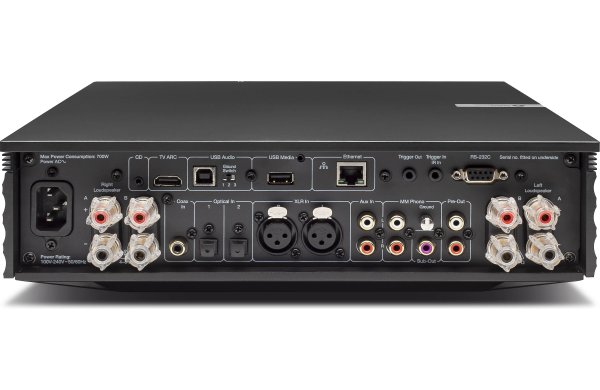 Cambridge Audio Evo 150 Back View (Click the image for the larger version)
Inputs
Cambridge Audio Evo 150 Back View (Click the image for the larger version)
Inputs
- Total Number of Analog Inputs: 2
- Phono Input
- 2 Optical Digital Input
- 1 Coaxial Digital Input
- USB Input:
- USB-B(connect to your Windows PC or Mac computer for playback)
- USB-A(music playback from a USB flash memory device or portable hard drive)
- HDMI Input (ARC)
Outputs
- Speaker Outputs (A/B switchable)
- Stereo RCA, Sub Preamp Outputs
- 3.5mm Headphone Output
- Subwoofer Output (1)
Bluetooth Connectivity
Cambridge Audio Evo 150 features built-in Bluetooth 4.2 for wireless music streaming from your Bluetooth-enabled devices such as Apple iPod/iPhone/iPad, Android smartphone/tablet, Windows PC, Mac computers/laptops.
Among the amps in the same price range, these are the 5 amps that have Bluetooth Connectivity:
Cambridge Audio Evo 150 supports the following Bluetooth Codecs when used with supported devices:
Phono Input
Cambridge Audio Evo 150 features one Phono Input which is compatible with
MM (Moving Magnet) type of phono cartridges, you can connect your turntable with MM cartridges directly to this amp without the need for a phono preamp. If you are using an MC cartridge on your turntable, you need to use a phono preamp that has MC phono stage such as the
Cambridge Duo or the
iFi ZEN Phono.
Subwoofer Output
Cambridge Audio Evo 150 has a dedicated subwoofer output which can be used to connect it directly to a powered subwoofer via an LFE(Low Frequency Effects) cable.
Check our
Powered Subwoofers page to find a subwoofer that will work with Cambridge Audio Evo 150 amp and your speakers.
Balanced connections
Cambridge Audio Evo 150 has a balanced XLR input. A balanced cable carries the signal twice, on two conductors of opposite polarity. Interference picked up along the way lands on both equally and cancels when the two are recombined at the far end, so the longer the cable run and the noisier the surroundings, the more the connection is worth. Whether a balanced connection also yields more power depends on how the amplifier is built inside - some are balanced end to end, others convert to single-ended internally and deliver the same power either way, so it is worth reading the maker's own wording rather than assuming.
DAC and Digital Music
The Cambridge Audio Evo 150's built-in DAC allows the connection of digital sources directly, eliminating the need for an external DAC. The DAC chip that is used in the Evo 150 is the
ESS Sabre ES9018 K2M, and supports resolutions up to
32-bit, 384KHZ.
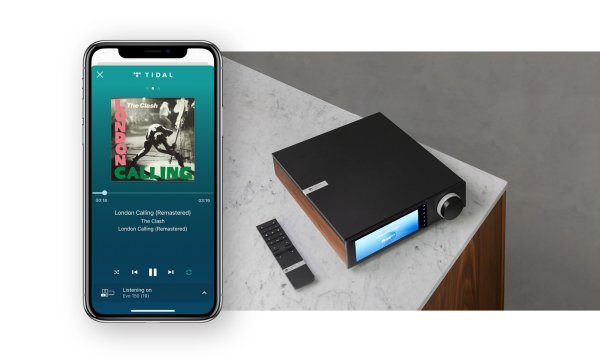 StreamMagic Wireless Control App
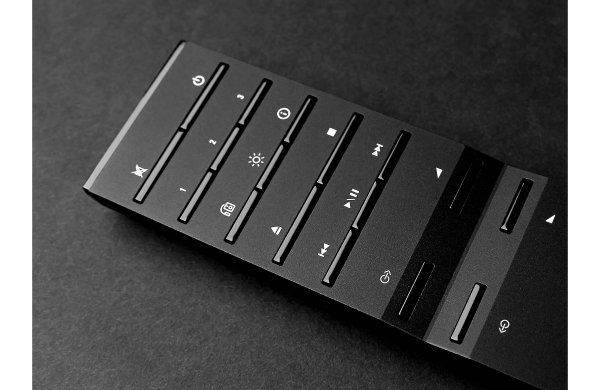 Cambridge Audio Evo 150 Handheld Remote
Cambridge Audio Evo 150 Pros and Cons
Drawn from the published figures on this page, not from listening.
- ✓150 watts per channel into 8 ohms is more than most rooms and most speakers will ever ask for.
- ✓Class D output stage, so it runs cool and wastes little power as heat - which is how it fits in a small case.
- ✓Built-in DAC handling 32-bit / 384 and DSD, so a TV, computer or streamer can connect digitally with nothing in between.
- ✓Digital inputs cover 2 optical, 1 coaxial and USB.
- ✓Phono stage built in (MM), so a turntable needs no separate preamplifier.
- ✓Streams over the network without a separate streamer: AirPlay 2, Chromecast built-in and Roon.
- ✓Bluetooth (version 4.2 and AptX HD) for playing straight from a phone.
- ✓Pre-outs (Stereo RCA, Sub) leave room to add a power amplifier or an active subwoofer later.
- ✓A and B speaker terminals, for a second pair or for bi-wiring.
- ✓Balanced XLR inputs, worth having on a long cable run.
- ✓Headphone output (3.5mm).
- ✓App control (StreamMagic).
- ✓Detachable mains lead (IEC 3-prong).
- ✗The phono stage is moving-magnet only; a moving-coil cartridge would need a step-up or an external stage.
Cambridge Audio Evo 150 External Dimensions and Weight
Cambridge Audio Evo 150 has external dimensions of (H x W x D) 3-1/2inch x 12-9/16inch x 14-5/8inch (89.0mm x 320.0mm x 372.0mm ). The unit weighs
5.31 kg (11.7 lbs).
Base Surface Area
Base surface area of an integrated amplifier may become an important decision factor when the space in your room or desk is limited.
The base area of the Cambridge Audio Evo 150 is approximately 1190.4cm2 / 184.5inch2.
- Width: 320.0mm (12-9/16")
- Height: 89.0mm (3-1/2")
- Depth: 372.0mm (14-5/8")
- Weight: 5.31 kg (11.7 lbs)
- Base Surface Area: ~1190.4cm2 / 184.5inch2
- Volume: ~10.6 liter / 2.8 gallon
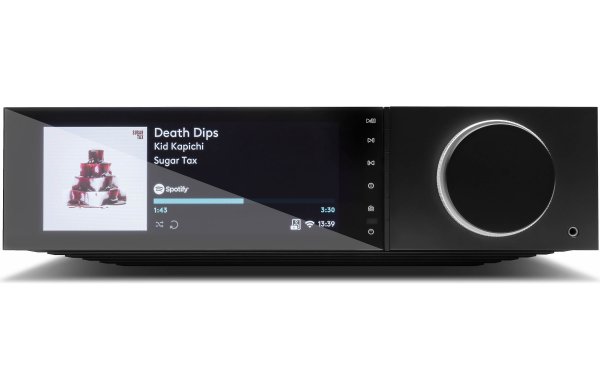 Cambridge Audio Evo 150 screen
What's in the Box of Cambridge Audio Evo 150?
Here are the items that are included inside the box of Evo 150:
- Integrated amplifier
- 6-feet AC power cord
- Remote control (EVO)
- 2 AAA batteries
- 4 Side-panels (2 pre-installed)
- Quick Setup Guide
- Important Safety Instructions
Official Product Page
Official manufacturer's product page for the Cambridge Audio Evo 150 Integrated Amplifier can be found below:
Official Product Page for Cambridge Audio Evo 150
Warranty
3 Years of parts warranty and 3 Years of labor warranty is generally provided for the Cambridge Audio Evo 150 by the manufacturer.
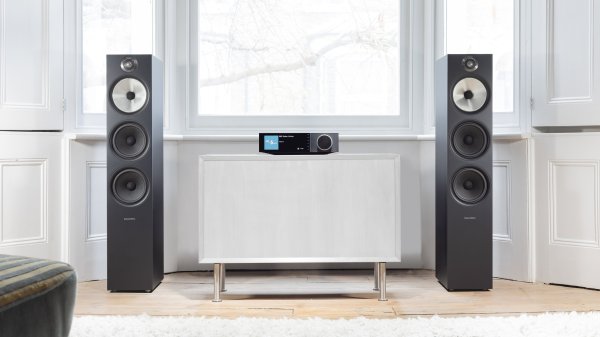 Cambridge Audio Evo 150 Lifestyle
| General |
| Brand |
Cambridge Audio |
| Full Model Name |
Cambridge Audio Evo 150 |
| Release Date |
April 2021 |
| Amplifier Type |
Integrated Amplifier |
| Number of Channels |
2 |
| Amp Class |
Class D |
| Amplifier Technology |
Solid State |
| Performance |
| Watts RMS per Channel into 8-ohms |
150 watts |
| Watts RMS per Channel into 6-ohms |
N/A |
| Watts RMS per Channel into 4-ohms |
250 watts |
| Frequency Bandwidth |
20 Hz-20 kHz |
| THD |
|
| Minimum Impedance |
4 |
| Signal to Noise Ratio |
N/A |
| Digital Music |
| Built-in DAC |
Yes |
| DAC Specs |
ESS Sabre ES9018 K2M |
| Bluetooth |
Yes |
| WiFi |
802.11ac |
| Ecosystem |
| Apple AirPlay |
Yes |
| Apple AirPlay2 |
Yes |
| DTS Play-Fi |
No |
| Chromecast built-in |
Yes |
| Roon |
Ready |
| HEOS |
No |
| BluOS |
No |
| CONNECTIONS |
| Total Analog Inputs |
2 |
| Phono Input |
Yes |
| Optical Digital Inputs |
2 |
| Coaxial Digital Inputs |
1 |
| USB Input |
Yes |
| USB Type |
USB-B(connect to your Windows PC or Mac computer for playback),USB-A(music playback from a USB flash memory device or portable hard drive) |
| Preamp Outputs |
Stereo RCA, Sub |
| Pre-out / Main-in Loop |
No |
| Headphone Output |
3.5mm |
| Subwoofer Output |
Yes |
| Removable Power Cord |
IEC 3-prong |
| PHYSICAL SPECS |
| Height |
89.0mm (3-1/2") |
| Width |
320.0mm (12-9/16") |
| Depth |
372.0mm (14-5/8") |
| Weight |
5.31 kg (11.7 lbs) |
| OTHER |
| Parts Warranty |
3 Years |
| Labor Warranty |
3 Years |