This week Headphonesty wrote up an analysis by the blogger Archimago of 835 Stereophile loudspeaker reviews. One finding stood out for anyone shopping for an amplifier. The median minimum impedance has stayed around 3.5 to 4 ohms since the early 1990s. But a stricter measure of amplifier strain, EPDR, has drifted lower. In other words, modern speakers are a slightly harder load, on average.
Stereophile measures speakers. We do not. What we do have is the spec sheet of every speaker we hold, with the release date. So I asked a simpler question. Do new speakers claim to be harder to drive? The answer is yes, on the box. And then mostly no, once you look at the right number.
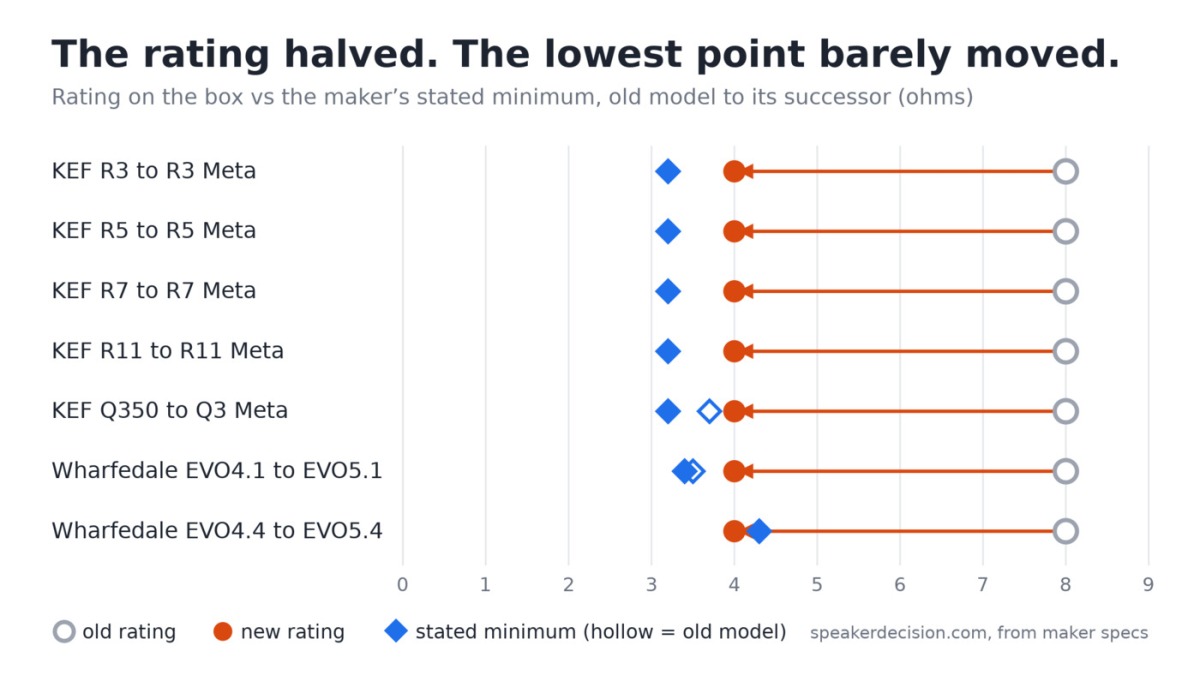 Seven speakers and their successors: the nominal impedance rating halved from 8 to 4 ohms while the maker's own stated minimum stayed almost exactly where it was
Quick facts
- On the box, yes. 17% of the passive bookshelf and floorstanding speakers we hold from 2017-18 are rated 4 ohms or lower. For 2023-24 it is 55%.
- Same speaker, new label. Of 105 speakers we can line up against their own successor, 21 got a lower impedance rating. Only 3 went up.
- The minimum barely moved. Where the maker quotes a minimum for both models (36 pairs), 23 are identical. The median change is zero.
- Sensitivity did not move either. Across all 105 pairs the median change is 0 dB.
On the box, yes: more speakers say 4 ohms
I took every passive bookshelf and floorstanding speaker in our database, 819 of them, and grouped them by release year. Then I counted how many are rated at 4 ohms or lower.
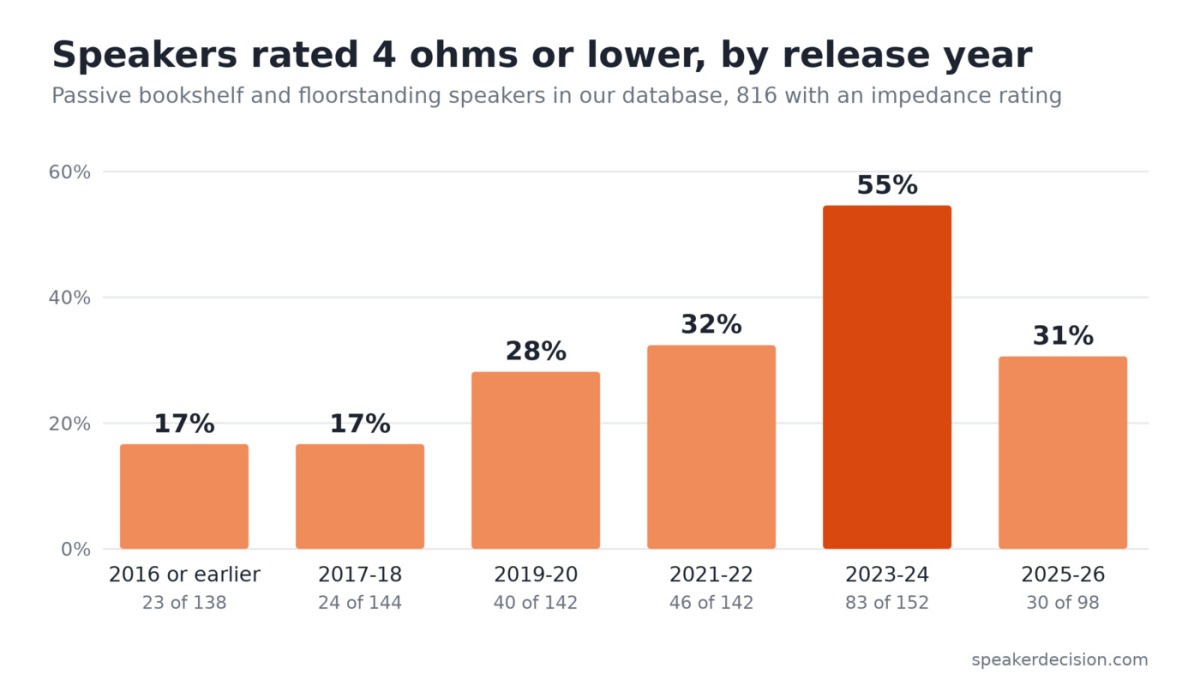 Share of passive bookshelf and floorstanding speakers in our database rated 4 ohms or lower, by release year
The share sat at 17% up to 2018, climbed through the early 2020s and hit 55% for speakers released in 2023 and 2024. For 2025 and 2026 it falls back to 31%. So something did happen, and it peaked a couple of years ago.
That chart is honest, but it is also easy to misread. A 4 ohm rating is a label the maker picks. It is not a measurement. Which brands released a lot of speakers in a given year moves the bars too. So the better test is to compare a speaker with its own replacement.
Same speaker, new label
We link most speakers to the model they replace. That gives 105 pairs of passive bookshelf and floorstanding speakers where both models have an impedance rating. In 81 pairs the rating did not change. In 21 it went down. In 3 it went up.
Here is the clearest case. KEF’s R3 came out in 2018 rated at 8 ohms. KEF quotes its minimum as 3.2 ohms. Its replacement, the R3 Meta, came out in 2022 rated at 4 ohms. KEF quotes its minimum as 3.2 ohms. Same sensitivity too, 87 dB.
| FEATURE and SPECS COMPARISON | |  |  |
| Model | KEF R3 Meta | KEF R3 |
| Speaker Type | Passive Bookshelf | Passive Bookshelf |
| Enclosure Type | Ported | Ported |
| Driver Setup | 3-way | 3-way |
| Tweeter | 1" Hard-Dome Tweeter | 1" Dome Tweeter |
| Mid-Range | 5" aluminum cone with Uni-Q Technology Midrange | 5" aluminum Midrange |
| Woofer | 1 x 6.5" Hybrid Aluminum Woofer | 1 x 6.5" Hybrid aluminum Woofer |
| Frequency Range / Low | 58Hz | 52Hz |
| Frequency Range / High | 28kHz | 28kHz |
| Impedance Nominal | 4Ω | 8Ω |
| Impedance Minimum | 3.2Ω | 3.2Ω |
| Sensitivity | 87dB | 87dB |
| Max Power (RMS) | 180w | 180w |
| Crossover Frequency | 420Hz and 2300Hz | 400Hz and 2900Hz |
| Port Position | rear | rear |
| Available Colors | Black Gloss, White Gloss, Walnut, Indigo Gloss Special Edition | Black Gloss, White Gloss, Walnut |
| Height | 423.0mm | 423.0mm |
| Width | 202.0mm | 199.0mm |
| Depth | 337.0mm | 337.0mm |
| Weight | 12.41kg | 13.55kg |
| MSRP(pair) | 2500USD | 2200USD |
| Check Current Price | Amazon | Amazon |
An amplifier does not read the label. It sees the actual load, and the lowest point of that load is what makes an amplifier work hard. On KEF’s own figures, the lowest point is the same. What changed is how KEF describes it. The R5 Meta, R7 Meta and R11 Meta all did the same thing: 8 ohms became 4, and the 3.2 ohm minimum stayed.
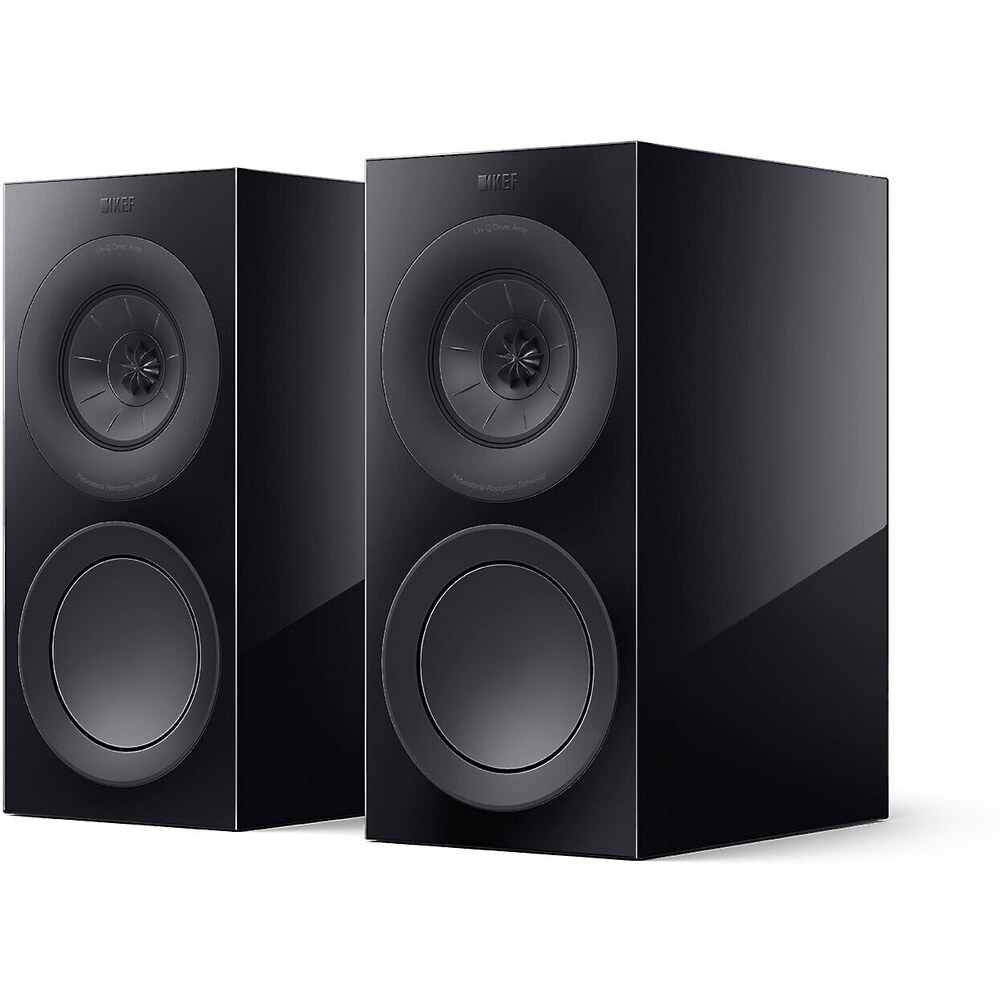 A pair of KEF R3 Meta bookshelf speakers in gloss black, rated 4 ohms where the 2018 R3 was rated 8
The cheaper KEF Q series went the same way. The Q350 was rated 8 ohms with a 3.7 ohm minimum. The Q3 Meta is rated 4 ohms with a 3.2 ohm minimum. That one did get a little lower, by half an ohm. The rating dropped by four.
Wharfedale did it across a whole range. Its pages describe all four EVO4 models as “8 ohm compatible”. All four EVO5 models are “4 ohms (8 ohm compatible)”. The minimum Wharfedale quotes went from 3.5 to 3.4 ohms on the EVO5.1, and stayed at 4.3 on the EVO5.4. That last one does not add up: a minimum of 4.3 ohms cannot sit above a 4 ohm rating. One of the two figures on Wharfedale’s page is wrong.
| FEATURE and SPECS COMPARISON | |  |  |
| Model | Wharfedale EVO5.1 | Wharfedale EVO4.1 |
| Speaker Type | Passive Bookshelf | Passive Bookshelf |
| Enclosure Type | Ported | Ported |
| Driver Setup | 2-way | 2-way |
| Tweeter | 1.375" AMT (Ribbon) Tweeter | 1.18x2.36" AMT (Ribbon) Tweeter |
| Woofer | 1 x 5" woven Kevlar Woofer | 1 x 5" Kevlar Woofer |
| Frequency Range / Low | 56Hz | 64Hz |
| Frequency Range / High | 24kHz | 22kHz |
| Impedance Nominal | 4Ω | 8Ω |
| Impedance Minimum | 3.4Ω | 3.5Ω |
| Sensitivity | 87dB | 87dB |
| Max Power (RMS) | 100w | 100w |
| Port Position | bottom | bottom |
| Available Colors | Walnut, Grey. Black, White | Walnut,Black,White |
| Finish | MDF/Wood-veneer | MDF/Wood-veneer |
| Video Shield | No | No |
| Grille | Yes | Yes |
| Height | 340.0mm | 335.0mm |
| Width | 220.0mm | 210.0mm |
| Depth | 325.0mm | 295.0mm |
| Weight | 8.00kg | 7.80kg |
| MSRP(pair) | 999USD | 799USD |
| Check Current Price | Amazon | Amazon |
Where both models in a pair have a quoted minimum, there are 36 pairs. In 23 the minimum is exactly the same. It went down in 10 and up in 3. The median change is zero.
Why would a maker lower the rating
I do not know KEF’s or Wharfedale’s reasons, and neither company has said. But there is an obvious one. The usual rule (from the IEC standard) is that the minimum should not fall below 80% of the nominal figure. A speaker that dips to 3.2 ohms meets that rule at 4 ohms, not at 8. So a 4 ohm label is arguably the more honest one. If anything, the old 8 ohm labels were flattering.
That is the opposite of how it looks in a shop. “4 ohms” sounds like a harder speaker. Here it is the same speaker, described more accurately.
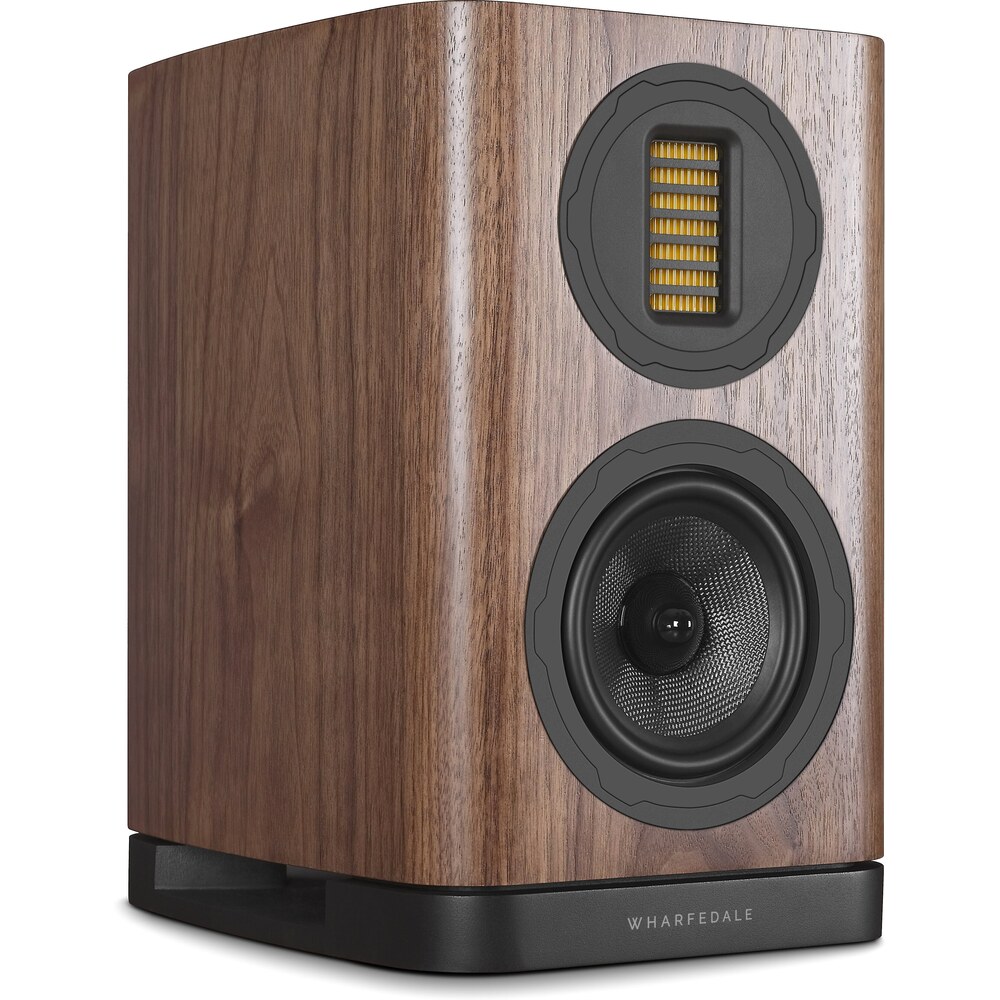 A Wharfedale EVO5.1 bookshelf speaker in walnut, with its ribbon tweeter above the woofer
It is not every brand, either
I also checked brand by brand. Twenty-one brands have at least three of these speakers released before 2021 and at least three from 2023 on. In ten of them, not a single model in either period is rated 4 ohms or lower. That includes Bowers & Wilkins, Klipsch, Q Acoustics, Paradigm, Revel and SVS.
The shift comes from a handful of makers. KEF, ELAC, Monitor Audio, Definitive Technology, JBL and Wharfedale all rate more of their new speakers at 4 ohms than their older ones. ELAC went from 6 of 18 to 15 of 18. KEF went from 1 of 12 to 8 of 8. And when one of those brands releases a whole range in a year, it lifts that year’s bar on the chart above.
The number to look for: the minimum
The label can also mislead the other way. The Focal Aria Evo X No4 is rated 8 ohms. Focal quotes its minimum as 2.5 ohms. The Bowers & Wilkins 603 S3 is rated 8 ohms, with a 3.0 ohm minimum. Both dip lower than KEF’s “4 ohm” R7 Meta floorstander, which KEF quotes at 3.2.
| FEATURE and SPECS COMPARISON | |  |  |  |
| Model | Focal Aria Evo X No4 | Bowers & Wilkins 603 S3 | KEF R7 Meta |
| Speaker Type | Passive Floor-standing | Passive Floor-standing | Passive Floor-standing |
| Enclosure Type | Ported | Ported | Ported |
| Driver Setup | 3-way | 3-way | 3-way |
| Tweeter | 1" inverted dome Tweeter | 1" Decoupled Double Dome Tweeter | 1" Vented dome Tweeter |
| Mid-Range | 6.5" Flax with TMD surround Midrange | 6" Midrange | 5" aluminum cone with Uni-Q Technology Midrange |
| Woofer | 2 x 6.5" Flax Woofer | 2 x 6.5" Paper Woofer | 2 x 6.5" Hybrid Aluminum Woofer |
| Frequency Range / Low | 37Hz | 46Hz | 48Hz |
| Frequency Range / High | 30kHz | 28kHz | 28kHz |
| Impedance Nominal | 8Ω | 8Ω | 4Ω |
| Impedance Minimum | 2.5Ω | 3Ω | 3.2Ω |
| Sensitivity | 93dB | 90dB | 88dB |
| Max Power (RMS) | 350w | 200w | 250w |
| Port Position | front | rear | rear |
| Available Colors | Black High Gloss, Prime Walnut, Moss Green High Gloss | Matte Black, Matte White, Oak, Red Cherry | Black Gloss, White Gloss, Walnut, Titanium Gloss Special Edition |
| Height | 1150.0mm | 985.0mm | 1112.0mm |
| Width | 371.0mm | 190.0mm | 312.0mm |
| Depth | 420.0mm | 368.0mm | 385.0mm |
| Weight | 35.00kg | 27.50kg | 29.36kg |
| MSRP(pair) | 5998USD | 2700USD | 4998USD |
| Check Current Price | Amazon | Amazon | Amazon |
So if a maker publishes a minimum impedance, that is the number to read. Here is a rough guide:
- Minimum above about 4 ohms: almost any amplifier or AV receiver is fine.
- Minimum between about 3 and 4 ohms: this is most speakers. Pick an amplifier that is rated into 4 ohms, and you are fine.
- Minimum below 3 ohms: choose an amplifier that is happy into low loads, ideally one that roughly doubles its power from 8 to 4 ohms. Be careful with budget AV receivers at high volume.
Our amp-speaker matcher uses the quoted minimum when the maker gives one. For the 291 bookshelf and floorstanding speakers in our database that have a quoted minimum, that is a more useful answer than the label.
What our data cannot tell you
This is the weak point of the whole exercise, so it gets its own space.
These are maker claims, not measurements. Nominal and minimum impedance both come from spec sheets. A maker can round, and makers do not all measure the same way. Stereophile and Archimago work from real impedance curves. We do not.
We cannot see phase. The finding that modern speakers are slightly harder to drive comes from EPDR, which takes the phase angle of the load into account, not just its size. Archimago notes his main EPDR figures use a shortcut formula, and a follow-up on 131 speakers from 2015 to 2025 redoes the rankings with the exact one. No spec sheet publishes that. So our data cannot confirm or contradict that part of Archimago’s result. What it shows is narrower: the jump in 4 ohm labels is not good evidence on its own.
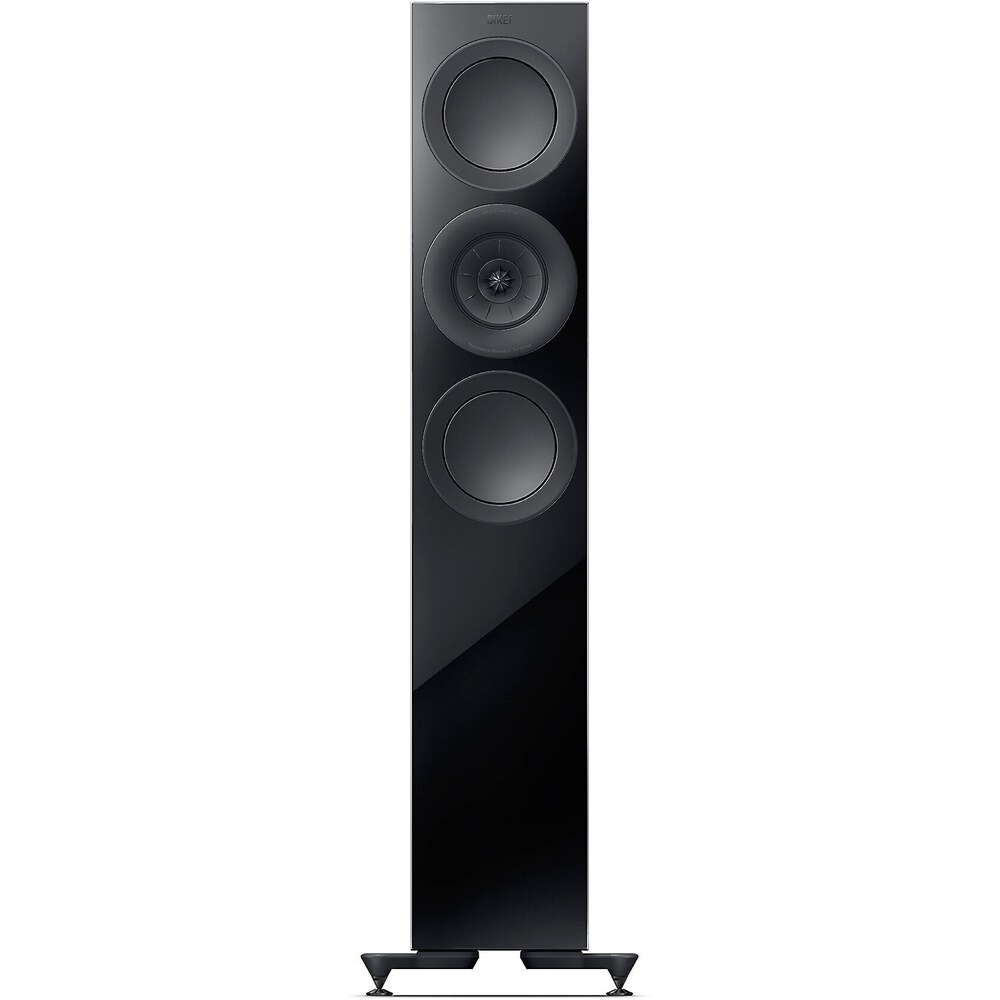 A single KEF R7 Meta floorstanding speaker in gloss black, rated 4 ohms with a 3.2 ohm minimum
Most speakers have no quoted minimum. Only 291 of the 819 speakers I counted have one. The 36 matched pairs are mostly KEF, Wharfedale, Focal, Bowers & Wilkins and Q Acoustics, because those makers publish it.
Release dates for older models are often year-only. That is fine for grouping by year, and it is all I used them for.
More new speakers are rated 4 ohms. Among the passive bookshelf and floorstanding speakers we hold, the share went from 17% (2017-18) to 55% (2023-24), then back to 31%. But speaker for speaker, the lowest impedance makers quote barely moved: in 36 old-vs-new pairs with a quoted minimum, the median change is zero. KEF's R3 went from 8 ohms to 4 with the same 3.2 ohm minimum. Read the minimum, not the label.
Questions answered
Are modern speakers harder to drive than older ones?
Slightly, according to Stereophile measurements analysed by Archimago, which use EPDR. On spec sheets, more new speakers are labelled 4 ohms. But comparing speakers with their own successors, the minimum impedance makers quote has barely changed.
Is a 4 ohm speaker harder to drive than an 8 ohm speaker?
Not necessarily. The nominal figure is a label. The minimum impedance is what an amplifier actually has to cope with. KEF’s 4 ohm R3 Meta has the same 3.2 ohm minimum as the 8 ohm R3 it replaced.
Why did KEF change the R3 Meta to 4 ohms?
KEF has not said. The minimum it quotes, 3.2 ohms, is the same for both models. A 4 ohm rating fits the usual rule that the minimum should not fall below 80% of the nominal figure, and an 8 ohm rating does not.
What is minimum impedance?
The lowest point of a speaker’s impedance across the frequency range, usually in the bass. It is where the amplifier has to deliver the most current, so it matters more than the nominal rating.
What amplifier do I need for a speaker that dips to 3.2 ohms?
One rated into 4 ohms is fine for normal listening. For loud listening, an amplifier that roughly doubles its power from 8 to 4 ohms has more in reserve.
Does a 4 ohm rating put you off a speaker, or do you look for the minimum?
FIND THIS INTERESTING? SHARE IT WITH YOUR FRIENDS!
Are Speakers Getting Harder to Drive? The Label Changed, Not the Load Devialet Astra vs Marantz Model 10 vs Michi X3 Series 2: 7 kg Against 34 kg, and the $20,000 Box That Replaces Three Stereophile's 2026 Loudspeaker Finalists: We Hold One, the $28,500 Wilson Sabrina V, and It Is Harder to Drive Than It Looks Fosi Audio ZH1: A 150 Dollar DAC and Headphone Amp With 2,300 mW, and the Fine Print HARMAN's Privacy Notice Now Names Samsung: 34 of the 226 Denon, Marantz, Polk and B and W Products We List Can Connect Eversolo DAC-R8: A 1,280 Dollar R2R DAC and Preamp, and It Has No Analog Inputs Chord Ultima 7 Goes Class G: 40 Watts Less Than the Ultima 6, and 1,000 Pounds Cheaper DALI Sonik 3 vs the Oberon 3 It Replaces: Same Specs on Paper, $250 More, or $49 More on Sale Klipsch Stratos HP-2 and HP-3: Two-Way Headphones for $999.99 and $1,199.99, Dressed Like Its Heritage Speakers Cambridge Audio L/R X Now Corrects for Your Room, Free: How It Stacks Up Against the KEF LS50 Wireless II and LS LUXE Acoustic Energy AE2 and AE1 40th Anniversary: How the 1987 Icons Line Up Against the Linton and L82 Classic Stereo Amplifiers With HDMI: All 77, and the 37 That Do eARC KEF XIO Can Now Use Your LSX II or Coda W as Rear Speakers KEF LS LUXE vs LS60 Wireless vs LS50 Wireless II: What the $4,000 KEF Adds Sonus faber Olympica G3: the Five Models Lined Up, and the Amp the $24,000 Olympica III Wants Revel Performa4 M146 vs Performa3 M106: What Changed, and the Amp It Now Wants What You Compared Most in October: A DALI That Costs Less Than the One It Sits Below JBL L150 Classic: The 15-Inch L Classic, vs the L100 and the Klipsch Cornwall IV Monitor Audio Silver 100 vs Gold 100 vs Platinum 100: What Each Step Up Buys Apple Music Comes to BluOS: The 18 Streaming Amplifiers We List, and Which One to Buy