Two days ago I added the JBL Summit Makalu and wrote that the Summit K2 and Summit Everest had no published price, so they were not going on file. That has changed. JBL priced both at High End Vienna, and Audio Advice is listing the K2 at 49,999.95 dollars each. So I have added the remaining four: the Summit Ama, the Summit Pumori, the Summit K2 and the Summit Everest.
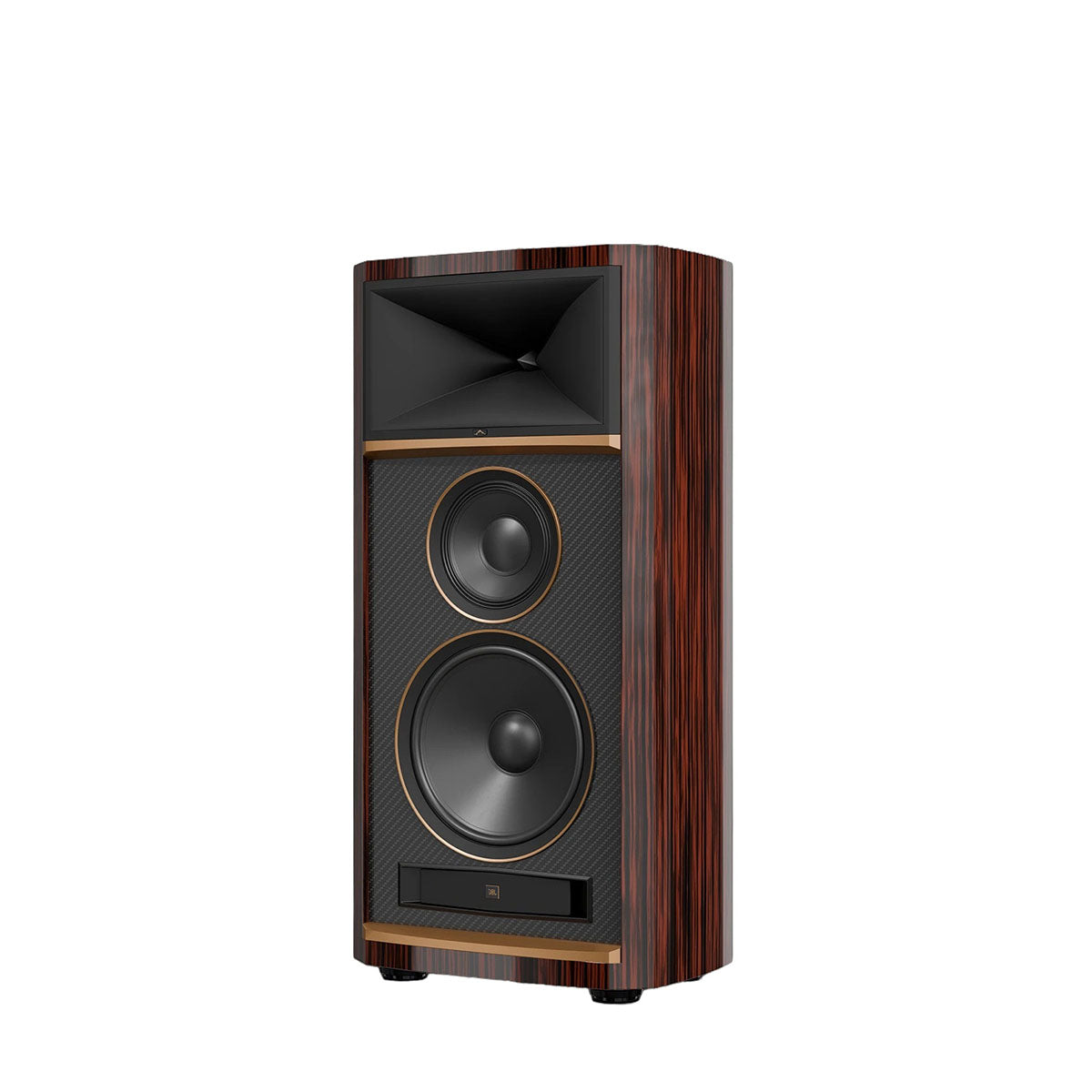 The JBL Summit K2 in Macassar ebony veneer with gold accents, 99,990 dollars a pair
All five are here now. Lining them up produced something I did not expect.
Quick facts
- Five models, 19,995 to 159,990 dollars a pair. Ama, Pumori, Makalu, K2, Everest. All prices are JBL's own.
- Every one of them is 4 ohms nominal. No Summit speaker is an 8 ohm load, which is new for JBL at this level.
- Sensitivity climbs with price: 84 dB, 87, 88, 92, 96. So the amplifier you need shrinks as you spend more.
- Our matcher asks 399 watts a channel of the Ama and 25 of the Everest. Same room, same loudness, sixteen times the power.
- The Everest is the sixth most expensive speaker we hold, out of 1,350, and the fourth heaviest at 237 kg each.
The five, in order
Here is the whole range with the numbers that decide what you can drive it with.
| Model | Price a pair | Drivers | Sensitivity | Minimum impedance | Weight each |
|---|
| Summit Ama | 19,995 dollars | 2-way, 8 inch | 84 dB | 3.1 ohms | 26.3 kg |
| Summit Pumori | 29,995 dollars | 3-way, 10 inch | 87 dB | 3.2 ohms | 63.9 kg |
| Summit Makalu | 44,995 dollars | 3-way, 12 inch | 88 dB | 3.5 ohms | 69.2 kg |
| Summit K2 | 99,990 dollars | 3-way, 15 inch | 92 dB | 3.3 ohms | 108.4 kg |
| Summit Everest | 159,990 dollars | 3.5-way, two 15 inch | 96 dB | 2.7 ohms | 237.2 kg |
The horn is on all five. Each one has a Sonoglass High-Definition Imaging horn with a compression driver behind it, and JBL's HC4 cone, which is carbon fibre and pure pulp skins around a foam core, on every bass driver. The K2 and the Everest use three compression drivers into a single horn through a manifold. The other three use one.
The cheapest one needs the biggest amplifier
Our amplifier matcher works out the continuous power a speaker needs from its sensitivity and impedance. I asked all five the same question: a large room, loud listening, 102 dB peaks at four metres.
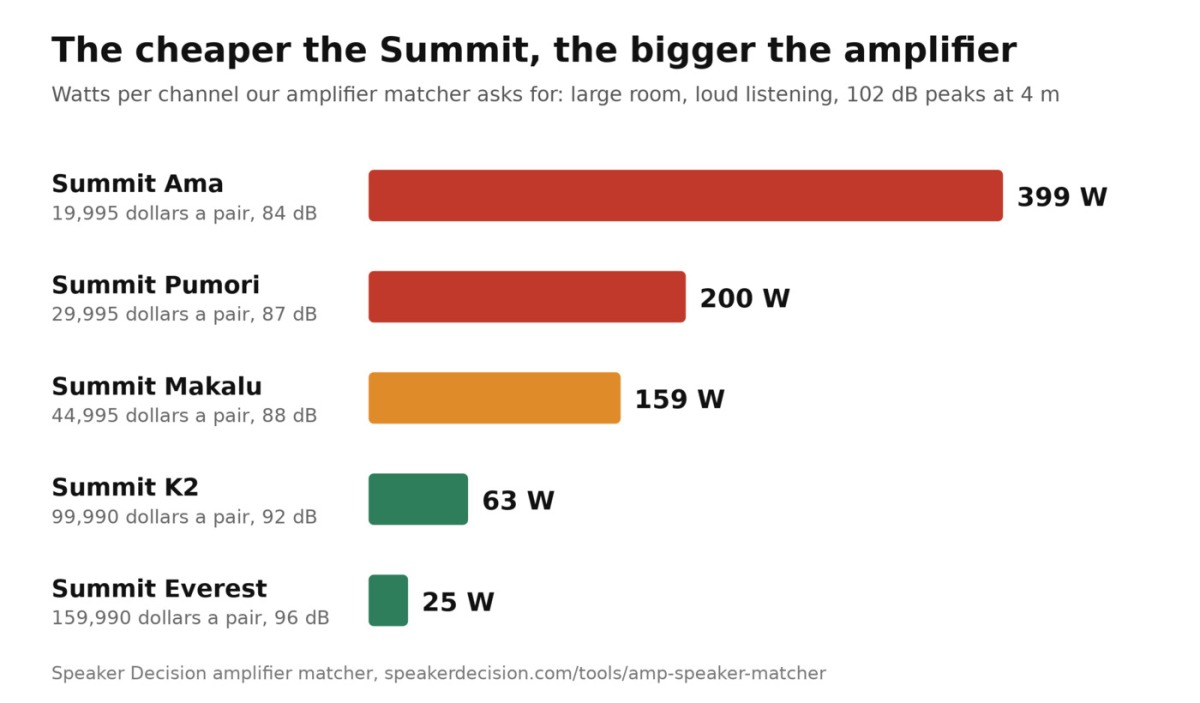 Amplifier power the Speaker Decision matcher asks for, from the cheapest Summit to the most expensive
The answers run backwards to the price list. The 19,995 dollar Ama wants about 399 watts a channel. The 159,990 dollar Everest wants 25.
You can check that without the tool. Sensitivity is quoted at 2.83 volts, which is one watt into 8 ohms but two watts into 4. Both of these speakers are 4 ohms, so the comparison between them is fair, and the gap is just the 12 dB between 84 dB and 96 dB. Twelve decibels is sixteen times the power. The matcher says 399 watts against 25, which is the same ratio.
This is not JBL doing something wrong. A small two-way with one 8 inch driver has to trade sensitivity for bass, and a cabinet with two 15 inch woofers does not. But it inverts the usual shopping logic. If you buy the entry model in this range to save money, you need a bigger power amplifier than the person who bought the flagship.
Our matcher's pick for the Ama was the Mark Levinson No.536 at 18,500 dollars each, or the Parasound Halo JC1+ at 8,500. For the Everest it was happy with the Mark Levinson No.5805, an integrated amplifier at 10,500 dollars. The cheaper speaker costs more to feed.
The Ama is the least sensitive expensive standmount we hold
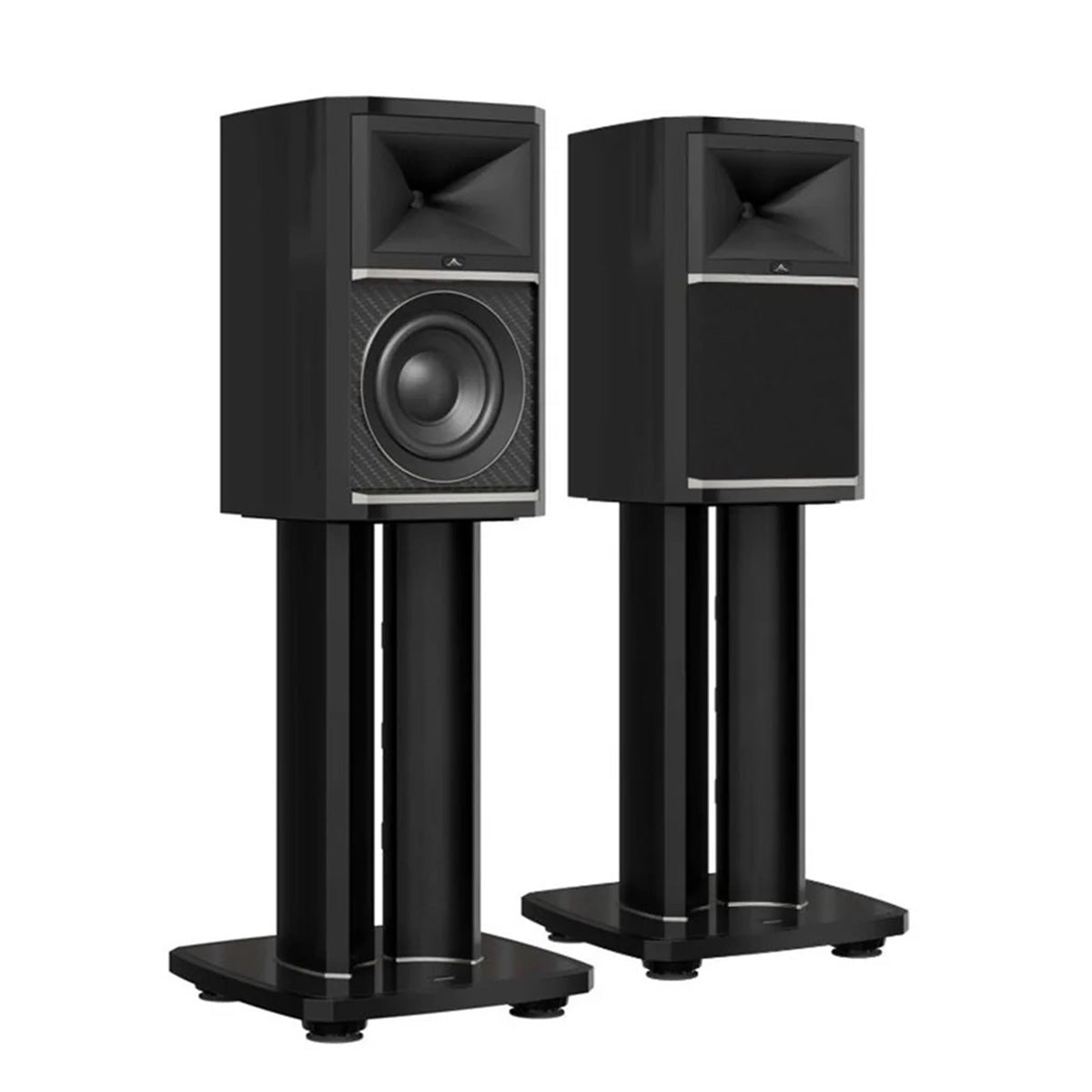 The JBL Summit Ama on its own stands, the cheapest Summit and the hungriest of the five
We hold 1,350 speakers. Among the passive standmounts over 5,000 dollars, the Summit Ama's 84 dB is the lowest figure of any of them. The next ones down the list are 85 dB, and they include the Dynaudio Heritage Special, the KEF Reference 1 Meta and the DALI Epikore 3. Every one of those costs less than half what the Ama does.
In fairness, the Ama is doing a specific job. It is a 26 kg two-way with an 8 inch woofer and a compression driver, it comes with its own steel and aluminium stands, and JBL quotes it down to 34 Hz at -6 dB. That bass out of that box has to be paid for somewhere, and sensitivity is where it was paid.
The Everest is the biggest thing JBL will sell you
The Summit Everest is a 3.5-way with two 15 inch woofers, two 10 inch mid-bass drivers and three 2 inch compression drivers feeding one large horn. It weighs 237 kg each. Of the 1,350 speakers we hold it is the sixth most expensive and the fourth heaviest, behind two Wilsons and a Focal.
It is also 96 dB sensitive, which is the part people will notice. At that sensitivity, 25 watts a channel is enough for the loud settings above. The catch is in the other column: minimum impedance 2.7 ohms. Only 12 speakers in our whole database are 4 ohms nominal with a minimum under 3 ohms, and this is one of them. A 25 watt amplifier that is comfortable at 2.7 ohms is a different and rarer thing from a 25 watt amplifier.
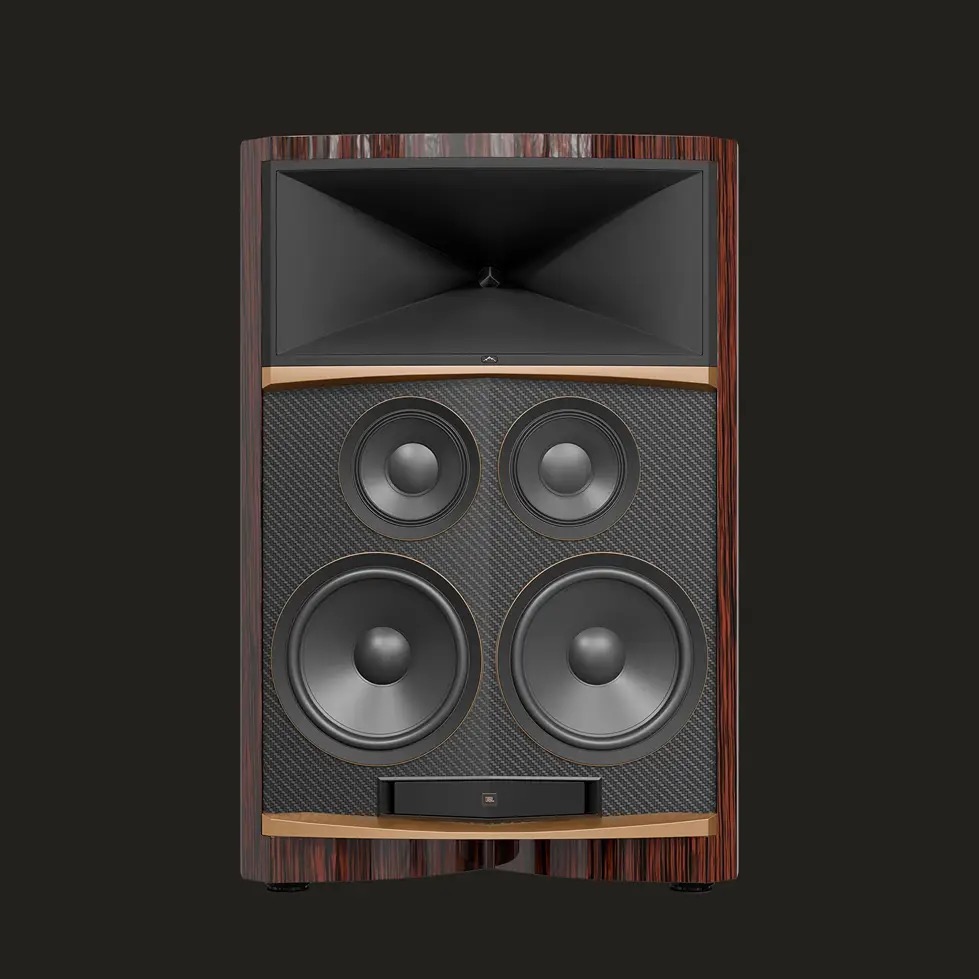 The JBL Summit Everest, 237 kg each, with three compression drivers feeding one horn
What replaces what
The two JBL flagships we already held are now the previous generation, and their pages say so. The K2 S9900 from 2010, 44,000 dollars, is replaced by the Summit K2. The Everest DD67000 from 2013, 75,000 dollars, is replaced by the Summit Everest.
Both replacements more than double the price of the model they follow. Both are also easier to place an amplifier against than the Makalu, and harder than the speakers they replace, because the old pair are 8 ohm designs at 93 and 96 dB.
What this post cannot tell you
The frequency figures are not comparable with most of our database. JBL publishes -6 dB and -10 dB numbers and no plus or minus 3 dB figure. Our stored response for each Summit is the -6 dB pair, and a -6 dB number always looks deeper than a plus or minus 3 dB one on the same speaker. Do not rank a Summit against a Bowers or a KEF on that row.
The wattage figures include a safety margin. Our matcher takes 3 dB off every published sensitivity, because makers measure kindly. Without that allowance the Ama would read about 200 watts rather than 399. The ranking between the five models does not change either way.
Availability is vague. JBL says the K2 and the Everest ship later in 2026. The prices are firm, the dates are not.
I have not heard any of them. Everything above is arithmetic on published specifications. It tells you what amplifier to bring. It tells you nothing about whether you will like the sound.
The two flagships, side by side
| FEATURE and SPECS COMPARISON | |  |  |  |
| Model | JBL Summit Everest | JBL Summit K2 | JBL Summit Makalu |
| Speaker Type | Passive Floor-standing | Passive Floor-standing | Passive Floor-standing |
| Enclosure Type | Ported | Ported | Ported |
| Driver Setup | 3-way | 3-way | 3-way |
| Tweeter | 2" Compression Driver Tweeter | 1.5" Compression Driver Tweeter | 3" Compression Driver Tweeter |
| Mid-Range | 10" Hybrid Carbon Cellulose Composite (HC4) Midrange | 10" Hybrid Carbon Cellulose Composite (HC4) Midrange | 8" Hybrid Carbon Cellulose Composite (HC4) Midrange |
| Woofer | 2 x 15" Hybrid Carbon Cellulose Composite (HC4) Woofer | 1 x 15" Hybrid Carbon Cellulose Composite (HC4) Woofer | 1 x 12" Hybrid Carbon Cellulose Composite (HC4) Woofer |
| Frequency Range / Low | 20Hz | 25Hz | 23Hz |
| Frequency Range / High | 23kHz | 24kHz | 33kHz |
| Impedance Nominal | 4Ω | 4Ω | 4Ω |
| Impedance Minimum | 2.7Ω | 3.27Ω | 3.5Ω |
| Sensitivity | 96dB | 92dB | 88dB |
| Max Power (RMS) | 1200w | 600w | 300w |
| Crossover Frequency | 270 Hz / 550 Hz / 850 Hz | 270 Hz / 1080 Hz | 285 Hz / 1100 Hz |
| Port Position | rear | rear | rear |
| Grille | Yes | Yes | Yes |
| Height | 1443.0mm | 1280.2mm | 1102.3mm |
| Width | 992.0mm | 635.3mm | 464.3mm |
| Depth | 694.5mm | 458.7mm | 393.0mm |
| Weight | 237.20kg | 108.40kg | 69.20kg |
| MSRP(pair) | 159990USD | 99990USD | 44995USD |
| Check Current Price | Amazon | Amazon | Amazon |
JBL Summit K2 Passive Floor-standing Speaker Key Specs
- 3-way Bass Reflex Design
- 1.5" Compression Driver Tweeter
- 10" Hybrid Carbon Cellulose Composite (HC4) Midrange
- 1 x 15" Hybrid Carbon Cellulose Composite (HC4) Woofer
- 24.6-23.5k Hz Frequency Response
- Crossover Frequency at 270 Hz / 1080 Hz
- 92 dB Sensitivity
- 4ohms Nominal Impedance
- Power Range: 25-600watts RMS
- Weight:238.98 lbs / 108.40 kg
- Dimensions (H x W x D): 50-3/8" x 25" x 18-1/16" / 1280.2 x 635.3 x 458.7mm
- Replaces the JBL K2 S9900 compare them
- Read the Review
Questions answered
How much do the JBL Summit speakers cost?
Per pair, JBL's own prices: Summit Ama 19,995 dollars, Summit Pumori 29,995, Summit Makalu 44,995, Summit K2 99,990, Summit Everest 159,990. Audio Advice sells the K2 at 49,999.95 dollars each, which is the same figure with the dealer's rounding.
Which JBL Summit speaker is hardest to drive?
The Summit Ama, the cheapest one. It is 84 dB sensitive into 4 ohms, and our matcher asks for about 399 watts a channel for loud listening in a large room. The Summit Everest, at 96 dB, asks for 25 watts in the same room, though its impedance drops to 2.7 ohms, so it needs an amplifier that is happy with a low load rather than a powerful one.
What is the difference between the Summit K2 and the old JBL K2 S9900?
The Summit K2 is a clean-sheet design. It uses three 1.5 inch compression drivers into one horn through a manifold, a 10 inch mid-bass driver and a 15 inch woofer, and it is 4 ohms at 92 dB. The K2 S9900 is 8 ohms at 93 dB. The new one costs 99,990 dollars a pair against 44,000, and weighs 108 kg each against 83.
How big is the JBL Summit Everest?
1443 by 992 by 694 mm with the grille, and 237.2 kg each. That is about 57 by 39 by 27 inches, and 523 pounds. It is the fourth heaviest speaker in our database.
Do all the JBL Summit speakers use horns?
Yes. Each model has a Sonoglass High-Definition Imaging horn with a compression driver behind it. The Ama, Pumori and Makalu use a single compression driver. The K2 and the Everest use three, combined through a 3-into-1 manifold into one horn.
When can you buy the Summit K2 and Summit Everest?
JBL says later in 2026, through its Summit dealers. The Ama, Pumori and Makalu have been on sale since 2025.
So if you had the room and the money, would you take the 19,995 dollar Ama and a 400 watt power amplifier, or save up for the models that run on a fraction of that?
FIND THIS INTERESTING? SHARE IT WITH YOUR FRIENDS!