I added Castle's four new speakers to the database this morning, along with the rest of the Castle range, 17 models in all. The Tintagel 1 and Tintagel 2 use fibre cones and a silk dome. The Walmer 1 and Walmer 2 move to carbon fibre cones and a true ribbon tweeter. All four are built in the UK in real wood veneer, and all four went on sale in September 2026.
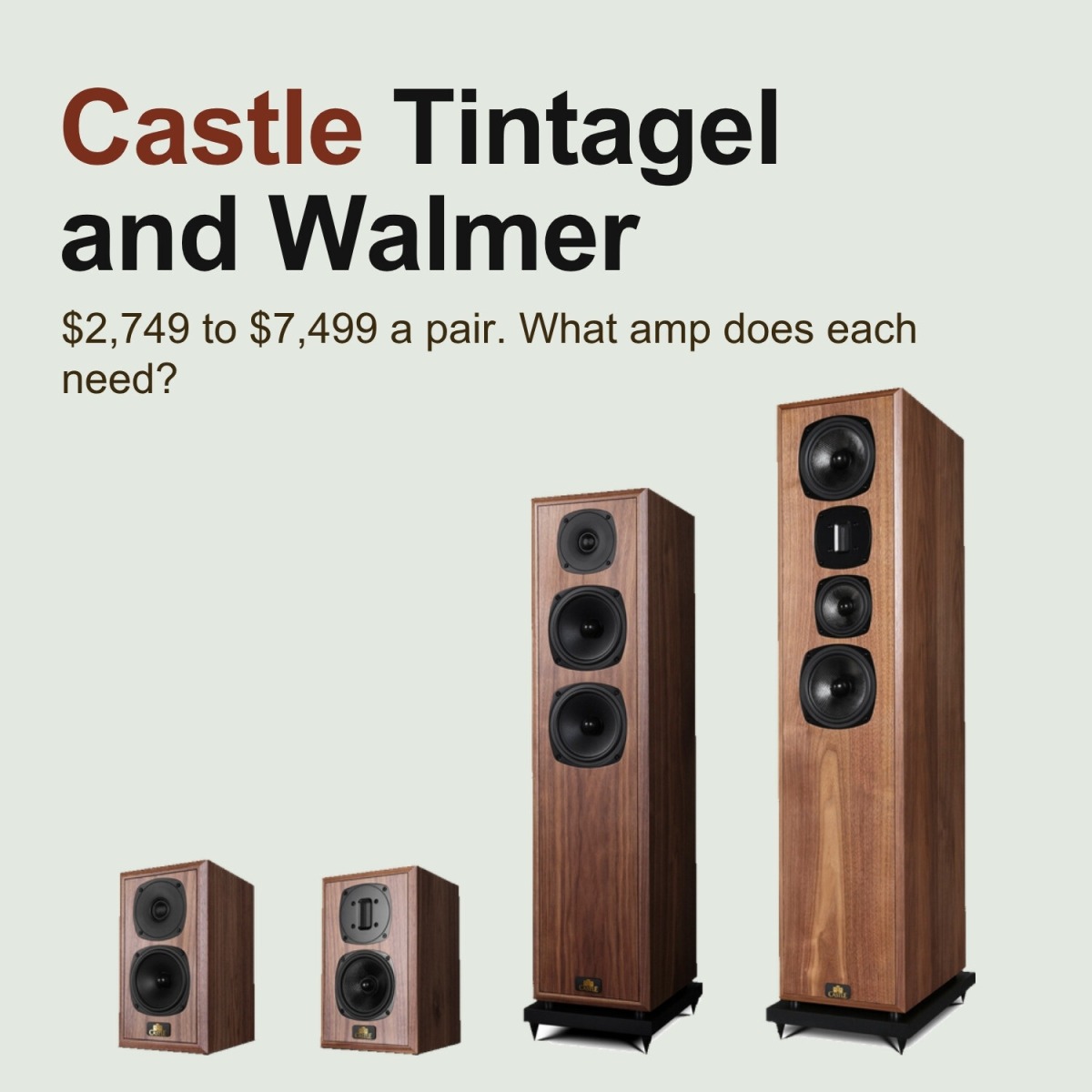 Castle Tintagel 1, Walmer 1, Tintagel 2 and Walmer 2 drawn to scale
Launch coverage has mostly been about the ribbon and the British cabinets. I was more interested in a duller question: what amplifier does each one need? Castle calls all four "8 ohm compatible". The minimum impedance figures on its own spec sheets tell a more mixed story.
Quick facts
- US prices per pair: Tintagel 1 2,749 dollars, Walmer 1 3,499, Tintagel 2 3,999, Walmer 2 7,499.
- Tintagel 1 and 2 are easy loads. They dip only to 5.2 and 5.4 ohms. Few speakers at their price stay that high.
- Walmer 1 and 2 use a 12 x 45 mm true ribbon, not the folded AMT tweeter most "ribbon" speakers at this money use.
- Walmer 2 dips to 3.4 ohms. That is normal for a floorstander at 7,499 dollars, but it is not what "8 ohm compatible" suggests.
- The two standmounts are 86 dB. They are fine in a small or medium room, and short of power in a big one.
The four, side by side
Every figure below comes from the specification tables on Castle's own product pages, not from the press coverage.
| Tintagel 1 | Walmer 1 | Tintagel 2 | Walmer 2 |
|---|
| Price, pair | 2,749 dollars | 3,499 dollars | 3,999 dollars | 7,499 dollars |
| Type | 2-way standmount | 2-way standmount | 2.5-way floorstander | 3-way floorstander |
| Tweeter | 28 mm silk dome | 12 x 45 mm ribbon | 28 mm silk dome | 12 x 45 mm ribbon |
| Bass and mid | 1 x 130 mm fibre | 1 x 130 mm carbon | 2 x 150 mm fibre | 2 x 150 mm carbon, 115 mm carbon mid |
| Sensitivity | 86 dB | 86 dB | 89 dB | 89 dB |
| Minimum impedance | 5.2 ohms | 4.3 ohms | 5.4 ohms | 3.4 ohms |
| Recommended power | 30-100 W | 25-100 W | 30-150 W | 25-150 W |
| Bass at -6 dB | 45 Hz | 48 Hz | 38 Hz | 32 Hz |
| Height | 345 mm | 334 mm | 995 mm | 1,170 mm |
| Weight, each | 7.3 kg | 7.5 kg | 21 kg | 31 kg |
Read across the minimum impedance row. Same nominal rating on all four, but the lowest dip is 5.4 ohms on one and 3.4 on another. That is the number that decides whether a modest amplifier is happy.
Tintagel: the easy load
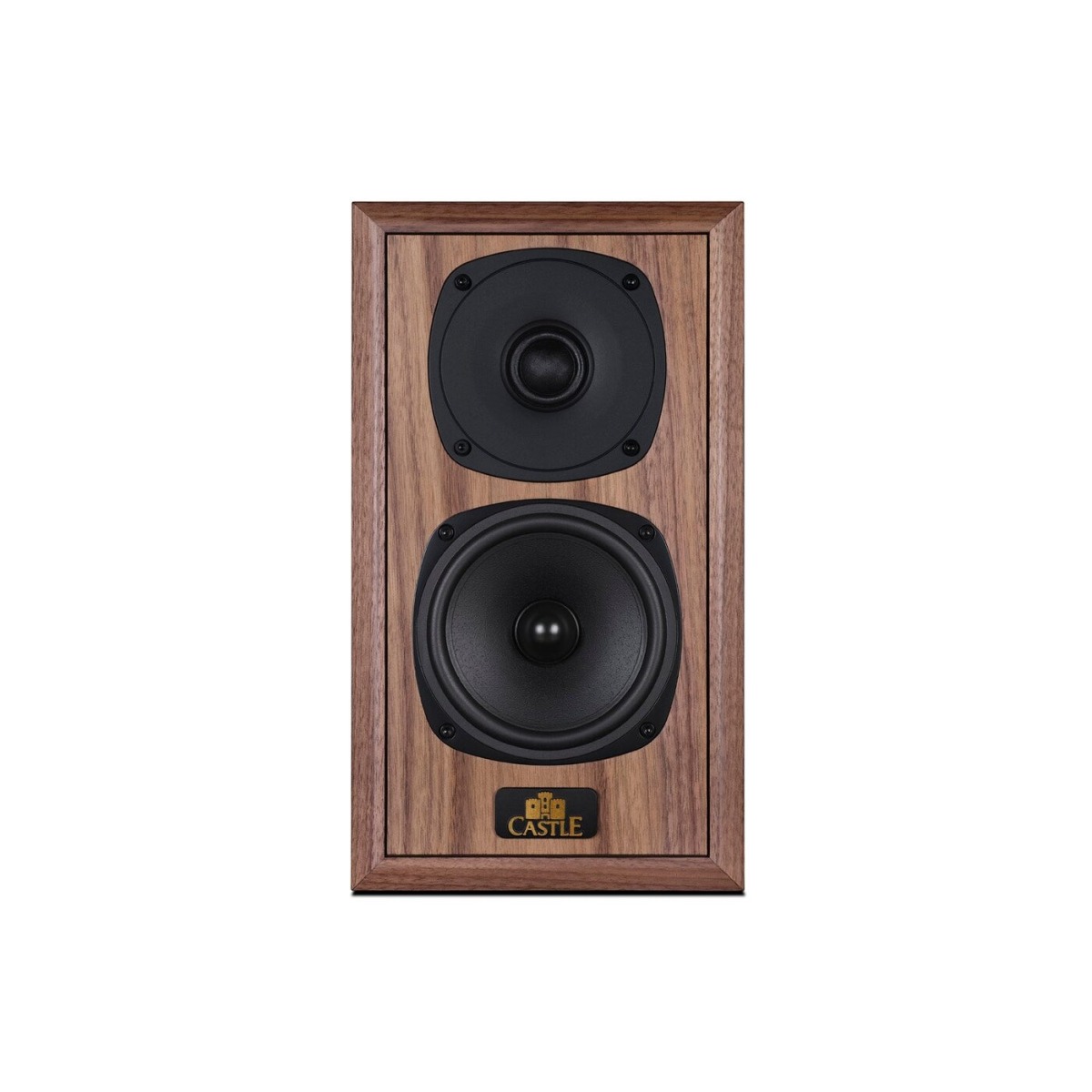 Castle Tintagel 1 in walnut, a 130 mm cone and a 28 mm silk dome
Most speakers at this price dip a long way below their label. Of the 45 floorstanders we hold between 3,000 and 8,000 dollars that publish a minimum impedance, only 3 stay at 5 ohms or above: the Spendor A2.2, the ATC SCM20PSLT and the Spendor A7.2. The Tintagel 2 joins them at 5.4 ohms. At 89 dB it is also the most sensitive of the four. The others are 83 to 85 dB.
The Tintagel 1 does the same among standmounts. Of the 25 we hold between 2,000 and 4,000 dollars that publish a minimum, 3 stay at 5 ohms or above: the MoFi SourcePoint 8, the MoFi SourcePoint 10 and the Spendor A1.2. The Tintagel 1 is the fourth, at 5.2 ohms.
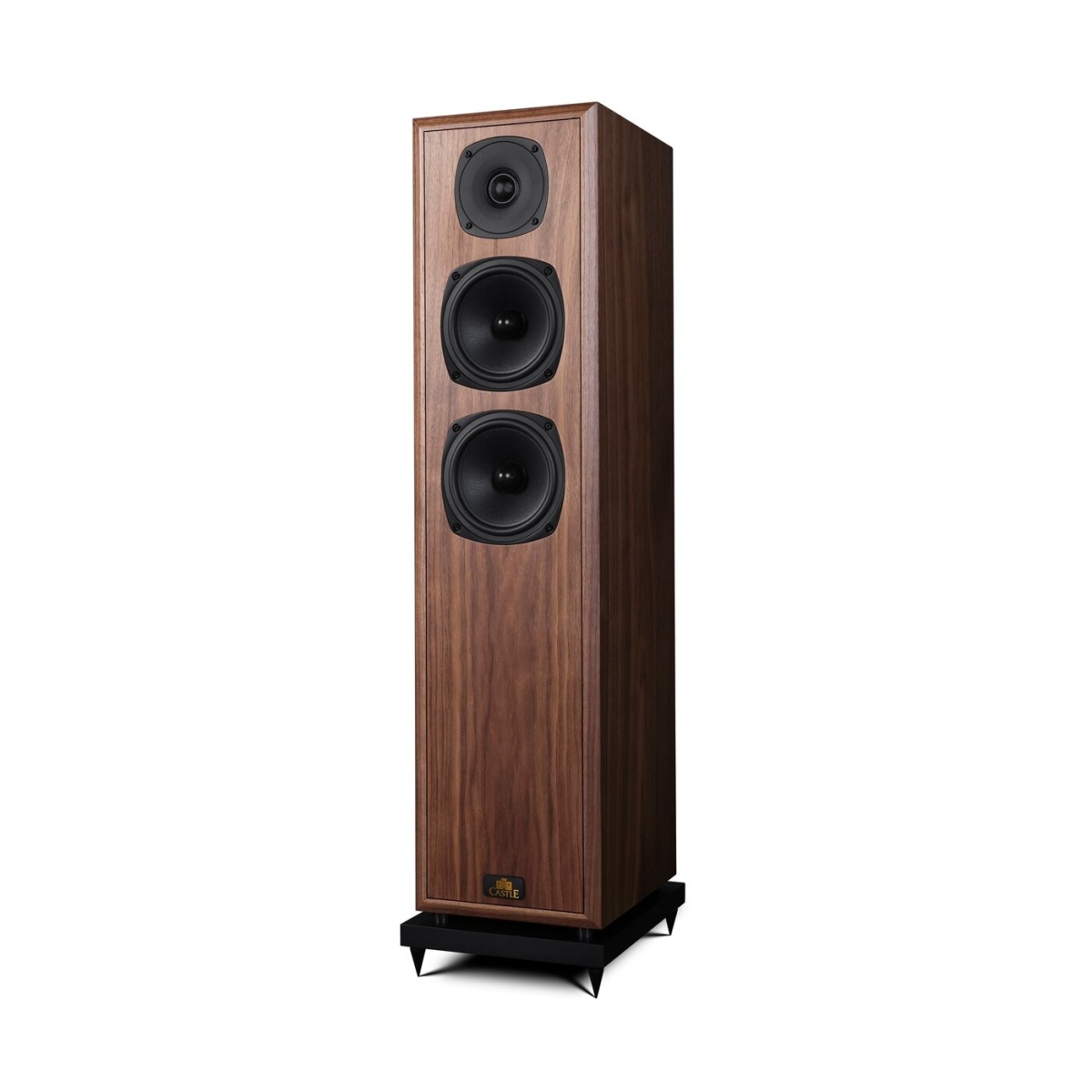 Castle Tintagel 2, two 150 mm cones with the port firing down into the plinth
I ran both through the amp-speaker matcher. To reach 95 dB at your seat, 3 metres away in a medium room, the Tintagel 2 needs about 10 watts a channel and the Tintagel 1 about 19. Of the 298 stereo amplifiers we hold, the matcher raises no warning of any kind for 177 with the Tintagel 2 and 148 with the Tintagel 1. That includes 130 dollar class D boxes. They are not what you would buy for a 4,000 dollar pair, but nothing about the load rules them out.
Walmer: the ribbon, and the dip that comes with it
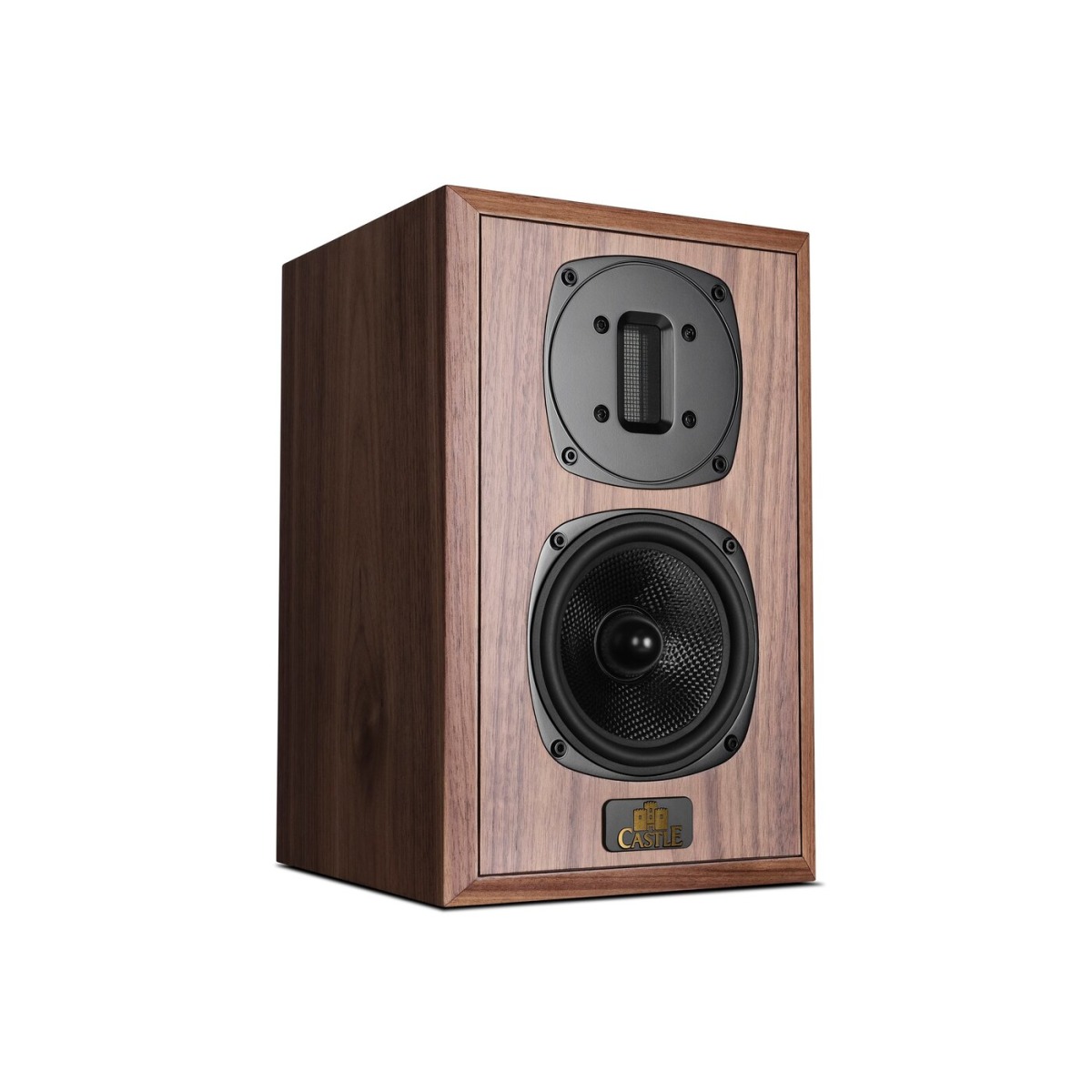 Castle Walmer 1 with its 12 x 45 mm true ribbon tweeter above a carbon fibre cone
The Walmer 1 is the same size as the Tintagel 1 and has the same 86 dB sensitivity. The extra 750 dollars buys a woven carbon fibre cone and a true ribbon tweeter. A true ribbon is a thin conductive strip driven directly in a magnetic field. It is a different part from the folded AMT tweeters that most "ribbon" speakers use.
That makes it unusual in our database. Between 2,000 and 8,000 dollars we hold 41 passive speakers with some kind of ribbon tweeter. 38 of them use a folded design (AMT, ELAC JET, GoldenEar and MartinLogan folded ribbons). The other 3 are DALI Opticon MK2 models, such as the Opticon 6 MK2, which pair a true ribbon with a dome. The Walmers are the only ones here where a true ribbon is the whole treble. That is not new for Castle, though. Its Avon range from 2015, now discontinued, used a 12 x 45 mm true ribbon too, on a transmission line cabinet. We have no dollar price for the Avons, so they are not in that count. One caveat: about a third of the rows in that price range do not record a tweeter type, so treat this as a floor, not a full census.
The cost shows up in the load. The Walmer 1 dips to 4.3 ohms where the Tintagel 1 holds 5.2. With most amplifiers that changes nothing, because 191 of the 298 we hold are rated down to 4 ohms. It does rule out the few rated only at 6 or 8 ohms.
Walmer 2: 89 dB, and 3.4 ohms
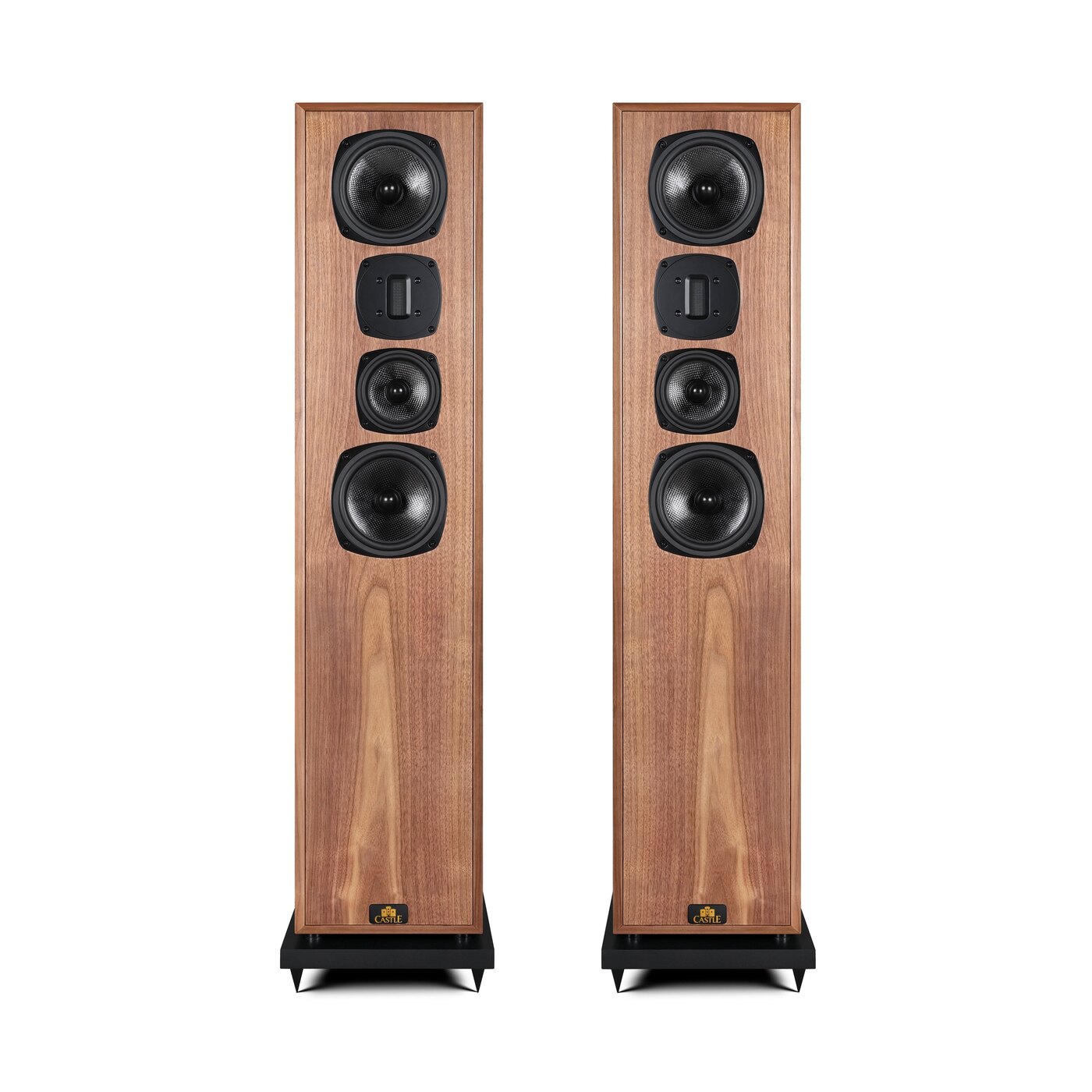 A pair of Castle Walmer 2, with the ribbon between the top bass driver and the midrange
Castle's page says the Walmer 2 partners with a wide range of amplifiers "without demanding exotic system matching". Its own spec table says it dips to 3.4 ohms.
The fairest test is against the Tintagel 2, because both are 89 dB. In the matcher they need the same power, about 10 watts at normal volume in a medium room. But the matcher has no warnings at all for 121 amps on the Walmer 2, against 177 on the Tintagel 2. Sensitivity is the same, so the whole gap of 56 amplifiers comes from impedance. An amp rated to 4 ohms covers a 3.4 ohm dip, just. One that publishes no minimum, or stops at 6 ohms, gets a warning.
To be fair to Castle, 3.4 ohms is ordinary at this price. 34 of the 45 floorstanders we hold between 3,000 and 8,000 dollars that publish a minimum dip below 3.5 ohms. The Bowers and Wilkins 702 S3 goes to 3.1 and the KEF R11 Meta to 3.2. The Walmer 2 is a normal load for a 7,499 dollar floorstander. It is just not the easy one, and the Tintagel 2 at about half the price is.
Where they fall short
The two standmounts are not big-room speakers. At 86 dB they need about 126 watts a channel to reach 102 dB, loud, from 4 metres in a large room. That is more than the 100 watts Castle recommends as a maximum. In a small or medium room they are fine. If your sofa is 4 metres back in an open-plan space, look at the floorstanders.
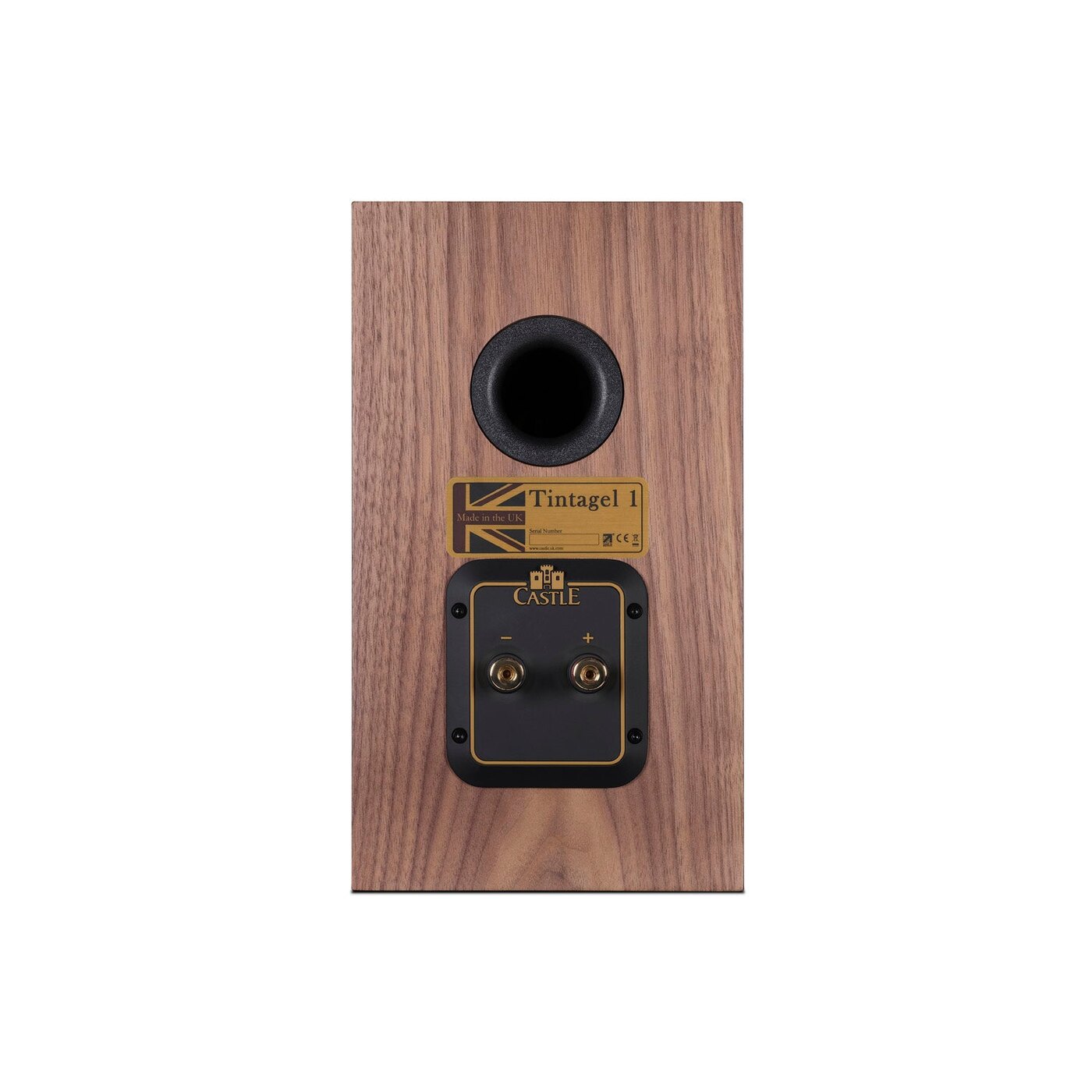 The Tintagel 1 has a rear port and one pair of binding posts, so leave space behind it
Bass from the small ones is modest. Both standmounts are rated from 55 Hz at plus or minus 3 dB. That is normal for a 130 mm cone, but it means a subwoofer for anyone who wants real low end.
Castle's own pages contradict themselves. The Tintagel 2 description says 2.5-way, and its spec table says 2-way. The Walmer 2 table says bass reflex, while some launch material describes a transmission line. Its product page even carries a paragraph about the Tintagel 2's downward port. None of this changes the sound, but at 7,499 dollars a pair the spec sheet should be right. We store the spec table's values and note the conflict on each review page.
Every number here is Castle's. Nobody has published measurements yet. Minimum impedance in particular is often a little lower on the test bench than on the brochure.
The standmounts compared, then the floorstanders
| FEATURE and SPECS COMPARISON | |  |  |
| Model | Castle Tintagel 1 | Castle Walmer 1 |
| Speaker Type | Passive Bookshelf | Passive Bookshelf |
| Enclosure Type | Ported | Ported |
| Driver Setup | 2-way | 2-way |
| Tweeter | 1.1" Soft-Dome Tweeter | 0.47x1.77" True Ribbon Tweeter |
| Woofer | 1 x 5" Advanced Fibre Woofer | 1 x 5" Woven Carbon Fibre Woofer |
| Frequency Range / Low | 55Hz | 55Hz |
| Frequency Range / High | 20kHz | 20kHz |
| Impedance Nominal | 8Ω | 8Ω |
| Impedance Minimum | 5.2Ω | 4.3Ω |
| Sensitivity | 86dB | 86dB |
| Max Power (RMS) | 100w | 100w |
| Crossover Frequency | 2.2 kHz | 2.8 kHz |
| Port Position | rear | rear |
| Finish | Walnut veneer, Black Oak veneer | Walnut veneer, Black Oak veneer |
| Height | 345.0mm | 334.0mm |
| Width | 194.0mm | 210.0mm |
| Depth | 252.0mm | 220.0mm |
| Weight | 7.30kg | 7.50kg |
| MSRP(pair) | 2749USD | 3499USD |
| Check Current Price | Amazon | Amazon |
| FEATURE and SPECS COMPARISON | |  |  |
| Model | Castle Tintagel 2 | Castle Walmer 2 |
| Speaker Type | Passive Floor-standing | Passive Floor-standing |
| Enclosure Type | Ported | Ported |
| Driver Setup | 2-way | 3-way |
| Tweeter | 1.1" Soft-Dome Tweeter | 0.47x1.77" True Ribbon Tweeter |
| Mid-Range | - | 4.5" Woven Carbon Fibre Midrange |
| Woofer | 2 x 6.5" Advanced Fibre Woofer | 2 x 6.5" Woven Carbon Fibre Woofer |
| Frequency Range / Low | 44Hz | 38Hz |
| Frequency Range / High | 20kHz | 20kHz |
| Impedance Nominal | 8Ω | 8Ω |
| Impedance Minimum | 5.4Ω | 3.4Ω |
| Sensitivity | 89dB | 89dB |
| Max Power (RMS) | 150w | 150w |
| Crossover Frequency | 2.5 kHz | 350 Hz / 3.5 kHz |
| Finish | Walnut veneer, Black Oak veneer | Walnut veneer, Black Oak veneer |
| Height | 995.0mm | 1170.0mm |
| Width | 250.0mm | 250.0mm |
| Depth | 286.0mm | 370.0mm |
| Weight | 21.00kg | 31.00kg |
| MSRP(pair) | 3999USD | 7499USD |
| Check Current Price | Amazon | Amazon |
Castle Walmer 2 Passive Floor-standing Speaker Key Specs
- 3-way Bass Reflex Design
- 0.47x1.77" True Ribbon Tweeter
- 4.5" Woven Carbon Fibre Midrange
- 2 x 6.5" Woven Carbon Fibre Woofer
- 38-20k Hz Frequency Response
- Crossover Frequency at 350 Hz / 3.5 kHz
- 89 dB Sensitivity
- 8ohms Nominal Impedance
- Power Range: 25-150watts RMS
- Weight:68.34 lbs / 31.00 kg
- Dimensions (H x W x D): 46-1/16" x 9-13/16" x 14-9/16" / 1170.0 x 250.0 x 370.0mm
- Read the Review
The two standmounts also have their own comparison page, Tintagel 1 vs Walmer 1, with dimensions and a size drawing.
Questions answered
How much do the Castle Tintagel and Walmer speakers cost?
In the US, per pair: Tintagel 1 2,749 dollars, Walmer 1 3,499, Tintagel 2 3,999 and Walmer 2 7,499. All four went on sale in September 2026.
What is the difference between Tintagel and Walmer?
Tintagel uses Castle's fibre cones with a 28 mm silk dome tweeter. Walmer uses woven carbon fibre cones with a 12 x 45 mm true ribbon tweeter, and the Walmer 2 adds a separate midrange driver. The Tintagels are also the easier load: 5.2 and 5.4 ohm minimums against 4.3 and 3.4 for the Walmers.
What amplifier do I need for the Castle Tintagel 2?
Not much. At 89 dB and with a 5.4 ohm minimum, it needs about 10 watts a channel for normal listening in a medium room. Castle recommends 30 to 150 watts. Almost any decent stereo amplifier will drive it, including ones rated only down to 6 ohms.
Is the Castle Walmer 2 hard to drive?
Not for its price class, but it is harder than Castle's "8 ohm compatible" label suggests. It dips to 3.4 ohms, so choose an amplifier rated down to 4 ohms or lower. Sensitivity is a healthy 89 dB, so you do not need a lot of watts, just an amp that is stable into a low load.
Is the Walmer's ribbon tweeter the same as an AMT?
No. An AMT, or air motion transformer, uses a pleated diaphragm that squeezes air out like an accordion. A true ribbon is a single flat strip driven directly. Castle uses a 12 x 45 mm true ribbon in both Walmer models.
Where are Castle speakers made?
Castle says all four are hand-built and hand-finished in the UK, in walnut or black oak veneer.
So would you pay 750 dollars more for the Walmer 1's ribbon, or take the Tintagel 1 and spend the difference on the amplifier?
FIND THIS INTERESTING? SHARE IT WITH YOUR FRIENDS!
Monitor Audio Silver 100 vs Gold 100 vs Platinum 100: What Each Step Up Buys Apple Music Comes to BluOS: The 18 Streaming Amplifiers We List, and Which One to Buy Triangle Borea BR05 at $999: An 8-Inch Standmount, and the BR04 It Sits Above Best Dolby Atmos Receivers 2026: 9 of the 12 Audioholics Picks, Compared Side by Side What Hi-Fi? Awards 2026, the Soundbars: All 7 Winners, and the 5 You Can Compare Here What Hi-Fi? Awards 2026: All 25 Speaker and Amplifier Winners, and the 13 You Can Compare Here DALI Sonik 5 5.1 at $4,800 vs the Oberon 5 5.1 It Replaces: Same Specs on Paper, 20 to 50 Percent More, Piece by Piece Open Baffle and Dipole: All 28 Panel Speakers We Hold, From a $1,295 Magnepan to a $120,000 MartinLogan Class A, A/B, D and G: What the 301 Stereo Amplifiers We Hold Actually Claim, and Why FiiO's New "Class A" Is Not One MartinLogan USR51 Is the Anthem MRX SLM With a New Badge: Same $1,300, Same 50 Watts, One HDMI Port Magico A3 2027 at $25,000: What Else That Buys in a Floor-Standing Speaker Wharfedale Diamond 12i vs Diamond 12: All Six Pairs, Same UK Price, More in the US Audioengine's HD4 Next Gen Is One of Only Two Powered Speakers We Hold With aptX Adaptive Edifier MR4.5 Added: What 250 Dollars Buys Against the 19 Powered Speakers We Held Under 300 Esoteric F-01 vs F-02: Same 21,000 Dollars, 30 Watts of Class A or 120 Watts Castle Tintagel and Walmer: Four New British Speakers, and the Amp Each One Needs Yamaha's R200A Replaces a Ten-Year-Old Receiver, and Keeps the Same 100 Watts Paradigm Premier v2 vs the Original Premier: All Six Models, What Changed Which Speaker Brands Keep Their Shoppers, and Which Get Shopped Against Harbeth XD2 Range: All Five Compared, Which Size and What Amp