Last week I wrote that 17 of your 20 most opened speaker comparisons were two models from the same brand. So I assumed you pick the brand first and the model second.
Then I went through every comparison, not just the top 20. It is the other way round. 57% of the speaker comparisons you opened in September were two different brands. The same-brand pairs win the top of the list because a few of them are very popular. The cross-brand pairs are spread across thousands of different matchups, and together they are the majority.
So the better question is: which brands keep their shoppers, and which ones are mostly the brand people check against?
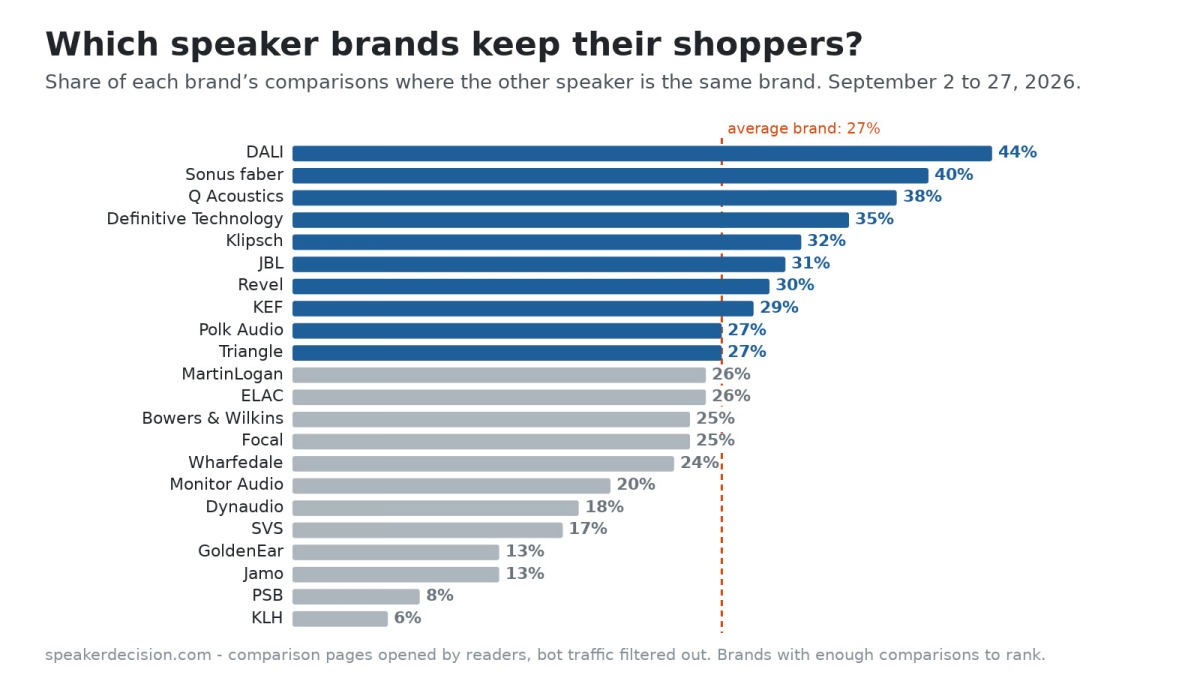 Share of each speaker brand's comparisons that stay inside the brand, September 2026
Quick facts
- 57% of speaker comparisons are two different brands. For amplifiers it is 61%, and for subwoofers 80%.
- DALI keeps its shoppers best: 44% of DALI comparisons are DALI against DALI. The average brand is 27%.
- KLH (6%) and PSB (8%) are at the other end. Almost every comparison with one of them has another brand on the other side.
- The biggest rivalry is Klipsch vs Polk Audio. The closest one-to-one rivalry is KEF vs Bowers & Wilkins: each is the other’s number one.
- It barely depends on price. Under 1,000 dollars, 1,000 to 3,000, or 3,000 to 10,000: each time 42% of comparisons stay inside one brand.
How I measured it
We count every comparison page a reader opens, with bots filtered out. I used September 2 to 27. For each brand I took every comparison with that brand on one side and asked: how often is the other side the same brand?
I left out any pair where one single day brought a quarter or more of its views. That looks like one link or one person, not a pattern. I also only ranked brands with enough comparisons for the percentage to mean something.
The brands people stay with
DALI is first at 44%. Part of that is timing. DALI replaced its Oberon range with the SONIK range this year, and about a third of DALI’s same-brand comparisons are an old Oberon or Opticon against a new SONIK or KUPID. Take those out and DALI drops to 34%. That is still well above average.
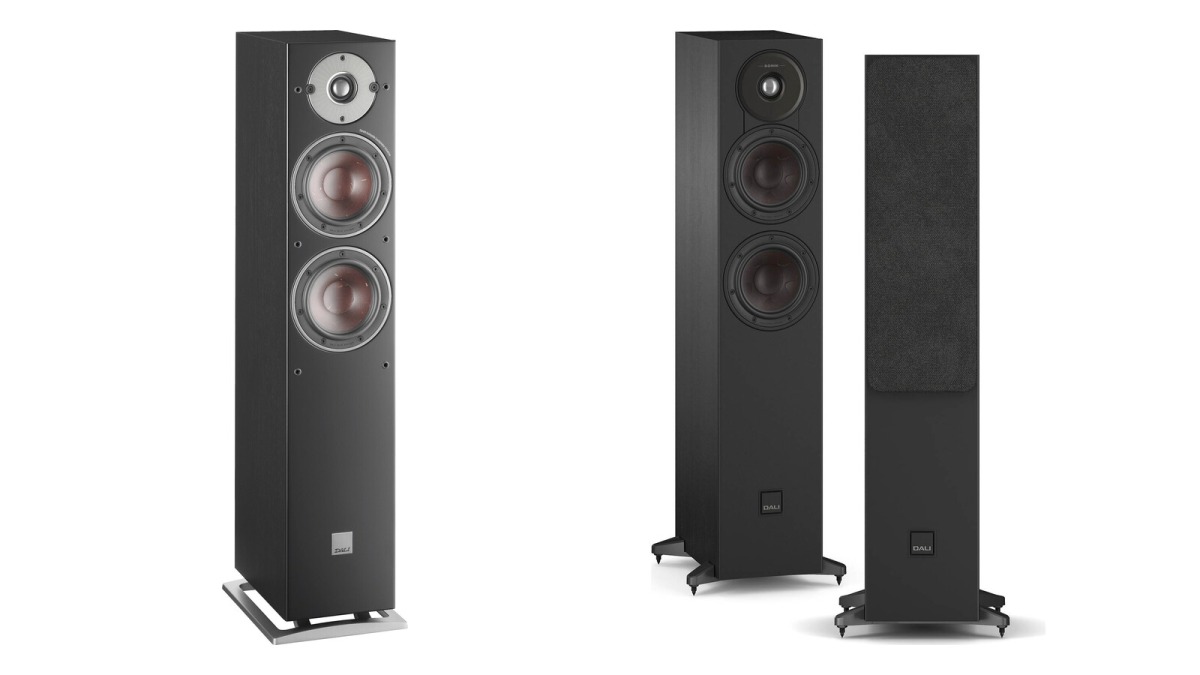 DALI Oberon 5 and SONIK 5, the pair behind a third of DALI's same-brand comparisons
Next come Sonus faber (40%), Q Acoustics (38%) and Definitive Technology (35%). Q Acoustics is the same as DALI on a smaller scale: its 3000i range was replaced by the 3000c.
You might think a brand with more models simply has more same-brand pairs to compare. It does not explain this. DALI, KEF and MartinLogan each have about 50 speakers in our database, not counting subwoofers. Their shoppers stay in the brand 44%, 29% and 26% of the time. And Klipsch has by far the most models of anyone, yet sits at 32%.
The brands people check against
At the bottom are KLH (6%), PSB (8%), Jamo and GoldenEar (13% each). When one of these is on a comparison page, the other speaker is nearly always a different brand.
These brands do have smaller ranges with us, under 20 speakers each for PSB and GoldenEar. That makes a same-brand pair less likely. But it also tells you how people shop them. Nobody is deciding between two PSBs. They are deciding whether a PSB beats the speaker they were already looking at. For PSB that is usually a KEF. For KLH it is usually a Wharfedale. For Jamo and GoldenEar it is usually a Klipsch.
If you make one of these speakers, that is the useful part. Your reader is not on your page. They are on a comparison page, and your rival is next to you.
Who gets compared with whom
The biggest rivalry by volume is Klipsch against Polk Audio. Each is the other’s most compared brand. But no single pair dominates it. The top one, the Klipsch RP-600M vs Polk ES20, is only a small part. It is the whole of both ranges, shelf by shelf.
The tightest rivalry is Bowers & Wilkins and KEF. B&W’s most compared rival is KEF, and KEF’s is B&W. The single most opened pair between them is an old favourite:
| FEATURE and SPECS COMPARISON | |  |  |
| Model | Bowers & Wilkins 606 | KEF Q350 |
| Speaker Type | Passive Bookshelf | Passive Bookshelf |
| Enclosure Type | Ported | Ported |
| Driver Setup | 2-way | 2-way |
| Tweeter | 1" Hard-Dome Tweeter | 1" Dome Tweeter |
| Woofer | 1 x 6.5" Continuum Woofer | 1 x 6.5" Aluminum Woofer |
| Frequency Range / Low | 52Hz | 63Hz |
| Frequency Range / High | 28kHz | 28kHz |
| Impedance Nominal | 8Ω | 8Ω |
| Impedance Minimum | 3.7Ω | 3.7Ω |
| Sensitivity | 88dB | 87dB |
| Max Power (RMS) | 120w | 120w |
| Port Position | rear | rear |
| Available Colors | Black, White, Oak | Black, Walnut, White |
| Finish | MDF/Vinyl | MDF/Vinyl-wrapped |
| Video Shield | No | No |
| Grille | Yes | Yes |
| Height | 345.0mm | 358.0mm |
| Width | 190.0mm | 210.0mm |
| Depth | 324.0mm | 306.0mm |
| Weight | 6.90kg | 7.60kg |
| MSRP(pair) | 899USD | 750USD |
| Check Current Price | Amazon | Amazon |
Other brands mostly point at one rival too. Focal, MartinLogan and Sonus faber shoppers look at B&W. Monitor Audio and Revel shoppers look at KEF. DALI shoppers who leave DALI look at Wharfedale. And Triangle shoppers look at DALI.
The cross-brand pairs you opened most
The top cross-brand pairs fall into three groups. The first is wireless speakers, where people compare across brands freely:
The second is retro speakers, the big wooden boxes with the old look:
The third is budget bookshelf speakers:
Subwoofers: almost nobody stays with the brand
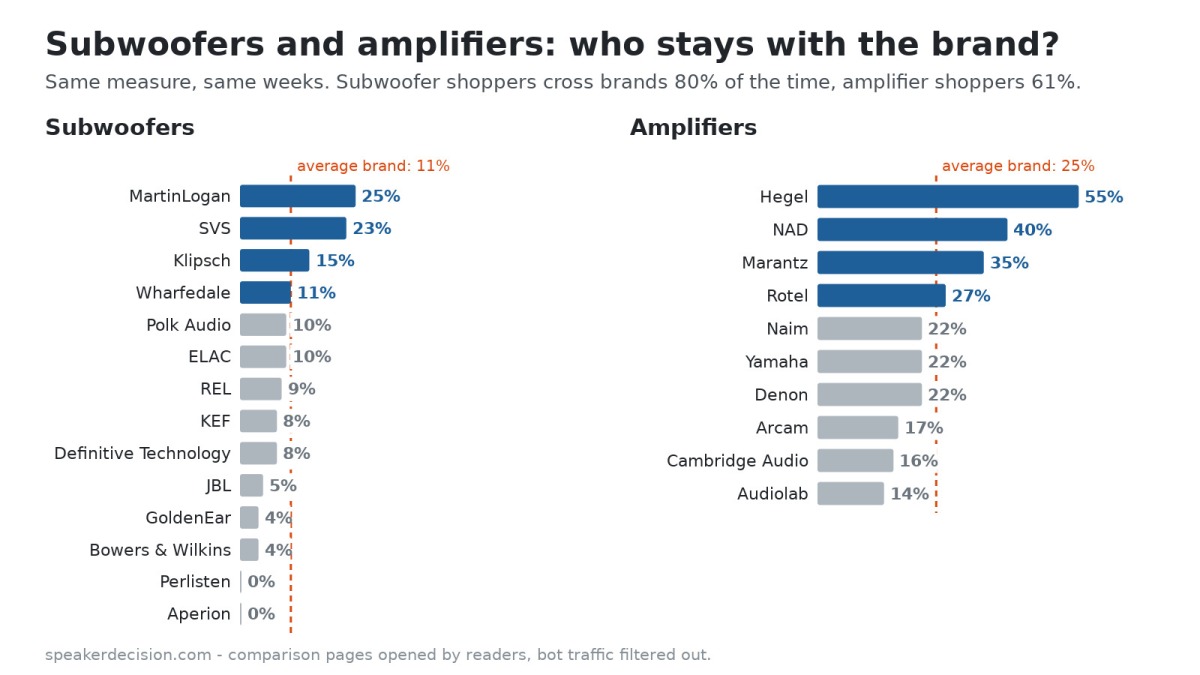 Share of each subwoofer and amplifier brand's comparisons that stay inside the brand, September 2026
Subwoofer shoppers cross brands 80% of the time, more than for speakers or amps. That makes sense. A subwoofer does not have to match the look or the sound signature of the rest of the range, so people shop on size, output and price.
Even so, SVS is the brand everyone checks against. It is the top rival for Klipsch, KEF and REL subwoofer shoppers. The most opened cross-brand sub pair was two very small subs:
| FEATURE and SPECS COMPARISON | |  |  |
| Model | SVS 3000 Micro | KEF KC62 |
| Driver | 2 x 8" Aluminum | 2 x 6.5" |
| Enclosure | Sealed | Sealed |
| Firing Direction | Side | Side |
| Amplifier Power (RMS) | 800 watts | 1000 watts |
| Amplifier Power (Peak) | 2500 watts | - |
| Amplifier Class | Class D Sledge STA-800DM | Class D |
| Frequency Response | 23-240 Hz | 11-200 Hz |
| Low Pass Crossover | 30-200 Hz | 40-140 Hz |
| High Pass Crossover | - | 40-120 Hz |
| Phase | Yes | Yes |
| Room Correction | Yes | Yes |
| Line Level Inputs | Stereo RCA/LFE | Stereo RCA/LFE |
| Speaker Level Inputs | No | Yes |
| Speaker Level Outputs | No | Yes |
| Wireless | Optional | Optional |
| App Control | iOS,Android | - |
| Height | 277.0mm | 245.0mm |
| Width | 297.0mm | 258.0mm |
| Depth | 310.0mm | 281.0mm |
| Weight | 10.23kg | 14.05kg |
| MSRP | 900 USD | 1500 USD |
| Check Current Price | Amazon | Amazon |
SVS itself is one of the most loyal sub brands, at 23%. MartinLogan is the only one above it.
Amplifiers: Hegel and NAD keep their shoppers
For stereo amplifiers, 61% of comparisons cross brands. Hegel is the most loyal at 55%, but it has the fewest comparisons of the ten brands I could rank, so read that loosely. NAD (40%) and Marantz (35%) are a more solid result.
At the other end are Audiolab (14%), Cambridge Audio (16%) and Arcam (17%). Audiolab and Arcam are each other’s top rival, at two price levels: the Audiolab 6000A vs Arcam A5 and the 7000A vs A15.
The most opened cross-brand amp pair is Marantz against Denon, which are sister brands under the same owner:
| FEATURE and SPECS COMPARISON | |  |  |
| Model | Marantz PM6007 | Denon PMA-600NE |
| Type | Integrated Amplifier | Integrated Amplifier |
| Amplifier Class | Class A/B | Class A/B |
| Power into 8 ohms | 45 watts | 45 watts |
| Power into 4 ohms | 60 watts | - |
| Minimum Impedance | 4 ohms | 4 ohms |
| THD | 0.08% | 0.07% |
| Signal to Noise Ratio | 102 | 105 |
| Frequency Bandwidth | 20 Hz-20 kHz | 20 Hz-20 kHz |
| Damping Factor | 100 | - |
| Built-in DAC | | |
| DAC | AK4490 24-bit/192kHz | 24-bit/192kHz |
| Max Bit Depth | - | 24 |
| Max Sample Rate | - | 192 |
| Analog Inputs | 4 | 4 |
| Phono Input | | |
| Phono Type | MM | MM |
| Optical Digital Inputs | 2 | 2 |
| Coaxial Digital Inputs | 1 | 1 |
| USB Input | No | No |
| Preamp Outputs | Sub | Sub |
| Headphone Output | 1/4 | 1/4 |
| Bluetooth | No | Yes |
| AirPlay 2 | | |
| Chromecast built-in | | |
| Roon | No | No |
| BluOS | | |
| HEOS | | |
| Tone Controls | | |
| Handheld Remote | | |
| Height | 105.0mm | 121.0mm |
| Width | 442.0mm | 435.0mm |
| Depth | 399.0mm | 323.0mm |
| Weight | 7.59kg | 6.82kg |
| MSRP | 899 USD | 499 USD |
| Check Current Price | Amazon, B&H Photo | Amazon, B&H Photo |
Yamaha and NAD shoppers also look at Marantz first. Rotel shoppers look at NAD.
What this does not tell
- A comparison is not a purchase. It tells you what people were weighing up, not what they bought.
- I cannot see how you arrived. Many readers land on a comparison page from a search. That still reflects a real question someone asked, but it is not the same as browsing a brand.
- It is less than a month. Our clean counting started in late August, and the first few days looked odd, so I left them out. I will check whether this holds in October.
- Small brands move easily. A few dozen comparisons can shift a smaller brand by several points. The big brands are the solid part of the ranking.
What to do with it if you are shopping
If the brand you are looking at scores low here, most people who looked at it also looked at a rival. It is worth opening that comparison yourself before you decide. The comparison box on our home page takes any two speakers we hold. And if the rival needs a different amount of power, the amp and speaker matcher will tell you whether your amplifier can drive it.
So which kind of shopper are you: did you pick the brand first, or did you pick the speaker and only then look at who made it?
FIND THIS INTERESTING? SHARE IT WITH YOUR FRIENDS!