The A2+ is one of the longest-running small speakers you can buy. It started as the A2 in 2007, and the A2+ Wireless added Bluetooth in 2019. Now there is the Audioengine A2+ Gen 3, at 299 dollars a pair.
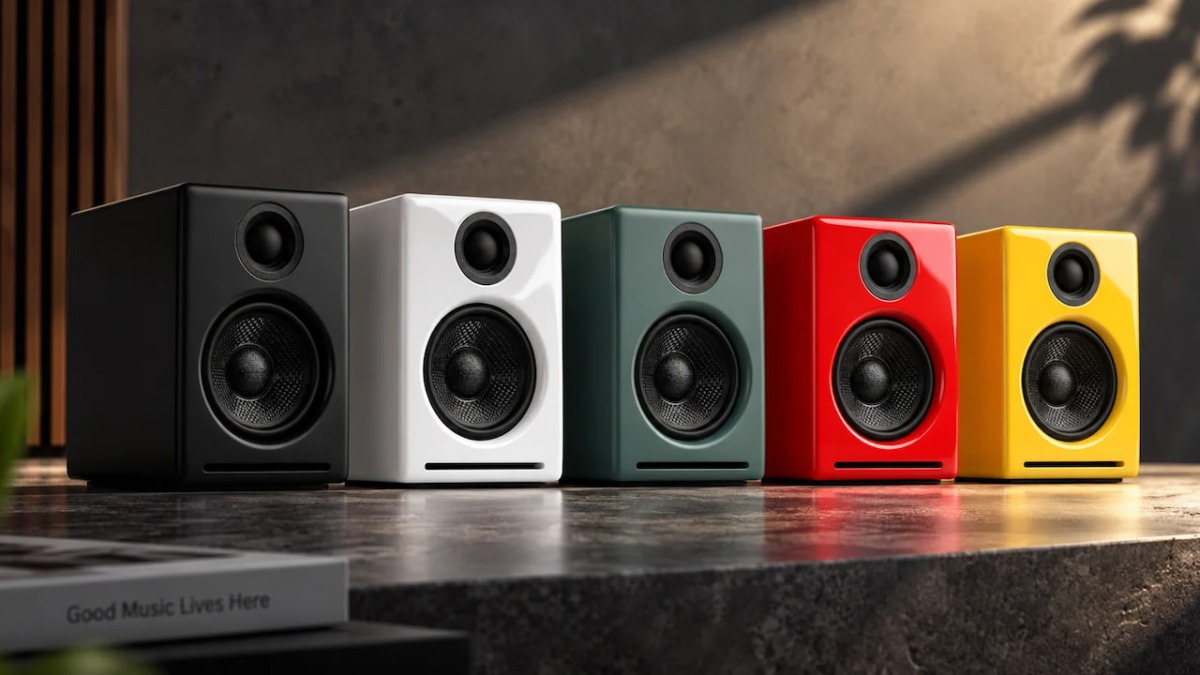 The Audioengine A2+ Gen 3 in its five finishes
I added it to our database today, next to the A2+ Wireless it replaces. I took the specs from Audioengine's own product page, not from the news stories. That turned out to matter.
Quick facts
- 299 dollars a pair, in matte black, matte green, gloss white, gloss red and a limited gloss yellow.
- Class D amplifier, rated by Audioengine at 15 watts RMS per channel into 4 ohms, 30 watts peak.
- Bluetooth 5.3 with aptX Adaptive, aptX HD, aptX, AAC and SBC.
- Inputs: USB-C, RCA and a 3.5 mm jack, all on the left speaker. The right one is passive and connects with the speaker wire in the box. There is an RCA output for a subwoofer.
- Same drivers as before: a 2.75 inch aramid woofer and a 0.75 inch silk dome tweeter in each speaker. Same 6 x 4 x 5.25 inch cabinet.
What changed, and what did not
Three things are new. The Bluetooth now does aptX Adaptive, which adjusts itself when the signal gets weak. The USB input is now USB-C, where the A2+ Wireless had micro USB. And the amplifier is now Class D instead of Class AB.
Everything you can hear directly stays the same. The woofer and tweeter sizes, the front port and the 65 Hz to 22 kHz response are unchanged. So if you already own an A2+ Wireless and it works, there is no sound upgrade waiting here.
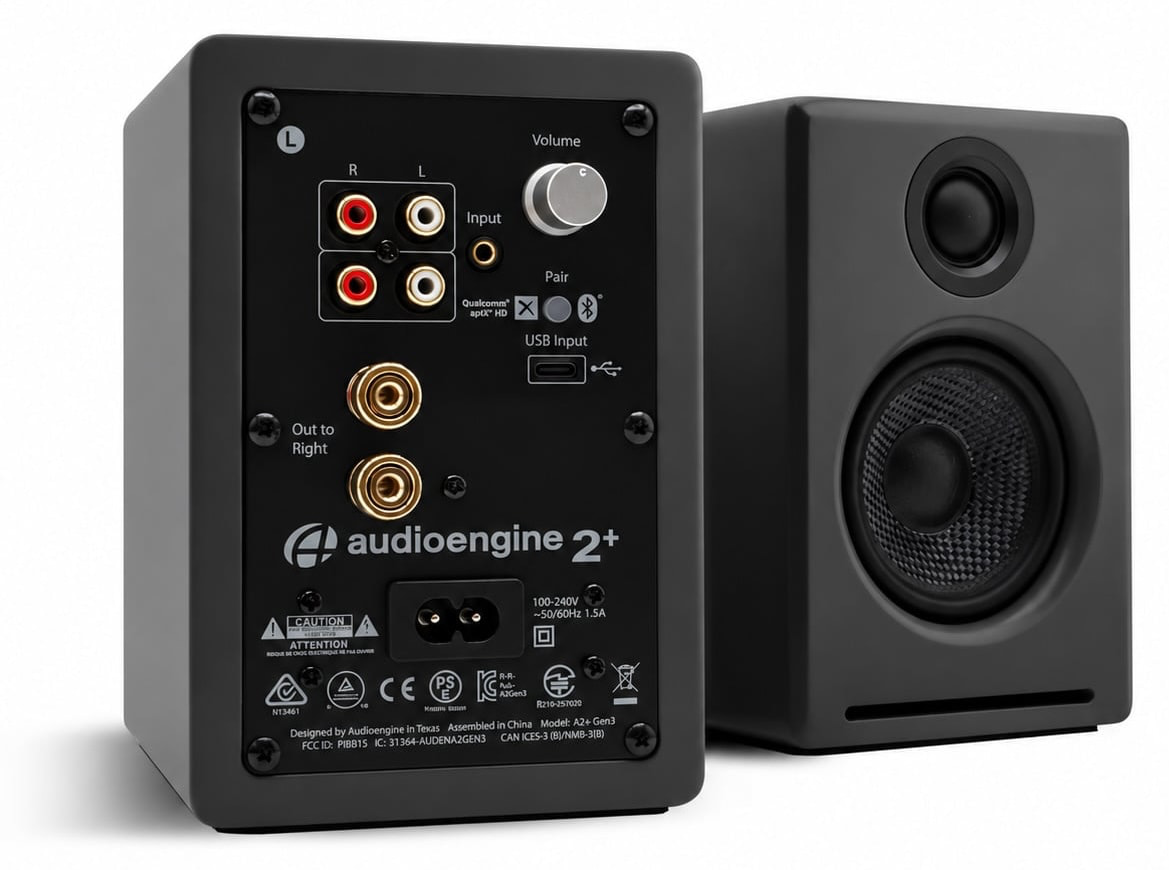 The A2+ Gen 3 rear panel, with USB-C, RCA in and out, a 3.5 mm input and the speaker terminals for the passive right speaker
Here is the A2+ Wireless vs A2+ Gen 3 comparison, side by side.
| FEATURE and SPECS COMPARISON | |  |  |
| Model | Audioengine A2+ Wireless | Audioengine A2+ Gen 3 |
| Speaker Type | Powered Bookshelf | Powered Bookshelf |
| Enclosure Type | Ported | Ported |
| Driver Setup | 2-way | 2-way |
| Max Power (RMS) | 30 watts | 30 watts |
| Tweeter | 0.75" Soft-Dome Tweeter | 0.75" Soft-Dome Tweeter |
| Woofer | 1 x 2.75" Kevlar Woofer | 1 x 2.75" Aramid fiber Woofer |
| Frequency Range / Low | 65Hz | 65Hz |
| Frequency Range / High | 22kHz | 22kHz |
| Port Position | front | front |
| Video Shield | Yes | Yes |
| Height | 158.8mm | 158.8mm |
| Width | 106.4mm | 106.4mm |
| Depth | 168.3mm | 168.3mm |
| Weight | 1.40kg | 1.51kg |
| USB Port | microUSB | USB-C |
| Aux Input | 3.5mm, RCA | 3.5mm, RCA |
| MSRP(pair) | 269USD | 299USD |
| Check Current Price | Amazon | Amazon |
The power number does not agree
The launch coverage says the Gen 3 goes from 15 to 20 watts per channel. I could not find that anywhere on Audioengine's site. Its spec block says 15 watts RMS per channel into 4 ohms, the same as before, with 30 watts peak.
The maker's page has a few loose ends, too. Its comparison table names an older Bluetooth chip. Its FAQ still calls the built-in converter 16-bit, while the same page says 24-bit. And in Audioengine's own photo, the badge on the rear panel still says aptX HD, not aptX Adaptive. Those look like leftovers from the older models. But until Audioengine clears it up, I have stored 15 watts, because that is the figure the maker puts its name to.
Honestly, for a 2.75 inch woofer on a desk, 15 or 20 watts makes little difference. But do not buy it for more power.
Where it sits in our database
We hold 103 pairs of powered stereo speakers. 31 of them list an aptX codec, and the A2+ Gen 3 is the only one with aptX Adaptive. At 300 dollars or less, 19 pairs, just four have any aptX at all, and all four are Audioengine.
On our site, readers compare the A2+ with the Kanto YU2 more than with anything else. It comes up about twice as often as the next one, the KEF LSX II. The YU2 is 240 dollars and about the same size, but it has no Bluetooth. The KEF is a different kind of speaker, with Wi-Fi streaming, for 1,299 dollars. The cheapest rival people check is the Mackie CR3-XBT, at 120 dollars, with basic Bluetooth.
| FEATURE and SPECS COMPARISON | | |  |  |
| Model | Audioengine A2+ Gen 3 | Kanto YU2 | Mackie CR3-XBT |
| Speaker Type | Powered Bookshelf | Powered Bookshelf | Powered Bookshelf |
| Enclosure Type | Ported | Ported | Ported |
| Driver Setup | 2-way | 2-way | 2-way |
| Max Power (RMS) | 30 watts | 50 watts | 25 watts |
| Max Power (Peak) | 60 watts | 100 watts | 50 watts |
| Tweeter | 0.75" Soft-Dome Tweeter | 0.75" Soft-Dome Tweeter | 0.75" Dome Tweeter |
| Woofer | 1 x 2.75" Aramid fiber Woofer | 1 x 3" Kevlar Woofer | 1 x 3" Polypropylene Woofer |
| Frequency Range / Low | 65Hz | 80Hz | 80Hz |
| Frequency Range / High | 22kHz | 20kHz | 20kHz |
| Port Position | front | rear | rear |
| Height | 158.8mm | 150.0mm | 206.4mm |
| Width | 106.4mm | 100.0mm | 139.7mm |
| Depth | 168.3mm | 135.0mm | 190.5mm |
| Weight | 1.51kg | 1.30kg | 3.54kg |
| USB Port | USB-C | No | No |
| Aux Input | 3.5mm, RCA | RCA | RCA |
| MSRP(pair) | 299USD | 240USD | 120USD |
| Check Current Price | Amazon | Amazon | Amazon |
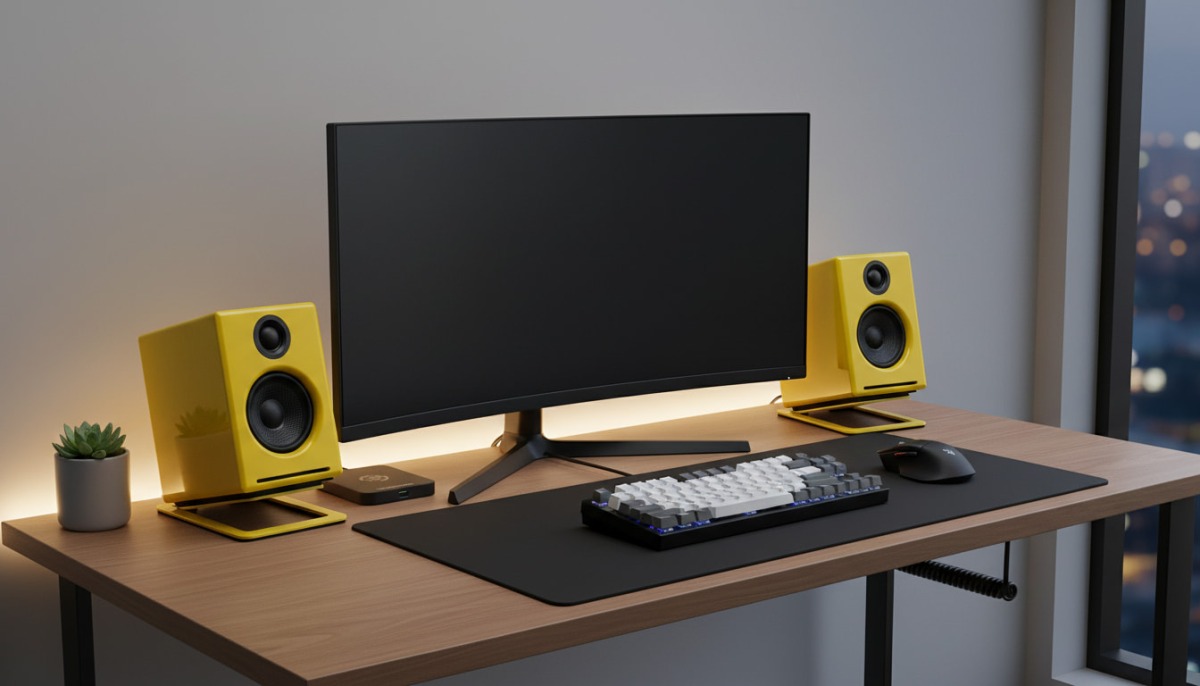 The A2+ Gen 3 in the limited Limoncello Yellow finish on a desk
What it still cannot do
- Real bass. The response stops at 65 Hz. For more, you need a subwoofer, like Audioengine's S6, which is another 299 dollars.
- Streaming. There is no Wi-Fi, so no AirPlay, Spotify Connect or multiroom. If you want those, look at the KEF.
- A remote. The volume knob is on the back of the left speaker.
- Optical input. There is none, so it will not connect directly to a TV's optical out.
- Being cheaper. Our A2+ Wireless row is 269 dollars. The Gen 3 is 30 dollars more for new Bluetooth and a new port.
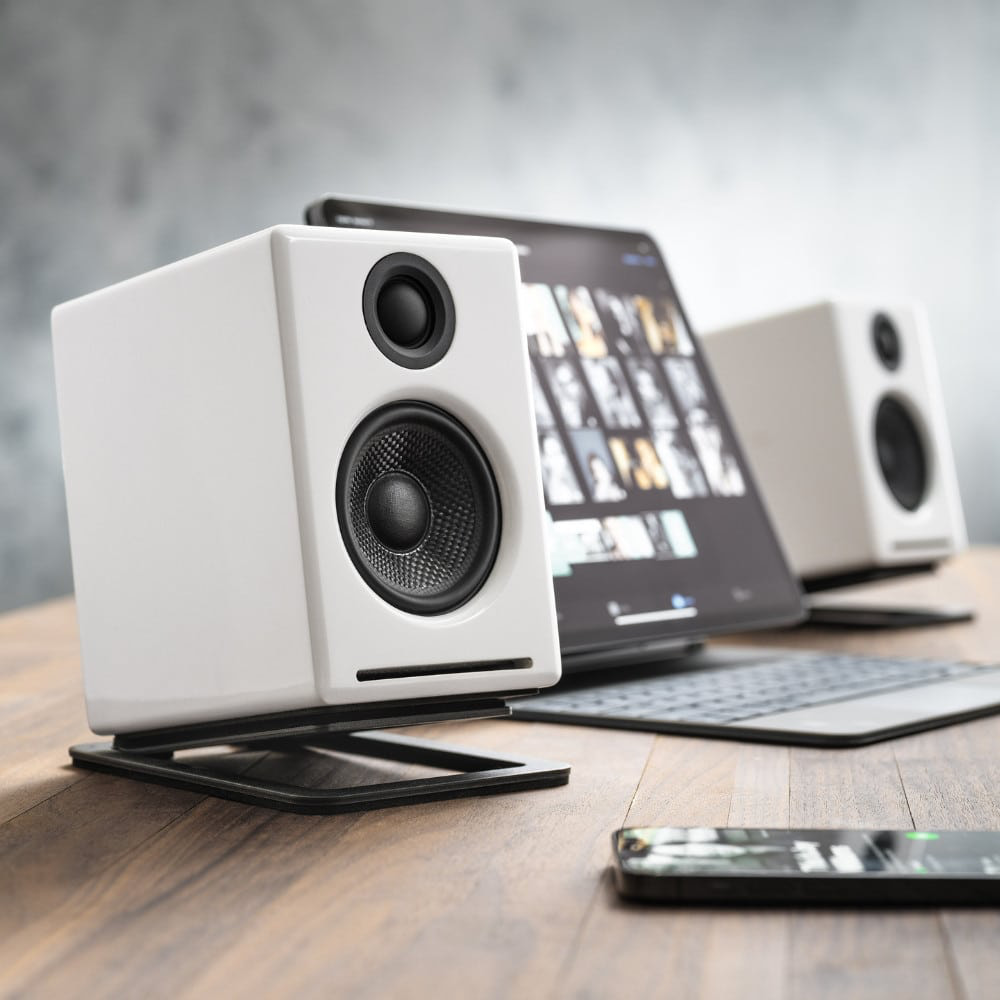 The A2+ Gen 3 in Hi-Gloss Piano White on Audioengine's DS1M desktop stands
Who it is for
Someone with a desk, a laptop and a phone, who wants a small pair of speakers without an app or an account. If your phone supports aptX Adaptive, the Gen 3 is the better buy than hunting for an old A2+ Wireless. If it does not, the difference is small, and the YU2 is worth a look if you only play from the computer.
Audioengine A2+ Gen 3 Powered Bookshelf Speaker Key Specs
- 2-way Bass Reflex Design
- 0.75" Soft-Dome Tweeter
- 1 x 2.75" Aramid fiber Woofer
- 65-22k Hz Frequency Response
- 30-watt RMS ( 60-watt Peak) Class D Type Integrated Amplifier
- 24-bit Max Depth / 48 kHz Max Sample Rate
- Built-in 5.3 Bluetooth
- Wired Subwoofer Output
- Weight:3.33 lbs / 1.51 kg
- Dimensions (H x W x D): 6.25" x 4.1875" x 6.625" / 158.8 x 106.4 x 168.3mm
- Read the Review
Tell me in the comments: what do your desk speakers connect to most, the computer or your phone?
FIND THIS INTERESTING? SHARE IT WITH YOUR FRIENDS!
What Hi-Fi? Awards 2026: All 25 Speaker and Amplifier Winners, and the 13 You Can Compare Here DALI Sonik 5 5.1 at $4,800 vs the Oberon 5 5.1 It Replaces: Same Specs on Paper, 20 to 50 Percent More, Piece by Piece Open Baffle and Dipole: All 28 Panel Speakers We Hold, From a $1,295 Magnepan to a $120,000 MartinLogan Class A, A/B, D and G: What the 301 Stereo Amplifiers We Hold Actually Claim, and Why FiiO's New "Class A" Is Not One MartinLogan USR51 Is the Anthem MRX SLM With a New Badge: Same $1,300, Same 50 Watts, One HDMI Port Magico A3 2027 at $25,000: What Else That Buys in a Floor-Standing Speaker Wharfedale Diamond 12i vs Diamond 12: All Six Pairs, Same UK Price, More in the US Audioengine's HD4 Next Gen Is One of Only Two Powered Speakers We Hold With aptX Adaptive Edifier MR4.5 Added: What 250 Dollars Buys Against the 19 Powered Speakers We Held Under 300 Esoteric F-01 vs F-02: Same 21,000 Dollars, 30 Watts of Class A or 120 Watts Castle Tintagel and Walmer: Four New British Speakers, and the Amp Each One Needs Yamaha's R200A Replaces a Ten-Year-Old Receiver, and Keeps the Same 100 Watts Paradigm Premier v2 vs the Original Premier: All Six Models, What Changed Which Speaker Brands Keep Their Shoppers, and Which Get Shopped Against Harbeth XD2 Range: All Five Compared, Which Size and What Amp What You Compared Most in September: The Old Speaker or Its Replacement 30 Tips to Better Sound Before You Buy New Speakers REL No.35 and No.36: 10,000 and 12,000 Dollar Subwoofers With the Same Watts as a 2,199 Dollar REL Audioengine A2+ Gen 3: What Changed Since the A2+ Wireless, and What It Still Cannot Do Sonos Beam Ultra: Real Atmos Height Drivers in a Soundbar Under 80 cm, for 699 Dollars