Until this week our database had every Audioengine, every Kanto and every Mackie desktop speaker, and not a single Edifier. That is a strange gap for a site about choosing speakers, because Edifier probably sells more powered bookshelf pairs than any of them. eCoustics reviewed the MR4.5 this week, so it is the first one in. The Edifier MR4.5 costs 250 dollars a pair, and I added the rest of the MR studio monitor series alongside it.
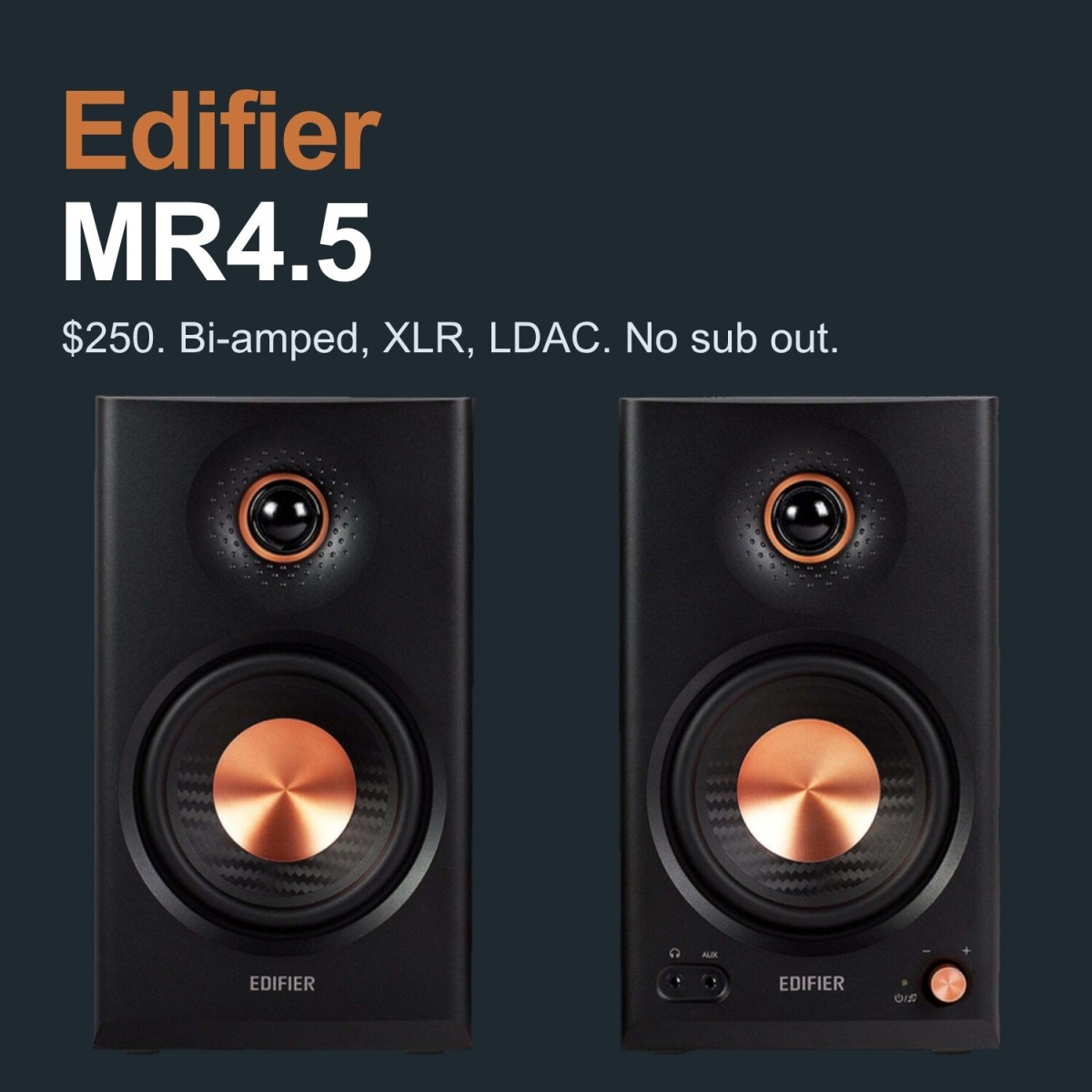 The Edifier MR4.5 studio monitors, 250 dollars a pair
Then I did what the database is for and lined it up against the 19 powered speakers we already held at 300 dollars or less. Three things on the MR4.5 appear on none of them, and one thing missing from it appears on most.
Quick facts
- 249.99 dollars a pair, black or white, on sale in the US since July 2026.
- Bi-amplified. 30 watts to each 4.5 inch mid-bass driver and 10 watts to each 1 inch silk tweeter, 80 watts in total, through an active crossover at 2.8 kHz.
- Balanced XLR and quarter-inch TRS inputs, plus RCA and a 3.5 mm jack. Bluetooth 6.0 with LDAC and SBC, two devices at once.
- 50 Hz to 40 kHz, 98 dB maximum, Hi-Res Audio and Hi-Res Audio Wireless certified at 24 bit and 96 kHz.
- No subwoofer output, no USB and no optical input. The only output is a headphone socket on the front.
Three things none of the other 19 had
Two amplifiers per speaker. Every one of the 19 cheaper or equal pairs we held sends one amplifier channel through a passive crossover to both drivers, as far as their makers publish. The MR4.5 gives the tweeter and the mid-bass driver an amplifier each and splits the signal before it. The cheapest bi-amplified pair we had before this was the Kanto ORA at 349 dollars.
XLR. None of the 19 has a balanced XLR input. Four of the Mackies take a balanced quarter-inch TRS plug, which does the same job with a different socket. Of the powered speakers whose inputs we record, the cheapest with an XLR socket before this week was the JBL 4305P, at 2,200 dollars. If your source is an audio interface, that matters. If it is a laptop, it does not.
LDAC. The MR4.5 and its bigger brother the MR5 are the first two speakers in our database to list the LDAC Bluetooth codec, which carries up to 990 kbps and 24 bit audio. Of the other 105 powered systems we hold, 36 publish a codec list and none of them includes it.
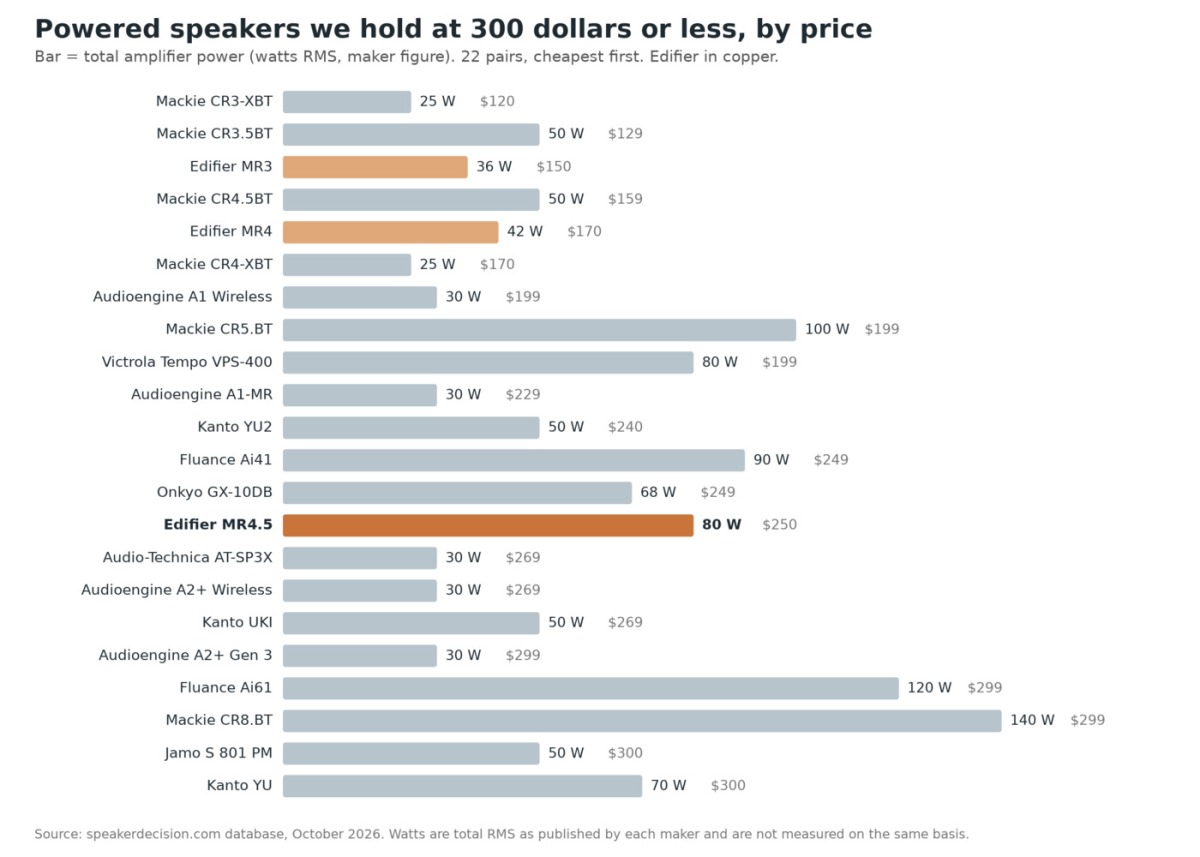 Total amplifier power of the 22 powered speakers we hold at 300 dollars or less
On power it sits high but not at the top. Fourteen of the 19 publish less than the MR4.5’s 80 watts and one publishes the same. Four publish more: the Mackie CR5.BT claims 100 watts for 199 dollars, the Fluance Ai41 90 watts for 249, and the Fluance Ai61 and Mackie CR8.BT claim 120 and 140 watts at 299. Treat all of these as the makers’ own figures. They are not measured on the same basis, and a bi-amplified 80 watts split four ways is not the same thing as 80 watts from one stereo chip.
What it does not have, and who that rules it out for
No subwoofer output. This is the one that will decide it for a lot of people. Eleven of the 19 cheaper or equal pairs we held have a line-level output for a subwoofer, including the 249 dollar Fluance Ai41 and the 299 dollar Audioengine A2+ Gen 3. The MR4.5 has none, and a 4.5 inch driver in a 24 cm cabinet is not going to give you the bottom octave on its own. eCoustics measured the roll-off starting around 45 Hz on a desk. If you want to add a sub later, this is the wrong speaker, full stop.
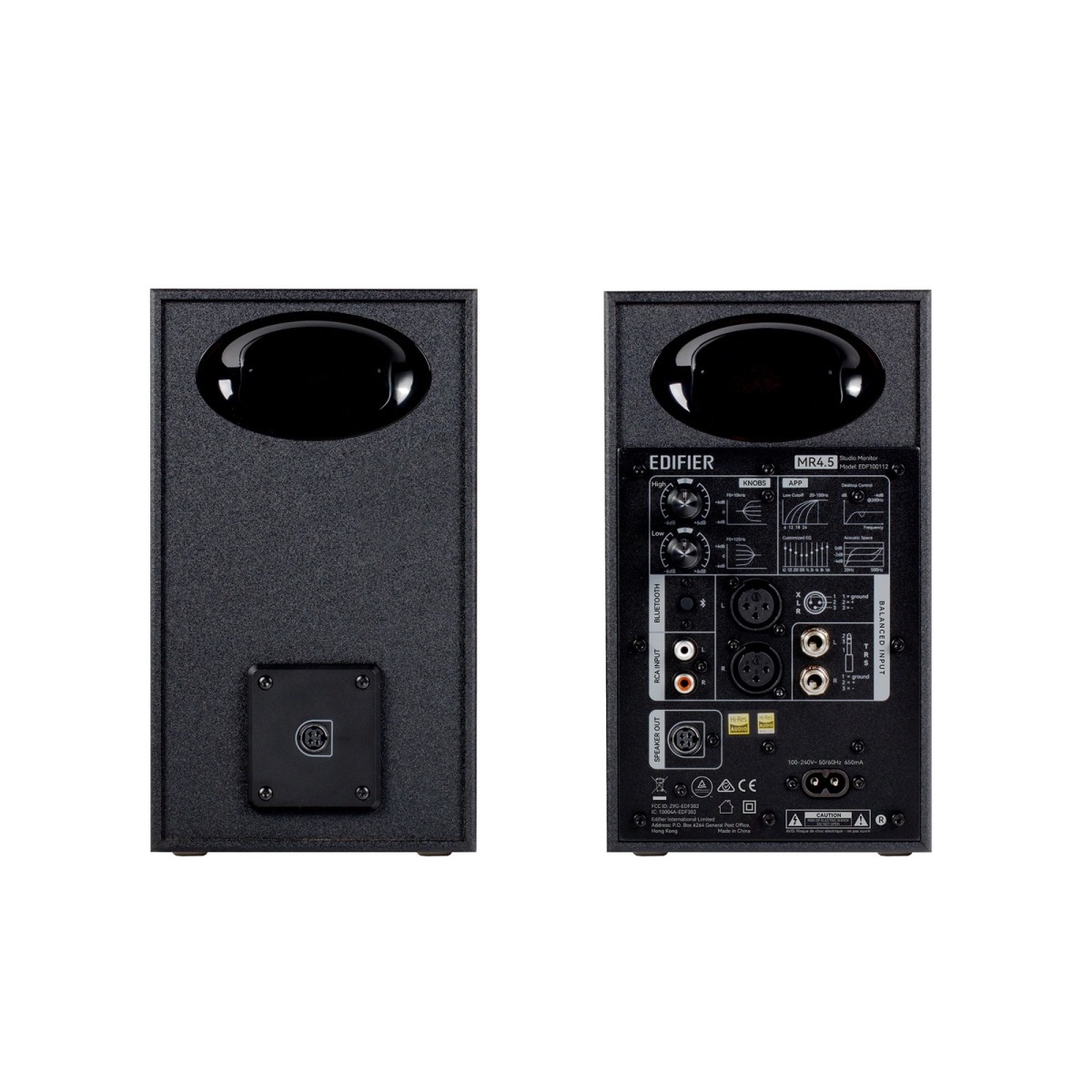 The rear of the MR4.5 with XLR and TRS balanced inputs, RCA, the Bluetooth button and the two tone knobs
No USB and no digital inputs. There is no USB socket at all, no optical and no HDMI. From a computer you connect by Bluetooth or by a 3.5 mm or RCA cable through the computer’s own converter. For a desktop speaker in 2026 at this price, the missing USB-C is the oddest decision on the back panel.
LDAC only helps Android owners. iPhones do not send LDAC and never have. On an iPhone the MR4.5 falls back to SBC, because there is no AAC either, and that is a step below what a 199 dollar Audioengine does over AAC. Android users get the full 990 kbps.
It is a near-field speaker. eCoustics found a narrow sweet spot that needed angled stands at three feet, and audible compression above 90 dB. Edifier itself calls it a near-field and mid-field monitor. It is for a desk, not a living room.
The MR series, all four of them
Edifier says the MR4.5 fills the gap between the MR4 and the MR5 rather than replacing anything, and the prices agree. We now hold all four, and the ladder is simple.
| MR3 | MR4 | MR4.5 | MR5 |
|---|
| Price a pair | 150 dollars | 170 dollars | 250 dollars | 350 dollars |
| Released | October 2024 | August 2021 | July 2026 | June 2025 |
| Drivers | 3.5 inch + 1 inch | 4 inch + 1 inch | 4.5 inch + 1 inch | 5 inch + 3.75 inch + 1 inch |
| Amplification | 2 x 18 W, one amp | 2 x 21 W, one amp | 2 x 30 + 2 x 10 W, bi-amped | 2 x 30 + 2 x 15 + 2 x 10 W, tri-amped |
| Response | 52 Hz to 40 kHz | 60 Hz to 20 kHz | 50 Hz to 40 kHz | 46 Hz to 40 kHz |
| Bluetooth | 5.4, SBC | None | 6.0, LDAC | 6.0, LDAC |
| Balanced inputs | TRS | TRS | XLR and TRS | XLR and TRS |
| App and room settings | Yes | No | Yes | Yes |
| Subwoofer output | No | No | No | No |
The MR4 is the odd one out. It is the only one with no Bluetooth, no app and no Hi-Res certification, and the only one where a single amplifier feeds a passive crossover. It is also five years old and still 170 dollars. The MR3 is newer, smaller and 20 dollars cheaper, and in most ways the better entry point.
The MR5 is the one to stretch to if you have the 100 dollars and the desk space. It adds a 3.75 inch midrange driver and a third amplifier per side, goes 4 Hz deeper and 3 dB louder, and is a noticeably bigger box, 264 mm tall and 280 mm deep against the MR4.5’s 244 by 229. None of the four has a subwoofer output.
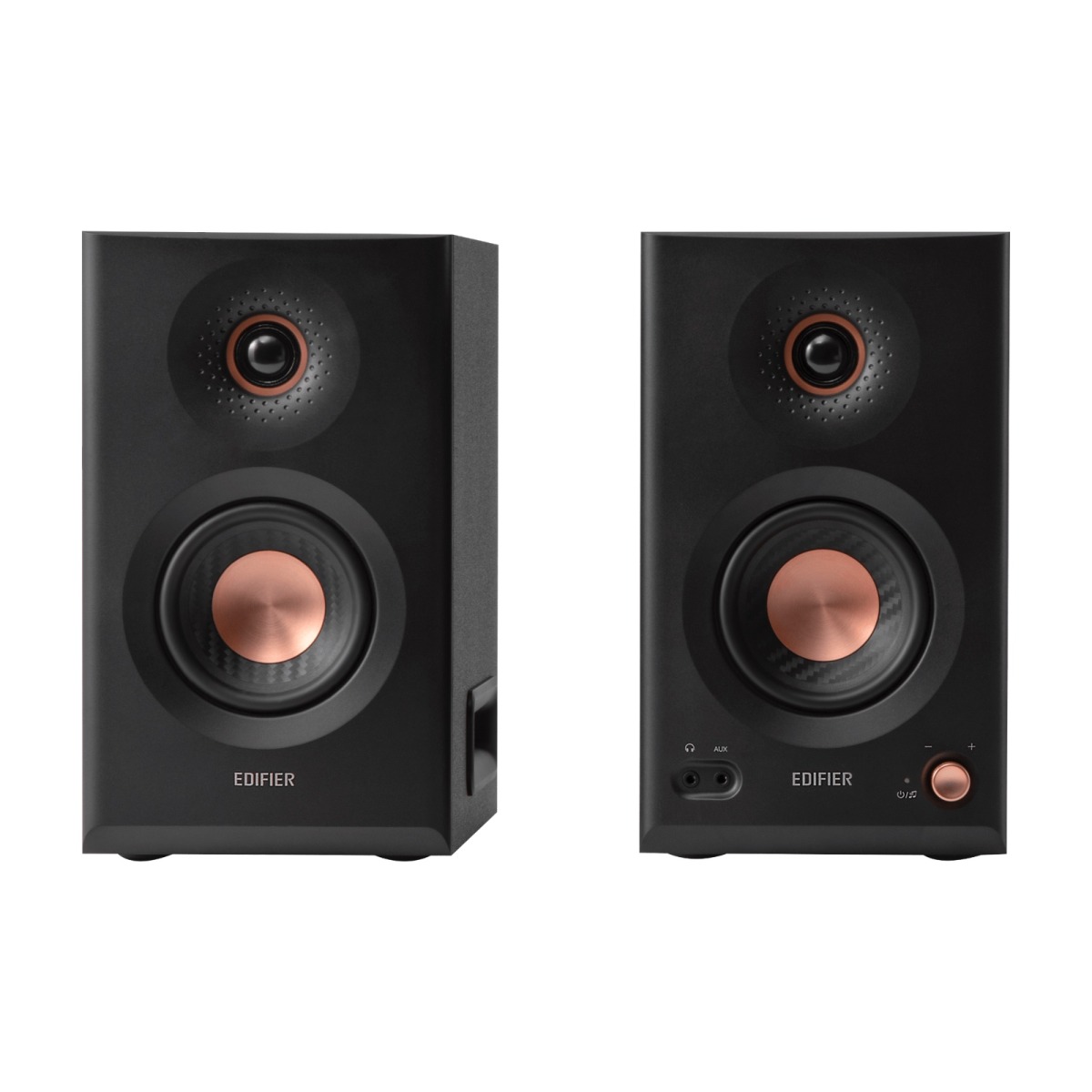 The three-way Edifier MR5, the 350 dollar flagship of the MR series
| FEATURE and SPECS COMPARISON | |  |  |  |
| Model | Edifier MR4 | Edifier MR4.5 | Edifier MR5 |
| Speaker Type | Powered Bookshelf | Powered Bookshelf | Powered Bookshelf |
| Enclosure Type | Ported | Ported | Ported |
| Driver Setup | 2-way | 2-way | 3-way |
| Max Power (RMS) | 42 watts | 80 watts | 110 watts |
| Tweeter | 1" Soft-Dome Tweeter | 1" Soft-Dome Tweeter | 1" Soft-Dome Tweeter |
| Mid-Range | - | - | 3.75" Midrange |
| Woofer | 1 x 4" Polypropylene with mica Woofer | 1 x 4.5" Woofer | 1 x 5" Woofer |
| Frequency Range / Low | 60Hz | 50Hz | 46Hz |
| Frequency Range / High | 20kHz | 40kHz | 40kHz |
| Available Colors | Black, White | Black, White | Black, White |
| Grille | No | No | No |
| Height | 228.0mm | 244.0mm | 264.0mm |
| Width | 140.0mm | 140.0mm | 159.0mm |
| Depth | 197.5mm | 229.0mm | 280.0mm |
| USB Port | No | No | No |
| Aux Input | 3.5mm, RCA | 3.5mm, RCA | 3.5mm, RCA |
| MSRP(pair) | 170USD | 250USD | 350USD |
| Check Current Price | Amazon | Amazon | Amazon |
Against the Audioengine A2+ Gen 3
The pair most people will cross-shop is the Audioengine A2+ Gen 3, which we wrote about in September. It is 49 dollars more and a very different proposition: 30 watts against 80, a 2.75 inch driver against 4.5, rated to 65 Hz against 50, and a cabinet about two thirds the height. It wins on the connections the MR4.5 lacks. It has a USB-C input, a subwoofer output and aptX Adaptive, which iPhones also cannot use but most recent Android phones can. The Edifier wins on power, bass extension, balanced inputs and the room settings. If the speaker is going to live on a desk with a laptop and nothing else, the Audioengine’s USB-C is worth a lot. If it is going to be fed by an interface or a phone, the Edifier does more for less.
| FEATURE and SPECS COMPARISON | | |  |  |
| Model | Edifier MR4.5 | Audioengine A2+ Gen 3 | Fluance Ai41 |
| Speaker Type | Powered Bookshelf | Powered Bookshelf | Powered Bookshelf |
| Enclosure Type | Ported | Ported | Ported |
| Driver Setup | 2-way | 2-way | 2-way |
| Max Power (RMS) | 80 watts | 30 watts | 90 watts |
| Tweeter | 1" Soft-Dome Tweeter | 0.75" Soft-Dome Tweeter | 1" Soft Dome Tweeter |
| Woofer | 1 x 4.5" Woofer | 1 x 2.75" Aramid fiber Woofer | 1 x 5" Woven, Glass Fiber Composite Woofer |
| Frequency Range / Low | 50Hz | 65Hz | 35Hz |
| Frequency Range / High | 40kHz | 22kHz | 20kHz |
| Port Position | rear | front | rear |
| Height | 244.0mm | 158.8mm | 277.0mm |
| Width | 140.0mm | 106.4mm | 165.0mm |
| Depth | 229.0mm | 168.3mm | 193.0mm |
| USB Port | No | USB-C | No |
| Aux Input | 3.5mm, RCA | 3.5mm, RCA | RCA |
| MSRP(pair) | 250USD | 299USD | 249USD |
| Check Current Price | Amazon | Amazon | Amazon |
Two notes on the data
Edifier publishes one net weight per model, and it is for the pair: 6.63 kg for the MR4.5. Our weight columns are per speaker, so rather than invent a split I have left them empty and put the pair figure in the notes on each page. The active speaker is also 21 mm deeper than the passive one, because of the amplifier and the sockets. The size figures on our pages are the active speaker’s.
And this is the start of Edifier on the site, not the end. Their US store lists about 60 speakers. The MR series is four of them. The R1280T, which is probably the best-selling powered bookshelf speaker in the world, is not on our pages yet. It will be.
Edifier MR4.5 Powered Bookshelf Speaker Key Specs
- 2-way Bass Reflex Design
- 1" Soft-Dome Tweeter
- 1 x 4.5" Woofer
- 50-40k Hz Frequency Response
- Crossover Frequency at 2800Hz
- 80-watt RMS Class D Type Integrated Amplifier
- Built-in Room Correction
- 24-bit Max Depth / 96 kHz Max Sample Rate
- Built-in 6.0 Bluetooth
- App Control Feature
- Dimensions (H x W x D): 9.6" x 5.5" x 9" / 244.0 x 140.0 x 229.0mm
- Read the Review
Questions answered
How much is the Edifier MR4.5?
249.99 dollars a pair in the United States, in black or white, from Edifier’s own store and Amazon. It went on sale in July 2026.
Does the Edifier MR4.5 have a subwoofer output?
No. There is no line-level output of any kind except the 3.5 mm headphone socket on the front. If you plan to add a subwoofer, 11 of the 19 powered speakers we hold under 300 dollars have an output for one, and the MR4.5 is not among them.
What is the difference between the MR4 and the MR4.5?
The MR4.5 has a 4.5 inch driver instead of 4 inch, two amplifiers per speaker instead of one, 80 watts in total instead of 42, Bluetooth 6.0 with LDAC where the MR4 has no Bluetooth at all, XLR inputs in addition to TRS, a wider 50 Hz to 40 kHz response, and app control with room settings. The MR4 stays on sale at 170 dollars; the MR4.5 is 80 dollars more.
Can I connect a computer to the MR4.5 by USB?
No. There is no USB input. You connect a computer by Bluetooth, by a 3.5 mm cable from the headphone output, or by RCA or balanced TRS from an audio interface.
Does LDAC work with an iPhone?
No. Apple phones do not support LDAC. On an iPhone the MR4.5 uses SBC, the basic codec. LDAC works with Android phones running Android 8 or later that include it, which is most recent ones.
How big is the Edifier MR4.5?
Each speaker is 244 mm tall and 140 mm wide. The active one is 229 mm deep and the passive one 208 mm. Edifier publishes 6.63 kg as the weight of the pair. The port is on the back, so leave it some space from the wall.
So, at 250 dollars, would you take the two amplifiers, the XLR sockets and LDAC, or does a desktop speaker without a USB input and a subwoofer output lose you before it starts?
FIND THIS INTERESTING? SHARE IT WITH YOUR FRIENDS!
Monitor Audio Silver 100 vs Gold 100 vs Platinum 100: What Each Step Up Buys Apple Music Comes to BluOS: The 18 Streaming Amplifiers We List, and Which One to Buy Triangle Borea BR05 at $999: An 8-Inch Standmount, and the BR04 It Sits Above Best Dolby Atmos Receivers 2026: 9 of the 12 Audioholics Picks, Compared Side by Side What Hi-Fi? Awards 2026, the Soundbars: All 7 Winners, and the 5 You Can Compare Here What Hi-Fi? Awards 2026: All 25 Speaker and Amplifier Winners, and the 13 You Can Compare Here DALI Sonik 5 5.1 at $4,800 vs the Oberon 5 5.1 It Replaces: Same Specs on Paper, 20 to 50 Percent More, Piece by Piece Open Baffle and Dipole: All 28 Panel Speakers We Hold, From a $1,295 Magnepan to a $120,000 MartinLogan Class A, A/B, D and G: What the 301 Stereo Amplifiers We Hold Actually Claim, and Why FiiO's New "Class A" Is Not One MartinLogan USR51 Is the Anthem MRX SLM With a New Badge: Same $1,300, Same 50 Watts, One HDMI Port Magico A3 2027 at $25,000: What Else That Buys in a Floor-Standing Speaker Wharfedale Diamond 12i vs Diamond 12: All Six Pairs, Same UK Price, More in the US Audioengine's HD4 Next Gen Is One of Only Two Powered Speakers We Hold With aptX Adaptive Edifier MR4.5 Added: What 250 Dollars Buys Against the 19 Powered Speakers We Held Under 300 Esoteric F-01 vs F-02: Same 21,000 Dollars, 30 Watts of Class A or 120 Watts Castle Tintagel and Walmer: Four New British Speakers, and the Amp Each One Needs Yamaha's R200A Replaces a Ten-Year-Old Receiver, and Keeps the Same 100 Watts Paradigm Premier v2 vs the Original Premier: All Six Models, What Changed Which Speaker Brands Keep Their Shoppers, and Which Get Shopped Against Harbeth XD2 Range: All Five Compared, Which Size and What Amp