KEF has announced its first proper outdoor range, and buried in it are four amplifiers called KASA. They are the interesting part, and not for the reason the model numbers suggest.
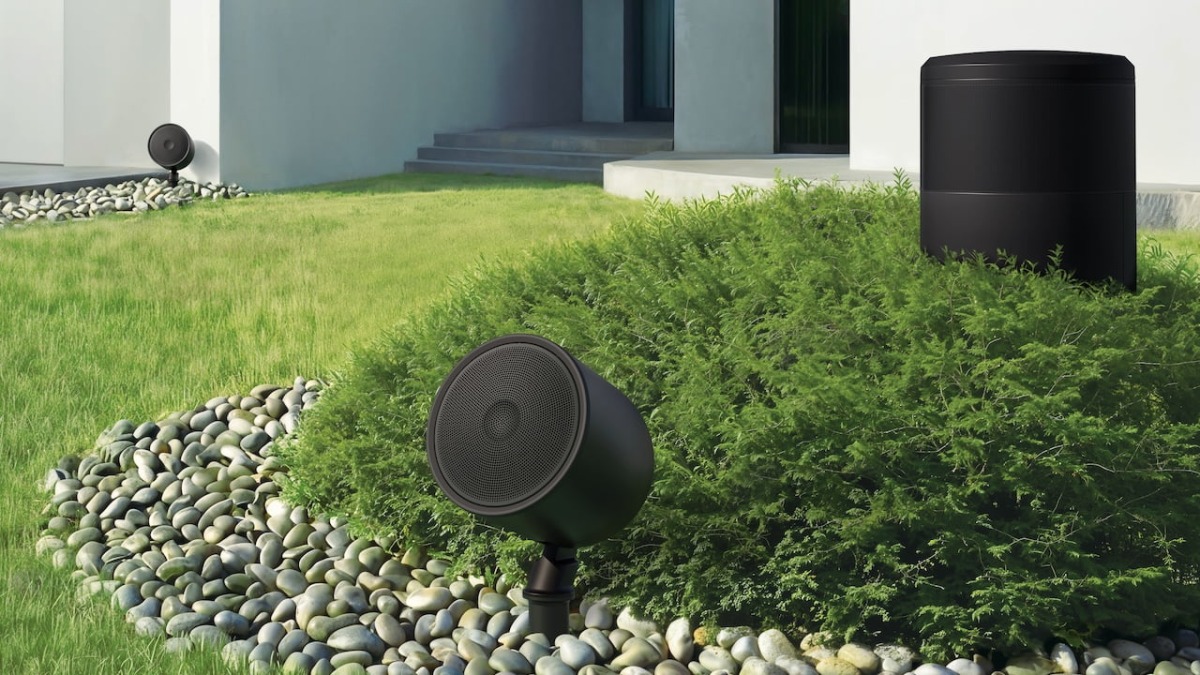 The KEF Landscape P6Q outdoor system, which ships with a KASA 4-250M amplifier
The range itself is large: landscape satellites, two sizes of bollard, three subwoofers, two three-way bollards with passive crossovers, and three packaged systems. It is also the first time KEF has built its Uni-Q driver specifically for outdoor use. But the line worth stopping on is in the amplifier specification table.
Quick facts
- Four KASA amplifiers, 1,600 to 4,000 dollars. In the UK, 1,250 to 3,150 pounds.
- The KASA 8-250M costs 4,000 dollars and is rated 250 watts into 4 ohms with one channel driven, 135 watts with all eight.
- The KASA 8-150M costs 3,300 dollars and is rated at the same 135 watts with all eight driven.
- Class D with GaN output devices, AKM converters, browser-based setup, Control4, Crestron and Savant control.
- Announced for 2027. The month depends on which outlet you read.
What the 250 in the name actually means
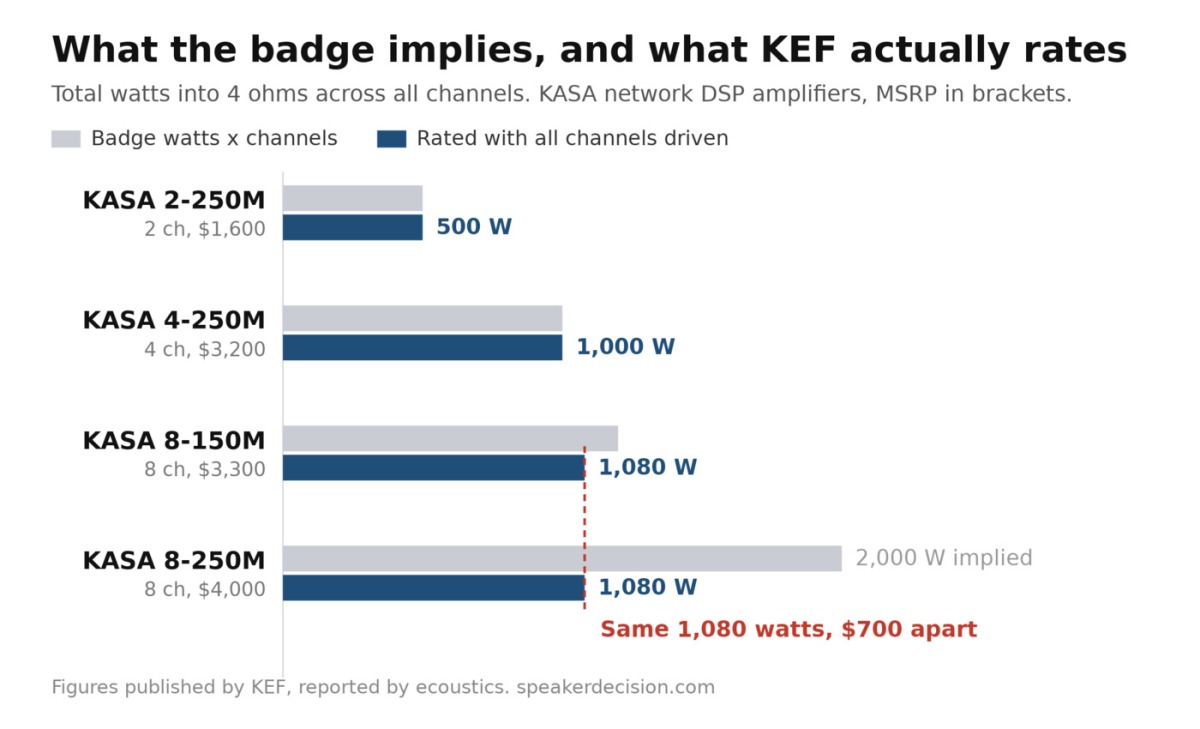 Badge watts against the all-channels-driven rating for the four KASA amplifiers
Here is the table KEF published, as reported by ecoustics. Every figure is into 4 ohms.
| Model | Channels | One channel driven | All channels driven | MSRP |
|---|
| KASA 2-250M | 2 | 250 W | 250 W | 1,600 dollars |
| KASA 4-250M | 4 | 250 W | 250 W | 3,200 dollars |
| KASA 8-150M | 8 | 150 W | 135 W | 3,300 dollars |
| KASA 8-250M | 8 | 250 W | 135 W | 4,000 dollars |
On the two-channel and four-channel models the badge is honest. Ask a 4-250M for 250 watts on all four channels at once and it gives you 250 watts on all four channels.
The 8-250M is different. Its name says 250. With all eight channels working it makes 135. That is 1,080 watts in total, not the 2,000 the model number implies.
And the 8-150M, which costs 700 dollars less, also makes 135 watts on all eight. The two amplifiers deliver the same total power in the only condition that matters when a whole system is playing. What the extra 700 dollars buys is headroom on a single channel, for the moments when one zone is loud and the other seven are quiet.
If every zone in the house is playing, the 3,300 dollar KASA and the 4,000 dollar KASA are the same amplifier. Buy the 8-250M for peaks in one room, not for a full house.
Work it out per watt and the family inverts. On total power with everything running, the 8-150M is the cheapest of the four at 3.06 dollars a watt. The 2-250M and 4-250M are both 3.20. The 8-250M, the most expensive amplifier in the range, is the worst value at 3.70.
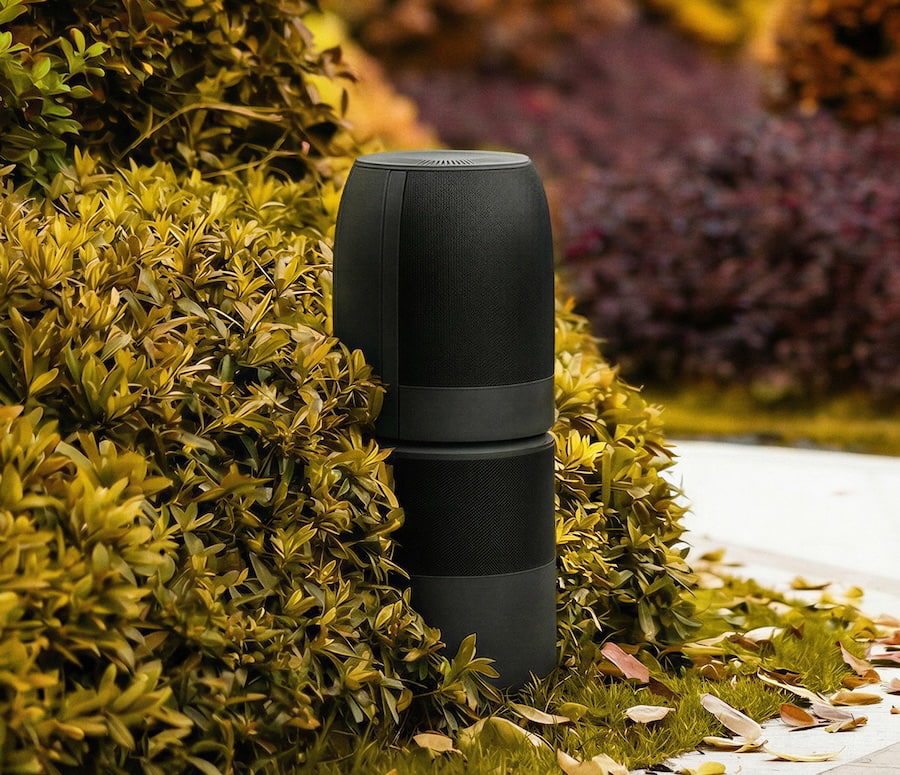 The BH6Q bollard, one of the speakers KEF says wants 240 watts, which is more than an eight-channel KASA gives with everything running
The part I could not verify
This needs saying plainly, because it is the weakest thing about this post.
The 135 watt figure comes from one outlet. KEF has published no product pages for any of this. Its US site today lists exactly one outdoor speaker, the Ventura 6 at 599.99 dollars, and nothing called a KASA 8-250M. I checked CE Pro, Essential Install and Gear Patrol. All three carry the models and the prices, which is good corroboration for those. None of them prints the all-channels number at all. Essential Install lists the 8-250M as simply "250W".
Four outlets got the same press material and three printed only the headline figure. That is not a criticism of them, it is what happens when the useful number sits in a column nobody reads. But it means this article rests on one source until KEF puts a spec sheet up.
The outlets also disagree on when you can buy it. ecoustics says January 2027. Gear Patrol says April 2027. CE Pro and Essential Install give no date. Take 2027 and leave it there.
One thing that does check out independently: this convention is KEF's house style, not a slip. KEF already sells a KASA500, a 1,499.99 dollar two-channel amplifier rated 250 watts a channel into 4 ohms, or 500 watts bridged into 8. The new 2-250M is that amplifier with network DSP added, 100 dollars more.
The speakers ask for more than the eight-channel amps give
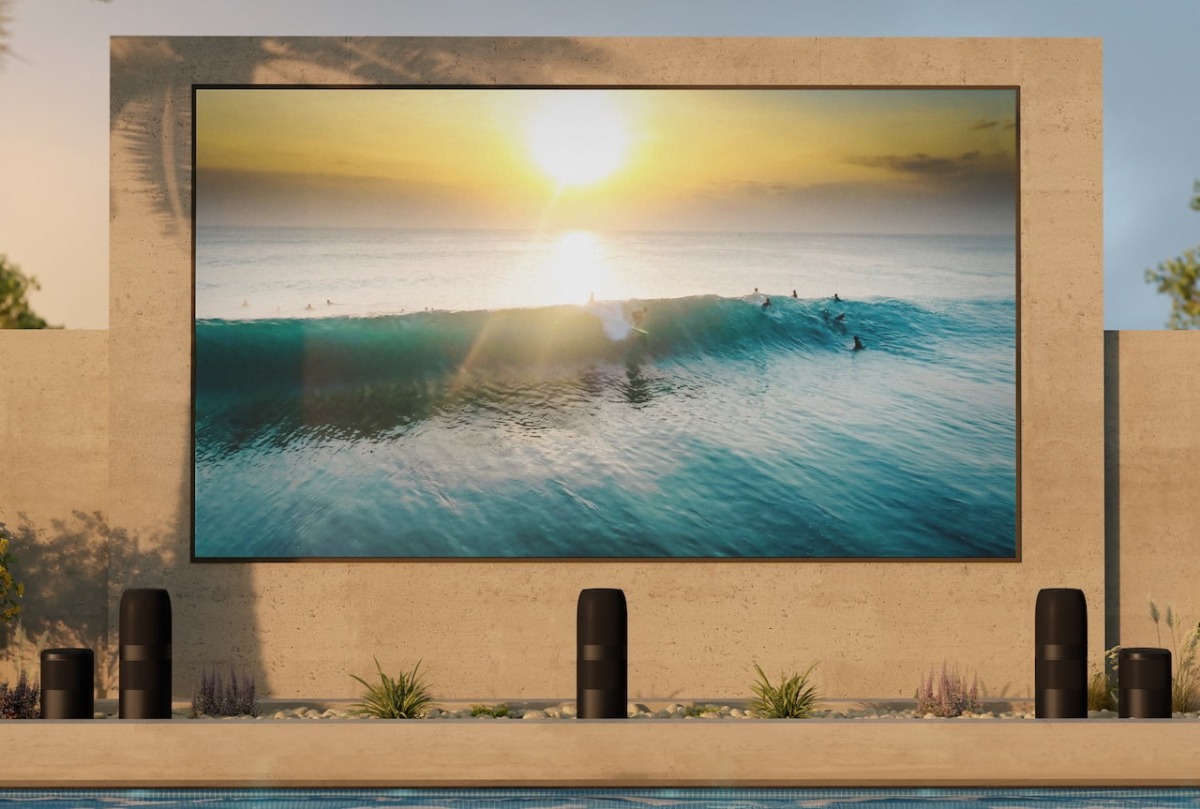 The BQ9 three-way bollards and BL8b subwoofer in an outdoor theatre layout
KEF publishes a recommended power figure for each new speaker, and this is where the 135 watts starts to matter.
- Four SR4Q satellites wired in parallel: 150 watts
- Four SR6Q satellites: 240 watts
- Either BH bollard, the BH6Q or BH8Q: 240 watts
- BQ9 three-way bollard: 240 watts. BQ11: 400 watts
- BL8b subwoofer: 150 watts. BL12b: 400 watts
Only one of those numbers is under 135. An eight-channel KASA running flat out does not reach KEF's own recommendation for most of KEF's own speakers.
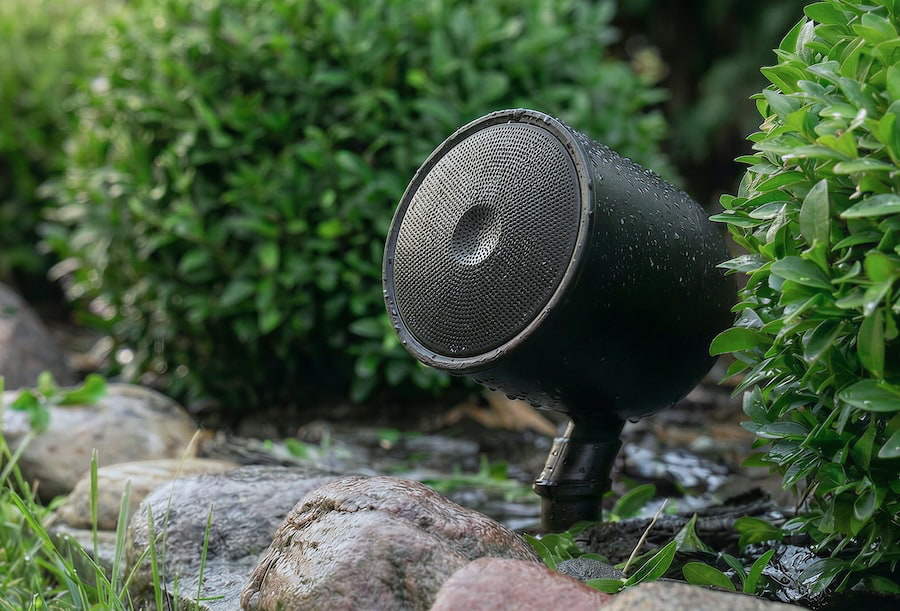 The SR6Q landscape satellite, rated IP66 and tested through 500 hours of salt spray
There is an answer, and KEF gives it: the KASA amplifiers bridge. Essential Install reports bridged operation for "significantly increased power delivery from a single channel", stable into 4 or 8 ohms. Bridge an 8-250M into four channels and the arithmetic works. That is almost certainly the intended use, and it makes the 8-250M look better than the raw table does, because bridging is exactly where single-channel headroom pays.
It also means the model name is doubly misleading. An 8-250M is not eight channels of 250 watts. It is either eight channels of 135, or four bridged channels of more.
The packaged systems raise the same question. The 8,000 dollar Landscape P6Q pairs four SR6Q satellites and a BL12b subwoofer with a KASA 4-250M. The satellites want 240 watts and the amplifier gives 250, which is fine. The BL12b wants 400. I would want KEF to say which channels are bridged in that package before I bought it.
Is this even a general-purpose amplifier?
Worth settling before comparing it to anything, because it is not obvious and the coverage does not agree.
KEF's own word for the KASA that already exists is system amplifier. The product page for the 1,499.99 dollar KASA500 calls it "a DSP controlled system amplifier", and its firmware carries named EQ profiles for named speakers: KEF lists settings for the Ci3160RLb-THX, Ci250RRb-THX, Ci200QSb-THX, Ci200TRb and Ci4100QLb. That is not an amplifier you buy and point at whatever you own. It is a component of a KEF system.
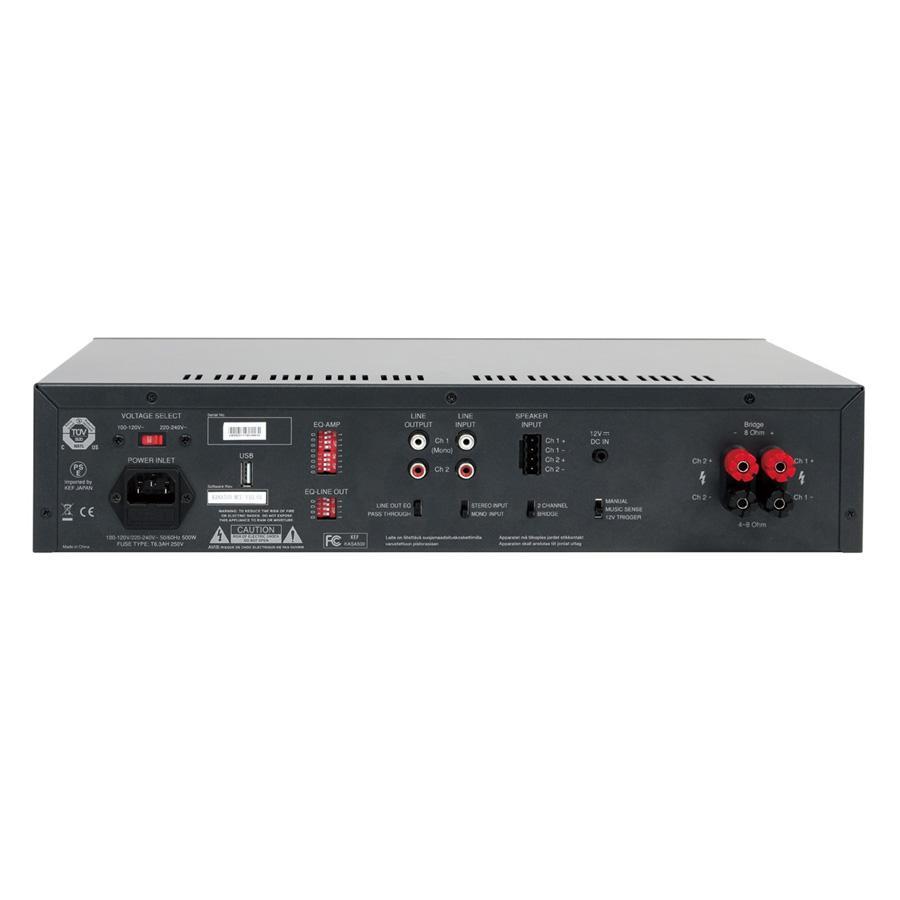 The KASA500, the KEF amplifier you can actually buy today. No photograph of the new models has been released
The new models carry that idea forward through the Music Integrity Engine, which holds model-specific processing so the installer picks the connected KEF speaker from a list rather than dialling in a configuration.
And they are not outdoor products, which is easy to miss given the company they launched in. Every weather rating here belongs to a speaker: IP66 for the satellites and BH bollards, IPX5 for the BL subwoofers and BQ models, tested from -13 to 158 degrees Fahrenheit through 500 hours of salt spray. No IP rating is published for any KASA. They are rack-mounted boxes, and the profiles inside them cover KEF architectural speakers generally, not only the ones for the garden. The amplifier sits in a cupboard indoors and sends power out to the lawn.
Which arguably makes the amplifiers the bigger story. An outdoor speaker range is an outdoor speaker range. Four new install amplifiers with a browser interface and three control-system integrations is KEF moving on the custom-install market, and they will drive indoor KEF just as happily.
Where the coverage splits is on whether that is compulsory. ecoustics says the SR4Q, SR6Q, BH6Q and BH8Q require KEF Network DSP amplification. Essential Install does not, and calls the amplifiers general-purpose units for a wide range of sources and systems. Both cannot be right, and it decides whether you are buying an amplifier or buying into a system.
One thing both agree on: the BQ9 and BQ11 three-way bollards have passive crossovers and do not need a KASA. KEF says they work with whatever amplification the owner prefers. If you want KEF's new outdoor sound without the lock-in, those are the two models to look at.
Against the multi-zone amplifiers we already hold
We list 375 amplifiers. Not one of them is a KEF, and none of the four KASA models is in the database yet, because there is no manufacturer spec sheet to build a row from. When KEF publishes one, they will go in.
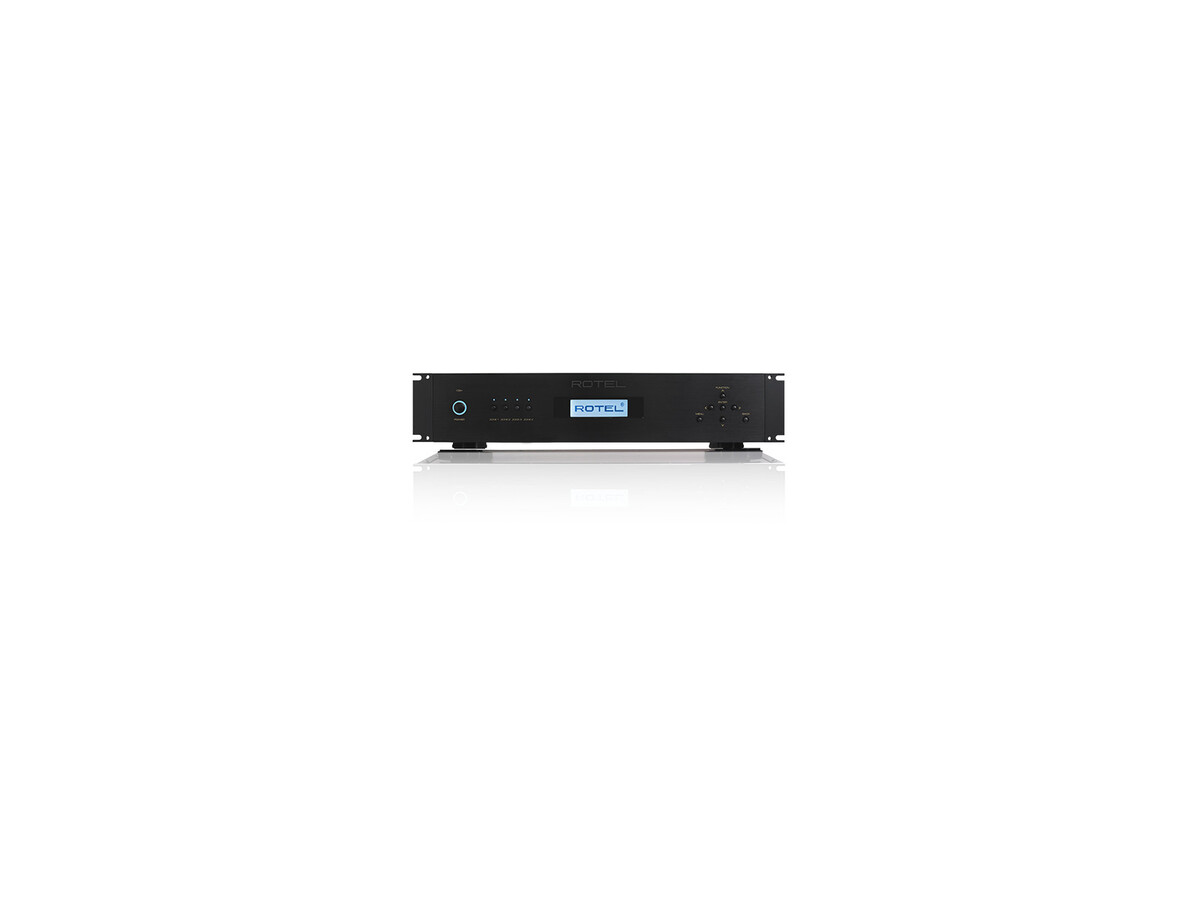 The Rotel C8+, eight channels rated with all eight driven, and the closest thing in our database to an 8-250M
Ten of those 375 are multi-zone amplifiers, the category we opened last week. Four of the ten publish a genuine all-channels-driven figure:
- OSD Nero HTX4150, 763 dollars, four channels at 75 watts, 300 watts total
- Rotel C8+, 3,499 dollars, eight channels at 100 watts, 800 watts total
- Sonos Amp Multi, 3,500 dollars, eight channels at 125 watts, 1,000 watts total
- McIntosh MI254, 6,000 dollars, four channels at 250 watts, 1,000 watts total
Do not put the KASA numbers straight into that list. Those four are rated into 8 ohms and every KEF figure here is into 4 ohms, which is an easier load and a bigger number. Comparing them directly would flatter the KEF by a margin nobody can calculate from published data.
What you can compare is the honesty, and there KEF comes out well. It publishes both figures side by side for every model. Most makers publish one and leave you to guess which test it came from. The problem is only that KEF also put the flattering half in the model name.
Who should skip it
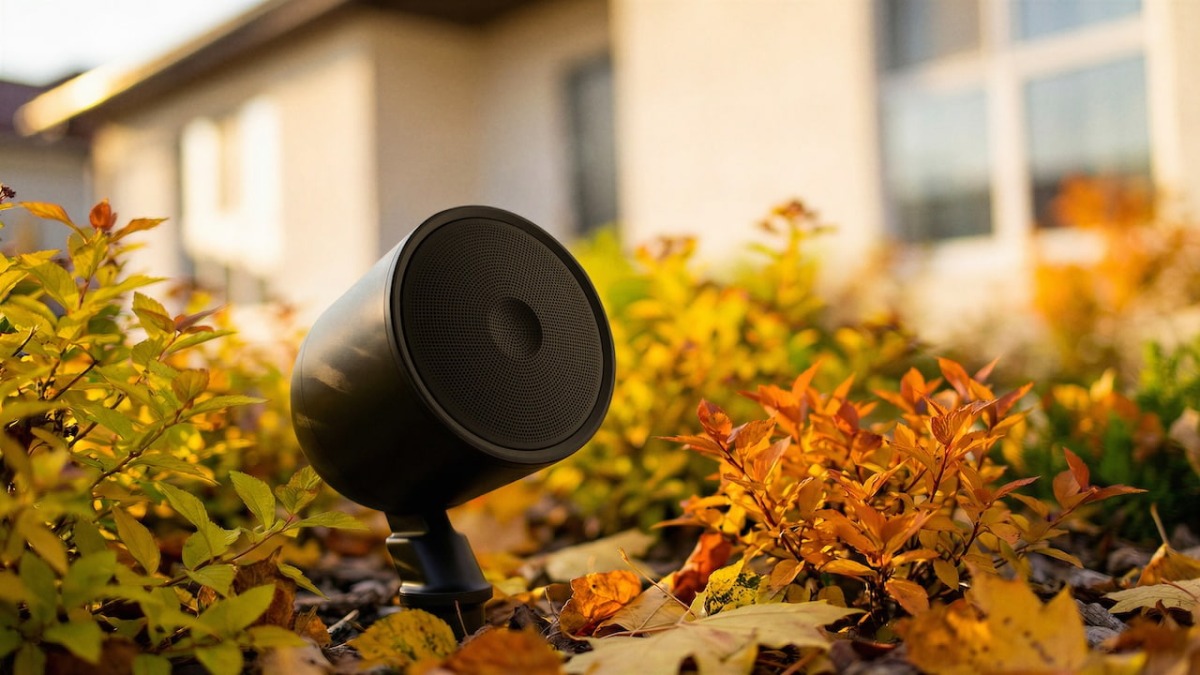 SR4Q landscape satellites on ground stakes, part of the new KEF Outdoor Collection
Three groups, and the first is the biggest.
Anyone who is not building a KEF system. This is a system amplifier, in KEF's own words for the existing KASA500, and the new ones are built around per-model DSP profiles. Feed one something that is not a KEF and you have paid for the half of the product you cannot use.
Anyone wanting a streamer. "Network DSP Amplifier" means networked control, not networked music. There is no sign of Spotify, Qobuz, AirPlay or Chromecast in the published specification. Inputs are analogue RCA, optical and coaxial.
Anyone buying the 8-250M to run eight zones loud. That is the whole argument above. For that job the 8-150M does the same work for 700 dollars less.
And a note on the range rather than the amplifiers. The 2,000 dollar Landscape P4F package uses the SR4F satellite, which is not a Uni-Q speaker. It is a conventional 4 inch full-range driver. The headline on this launch is Uni-Q going outdoors, and the cheapest way in does not include it.
Questions answered
Is the KASA 8-250M really a 135 watt amplifier?
With all eight channels driven into 4 ohms, yes, according to the specification KEF supplied to press. The 250 watt figure is real too, but it applies with one channel driven while the other seven sit idle. Both numbers describe the same box under different tests, and the model name uses the flattering one.
So should I buy the 8-150M instead?
If every zone will be playing at once, yes. Both make 135 watts a channel in that condition and the 8-150M costs 700 dollars less. The 8-250M is the better buy if you have one zone that needs to go loud while the rest are quiet, or if you plan to bridge channels.
What does bridging change?
Bridging combines two amplifier channels into one with substantially more power. It halves the channel count, so a bridged 8-250M becomes a four-channel amplifier. KEF supports it and says the amplifiers stay stable into 4 or 8 ohms bridged. This is likely how the bigger speakers, such as the 400 watt BL12b subwoofer, are meant to be driven.
Are the KASA amplifiers in your database?
Not yet. We hold 375 amplifiers and no KEF amplifier of any kind, and we will not add a row until KEF publishes a specification sheet. Everything here comes from press material, and a database row built on one outlet's reading of a press kit is a row that has to be corrected later. Where they go is an open question too. The multi-zone amplifier section is the obvious home, since these route sources to zones with independent volume. But if the DSP really is compulsory for the satellites and bollards, a KASA is closer to a system component than to an amplifier you can shop for, and listing it next to a Rotel or a Sonos would imply a choice that does not exist.
Do you list any outdoor speakers?
None. We hold 1,601 speakers and subwoofers, and not one is sold as an outdoor speaker, KEF's existing Ventura models included. It is a category we have never covered, which is part of why this launch caught our eye.
When you last looked at a multichannel amplifier, did you check what its power rating was measured with, or did the number in the model name do the work?