Arcam's new Radia AV receivers replace the HDA line one for one. The AVA15 replaces the AVR11, the AVA25 replaces the AVR21, and the AVA35 replaces the AVR31.
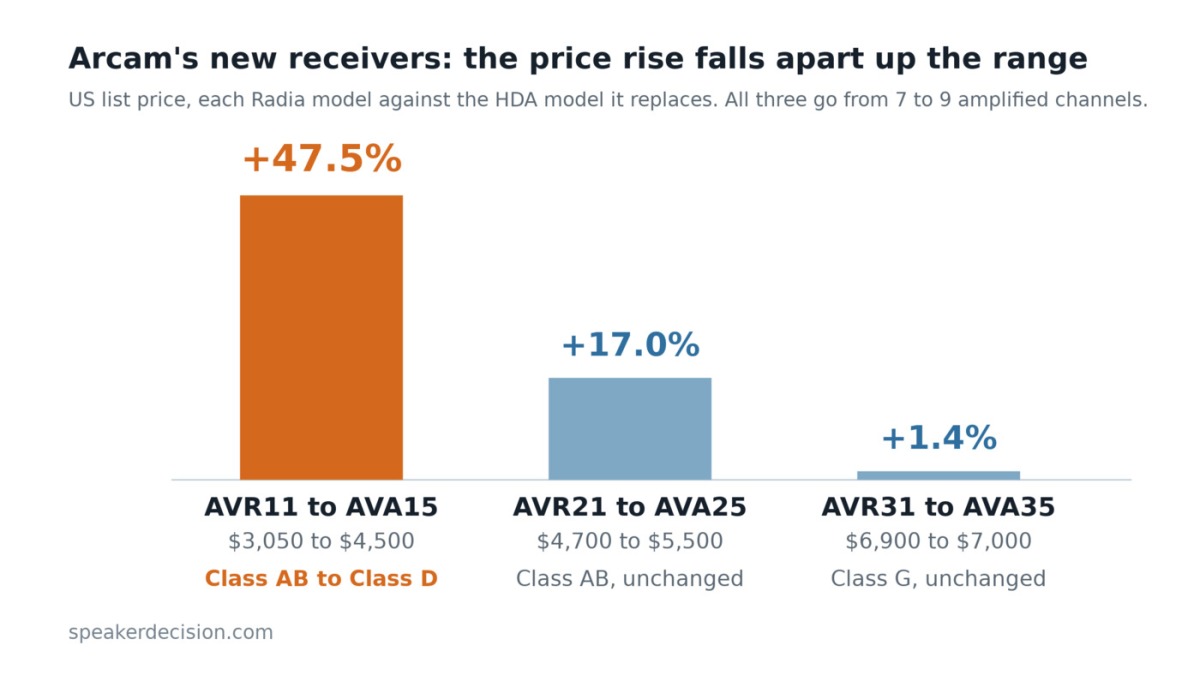 The price step from each Arcam HDA receiver to the Radia model that replaces it. The cheapest one absorbs almost all of the increase.
The prices did not move together. The AVA35 costs 100 dollars more than the AVR31, a rise of 1.4 percent. The AVA15 costs 1,450 dollars more than the AVR11, a rise of 47.5 percent. Same range, same generation, same day.
That gap is what prompted a thread on AV NIRVANA asking why the US prices make no sense. It is a fair question, so we went through Arcam's own specifications rather than the launch coverage. There is an answer, and it is not the one the price list suggests.
Quick facts
- All three go from 7 amplified channels to 9, and from HDMI 2.1 to 2.1a. Every one keeps Dirac Live and 7 HDMI inputs.
- The AVA15 is the only model that changed amplifier class, from Class AB to Class D. It also lost 6.5 kg.
- With seven channels driven it makes 85 watts against the AVR11's 60, a 42 percent gain. The other two gained 0 and 10 percent.
- We list 57 AV receivers. Only 9 cost more than the AVA15, and only 7 publish an all-channels-driven figure at all.
- Every number here comes from Arcam's own specifications, not from the launch coverage. Two of our own rows were wrong and have been corrected.
What you get in all three cases
The shared changes are easy to list. Seven amplified channels become nine, so a 7.1.2 or 5.1.4 layout no longer needs an outboard power amplifier. HDMI goes from 2.1 to 2.1a. Dirac Live stays on every model, as do seven HDMI inputs, Dolby Atmos and DTS:X.
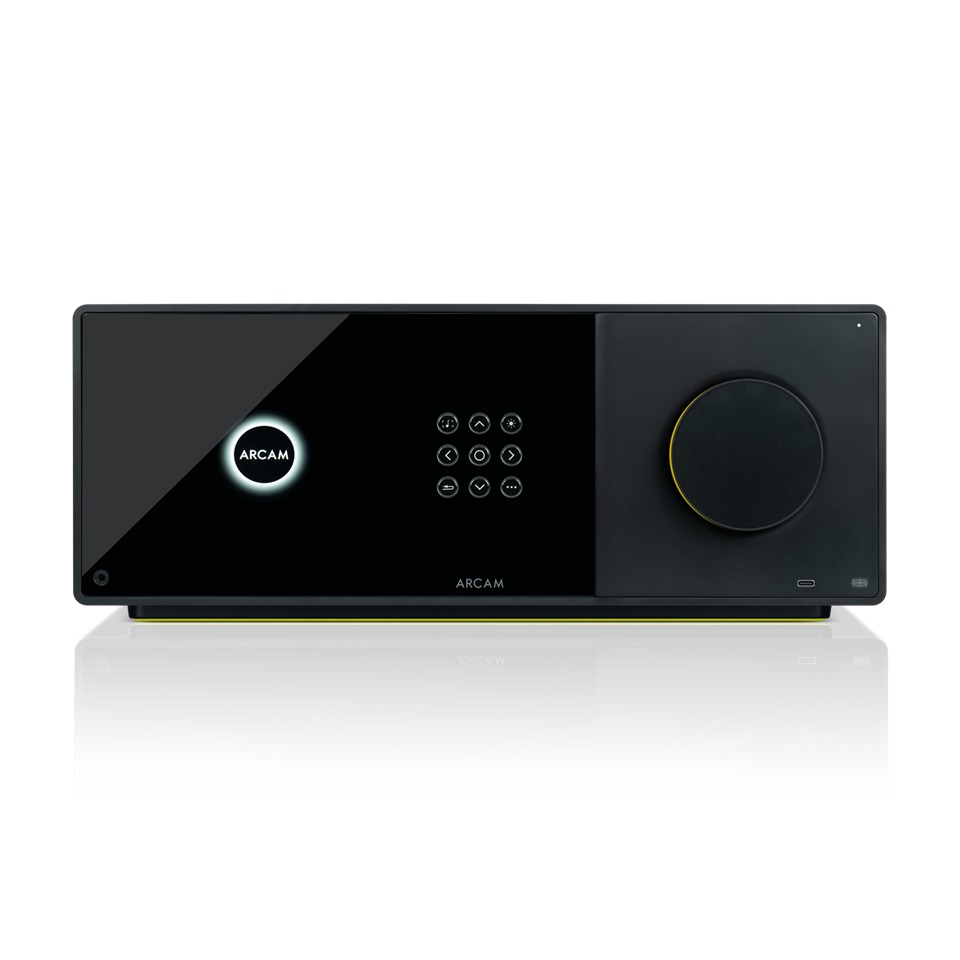 The Arcam AVA15. Nine amplified channels, Class D, 10 kg, and 4500 dollars.
If that were the whole story, the AVA15 buyer would be paying 1,450 dollars for two channels and a letter on a spec sheet. But the three receivers did not receive the same update at all.
The AVA25 and AVA35 kept the amplifier topology of the models they replace and got heavier, by 4.9 and 4.6 kg. The AVA15 went the other way. It swapped Class AB for Class D and came out 6.5 kg lighter than the AVR11, which is a 40 percent drop.
| FEATURE and SPECS COMPARISON | |  |  |  |  |
| Model | ARCAM AVA15 | ARCAM AVR11 | ARCAM AVA25 | ARCAM AVA35 |
| Type | Home Theater Receiver | Home Theater Receiver | Home Theater Receiver | Home Theater Receiver |
| Amplifier Class | D | AB | AB | G |
| Power into 8 ohms | 85 watts | 80 watts | 120 watts | 145 watts |
| Minimum Impedance | 8 ohms | 8 ohms | 4 ohms | 4 ohms |
| Analog Inputs | 3 | 6 | 3 | 3 |
| Phono Input | | | | |
| Optical Digital Inputs | 2 | 2 | 2 | 2 |
| Coaxial Digital Inputs | 2 | 4 | 2 | 2 |
| USB Input | Yes | No | Yes | Yes |
| HDMI Input | 7 | 7 | 7 | 7 |
| Preamp Outputs | No | 11.2-channel | No | No |
| Subwoofer Output | 1-5 (assignable) | Dual | 1-5 (assignable) | 1-5 (assignable) |
| Room Correction System | Dirac Live | Dirac Live | Dirac Live | Dirac Live |
| Height | 169.9mm | 169.9mm | 171.5mm | 171.5mm |
| Width | 433.3mm | 433.3mm | 433.3mm | 433.3mm |
| Depth | 427.0mm | 471.4mm | 477.8mm | 477.8mm |
| Weight | 10.00kg | 16.50kg | 21.50kg | 22.70kg |
| MSRP | 4500 USD | 3050 USD | 5500 USD | 7000 USD |
| Check Current Price | Amazon, B&H Photo | Amazon, B&H Photo | Amazon, B&H Photo | Amazon, B&H Photo |
The number that actually separates them
A receiver's headline power figure is measured with two channels working. Nobody watches a film that way. The figure that matters is what each channel makes when all of them are busy, and Arcam publishes it.
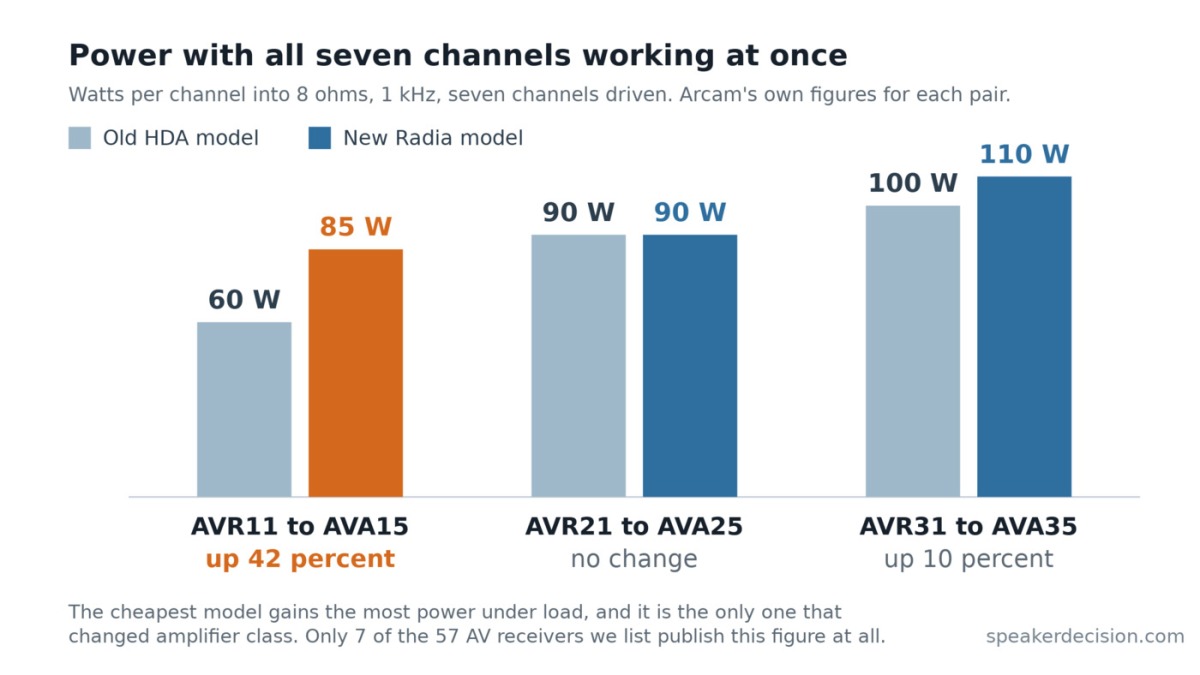 Watts per channel with seven channels driven, each new Arcam against the model it replaces
The AVR11 makes 80 watts with two channels driven and 60 watts with seven. That is a 25 percent drop, and it is normal for a Class AB receiver at this price. Its power supply cannot feed every channel at once.
The AVA15 makes 85 watts with two channels driven and 85 watts with seven. It does not drop at all.
So the all-channels figure goes up 42 percent, from 60 watts to 85, while the headline figure moves by 5 watts. Across the pairs, the cheapest model gained the most and the dearest gained the least. The AVA25 makes exactly the same 90 watts under load as the AVR21 did.
This is the honest reading of the price step. Arcam did not put up the price of the entry receiver by 47 percent for two extra channels. It put up the price because that model got a new amplifier, and the other two did not. Whether a Class D output stage is worth 1,450 dollars to you is a separate question, and a fair one to answer with no.
The part that should give you pause
Three things cut the other way, and the first is the simplest.
It is a lot of money. We list 57 AV receivers and the median price is 1,849 dollars. Only 9 of the 57 cost more than the AVA15. Paying 4,500 dollars for a receiver puts you in the top sixth of the market, and the AVR11 it replaces is still the better value on paper if you only ever drive five channels hard.
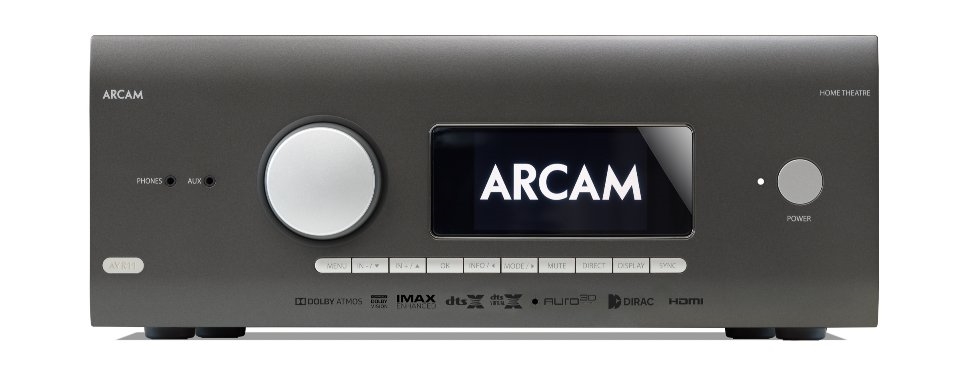 The Arcam AVR11 it replaces. Seven channels, Class AB, 16.5 kg, and 3050 dollars.
The two power figures are not measured the same way. Arcam rates two channels across the full 20 Hz to 20 kHz band at low distortion. It rates seven channels at 1 kHz only, at higher distortion. A single tone is the easier test. The 60 and the 85 are comparable with each other because both are measured the same way, but neither is comparable with the 80 and the 85 above them. We ran into the same problem with the TAD A1000D two days ago, and it is worth flagging every time.
Class D is not automatically an upgrade. It holds up under load because the output stage is efficient, not because it is better. Our look at Class D weight found that the expensive Class D amplifiers are the ones with big linear power supplies, and the AVA15 at 10 kg is not one of those. It is light because it does not need to be heavy, and that is a real engineering gain, but it is not the same thing as sounding better.
Where the AVA15 sits in our data
We hold 57 AV receivers. Nine of them use a Class D output stage, and the AVA15 lands near the top of that group by price.
The NAD T 778 is the awkward neighbour. It is 299 dollars dearer, also Class D, also nine channels, and publishes 140 watts into 8 ohms against the Arcam's 85. NAD does not publish an all-channels figure, so the comparison that would settle it does not exist.
What we fixed while checking this
Verifying this post against Arcam's own documents turned up three problems on our side, and they are all fixed now.
Our AVA35 row said Class AB. Arcam's specification says Class G. Our AVA35 weight said 21.5 kg, copied from the AVA25. Arcam says 22.7. Both are corrected.
None of the six rows carried an all-channels-driven figure, even though Arcam publishes one for every model. All six now do. That takes the site from 1 AV receiver publishing that number to 7, out of 57, which tells you how rarely anyone prints it.
And none of the six knew what replaced what, so no page linked a receiver to its predecessor. Filling that in exposed a real bug: the amplifier page looked the predecessor up in a stereo-only table, so for every AV receiver, headphone amplifier and multi-zone amplifier we list, 81 products in total, that link could never have worked. It works now.
ARCAM AVA15 Key Specs
- 85W into 8 ohms (D)
- Home Theater Receiver
- Minimum Impedance: 8 ohms
- 7 HDMI Input
- 1-5 (assignable) Subwoofer Output
- Weight: 10.00 kg
- Dimensions (H x W x D): 169.9 x 433.3 x 427.0 mm
- Replaces the ARCAM AVR11 compare them
- Read the Review
Questions answered
Why does the Arcam AVA15 cost 47 percent more than the AVR11?
Because it is the only model in the new range with a different amplifier. The AVA15 uses a Class D output stage where the AVR11 used Class AB, and it goes from seven amplified channels to nine. The AVA25 and AVA35 kept the topology of the models they replace, which is why their prices barely moved. Whether the change is worth 1,450 dollars is a judgement, not a specification.
Is the AVA15 more powerful than the AVR11?
With two channels driven, barely: 85 watts against 80 into 8 ohms. With seven channels driven, substantially: 85 watts against 60, a 42 percent gain. The second figure is the one that applies to a home cinema layout. Note that Arcam measures the two-channel figure across the full audio band and the seven-channel figure at 1 kHz only, so the two are not directly comparable with each other.
Is a lighter receiver a worse receiver?
Not in itself. The AVA15 is 6.5 kg lighter than the AVR11 because a Class D output stage wastes far less power as heat, so it needs less heatsink and less power supply. In our data, weight in an amplifier tracks price more closely than it tracks power. It tells you what a maker spent, not how the amplifier will sound.
Which new Arcam receiver is the best value?
On the numbers, the AVA35 at 7,000 dollars is the smallest price rise for the largest specification, though it is also the most expensive receiver in the range by some distance. The AVA25 is the hardest to argue for: it costs 800 dollars more than the AVR21, gained 4.9 kg, and makes exactly the same 90 watts with seven channels driven. Two extra channels and HDMI 2.1a are the whole upgrade there.
Are the old Arcam AVR receivers still worth buying?
If you can find one discounted, the AVR11 at 3,050 dollars list is the better deal for a five channel system, because a five channel layout never asks the power supply for everything at once. The case for the AVA15 gets stronger the more channels you actually drive. The AVR line is also HDMI 2.1 rather than 2.1a, which matters little today.
So here is the question the table leaves open. If the entry model is the only one that got a genuinely new amplifier, was Arcam right to charge for it, or should the increase have been spread across a range where two of the three barely changed at all?