TAD has announced the TAD-A1000D, an integrated amplifier due in mid-November 2026. It makes 250 watts into 4 ohms, it takes digital inputs up to DSD256, it has no streaming platform inside it, and it weighs 29 kg. That is 64 pounds.
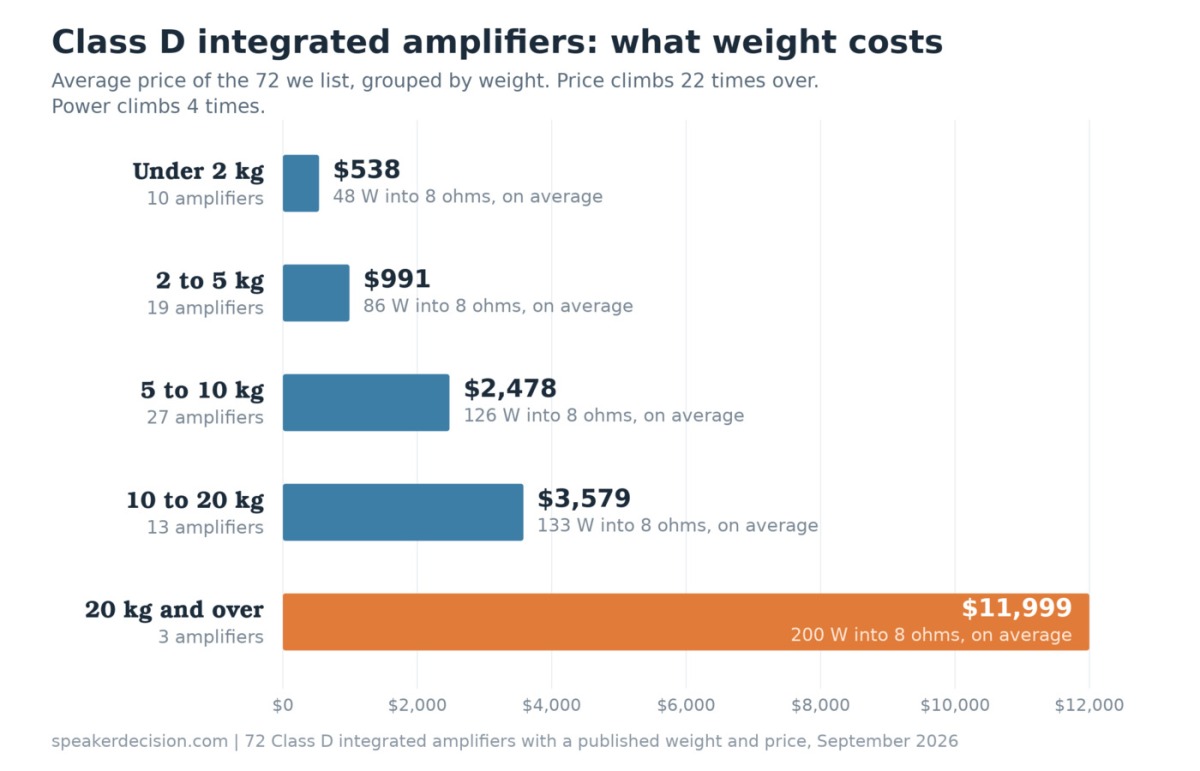 Average price of the 72 Class D integrated amplifiers we list, grouped by weight. Price climbs 22 times over. Power climbs 4 times.
The output stage is Class D. TAD says so plainly in the specification for the A1000 that this model is derived from, calling it a class-D analog amplification platform. And that is the part worth stopping on, because 29 kg is not what Class D is supposed to weigh.
Quick facts
- We list 214 integrated amplifiers. 204 publish a weight, 211 publish an amplifier class, and 201 publish both. Everything below is counted on those.
- Of the 72 Class D integrated amplifiers with a weight, the median is 5.8 kg and 29 of them are under 5 kg.
- Exactly one is heavier than 29 kg, so the TAD would come in second.
- Across every class we hold, the TAD would be the seventh heaviest integrated amplifier on the site.
- TAD has not announced a price outside Japan, and publishes no 8 ohm power rating at all. Both get their own section below.
What Class D actually weighs in our data
The light reputation is earned at the bottom of the market and nowhere else. The lightest Class D integrated amplifier we hold is the OSD Nero Stream ARC at 1.1 kg. The WiiM Amp is 1.9 kg. The Sonos Amp makes 125 watts into 8 ohms and weighs 2.1 kg.
Then the curve keeps going, and it goes a long way. Here is the top of the Class D weight table, all of it ours.
Look at the right hand column rather than the middle one. The heavy Class D amplifiers are not the powerful ones. They are the expensive ones.
| FEATURE and SPECS COMPARISON | |  |  |  |  |  |  |
| Model | Marantz Model 10 | Technics SU-R1000 | Marantz PM-10 | Naim Nova PE | Marantz Model 30 | Technics SU-G700M2 Grand Class |
| Type | Integrated Amplifier | Integrated Amplifier | Integrated Amplifier | Integrated Amplifier | Integrated Amplifier | Integrated Amplifier |
| Amplifier Class | Class D | Class D | Class D | Class D | Class D | Class D |
| Power into 8 ohms | 250 watts | 150 watts | 200 watts | 150 watts | 100 watts | 70 watts |
| Power into 4 ohms | 500 watts | 300 watts | 400 watts | 250 watts | 200 watts | 140 watts |
| Minimum Impedance | 4 ohms | 4 ohms | 4 ohms | 4 ohms | 4 ohms | 4 ohms |
| THD | 0.005% | - | 0.005% | 0.005% | 0.005% | 0.5% |
| Signal to Noise Ratio | 122 | - | 111 | - | 88 | - |
| Frequency Bandwidth | 5 Hz-60 kHz | - | 5 Hz-50 kHz | 20 Hz-20 kHz | - | - |
| Damping Factor | 500 | - | - | - | 500 | - |
| Built-in DAC | | | | | | |
| DAC | - | Full-digital JENO Engine PWM conversion, no conventional DAC stage | - | Burr Brown | - | - |
| Max Bit Depth | - | - | - | 32 | - | 32 |
| Max Sample Rate | - | - | - | 384 | - | 384 |
| Analog Inputs | 6 | 5 | 5 | 2 | 6 | 2 |
| Phono Input | | | | | | |
| Phono Type | MM/MC with 3-position MC impedance selector | MM/MC on RCA plus MC on XLR, four-level gain adjustment | MM,MC | - | MM,MC | MM,MC |
| Optical Digital Inputs | - | 2 | No | 2 | No | 2 |
| Coaxial Digital Inputs | - | 2 | No | 2 | No | 2 |
| USB Input | - | Yes | No | Yes | No | Yes |
| HDMI Input | No | No | - | Yes | - | - |
| HDMI ARC | - | - | - | ARC | - | - |
| XLR Input | Yes | Yes | - | - | - | - |
| Preamp Outputs | RCA and XLR pre out | Stereo RCA line out and stereo RCA pre out | No | Stereo RCA | Stereo RCA | Stereo RCA |
| Headphone Output | Yes | Yes | 1/4 | 3.5mm | 1/4 | 1/4 |
| Bluetooth | No | No | No | Yes | No | No |
| Wi-Fi | No | No | - | 802.11ac | - | - |
| AirPlay 2 | - | - | | | | |
| Chromecast built-in | - | - | | | | |
| Roon | - | - | No | Ready | No | No |
| BluOS | - | - | | | | |
| HEOS | - | - | | | | |
| Room Correction | - | Yes | - | - | - | - |
| Room Correction System | - | LAPC (Load Adaptive Phase Calibration) | - | - | - | - |
| Tone Controls | Yes, bass 50Hz and treble 15kHz, +/-10dB | - | - | - | | |
| Handheld Remote | | | | | | |
| Height | 192.0mm | 191.0mm | 169.0mm | 116.0mm | 131.0mm | 148.0mm |
| Width | 440.0mm | 430.0mm | 442.0mm | 432.0mm | 443.0mm | 431.0mm |
| Depth | 473.0mm | 459.0mm | 477.0mm | 265.0mm | 459.0mm | 480.0mm |
| Weight | 33.70kg | 22.82kg | 21.55kg | 15.10kg | 14.82kg | 12.73kg |
| MSRP | 15000 USD | 11999 USD | 8999 USD | 9999 USD | 2999 USD | 2700 USD |
| Check Current Price | Amazon, B&H Photo | Amazon, B&H Photo | Amazon, B&H Photo | Amazon, B&H Photo | Amazon, B&H Photo | Amazon, B&H Photo |
The split, in one number
Grouping all 72 by weight makes it obvious. Every one of them has a published price, so nothing here is guesswork about the sample.
| Weight | How many | Average price | Average power into 8 ohms |
|---|
| Under 2 kg | 10 | 538 dollars | 48 W |
| 2 to 5 kg | 19 | 991 dollars | 86 W |
| 5 to 10 kg | 27 | 2,478 dollars | 126 W |
| 10 to 20 kg | 13 | 3,579 dollars | 133 W |
| 20 kg and over | 3 | 11,999 dollars | 200 W |
From the lightest band to the heaviest, the average price goes up 22 times. The average power goes up 4 times. Whatever the extra money is buying, it is mostly not watts.
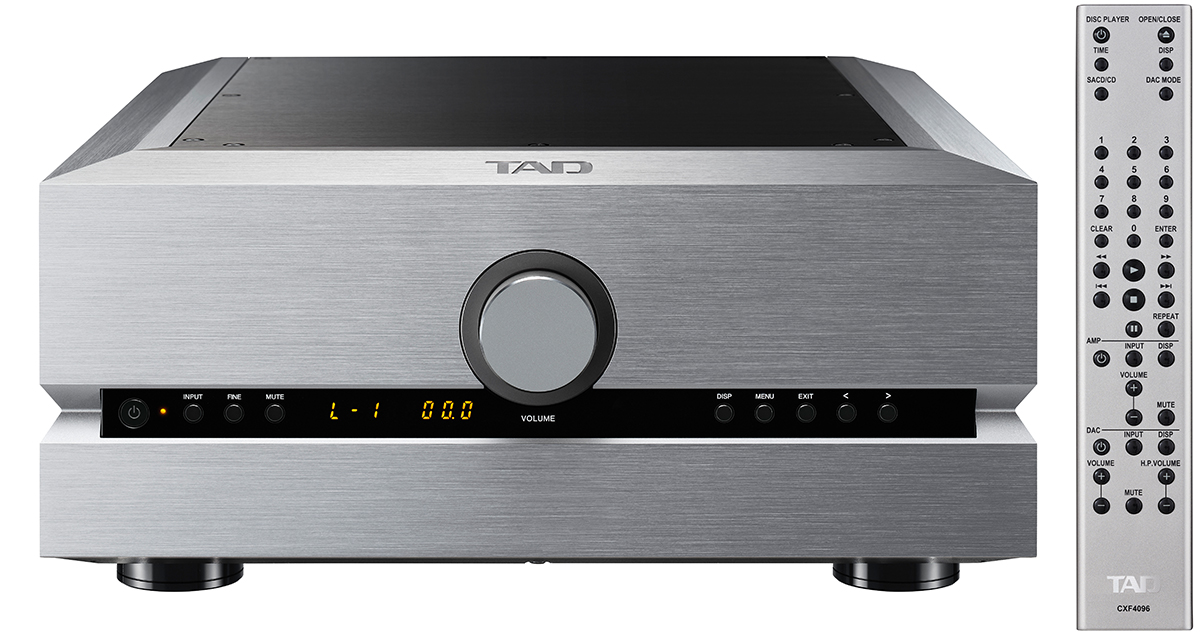 The TAD-A1000D in silver, announced 2 September 2026 and due mid-November. 29 kg, 250 watts into 4 ohms, no network streaming.
It is buying the things around the output stage. TAD's own description of the A1000D is a list of them: a high capacity toroidal transformer with a linear regulator, four 33,000 microfarad smoothing capacitors, separate rectifying and smoothing circuits per channel, five separate chambers inside the case, and a chassis on three spiked feet. None of that is the amplifier. All of it is heavy.
This is the honest reading of the whole table. In a Class D amplifier the output stage is small and cool whatever you pay. The weight is the power supply and the box. So weight tells you what a maker spent, not how the amplifier will sound, and certainly not how loud it will go.
Against Class A/B, which is the comparison people actually make
We hold 103 Class A/B integrated amplifiers with a weight. Their median is 10.9 kg against 5.8 kg for Class D, so the old rule of thumb still holds in the middle of the market. Class D really is about half the weight for the money.
It stops holding at the top. Only six integrated amplifiers we list, of any class, weigh more than the TAD. The heaviest is the Michi X5 Series 2 at 43.8 kg. Three more are PrimaLuna valve designs, heavy for a completely different reason, and one is the Musical Fidelity M6si500 at 29.9 kg. The sixth is the Marantz Model 10, which is Class D.
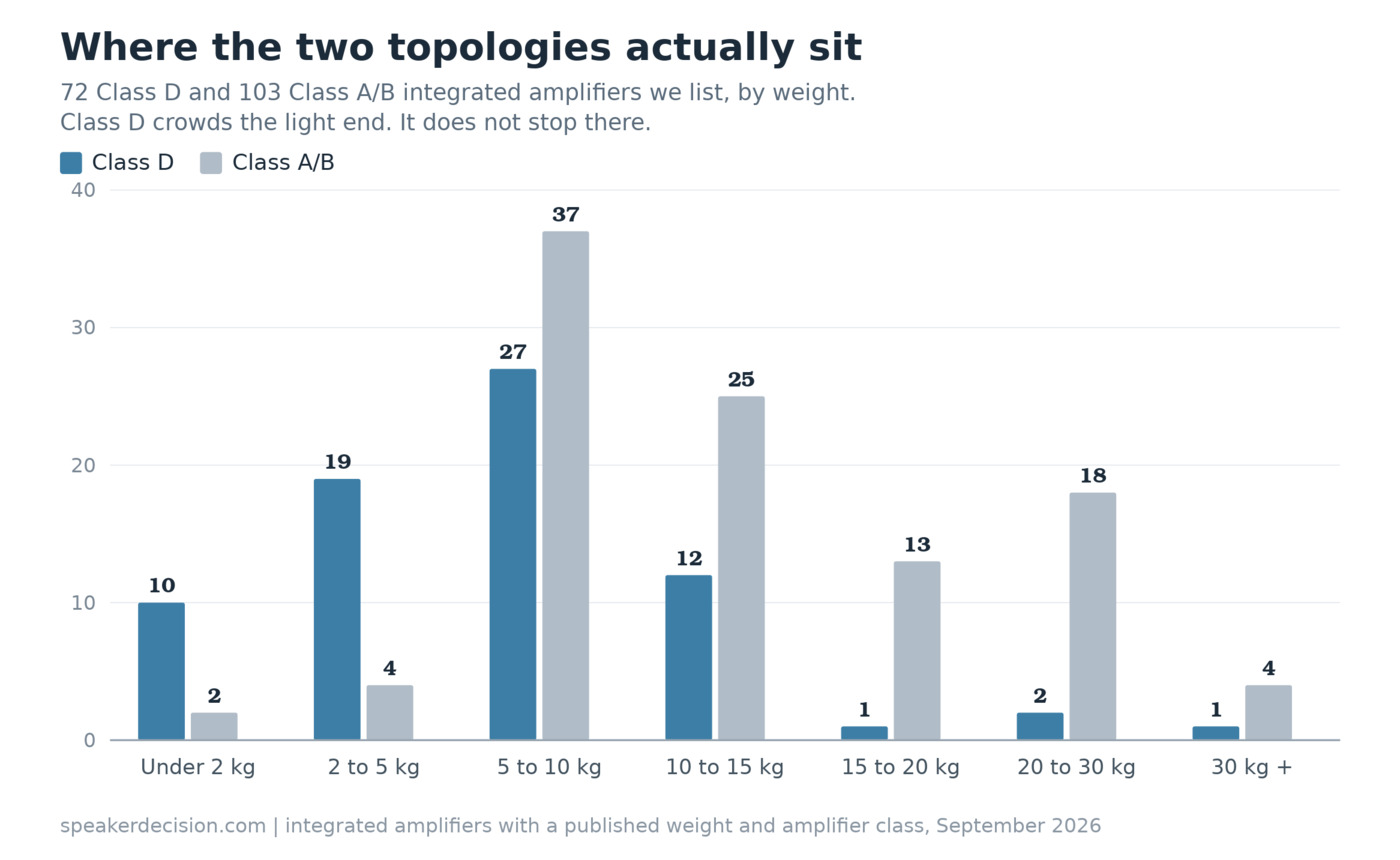 The 72 Class D and 103 Class A/B integrated amplifiers we list, grouped by weight
The Mark Levinson No.5805 is the clearest illustration. It is Class A/B, it weighs 28.2 kg, and it makes 125 watts into 8 ohms. The Marantz Model 10 is Class D, weighs 33.7 kg, and makes twice that. Two heavyweight amplifiers, two different topologies, and the weight tells you nothing useful about which one drives your speakers harder.
The number TAD has not published
Now the part that should slow you down, and it is a familiar one.
TAD publishes a single power figure: 250 watts at 1 kHz into 4 ohms. There is no 8 ohm rating anywhere in the specification. Of the 214 integrated amplifiers we list, 209 publish an 8 ohm figure and only four publish a 4 ohm figure without one. The TAD would be the fifth.
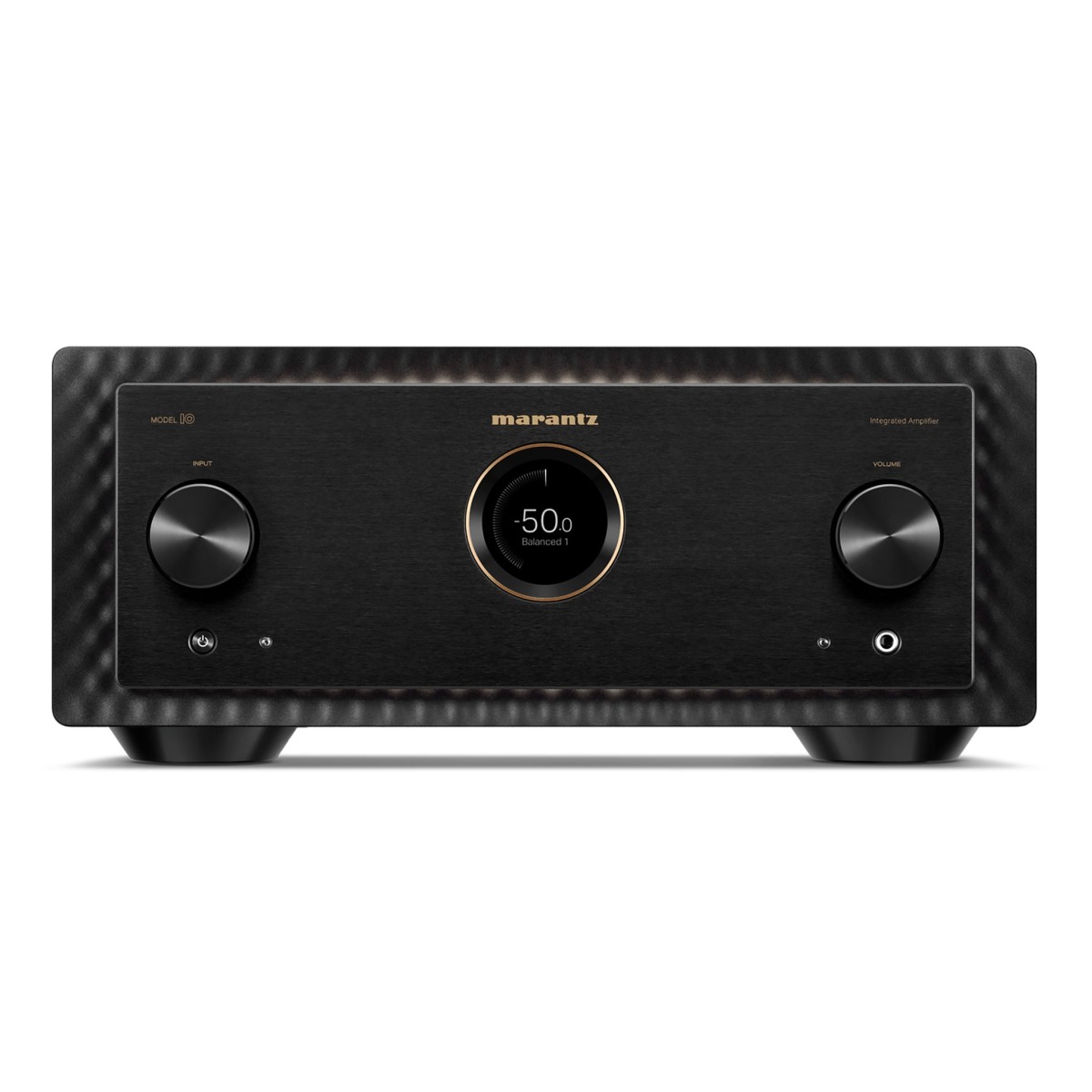 The Marantz Model 10, at 33.7 kg the heaviest Class D integrated amplifier in our database
That matters twice over. Most speakers people buy are nominally 8 ohms, and an amplifier almost always makes less into 8 ohms than into 4. So the figure you need for your own speakers is the one that does not exist. We ran into exactly this a week ago with the Marantz MCR 60n, and it is worth flagging every time it happens.
The measurement conditions differ too. TAD rates its 250 watts at 1 kHz. Marantz rates the Model 10 at 250 watts into 8 ohms across the full 20 Hz to 20 kHz band at 0.05 percent distortion. A single tone at 1 kHz is the easier test. Putting the two 250s side by side would be wrong, and I am not going to.
Price, size and what we do not hold
TAD has announced no price for the United States, Canada or Europe. The Japanese price is 3,800,000 yen before consumption tax, which converts to roughly 27,500 dollars today. A conversion is not a price, so treat it as a rough signal about which shelf this sits on.
The other practical number is depth. The A1000D is 440 mm wide, 200 mm tall and 553 mm deep. That is deeper than a great many hi-fi racks, and at 29 kg it is not something you slide out to check.
And the honest limitation on our side: we do not hold this amplifier yet, or any other TAD product. There is no review page to link and no price to put in the table above. When TAD publishes one, it goes in.
Two smaller gaps in our own data: 10 of the 214 integrated amplifiers we list have no published weight, and 3 have no amplifier class recorded. Every count here is of the amplifiers that publish the figure.
Marantz Model 10 Key Specs
- 250W into 8 ohms, 500W into 4 ohms (Class D)
- Integrated Amplifier
- Minimum Impedance: 4 ohms
- 0.005% THD
- Signal to Noise Ratio: 122dB
- Frequency Bandwidth: 5 Hz-60 kHzHz
- Phono Input (MM/MC with 3-position MC impedance selector)
- XLR Input
- Headphone Output
- Weight: 33.70 kg
- Dimensions (H x W x D): 192.0 x 440.0 x 473.0 mm
- Read the Review
Questions answered
Does a heavier amplifier sound better?
Weight is not a performance specification. In our data it tracks price far more closely than it tracks power, because what is heavy in an amplifier is the mains transformer, the smoothing capacitors and the case, not the part that amplifies. A heavy amplifier tells you the maker spent money on the power supply and the chassis. Whether that money reached your ears is a separate question, and the scales cannot answer it.
Why is a Class D amplifier this heavy when Class D is supposed to be light?
Because only the output stage is Class D. Cheap Class D amplifiers pair it with a switch mode power supply and a small case, and come out at one or two kilograms. Expensive ones pair it with a large linear power supply, a toroidal transformer and a machined chassis. The TAD is the second kind. So is the Marantz Model 10 at 33.7 kg.
How much will the TAD-A1000D cost?
TAD has not said, outside Japan. The Japanese price is 3,800,000 yen before tax for the silver version, with the black built to order and slightly dearer. Availability is mid-November 2026 internationally. Until a local price is announced, any dollar figure you see is somebody's exchange rate calculation.
Is 250 watts into 4 ohms a lot?
It is a substantial amount of power, but it is not directly comparable with the 8 ohm ratings most amplifiers publish, and TAD does not publish an 8 ohm figure. It is also rated at 1 kHz rather than across the full audio band, which is the easier of the two tests. For context, the heaviest Class D amplifier we list makes 250 watts into 8 ohms and 500 into 4, measured across 20 Hz to 20 kHz.
Does it stream?
No, and that appears to be deliberate. The digital inputs are balanced, coaxial, optical and USB. There is no network platform, no Wi-Fi and no app. If you want Qobuz or Tidal you supply your own streamer, which is a very different design decision from most of the heavy Class D amplifiers in the table above.
So here is the question the table leaves open. If the weight in a modern amplifier is mostly the power supply and the case, would you rather pay for that engineering, or put the same money into speakers and let a two kilogram Class D amplifier drive them?