Buchardt is an awkward brand to shop for, through no fault of its own. The company sells direct from Denmark and has no dealers, so you cannot walk into a shop and hear an S400 next to something else in the same price bracket. You are buying from a spec sheet, a lot of YouTube reviews, and a return policy.
So we finished the set. Every Buchardt product is now in the database with the same spec fields filled in as everything else: six passive bookshelf speakers, four active models, one subwoofer and one amplifier. That means you can put any of them against any of the 876 other speakers here and compare like for like, rather than reading two different manufacturers’ marketing pages side by side and hoping they measure the same way.
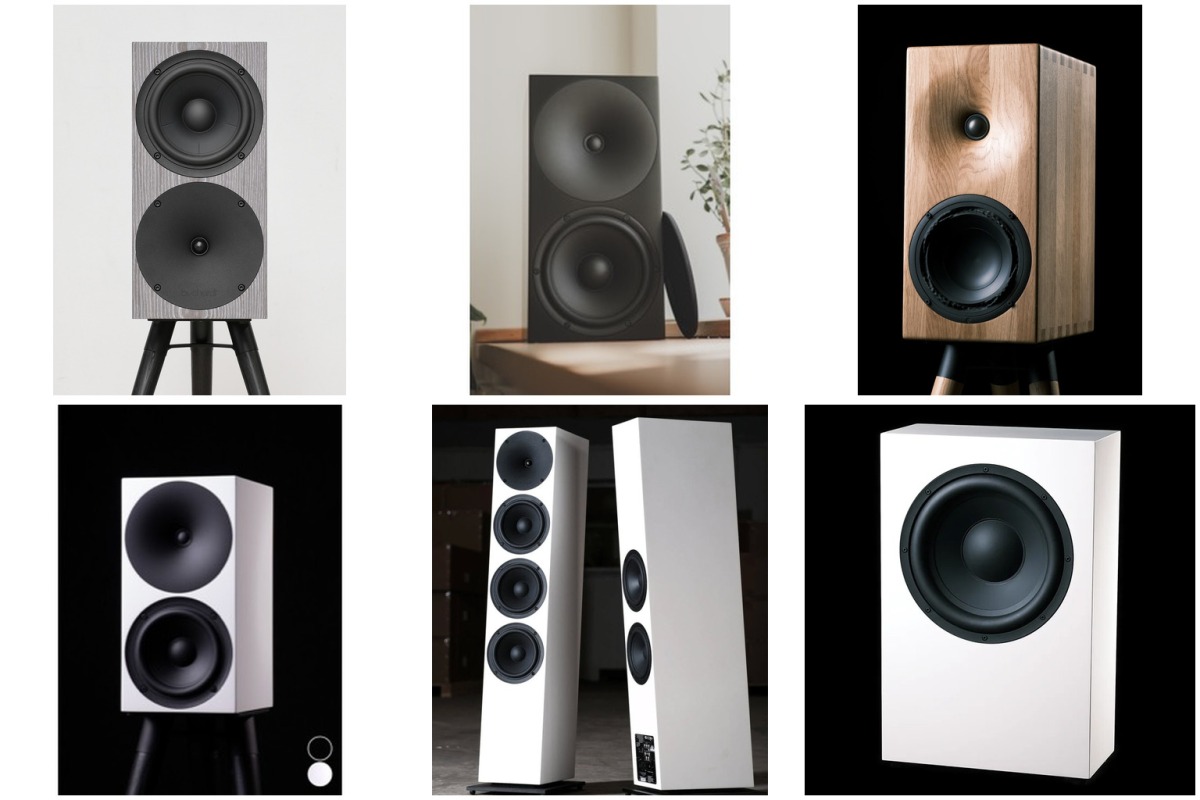 Buchardt speaker lineup compared
Quick facts
- 12 Buchardt products, all with complete specs.
- Cheapest way in: the P300 at $1,450 a pair.
- Every passive model is a 4 ohm load at 85 to 88dB.
- No dealers anywhere. Direct from Denmark, 45 day trial.
Who Buchardt actually are
Buchardt Audio is based in Silkeborg, Denmark, and it is small. Office, warehouse, development, assembly and a woodworking workshop all sit under one roof, and they now make many of the cabinets and stands themselves. That is unusual at this price. Most speakers in the $1,500 to $4,000 range have their cabinets built by a contract factory somewhere else entirely.
The part that matters to you as a buyer is how they sell. In their own words they have “chosen to bypass traditional dealer and distributor networks to deliver high-end sound directly to consumers”. There is no showroom, no dealer margin, and no chance to hear a pair before your card is charged. What you get instead is a 45 day trial at home, which starts the day the boxes arrive.
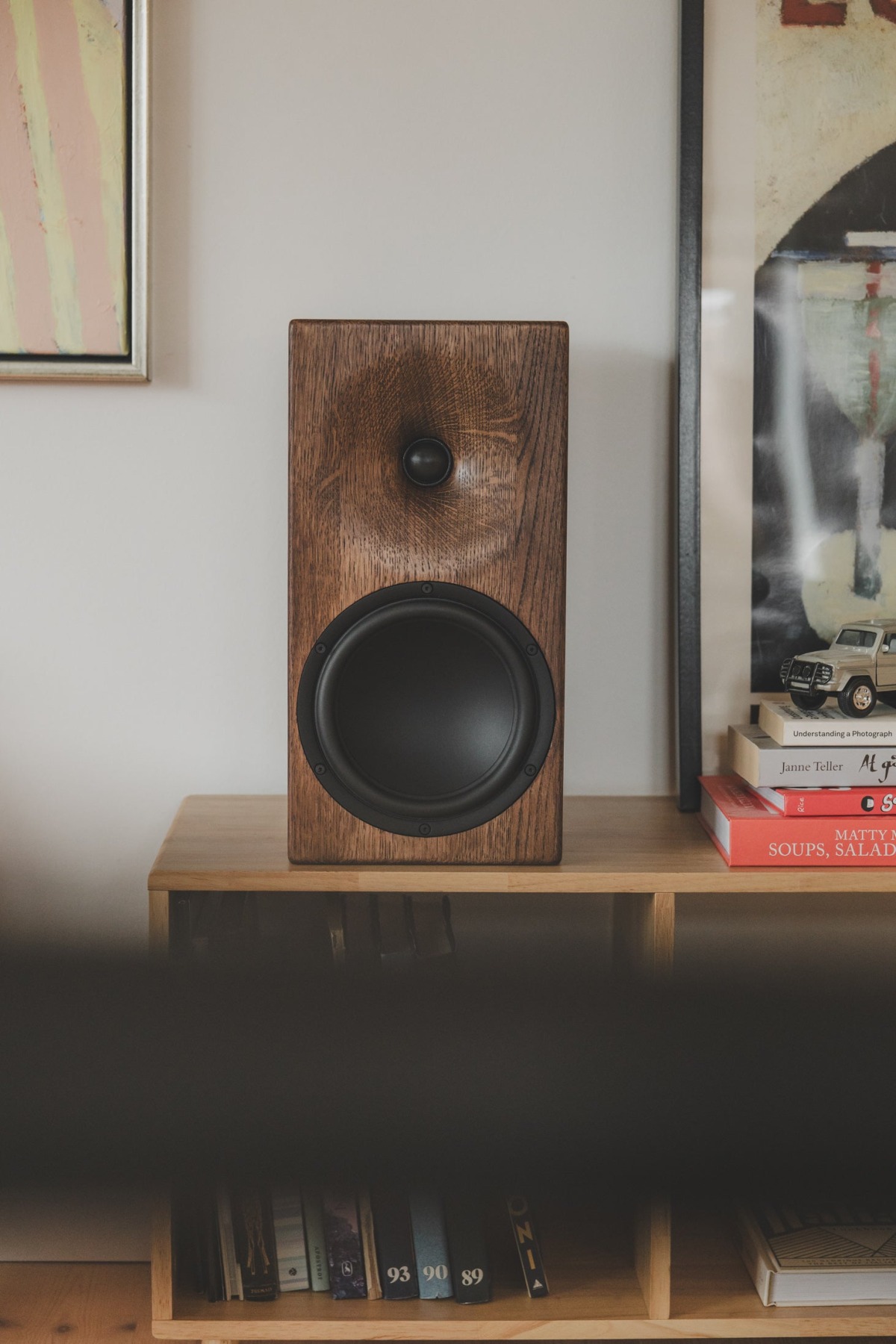 Buchardt Audio E50-S Bookshelf Speaker
A 45 day trial in your own room is worth more than 20 minutes in a dealer demo room. But it only works if you keep the boxes and you are willing to eat the return fee, so treat it as a real trial, not a free one.
Read the return terms before you order, because they are not free. Buchardt charges a return fee of 100 euros on a returned pair, rising to 200 euros for floor-standing models, and the speakers have to go back in the original shipping carton. No box, no return. That is a fair policy for a small company shipping heavy things across the world, but it does mean an unsuccessful trial costs you real money, and it is the sort of detail that never makes it into a review video.
They also run a B stock and clearance section on their own site, which is worth a look if you do not mind a cosmetic mark. That is the closest thing to a discount Buchardt offers, since there are no dealers to run a sale.
The passive bookshelf speakers, six of them
This is where Buchardt made its name. Every one of them is a two-way in a compact cabinet, and five of the six use a passive radiator instead of a port.
| Model | Year | Tweeter | Woofer | Frequency response | Sensitivity | Loading | Weight | Price/pair |
|---|
| S400 | 2017 | 0.74in alu waveguide | 1 x 6in paper | 33Hz - 40kHz | 88dB | Passive radiator | 7.3kg | Discontinued |
| P300 | 2022 | 0.74in alu waveguide | 1 x 6in paper | 37Hz - 40kHz | 86dB | Passive radiator | 6.3kg | $1,450 |
| S400 MKII | 2021 | 0.74in alu waveguide | 1 x 6in paper | 33Hz - 40kHz | 88dB | Passive radiator | 7.5kg | $2,200 |
| S400 MK3 | 2025 | 1in waveguide | 1 x 7.5in Satori papyrus | 33Hz - 20kHz | 87dB | Bass reflex | 8.5kg | $2,300 |
| E50 | 2024 | 1in waveguide | 1 x 6.5in PURIFI | 36Hz - 30kHz | 85dB | Passive radiator | 8.6kg | $3,950 |
| E50-S | 2025 | 1in waveguide | 1 x 7.5in Satori TeXtreme | 38Hz - 22kHz | 88dB | Passive radiator | 9.0kg | $4,100 |
Sensitivity above is the anechoic figure, which is the honest one. Buchardt quotes an in-room number too, and it is always about 3dB higher: the MK3 is 87dB anechoic and 90dB in room. When you see 90dB on a Buchardt page, mentally take three off before comparing it with a brand that only publishes the anechoic figure.
The S400 is the model Buchardt is known for, and it has now run through three generations. Putting them side by side is the clearest way to see how the company’s thinking has changed.
| FEATURE and SPECS COMPARISON | |  |  |  |
| Model | Buchardt S400 | Buchardt S400 MKII | Buchardt S400 MK3 |
| Speaker Type | Passive Bookshelf | Passive Bookshelf | Passive Bookshelf |
| Enclosure Type | Passive Radiator | Passive Radiator | Bass Reflex |
| Driver Setup | 2-way | 2-way | 2-way |
| Tweeter | 0.74" aluminum waveguide Tweeter | 0.74" aluminum waveguide Tweeter | 1" waveguide Tweeter |
| Woofer | 1 x 6" paper Woofer | 1 x 6" paper Woofer | 1 x 7.5" SB Acoustics Satori Egyptian Papyrus papercone Woofer |
| Frequency Range / Low | 33Hz | 33Hz | 33Hz |
| Frequency Range / High | 40kHz | 40kHz | 20kHz |
| Impedance Nominal | 4Ω | 4Ω | 4Ω |
| Sensitivity | 88dB | 88dB | 87dB |
| Crossover Frequency | 2000Hz | 1800Hz | 2200Hz |
| Available Colors | Black, White, Walnut,Graphite Oak | Black, White, Walnut, Rosewood, Light Oak | Black, White, Walnut, Natural oak |
| Grille | Yes | Yes | Yes |
| Height | 375.0mm | 365.0mm | 392.0mm |
| Width | 180.0mm | 180.0mm | 198.0mm |
| Depth | 245.0mm | 280.0mm | 280.0mm |
| Weight | 7.30kg | 7.50kg | 8.50kg |
| Check Current Price | Amazon | Amazon | Amazon |
Two things jump out of that table. The MK3 is the first S400 to drop the passive radiator for a conventional port, and it grows the woofer from 6 inches to 7.5. It is also a slightly easier load than the MKII on paper, which matters more than it sounds for a speaker most people drive with a modest amplifier.
The quoted treble figures got worse, and that is not a mistake
You will notice the older models claim 40kHz at the top and the two newest claim 20kHz and 22kHz. That looks like a downgrade and it is worth being clear about: those numbers come straight from Buchardt’s own product pages, so it is not an error in our data. The S400 MK3 page says 33 - 20 and the E50-S page says 38 - 22.
What changed is how the number is arrived at, not the tweeter getting worse. Treat frequency response figures from any manufacturer as a rough shape rather than a score, and never compare two brands on the top number alone. It is the least standardised specification in this entire database.
The active speakers, and the WiSA catch
The active models are the more interesting half of the range. They have amplification and DSP built in, they take audio wirelessly, and they run Buchardt’s Mastertunings: downloadable files that rewrite the DSP inside the speaker rather than just applying EQ on top of it. One set of them even switches the speaker to cardioid dispersion so it can live close to a wall or inside a bookshelf. That is a genuinely unusual thing to be able to change after purchase.
| Model | Year | Type | Drivers | Frequency response | Amplification | Weight | Price/pair |
|---|
| A200 | 2025 | 2-way bookshelf | 0.74in tweeter, 2 x 5in | 25Hz - 22kHz | 200W Class D PowerDAC | 6.75kg | $2,750 |
| A500 | 2019 | 3-way bookshelf | 0.74in tweeter, 1 x 6in | 25Hz - 40kHz | 450W Class D | 9.0kg | $3,850 |
| A10 Anniversary | 2023 | 2-way bookshelf | 0.74in dome, 1 x 6.5in | 28Hz - 40kHz | 200W digital | 6.8kg | $3,950 |
| A700 | 2020 | 3-way floor-standing | 0.74in tweeter, 4 x 6in | 17Hz - 40kHz | 600W Class D | 28kg | $6,600 |
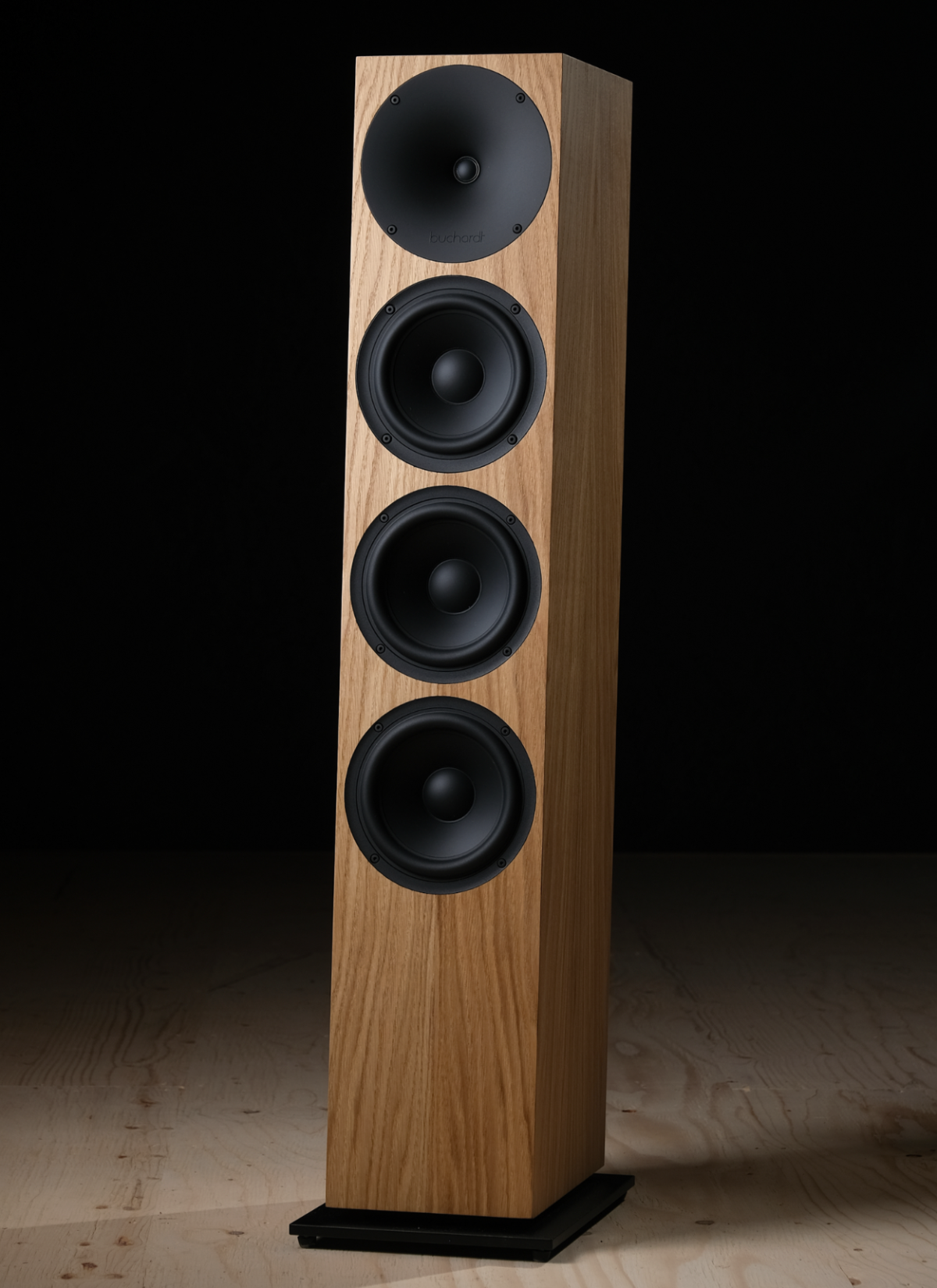 A700 in natural oak Finish
The A700 is the only floor-stander Buchardt makes and it is a different animal: a metre tall, 28kg each, four 6 inch woofers a side, and a quoted 17Hz at the bottom. If that figure holds up in your room it removes the argument for a subwoofer entirely.
Now the catch, and it is a real one. These are wireless speakers built around WiSA, and they need a transmitter. Our records show room correction on all four requires the optional WiSA hub. So the price in that table is not the price of a working system unless you already own a WiSA source. Budget for the hub, and check that the thing you actually want to play music from can talk to it, before you fall in love with the idea.
The subwoofer and the amplifier
Two more products round out the range. The SUB10 is a sealed 10 inch subwoofer with a 400 watt Hypex Class D amplifier, quoted at 20Hz to 300Hz, with room correction built in, at $1,300. It is designed to disappear next to the bookshelf models rather than to shake a home cinema.
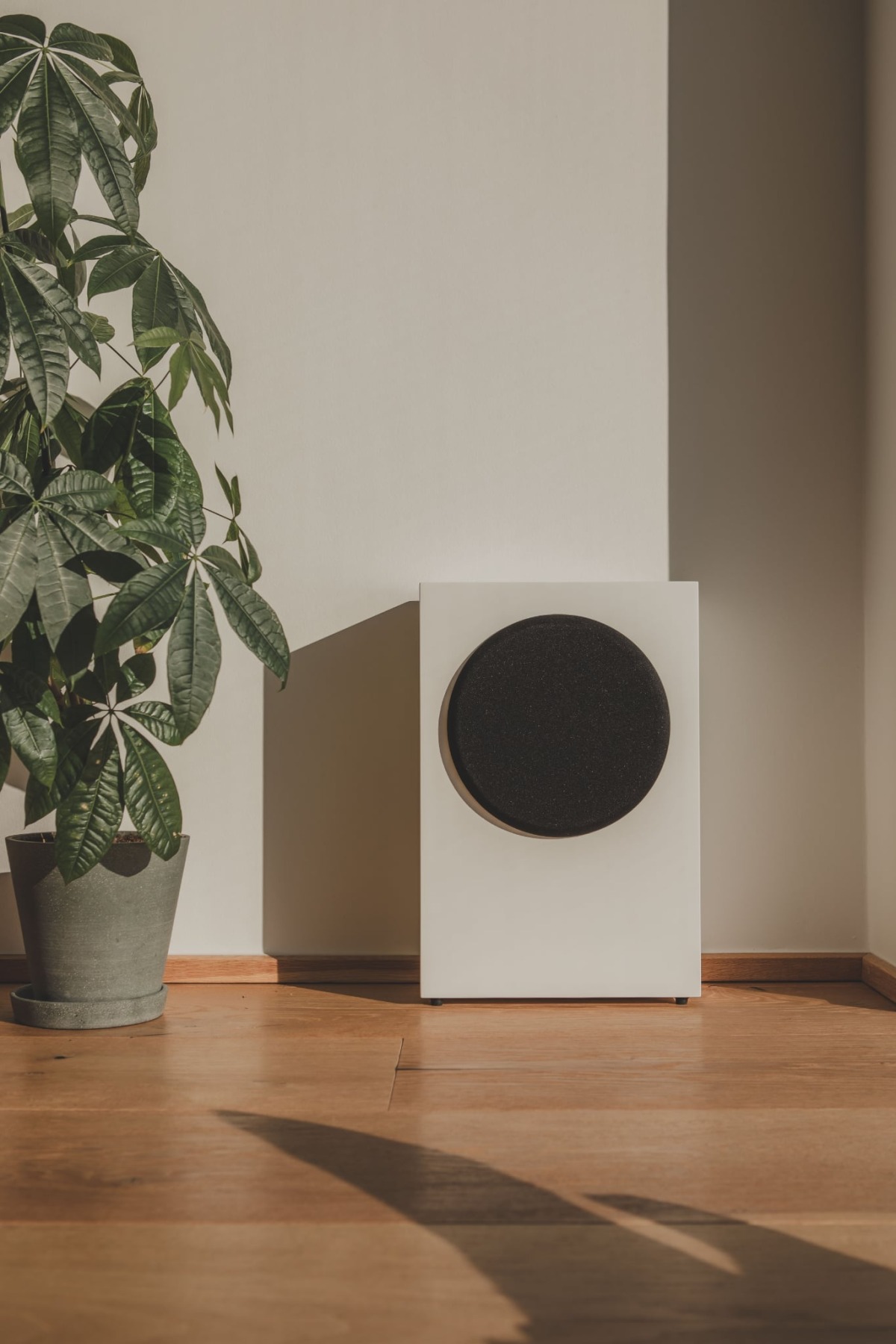 SUB10 Subwoofer
The I150 integrated amplifier at $2,500 is the obvious partner for the passive speakers, and it is the one Buchardt product that has to compete with a very crowded market. Put it against the 177 integrated amplifiers we hold before deciding.
The honest problems with buying Buchardt
- Every passive model is 4 ohms at 85 to 88dB. That is a demanding combination. These are not speakers for a cheap receiver, and the E50 at 85dB is the hungriest of the lot. Buchardt themselves flag that the MK3 was made easier to drive than the MKII, which tells you the older ones were a handful.
- You cannot hear them first. No dealers means no audition. The 45 day trial is the substitute and it is a good one, but it is not free.
- The return fee is real. 100 euros a pair, 200 for floor-standers, and you must have kept the box.
- The actives need a WiSA transmitter that is not in the price.
- The range moves fast. Three S400 generations in eight years and an E50-S barely a year after the E50. Buy expecting a replacement sooner than most brands, which is good for buyers of the outgoing model and less good if you like feeling current.
Questions answered
Questions answered
Where do you buy Buchardt speakers?
Only from Buchardt, direct from Denmark. The company has deliberately skipped dealers and distributors, so there is no shop anywhere that stocks them and no authorised reseller to buy from. They ship worldwide from Silkeborg.
Can you listen before buying?
Not in a shop. Buchardt gives you a 45 day trial at home instead, starting when the boxes arrive. If you send them back there is a return fee of 100 euros, or 200 euros on floor-standing models, and you need the original shipping carton.
What is a Mastertuning?
A downloadable file for the active speakers that rewrites the DSP inside them, rather than applying an equaliser on top. Different tunings change the tonal balance, and some change the dispersion pattern so the speaker suits being close to a wall. It means one pair of speakers can behave like several.
Which Buchardt is the best value?
On paper the P300 at $1,450 a pair, which uses the same 0.74 inch waveguide tweeter and 6 inch paper woofer as the S400 MKII for $750 less, giving up about 4Hz of bass extension and 2dB of sensitivity. Whether that is the right speaker for you depends on your amplifier, since it is the least sensitive way into the range.
The one I keep coming back to is the S400 MK3 dropping the passive radiator that defined the first two generations. Buchardt spent eight years telling everyone a radiator was the right answer for a small box, then put a port in the third one. My guess is that was as much about making the speaker easier to build and easier to drive as it was about the sound. If you have heard an MKII and an MK3 in the same room, was the change actually audible?
FIND THIS INTERESTING? SHARE IT WITH YOUR FRIENDS!