The usual deal with a small subwoofer is that you pay more and get less bass. Klipsch has just broken both halves of that.
The Reference Premiere Compact range was announced on 7 August at Audio Advice Live in Raleigh, and it lands in November. Three models, all sealed: the RP-1200CSW at 849.99 dollars, the RP-1400CSW at 1,099.99, and the RP-1600CSW at 1,499.99. All three are now in our database.
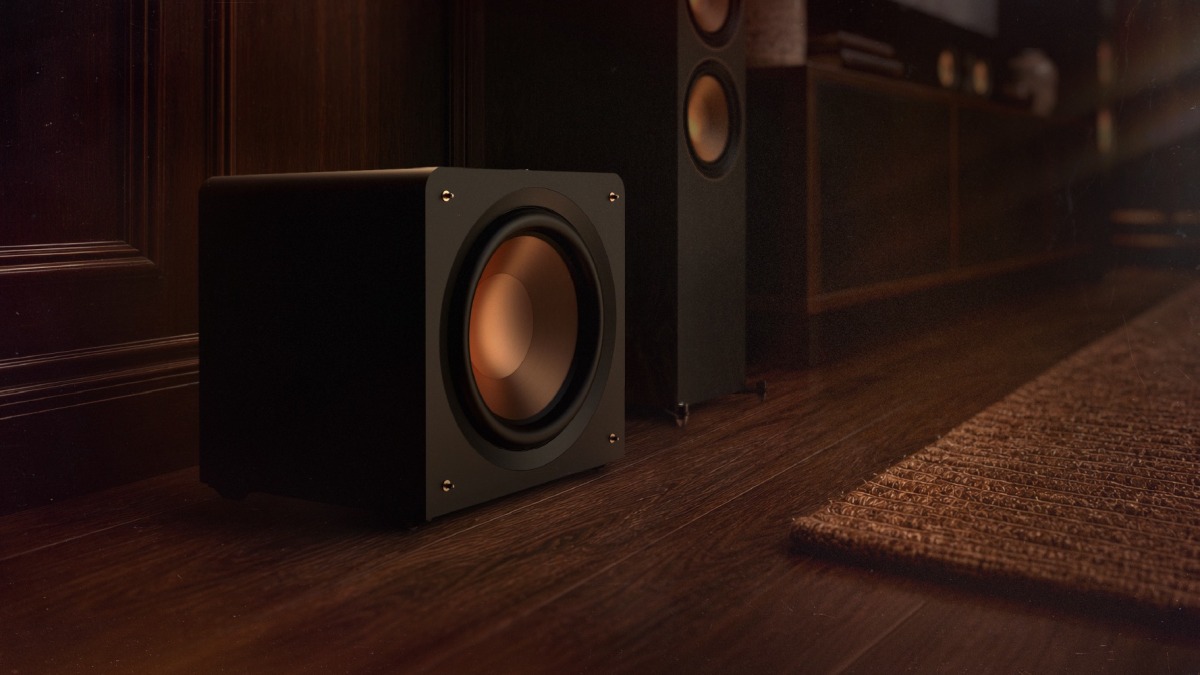 A Klipsch Reference Premiere Compact subwoofer beside a floor-standing speaker
Klipsch already sells a ported Reference Premiere subwoofer with each of those woofer sizes. So for once there is a clean comparison to make: same brand, same nominal driver, same amplifier rating, one box ported and one box sealed.
The short version
- The sealed model is 250, 450 and 500 dollars cheaper than the ported model with the same woofer.
- It takes 45 to 48 percent less floor area and holds 54 to 57 percent less cabinet.
- Claimed low-frequency reach is within 1 Hz in every pair, and identical in the 16-inch pair.
- The cost is 2.5 to 3 dB of maximum output. That is not nothing, and it is below.
- No app, no parametric EQ, no XLR. Klipsch has not published a crossover range or a warranty term yet.
Same woofer, same amplifier, cheaper
Here is every pair, with the prices Klipsch lists today.
| Woofer | Ported | Sealed | You save |
|---|
| 12 inch | RP-1200SW, $1,099.99 | RP-1200CSW, $849.99 | $250 |
| 14 inch | RP-1400SW, $1,549.99 | RP-1400CSW, $1,099.99 | $450 |
| 16 inch | RP-1600SW, $1,999.99 | RP-1600CSW, $1,499.99 | $500 |
Worth saying plainly, because we got it wrong ourselves: those ported prices are current, not launch prices. Klipsch has raised all four Reference Premiere subwoofers since 2023, by 11 to 15 percent. Our own rows still carried the 2023 figures until this week. They are fixed now, and the RP-1000SW, the 10-inch model with no compact counterpart, went from 749 to 849.99 as well.
The amplifier is identical inside each pair: 400 watts RMS for the 12-inch, 500 for the 14, 800 for the 16. The woofer is the same nominal size and the same Cerametallic cone. What changed is the box.
Half the floor area is not marketing talk
Klipsch says "about half the footprint". We checked it against the dimensions on its own spec sheets rather than taking the claim.
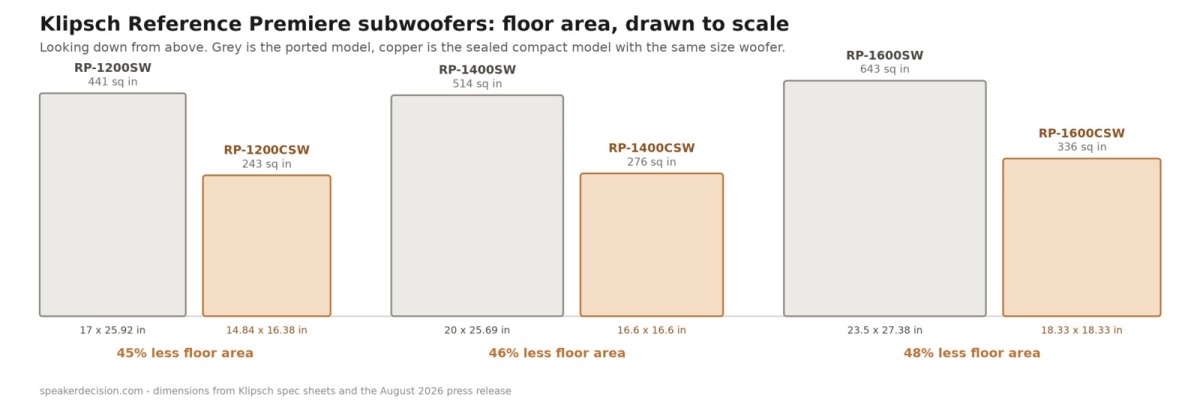 Floor area of each ported Klipsch RP subwoofer against its sealed compact version, drawn to scale
| Ported, floor area | Sealed, floor area | Cut |
|---|
| 12 inch | 441 sq in | 243 sq in | 45% |
| 14 inch | 514 sq in | 276 sq in | 46% |
| 16 inch | 643 sq in | 336 sq in | 48% |
So the claim holds. And by volume the cut is bigger still, because the sealed cabinets are shorter as well as smaller on the floor: 137 litres down to 63, 180 down to 79, 248 down to 106. That is 54 to 57 percent less cabinet.
Most of it comes off the depth. The RP-1200SW is nearly 26 inches deep, which is the dimension that stops a subwoofer fitting beside a sofa or under a console. The RP-1200CSW is 16.4 inches deep. The 14 and 16-inch compacts are square in plan and close to cubes.
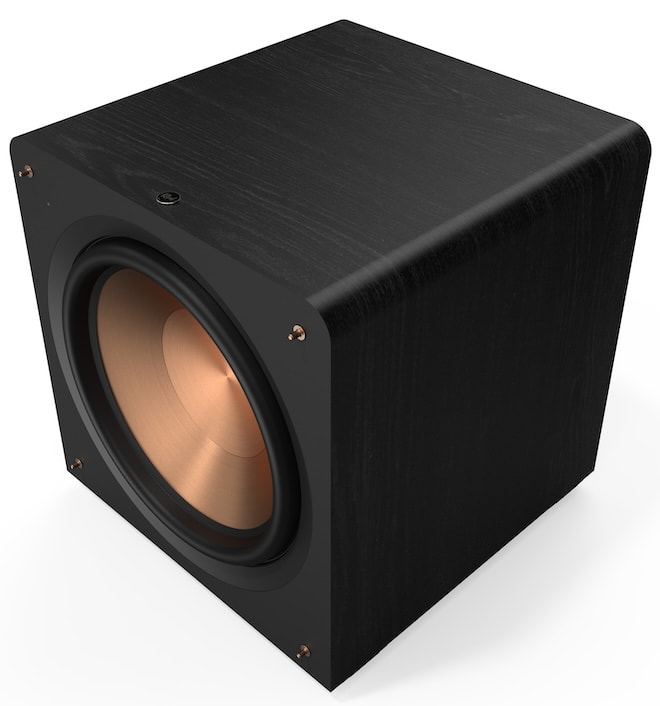 The Klipsch RP-1600CSW, a 16-inch sealed subwoofer in a near-cubic cabinet
They are lighter too, by about 30 percent. The RP-1600SW weighs 110 pounds. The RP-1600CSW weighs 78.8. One of those you can move on your own.
The bass depth barely moves
This is the part that surprised us, because sealed boxes are supposed to give up extension.
| Ported | Sealed |
|---|
| 12 inch | 16.5 Hz | 17 Hz |
| 14 inch | 16 Hz | 15 Hz |
| 16 inch | 14.5 Hz | 14.5 Hz |
All at plus or minus 3 dB, all from Klipsch. The 16-inch pair is identical. The 14-inch sealed model is actually rated 1 Hz lower than the ported one. Only the 12-inch pair goes the way you would expect, and it goes there by half a hertz.
Against our own database that puts these in unusual company. We list 261 powered subwoofers, and only 14 of the sealed ones publish a figure of 17 Hz or lower. Until this launch the cheapest of those was the SVS SB-3000 R|Evolution at 1,300 dollars, followed by the ELAC Varro RS700-SB at 1,499 and the KEF KC62 at 1,500. The RP-1200CSW arrives at 849.99 and takes that spot by 450 dollars.
Go deeper and it thins out fast. Counting every enclosure type, only one subwoofer we list reaches 15 Hz or lower for less than the RP-1400CSW does, and that is the GoldenEar ForceField 4 at 799 dollars with a 10-inch driver and a passive radiator.
The 16-inch model is the odd one out in a different way. We hold exactly eight sealed subwoofers with a 14-inch or larger driver, and only one other sealed 16-inch: the SVS SB16-Ultra, which is 2,300 dollars, rated to 16 Hz, and holds 129 litres. The RP-1600CSW is 1,499.99, rated to 14.5 Hz, and holds 106.
What you actually give up: 3 dB
Here is the honest cost, and it is a real one.
| Ported, max output | Sealed, max output |
|---|
| 12 inch | 121 dB | 118 dB |
| 14 inch | 124 dB | 121 dB |
| 16 inch | 125.5 dB | 123 dB |
Three decibels is half the acoustic power. Put another way, the 14-inch sealed model tops out where the 12-inch ported one does. If you are filling a large room at reference level, or you buy subwoofers to feel films in your chest, that is the number that should decide this and it points at the ported box.
And there is a limit to how far we can check it. Only 29 of our 261 subwoofers publish a maximum output figure at all, so we cannot tell you how a 118 dB rating compares across the category. Klipsch is unusually forthcoming here. Most makers simply do not say.
Depth and loudness are also not the same thing. A published low-frequency limit says where the response is still within 3 dB. It says nothing about how much output there is down there, and that is exactly where a sealed box gives ground. Klipsch's own 121 against 118 is the closest thing to a measurement of that trade anyone has published for these two boxes.
The rest of the small print
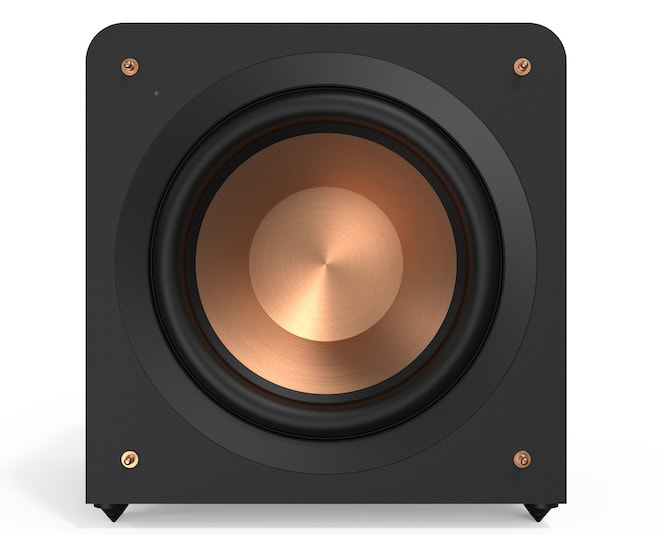 The Cerametallic woofer of the RP-1200CSW with the grille removed
No DSP and no app. Rear-panel crossover, phase and gain, and that is it. No parametric EQ, no presets, no phone control. The SVS SB-2000 Pro, a sealed 12-inch we list at 900 dollars, gives you all of it through a phone app. What it does not give you is the depth: 19 Hz against the RP-1200CSW's 17. If you run Dirac, Audyssey or ARC through a processor you may not care about the DSP. If the subwoofer is your only room correction, you should.
No balanced input. Dual RCA line-level in, plus a port for the optional WA-2 wireless kit. Klipsch does let the RCA and wireless inputs run at the same time, so one subwoofer can serve a stereo system and a home theatre without replugging, which is a genuinely good touch.
Two things Klipsch has not published. There is no crossover adjustment range and no warranty term for these models. The ported Reference Premiere subwoofers carry five years. We have left both fields empty on our rows rather than assume the compacts inherit them.
A wrinkle in the source. There is no product page for any of the three yet, so Klipsch's press release is the only primary source we have, and its specification table prints the same metric conversion, 48.8 by 46.6 cm, against all three models. Those are the RP-1600CSW's figures repeated. The inch measurements differ correctly per model, so those are the ones we used, and our millimetre columns are converted from them.
And the gain control goes to 11. Klipsch made the joke, not us.
Who should buy which
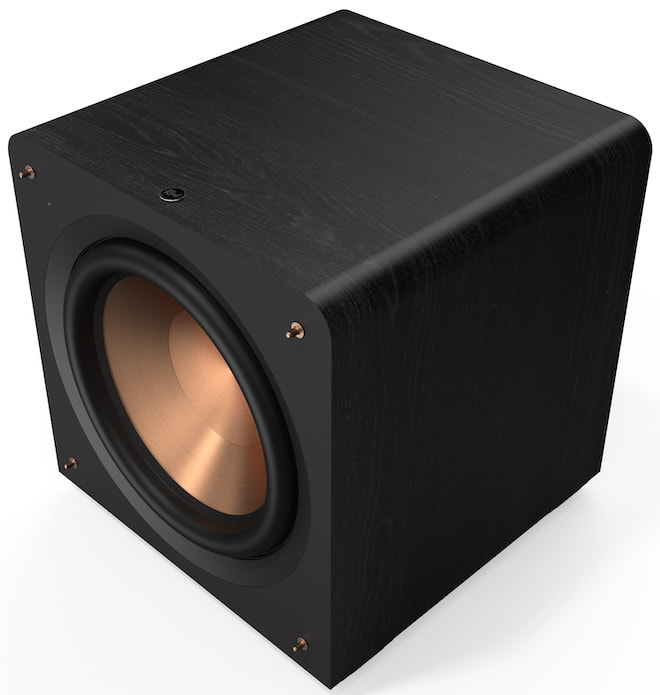 The Klipsch RP-1400CSW, a 14-inch sealed subwoofer in 79 litres
If the subwoofer has to fit somewhere real, and 118 or 121 dB is loud enough for your room, the compact is the better buy on every measure that is published. It is smaller, lighter, cheaper, and reaches as deep.
If you want maximum output and the space is there, the ported model still wins, and it wins by the one thing that is hard to add later.
Our compare page runs the two side by side and reaches the same conclusion from the data alone:
| FEATURE and SPECS COMPARISON | |  |  |
| Model | Klipsch RP-1200CSW | Klipsch RP-1200SW |
| Driver | 12" Cerametallic | 12" Cerametallic |
| Enclosure | Sealed | Ported |
| Port Type | - | Aerofoil slot |
| Firing Direction | Front | Front |
| Amplifier Power (RMS) | 400 watts | 400 watts |
| Amplifier Power (Peak) | 800 watts | 800 watts |
| Amplifier Class | Class D | Class D |
| Frequency Response | 17-160 Hz | 16.5-138 Hz |
| Low Pass Crossover | - | 40-160 Hz |
| Phase | Yes | Yes |
| Line Level Inputs | Stereo RCA/LFE | Stereo RCA/LFE |
| Speaker Level Inputs | No | No |
| Speaker Level Outputs | No | No |
| Wireless | Optional | Optional |
| Height | 399.5mm | 482.0mm |
| Width | 376.9mm | 432.0mm |
| Depth | 416.1mm | 659.0mm |
| Weight | 21.64kg | 31.18kg |
| Finish | MDF with Vinyl | MDF with Vinyl |
| MSRP | 850 USD | 1100 USD |
| Check Current Price | Amazon | Amazon |
Klipsch has quietly made the compact version the default choice for most rooms, and priced it as the cheaper option rather than the premium one. That is the unusual part.
Would you take the smaller sealed box and the 3 dB, or is maximum output still the thing you buy a subwoofer for?