A subwoofer is normally something you hide. Velodyne Acoustics went the other way with the MiniVee X: a version with the cabinet cut from transparent acrylic, so the driver, the passive radiator and the electronics are all on display. Darko.Audio compares the look to the old Harman Kardon SoundSticks, which is about right.
One correction before the specs, because we nearly got this wrong ourselves. This is not a new product. Velodyne announced the acrylic edition, along with a high-gloss white finish, back in February 2025, and described it then as a limited edition sold through authorised dealers. It has simply taken eighteen months to get noticed outside the trade press.
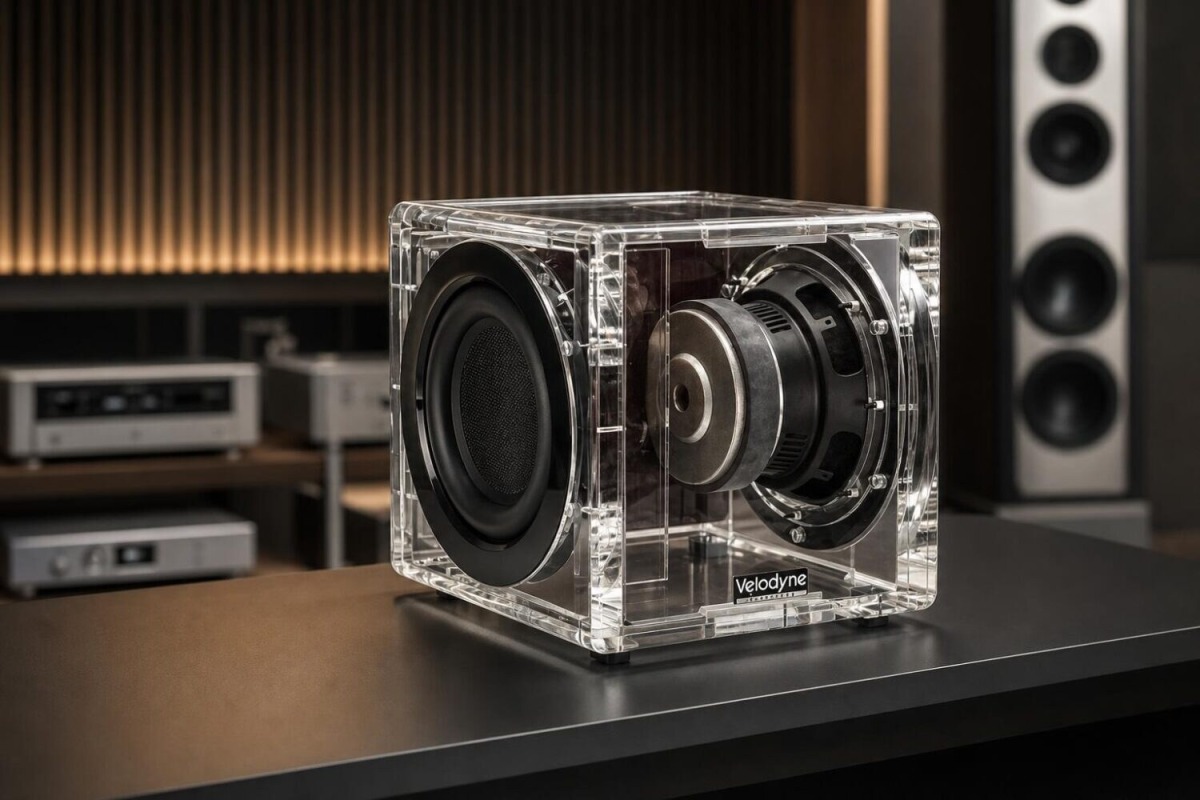 Velodyne MiniVee X Acryl transparent cabinet
Quick facts
- $2,299 for the acrylic, against $1,499 in black or white.
- Nothing else changes. Same driver, amplifier and response.
- 8in active driver plus an 8in passive radiator, facing opposite ways.
- A limited edition, announced February 2025, not new.
It is a finish, not a new subwoofer
Worth being blunt about this before anything else. The acrylic version has the same 8 inch long-throw driver, the same 8 inch passive radiator, the same Class D amplifier, the same frequency response and the same connections as the black one that has been on sale since 2024. Velodyne’s own US store lists all three finishes: $1,499 in black, $1,499 in white, $2,299 in acrylic. So you are paying $800 for the cabinet material, and nothing else. In Europe the gap is EUR 1,299 against EUR 1,999.
That is not automatically a bad deal. Cutting and bonding acrylic to the tolerances a sealed subwoofer needs is genuinely harder than painting MDF, and the panels have to be thick enough not to resonate. But it is a decoration charge, and it should be judged as one. If the sight of a driver moving does nothing for you, the black or white one is the same machine for a third less.
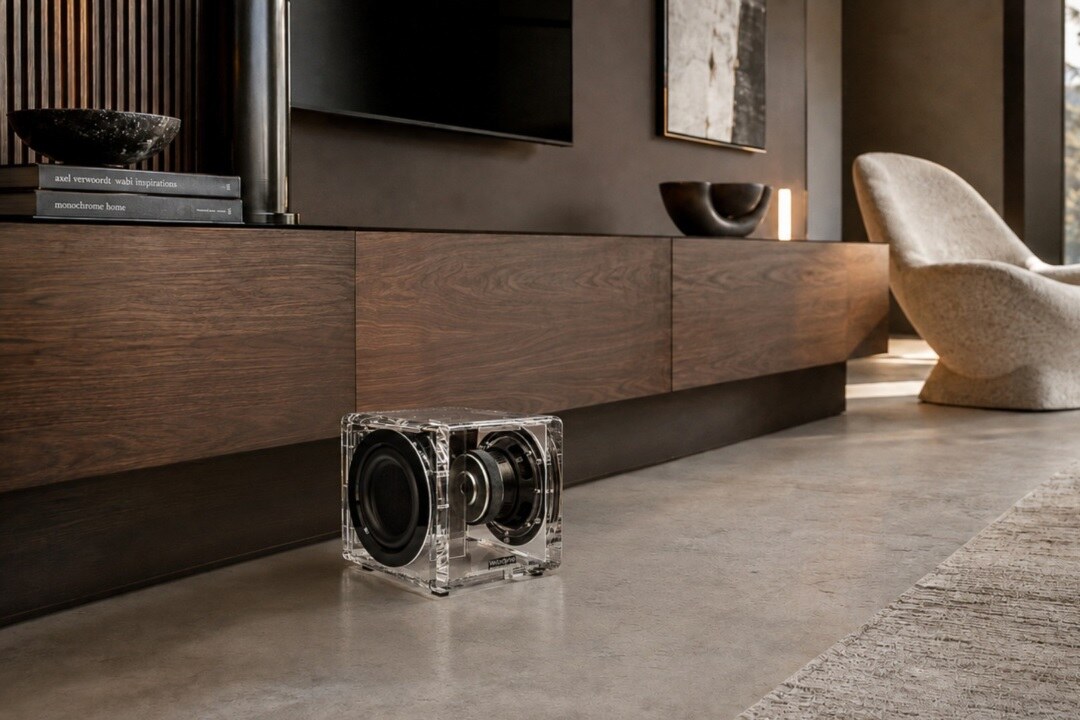 Velodyne MiniVee X Acryl in a living room
Ask yourself whether you want to look at your subwoofer. If the answer is no, this is an $800 upgrade to something you were planning to hide behind the sofa.
What is inside either
The layout is the interesting part, and it is why a see-through cabinet is not a silly idea here. An 8 inch long-throw driver sits on one face and an 8 inch passive radiator sits on the opposite one, in an otherwise sealed box. Above the radiator’s tuning frequency the two move in opposite directions, so the forces they exert on the cabinet partly cancel and the box stays put instead of walking across the floor. Velodyne calls it force-cancelling. It is the same principle SVS uses in its dual-opposed micro subwoofers, with a passive radiator standing in for the second motor.
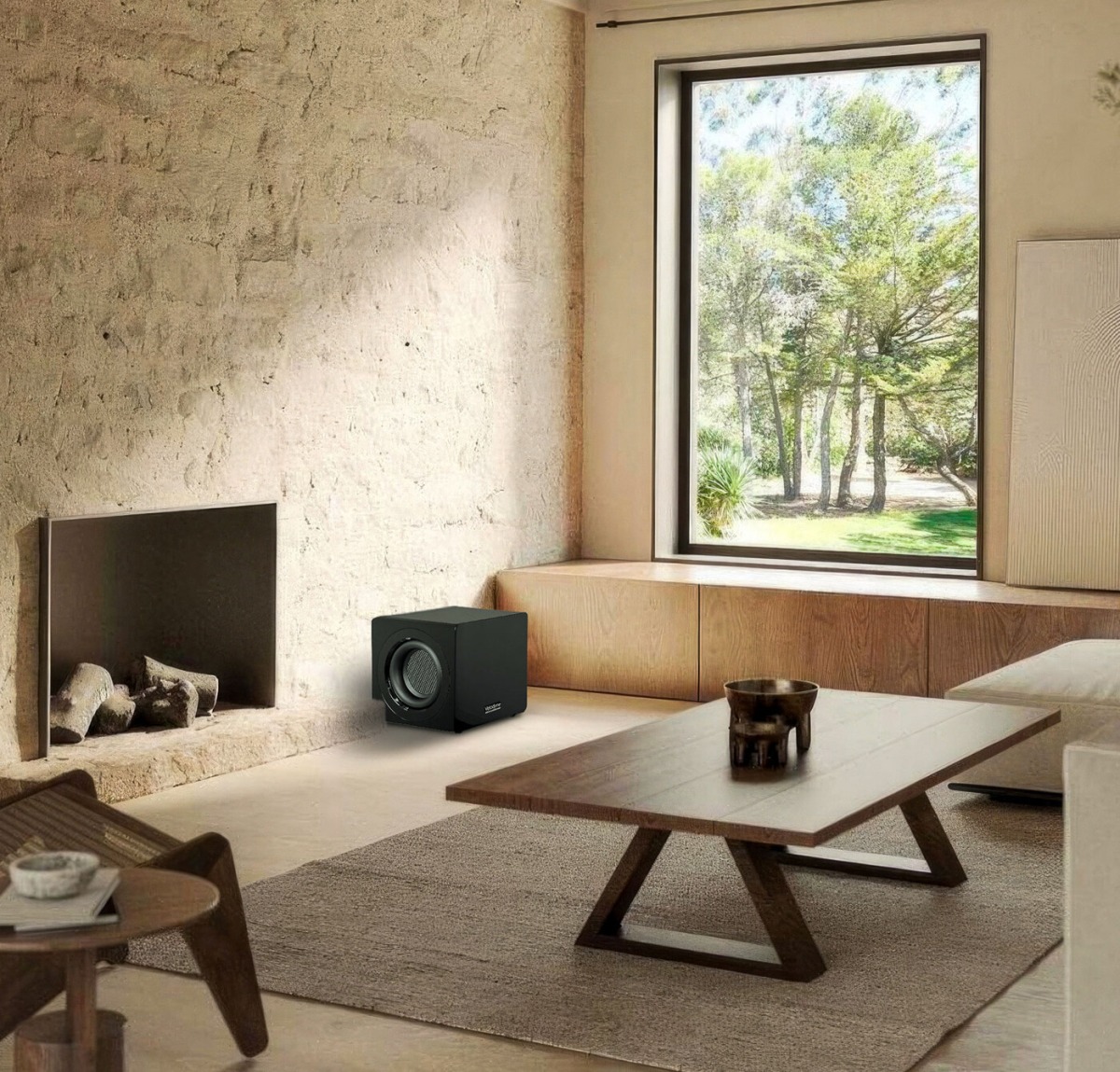 Velodyne MiniVee X in high gloss black
The active cone runs a dual ferrite magnet motor and a 2 inch voice coil wound in four layers of copper. Amplification is Class D, and Velodyne quotes it three ways: 350W RMS at 0.5% THD, 600W at 2% THD, and 800W maximum. The first of those is the number worth comparing with anything else.
Read the frequency response carefully
Velodyne publishes two figures, and they are a long way apart. Overall response is quoted as 18Hz to 300Hz. The tighter figure, the one with a stated tolerance, is 32Hz to 180Hz at plus or minus 3dB.
Our database stores the 32Hz number. That is deliberate and it makes the MiniVee X look worse than it would otherwise, so here is the reasoning: an 18Hz claim with no tolerance attached is not comparable with a rival that publishes a bounded figure. Putting the flattering number in the field would quietly promote this subwoofer above competitors who were more careful about how they specified theirs. For an 8 inch driver in a 29cm cube, 32Hz is a respectable honest answer.
Connections, which are better than the size suggests
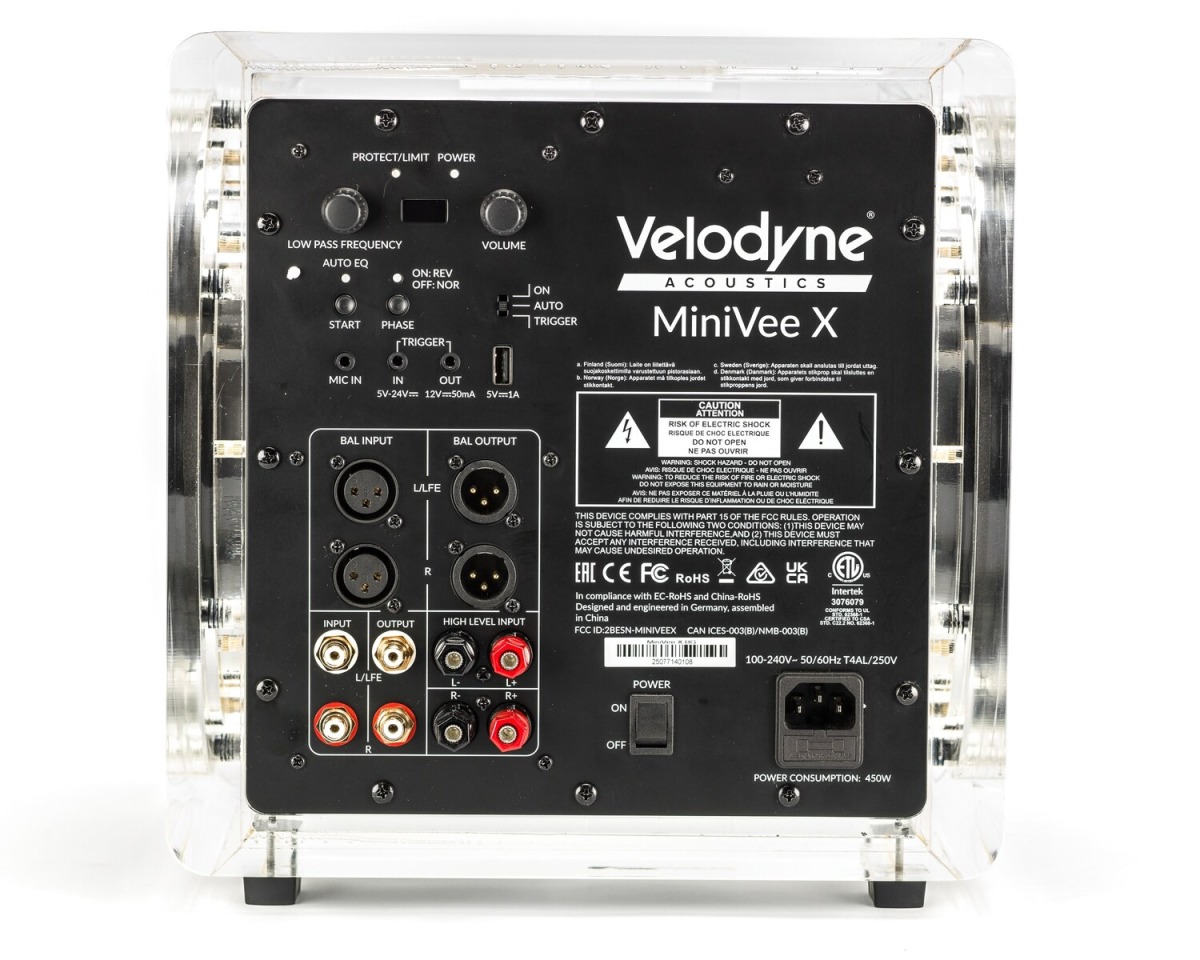 Velodyne MiniVee X Acryl connection panel
The back panel is unusually complete for a compact subwoofer, and the acrylic version is the only way you will ever see it without turning the box around.
- Line level in stereo or LFE, on both unbalanced RCA and balanced XLR, each with a matching output so you can daisy-chain a second one.
- Speaker level binding posts, so an integrated amplifier with no subwoofer output is not a dealbreaker. That is rarer than it should be at this size.
- A 12V trigger input on a 3.5mm jack, and a trigger output with a five second delay.
- A 5V USB socket that exists only to power Velodyne’s Wi-Connect II wireless receiver, which is sold separately. It is not a data port and it will not charge your phone.
Two more things the panel gives away: it is rated at 450W power consumption, which is what a 350W amplifier draws when it is working, and the label reads “designed and engineered in Germany, assembled in China”. Velodyne is a German company now, whatever you remember of the American original.
Setup runs through Velodyne’s Auto EQ SUB app on iOS and Android, and a measurement microphone is included rather than sold as an extra. The app sets gain, crossover and phase, and it does room correction. Below 300Hz is exactly where correction earns its keep, because your walls and ceiling will wreck the response no matter how carefully you place the box. That matters more than the acrylic does.
How it sits against the compact competition
All of these are dual-driver or driver-plus-radiator designs in roughly the same footprint, and all four are in our database.
 The SVS 3000 Micro, the obvious rival at a lower price
The SVS pair are the awkward comparison. Both have two powered drivers rather than one plus a radiator, more amplifier power, and lower quoted extension, for less money than even the black MiniVee X. What the Velodyne answers with is the connection panel, the included measurement microphone, and a genuinely sealed acoustic design. Whether that is worth the difference is a real argument. Whether the acrylic is worth another $800 on top is a different one entirely, and it is not an acoustic question.
Questions answered
Questions answered
How much is the acrylic MiniVee X, and is it new?
$2,299 in the US against $1,499 for black or white, all three listed in stock on Velodyne Acoustics USA. In Europe it is EUR 1,999 against EUR 1,299, and the black launched at EUR 999 in 2024. It is a limited edition, so it will not be around forever.
Does the acrylic cabinet sound different?
Velodyne has not claimed that it does, and every published specification is identical to the black model. Treat it as a finish. Any difference in cabinet resonance between thick acrylic and painted MDF is not something either of us can measure from a press release.
Why does your database say 32Hz when Velodyne says 18Hz?
Velodyne quotes both. The 18Hz to 300Hz figure carries no tolerance; the 32Hz to 180Hz figure is specified at plus or minus 3dB. We store the one with the tolerance so it can be compared honestly against rivals who publish bounded numbers.
Is there a wireless option?
Yes, but it costs extra. The Wi-Connect II receiver is sold separately, and the USB socket on the back panel exists to power it. Out of the box the MiniVee X is a wired subwoofer with a very good set of inputs.
What I keep turning over is who this is for. A subwoofer is the one box in a system with no reason to be seen, and Velodyne is charging a 53% premium to make it visible. I can see the appeal next to a turntable or a pair of speakers you already chose partly on looks. I cannot see it in a room where the sub lives behind the sofa. Would you pay the $800 to look at it?