At CEDIA Expo 2026 in Denver, eCoustics gave SVS its Best Budget Home Theater award. The room was a 5.2.2 system, which means five main speakers, two subwoofers and two height speakers. eCoustics put the price at just under 12,000 dollars for the speakers alone, in a show where many rooms cost more than half a million.
Every product in that room is already in our database. So I added it up at SVS's own list prices, and then priced the same layout with cheaper towers and smaller subwoofers.
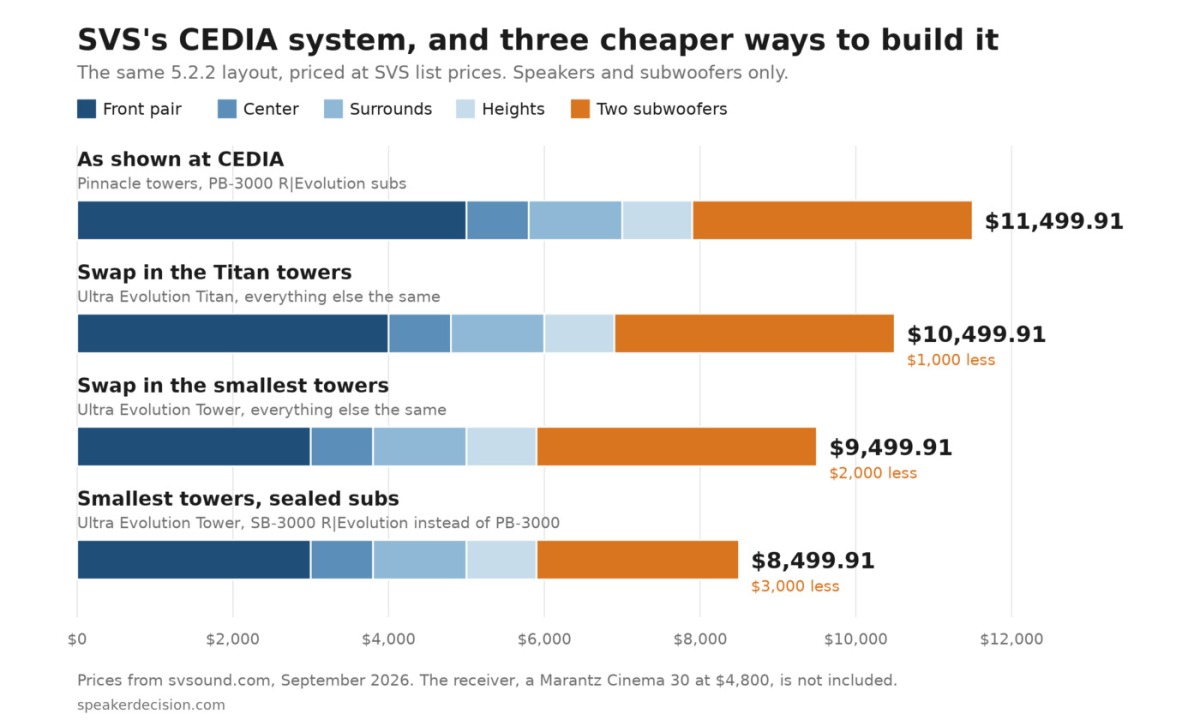 The SVS 5.2.2 system from CEDIA 2026 at SVS list prices, and the same layout built three cheaper ways
Quick facts
- The CEDIA system comes to 11,499.91 dollars at SVS list prices. That matches the “just under 12,000” eCoustics reported.
- The front towers and the two subwoofers are 75 percent of the bill. The center, surrounds and heights together are 2,899.95.
- Swap to the smallest Ultra Evolution towers and sealed subwoofers and the same layout is 8,499.91.
- The receiver is not in that price. SVS used a Marantz Cinema 30 at 4,800 dollars.
- SVS prices for this series have not moved since the range shipped in 2024.
What was in the room
eCoustics lists the parts, and all nine boxes are ones we track.
I checked each price against svsound.com this week. All of them match what SVS listed when the Ultra Evolution range started shipping in 2024. Two and a half years on, not one has changed.
The heights are worth a word. They are not up-firing speakers that bounce sound off the ceiling. They mount high on the wall or on the ceiling and point at you, so they do not depend on a low, flat ceiling to work. For a lot of real living rooms that is the more practical choice.
The same room, three cheaper ways
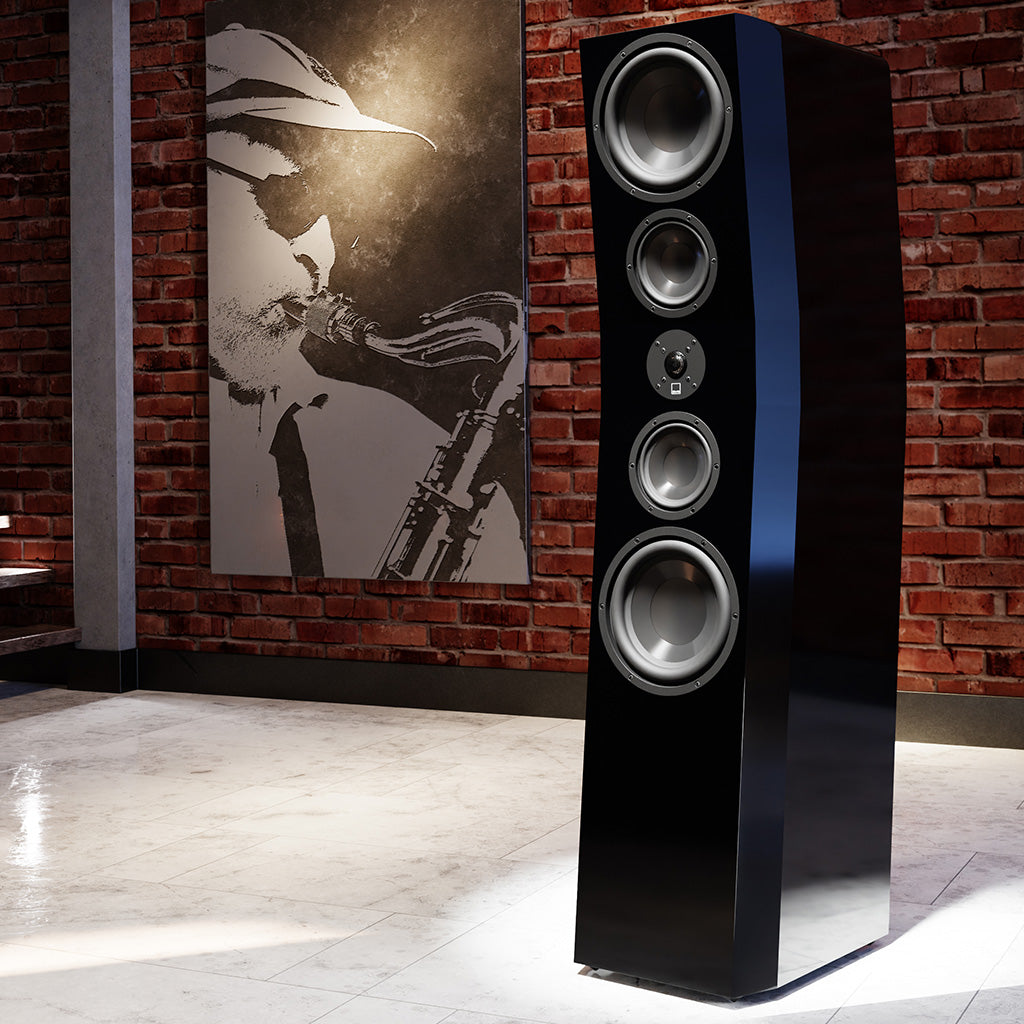 The SVS Ultra Evolution Pinnacle, the front pair in the CEDIA system and the most expensive part of it at 4,999.98 dollars a pair
The Pinnacle pair is the single biggest line on the bill, at 4,999.98. SVS sells two smaller towers in the same series. Keeping everything else the same:
If you want to go further, the Ultra Evolution Nano is 899.98 a pair against 1,199.98 for the Bookshelf. Using Nanos as surrounds takes off another 300.
So what do you give up with the smaller towers? On paper, less than you might think in this particular system.
| Pinnacle | Titan | Tower |
|---|
| Price per pair | 4,999.98 dollars | 3,999.98 dollars | 2,999.98 dollars |
| Woofers | four 8 inch | four 6.5 inch | four 5.25 inch |
| Midrange | two 5.25 inch | two 4.5 inch | two 4.5 inch |
| Low extension | 24 Hz | 27 Hz | 30 Hz |
| Sensitivity | 88 dB | 88 dB | 87 dB |
| Height | 1,275 mm | 1,197 mm | 1,130 mm |
| Weight each | 43.9 kg | 31.6 kg | 27.0 kg |
The biggest difference between the three is how low and how loud they go on their own. But in a system with two subwoofers, the receiver sends the deep bass to the subwoofers and the towers never have to play it. That is my judgement rather than a measurement. Still, it means the Pinnacle's lower extension is doing much less work here than it would in a stereo system with no subwoofer.
What you do keep giving up is output. Four 8 inch woofers move a lot more air than four 5.25 inch ones. In a big room played loud, that matters. In a normal living room, the Tower version is probably the smarter place to put the savings.
| FEATURE and SPECS COMPARISON | |  |  |  |
| Model | SVS Ultra Evolution Pinnacle | SVS Ultra Evolution Titan | SVS Ultra Evolution Tower |
| Speaker Type | Passive Floor-standing | Passive Floor-standing | Passive Floor-standing |
| Enclosure Type | Ported | Ported | Ported |
| Driver Setup | 3-way | 3-way | 3-way |
| Tweeter | 1" Dome Tweeter | 1" Dome Tweeter | 1" Dome Tweeter |
| Mid-Range | 5.25" Composite glass-fiber cone Midrange | 4.5" Composite glass-fiber cone Midrange | 4.5" Composite glass-fiber cone Midrange |
| Woofer | 4 x 8" Composite glass-fiber Woofer | 4 x 6.5" Composite glass-fiber Woofer | 4 x 5.25" Composite glass-fiber Woofer |
| Frequency Range / Low | 24Hz | 27Hz | 30Hz |
| Frequency Range / High | 40kHz | 40kHz | 40kHz |
| Impedance Nominal | 6Ω | 6Ω | 6Ω |
| Sensitivity | 88dB | 88dB | 87dB |
| Max Power (RMS) | 300w | 300w | 300w |
| Crossover Frequency | 140HZ and 1800Hz | 160HZ and 1900Hz | 170HZ and 1800Hz |
| Port Position | rear | rear | rear |
| Available Colors | Piano Gloss Black,Piano Gloss White,Black Oak Veneer | Piano Gloss Black,Piano Gloss White,Black Oak Veneer | Piano Gloss Black,Piano Gloss White,Black Oak Veneer |
| Grille | Yes | Yes | Yes |
| Height | 1275.0mm | 1197.0mm | 1130.0mm |
| Width | 300.0mm | 249.0mm | 218.0mm |
| Depth | 461.0mm | 439.0mm | 424.0mm |
| Weight | 43.90kg | 31.60kg | 27.00kg |
| MSRP(pair) | 4999USD | 3999USD | 2999USD |
| Check Current Price | Amazon | Amazon | Amazon |
Ported or sealed subwoofers
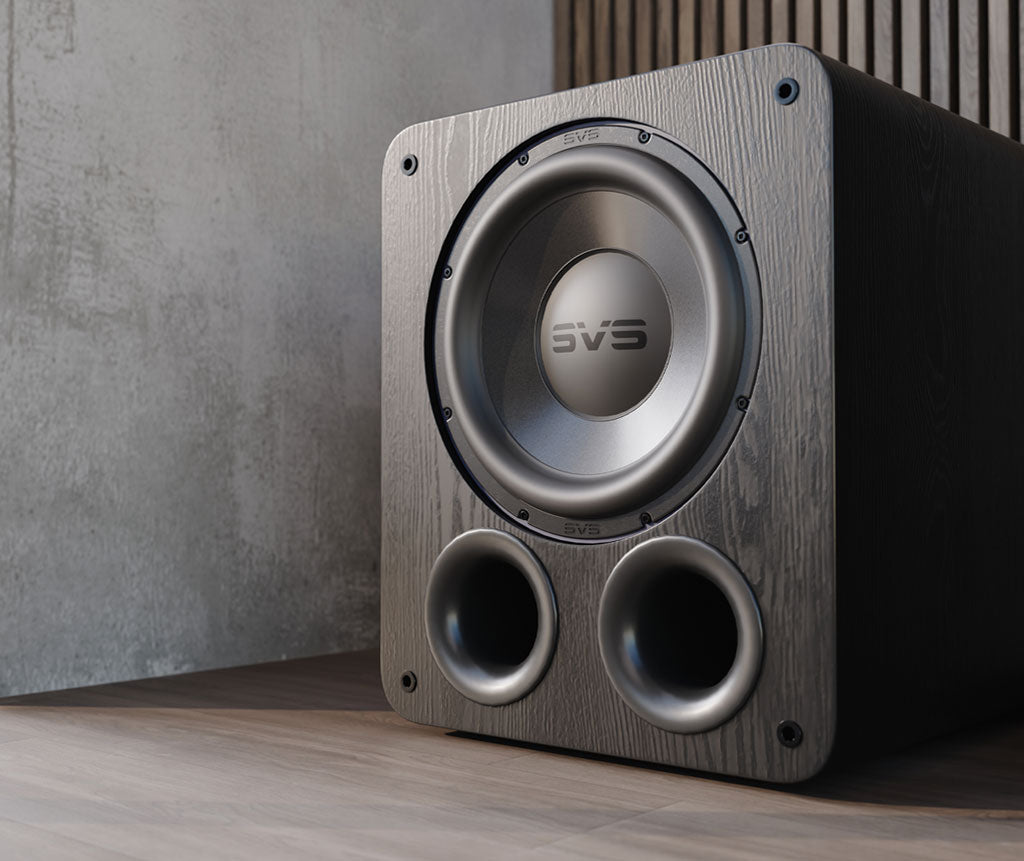 The SVS PB-3000 R-Evolution, a ported 13 inch subwoofer rated to 16 Hz. The CEDIA room used two.
The last 1,000 dollars comes from the subwoofers. SVS rates the two 13 inch models almost the same on paper: 16 Hz for the ported PB-3000 R|Evolution and 17 Hz for the sealed SB-3000 R|Evolution. They share the same amplifier rating, 1,200 watts.
The difference is the box. By our dimensions the PB-3000 R|Evolution is 162 liters and the SB-3000 R|Evolution is 65 liters. The ported sub is two and a half times the size, and you need two of them. That extra volume buys more output at the very bottom, which is what the ports are for. The sealed one gives up some of that for a box you can actually hide. We have covered that trade-off before, and it applies here exactly.
| FEATURE and SPECS COMPARISON | |  |  |
| Model | SVS PB-3000 R|Evolution | SVS SB-3000 R|Evolution |
| Driver | 13" Aluminum | 13" Aluminum |
| Enclosure | Ported | Sealed |
| Firing Direction | Front | Front |
| Amplifier Power (RMS) | 1200 watts | 1200 watts |
| Amplifier Power (Peak) | 4000 watts | 4000 watts |
| Amplifier Class | Sledge STA-1200D2 Class D | Sledge STA-1200D2 Class D |
| Frequency Response | 16-235 Hz | 17-230 Hz |
| Low Pass Crossover | 30-200 Hz | 30-200 Hz |
| Phase | Yes | Yes |
| Line Level Inputs | Stereo RCA/LFE | Stereo RCA/LFE |
| Height | 556.0mm | 396.0mm |
| Width | 465.0mm | 386.0mm |
| Depth | 627.0mm | 427.0mm |
| MSRP | 1800 USD | 1300 USD |
| Check Current Price | Amazon | Amazon |
Why “budget” needs an asterisk
This is a good system at a fair price for what it is. But 11,499.91 is not what the room cost, and the award wording hides that.
The price covers speakers and subwoofers only. The room ran on a Marantz Cinema 30, which is 4,800 dollars. That takes you to 16,299.91 before a disc player, a projector or a screen.
If you are shopping for the whole room, the receiver is 29 percent of the audio bill. It is also one of the receivers where Dirac Live room correction is a paid extra rather than included. Audyssey MultEQ XT32 is built in.
And the Pinnacle is a big speaker. At 1,275 mm tall and 43.9 kg each, it wants a room with space around it, and so do two 162 liter subwoofers. eCoustics also notes the demo was in an open-topped show booth, which is a very different acoustic space from a living room with four walls and a ceiling.
SVS Ultra Evolution Pinnacle Passive Floor-standing Speaker Key Specs
- 3-way Bass Reflex Design
- 1" Dome Tweeter
- 2 x 5.25" Composite glass-fiber cone Midrange
- 4 x 8" Composite glass-fiber Woofer
- 24-40k Hz Frequency Response
- Crossover Frequency at 140HZ and 1800Hz
- 88 dB Sensitivity
- 6ohms Nominal Impedance
- Power Range: 20-300watts RMS
- Weight:96.70 lbs / 43.90 kg
- Dimensions (H x W x D): 50.2" x 11.8" x 18.1" / 1275 x 300 x 460.7mm (D)
- Read the Review
Questions answered
How much did the SVS CEDIA home theater system cost?
11,499.91 dollars at SVS list prices, for two Ultra Evolution Pinnacle towers, an Ultra Evolution Center, two Ultra Evolution Bookshelf surrounds, two Ultra Evolution Elevation heights and two PB-3000 R|Evolution subwoofers. The Marantz Cinema 30 receiver it ran on is another 4,800.
What is the cheapest way to build the same system?
Keep the layout and swap the Pinnacles for Ultra Evolution Towers and the subwoofers for SB-3000 R|Evolution sealed models. That comes to 8,499.91. Using Ultra Evolution Nano speakers as surrounds takes off another 300.
Is the Ultra Evolution Elevation an up-firing Atmos speaker?
No. It mounts on the wall or ceiling and aims directly at the listener. That means it does not need a low, flat, reflective ceiling to work, which up-firing speakers do.
Do the smaller towers lose much with two subwoofers?
Less than they would on their own. With bass management the receiver sends the deepest bass to the subwoofers, so the 24 Hz against 30 Hz difference in rated tower extension matters much less. What you still lose is output, because the Pinnacle's four 8 inch woofers move far more air than the Tower's four 5.25 inch ones.
So here is my question. If you were building this room, would you spend the extra 3,000 on the Pinnacles and the ported subs, or keep it and put it toward the receiver and a proper screen?
FIND THIS INTERESTING? SHARE IT WITH YOUR FRIENDS!