The spot where a subwoofer measures best is almost never the spot near your amplifier. So you either run a long cable through a wall, or you run it across the floor and hope nobody trips.
SVS has a new answer. The SoundPath Multi-Band Wireless Audio Adapter is 229.99 dollars, on sale now, and it sends a full stereo signal 165 feet without a cable.
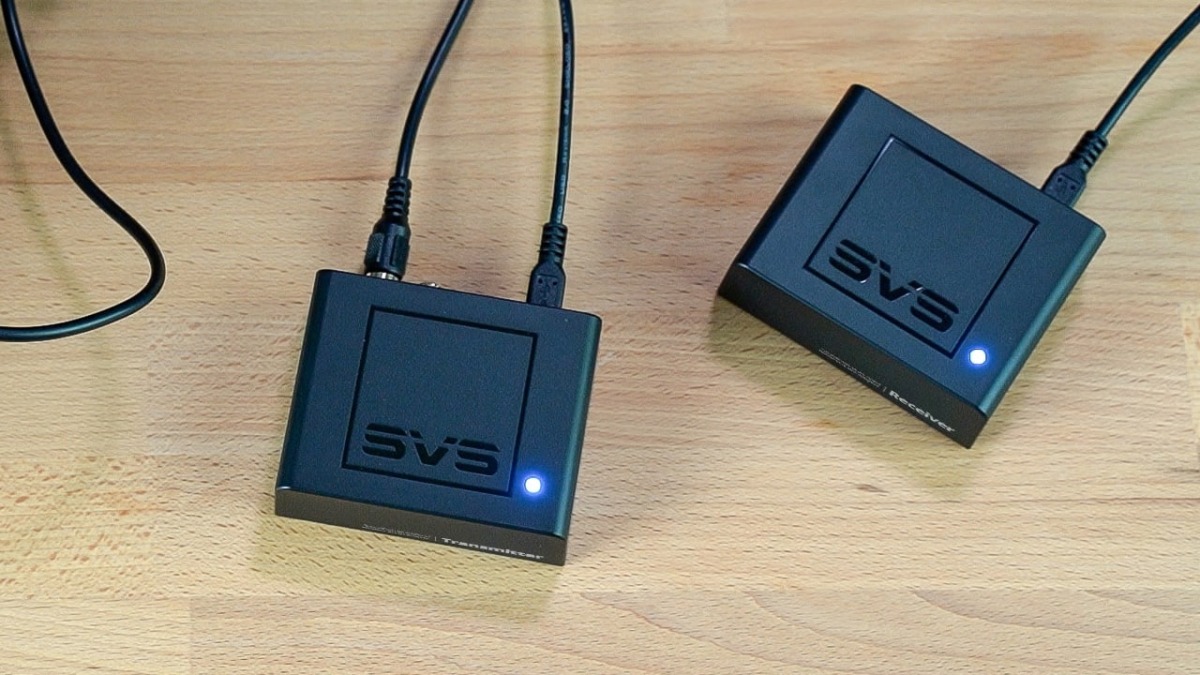 SVS SoundPath Multi-Band transmitter and receiver
Quick facts
- 229.99 dollars for one transmitter and one receiver. Up to four receivers per transmitter.
- 24-bit / 48 kHz stereo, rated 3 Hz to 20 kHz, plus or minus 0.5 dB.
- 165 feet line of sight, auto-switching across 46 channels on 5.2 and 5.8 GHz.
- Under 15 milliseconds of delay. RCA in, RCA out, no app, pre-paired.
- It does not make a passive speaker wireless. That part matters, and it is below.
The thing it will not do, and why that matters for SVS owners
This is the part to read before anything else.
The transmitter takes a line-level analogue signal on RCA. The receiver puts a line-level analogue signal back out on RCA. So the far end still needs something with its own amplifier and its own mains power: a powered subwoofer, a powered speaker, or a power amplifier feeding passive speakers on short cables.
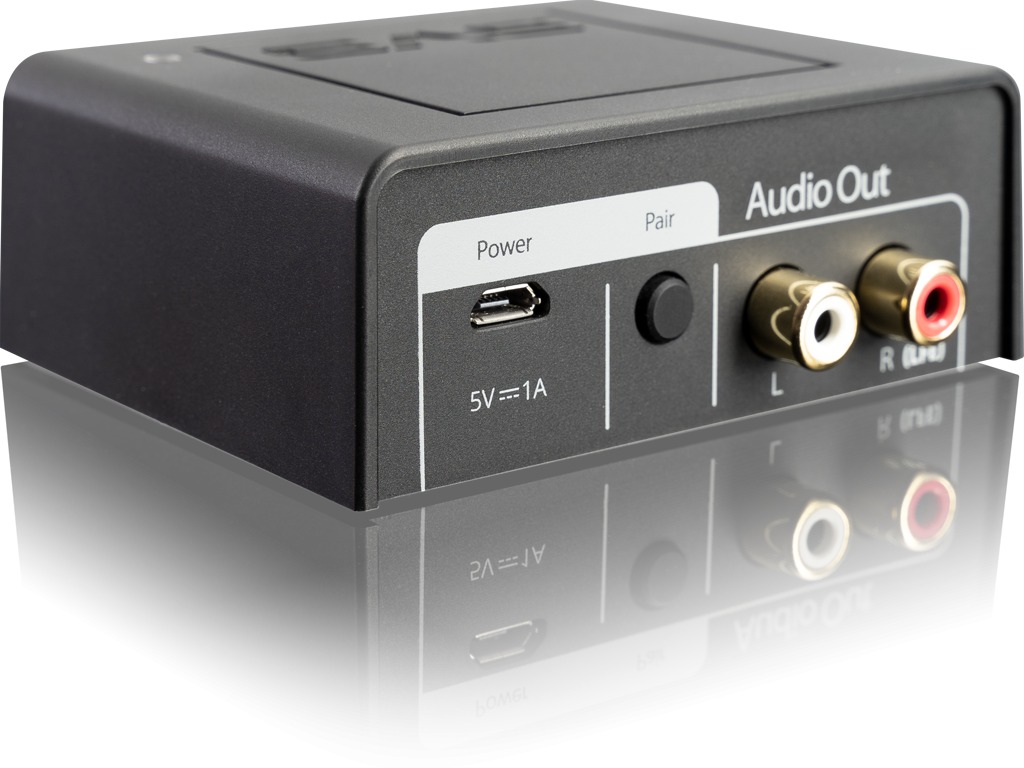 The receiver end: RCA line outputs and a USB power socket
A passive speaker cannot use it on its own. And that rules out most of the SVS range. Of the 18 SVS speakers we list, 16 are passive, including every Ultra Evolution and every Prime model. For those, the adapter removes the long cable between your processor and a remote amplifier. It does not remove the amplifier.
The two powered ones are the Prime Wireless and the Prime Wireless Pro, and even there it is worth being precise. Prime Wireless Pro is one active speaker plus one passive companion, joined by a supplied cable. Feeding it a SoundPath signal makes the pair wireless from the source. It does not make the two speakers wireless from each other.
Where it does work cleanly is subwoofers, because a powered subwoofer already has an amplifier and a plug.
How many subwoofers actually need one
We list 270 subwoofers. Wireless is recorded for 149 of them, and of those, 95 have no wireless option at all. That is where a box like this earns its money.
SVS is a good example of the pattern. We hold 27 SVS subwoofers, from the 499 dollar PB-1000 to the 3,000 dollar PB17-Ultra R Evolution, and not one of them has wireless built in. Seven are marked as wireless-optional, which means exactly this adapter. SVS has always sold the radio separately rather than building it into every cabinet.
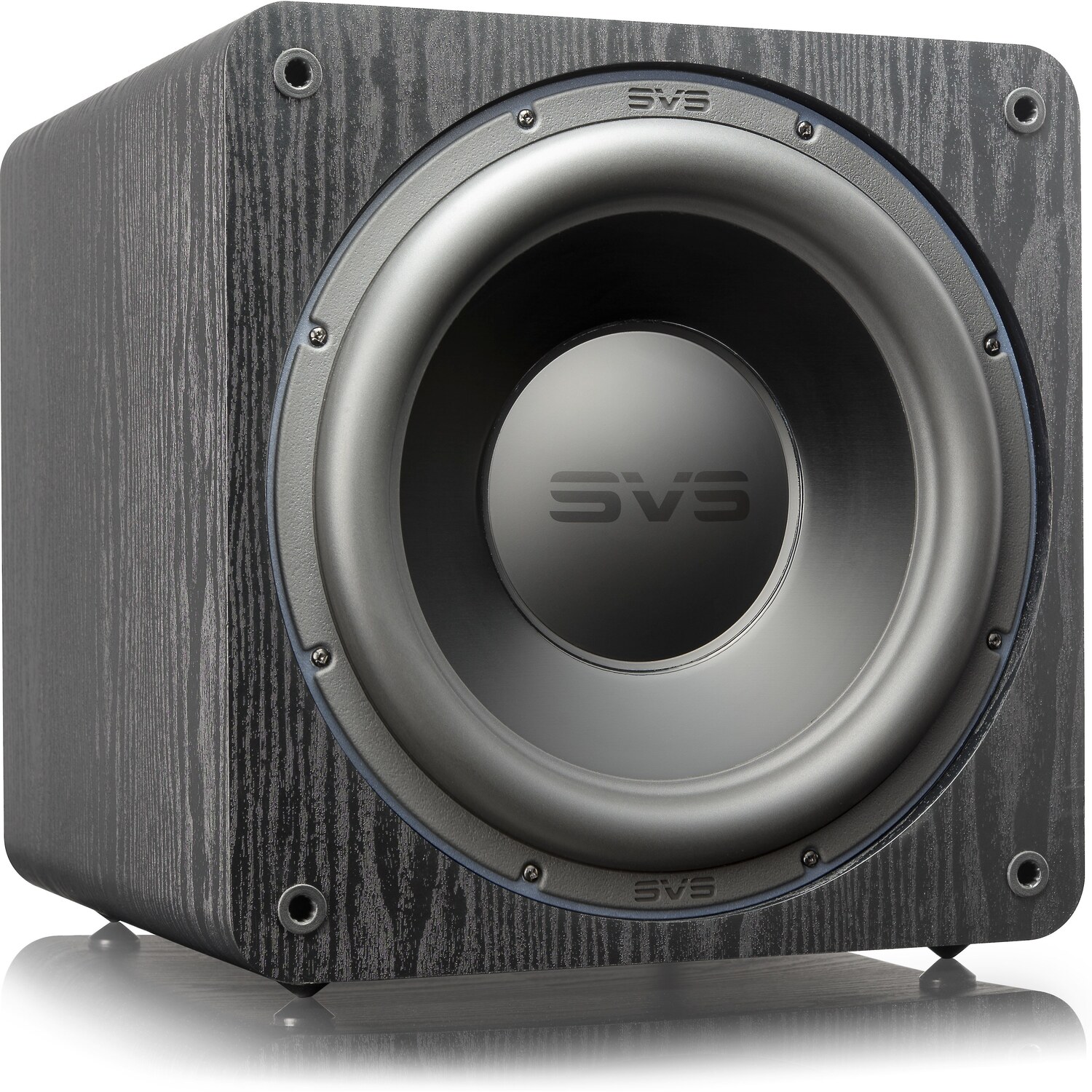 The SVS SB-3000, one of 27 SVS subwoofers we list with no wireless built in
The SB-3000 above is typical of the range. Whether that is the right call is a fair argument. It keeps the price of the subwoofer down for people who will never need it, and it costs more for people who do.
Three adapters now, and newer is not uniformly better
SVS sells three of these, 50 dollars apart, and the newest is not better at everything.
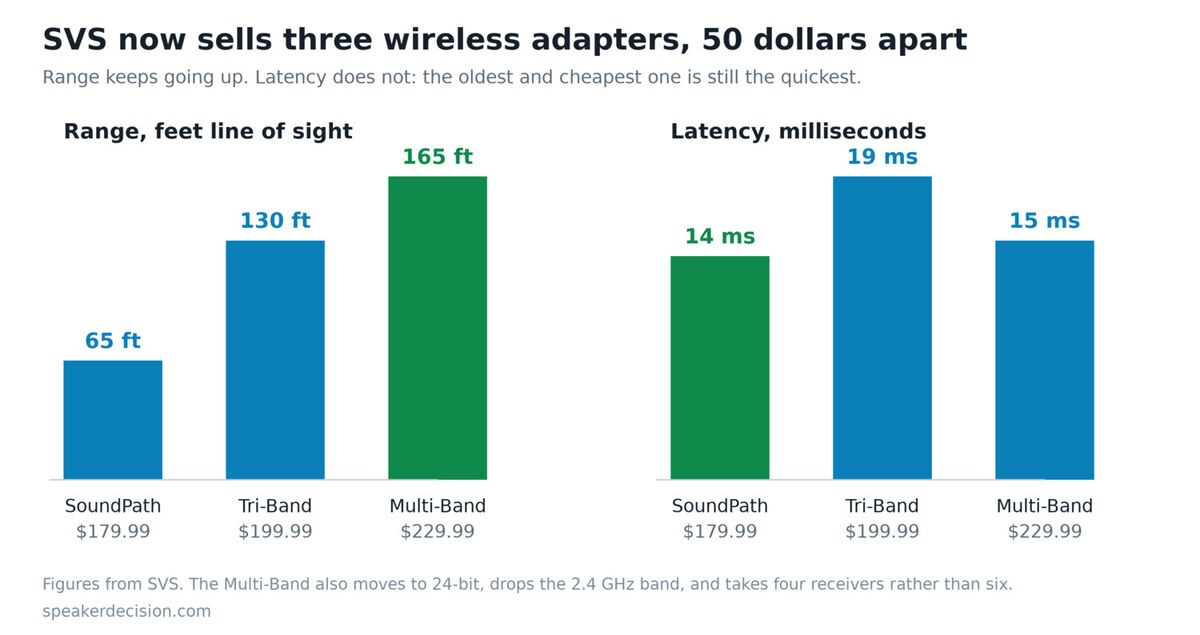 The three SVS SoundPath wireless adapters compared on range and latency
| SoundPath | Tri-Band | Multi-Band |
|---|
| Price | $179.99 | $199.99 | $229.99 |
| Bands | 2.4 GHz | 2.4 / 5.2 / 5.8 | 5.2 / 5.8 |
| Range, line of sight | 65 ft | 130 ft | 165 ft |
| Resolution | 16-bit / 48 kHz | 16-bit / 48 kHz | 24-bit / 48 kHz |
| Latency | 14 ms | under 19 ms | under 15 ms |
| Frequency response | 6 Hz to 22 kHz | 6 Hz to 20 kHz | 3 Hz to 20 kHz |
| Receivers per transmitter | up to 6 | up to 6 | up to 4 |
Three things go backwards on the new one. The oldest and cheapest adapter has the lowest latency, at 14 ms against 15. It also reaches higher, to 22 kHz. And the Multi-Band takes four receivers where the older two take six, so a big multi-subwoofer install may want the Tri-Band instead.
What you gain is range, bit depth, and getting off 2.4 GHz entirely. That last one is the real argument. 2.4 GHz is where your router, your doorbell, your microwave and half your smart plugs live.
Small things worth knowing
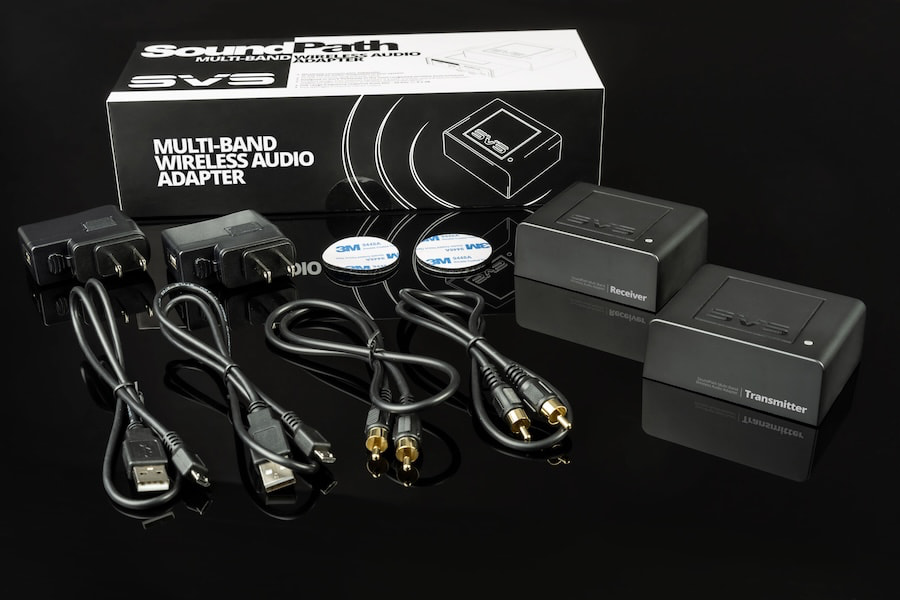 What comes in the SoundPath Multi-Band box
Your receiver will report the subwoofer in the wrong place. SVS say an AV processor may show the sub 14 to 20 feet further away than it physically is, because it is measuring the wireless delay as distance. That is correct behaviour, not a fault, and room correction handles it. It still looks alarming the first time.
165 feet means line of sight. Not 165 feet through two walls and a kitchen. SVS's own manual asks for line of sight where possible and says walls and distance still matter.
The box is well filled. Two mono RCA cables, two USB power cables and two USB power adapters, and the pair arrives already paired. No app, no network setup.
One nitpick. SVS's own page calls the 24-bit / 48 kHz signal "CD-quality". CD is 16-bit / 44.1 kHz, so the adapter is actually better than that. It is odd to undersell your own spec.
The alternatives
SVS is not alone here, and some rivals are much cheaper.
The Dynasty ProAudio WSA-5TR-V2 is about 98 dollars and does the same 5.2 and 5.8 GHz switching at 24-bit / 48 kHz, but reaches 100 feet line of sight rather than 165. RSL's Wireless Audio Connection Kit is around 100 dollars, on 2.4 GHz, good for 50 feet, with extra receivers at 50 dollars each.
REL, whose ten subwoofers we list, sells its own: the HT-Air MKII at about 149 dollars on 5.8 GHz, 40 feet, 17 ms, plus the AirShip Direct and Arrow for specific REL models.
So none of the individual features is unique. What SVS has put in one box is the long range, the 24-bit link, the 5 GHz-only operation and the fact that it works with anything that takes RCA, rather than only with its own subwoofers.
Is 230 dollars worth paying to move your subwoofer to where it actually measures best, or would you rather spend it on the subwoofer?