Over the last few weeks I have been building calculators. It started with one question people ask me all the time: will this amplifier drive these speakers? Then the list kept growing. There are now 11 of them, all free, all at speakerdecision.com/tools.
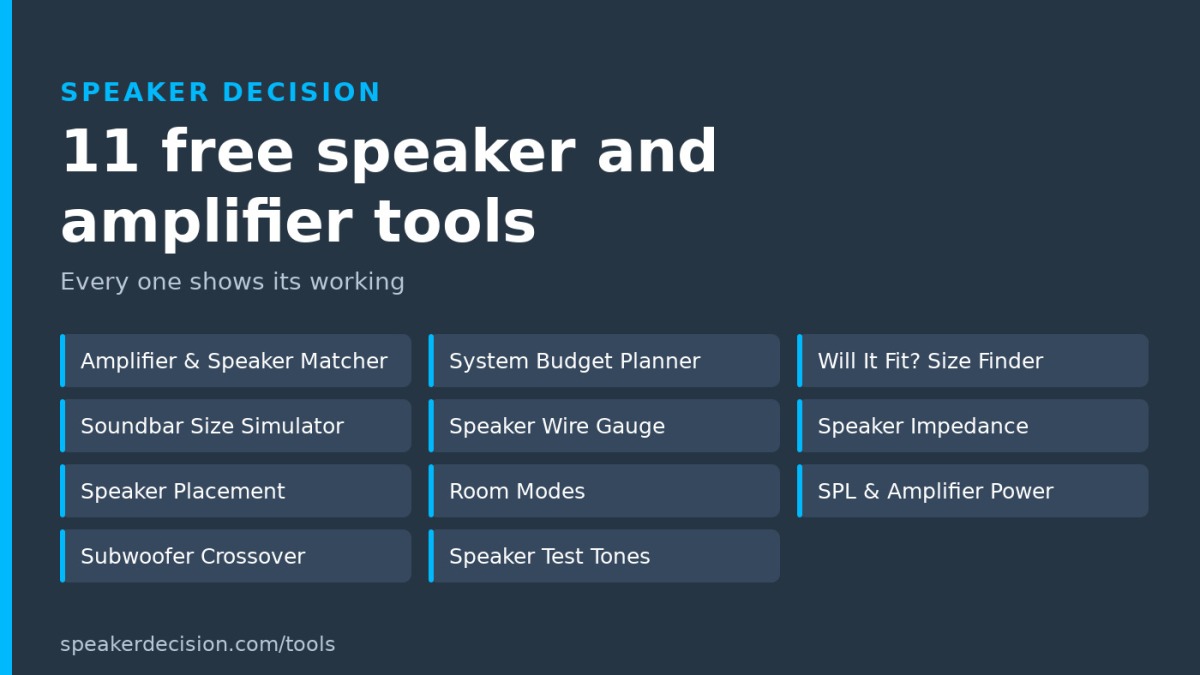 The 11 free speaker and amplifier tools on Speaker Decision
I built them for one reason. Most audio calculators on the web give you a number and no way to check it. And quite a few of them are wrong. So every tool here has a Show the working panel. It lists each term that went into the answer, and it says which parts are physics and which are a judgement call.
The 11 tools
- Choosing: amplifier and speaker matcher, system budget planner, will it fit, soundbar size simulator.
- Wiring: speaker wire gauge, speaker impedance.
- Room and placement: speaker placement, room modes.
- Level and power: SPL and amplifier power, subwoofer crossover. Setting up: speaker test tones.
Tools for choosing
Amplifier and Speaker Matcher. Pick your speakers. It works out how much power they need for your room and how loud you listen, checks that the impedance is safe, and then ranks all 297 stereo amplifiers we list against them.
System Budget Planner. Type in a total and it splits it across speakers, amplifier and subwoofer. For stereo the split is 50 percent speakers, 35 percent amplifier and 15 percent for cables and stands. Then it fills every slot with a real model, and the matcher picks the amplifier to suit the speakers it chose. So you get a system that works, not three products that add up.
Will It Fit? Measure your shelf or alcove and it shows every speaker that fits. It also warns you when a speaker has a rear port. Pushed against a wall, those get boomy.
Soundbar Size Simulator. Pick your TV size and how the TV stands. It draws any soundbar in front of it, to scale, and shows if the bar would cover the bottom of the picture.
Tools for wiring
Speaker Wire Gauge Calculator. How thick your cable needs to be for the length of the run. The most common mistake in wire tables on the web is forgetting that current goes down one wire and back up the other. So the resistance counts twice. This calculator does count it twice.
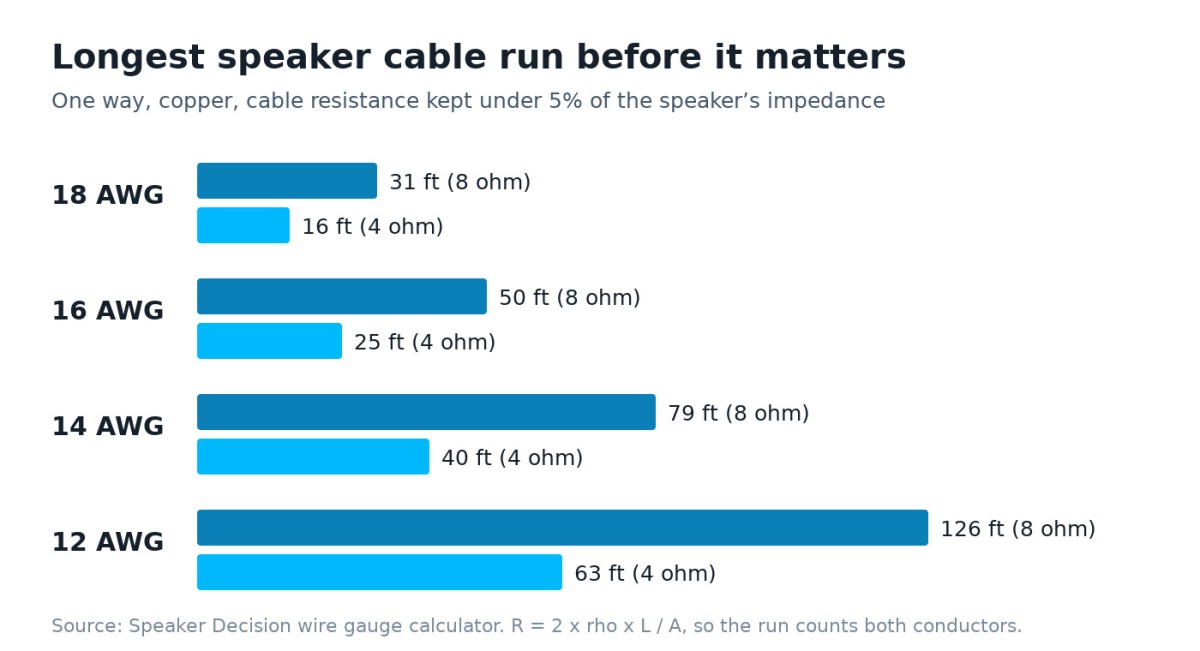 The longest speaker cable run for each wire gauge at 8 and 4 ohms
The rule it uses is simple: keep the cable under 5 percent of the speaker’s impedance. That is about 0.4 dB of loss. Ordinary 16 gauge cable is fine up to 50 feet for an 8 ohm speaker, but only 25 feet for a 4 ohm one. Most people need thicker cable than the box that came with the speakers, but not the expensive kind.
Speaker Impedance Calculator. Wire two or more speakers in series or in parallel, and see the load your amplifier really sees. Two 8 ohm speakers in parallel make 4 ohms. If your receiver says "8 ohms minimum", that can make it run hot or shut down. The tool tells you that in plain words.
Tools for your room
Speaker Placement Calculator. It draws your room from above. It shows how far apart the speakers should be, how far from the walls, and where the first reflection hits the side wall. That is the exact spot where an acoustic panel helps most.
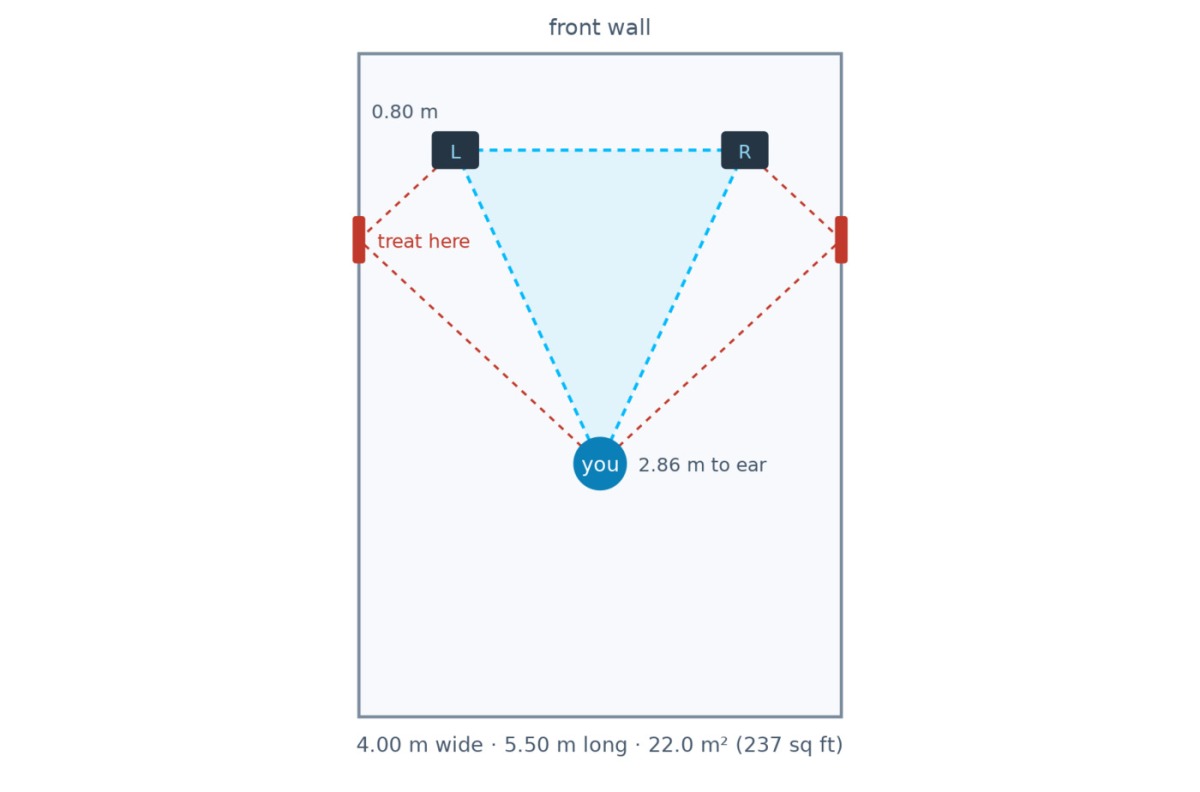 The plan view drawn by the speaker placement calculator
It also shows something most placement guides skip. Sound from the speaker bounces off the wall behind it and cancels part of the bass. With the speaker 0.5 metres from the wall, the dip lands at about 171 Hz. No distance makes it go away. You can only move it somewhere it hurts less.
Room Mode Calculator. Type in your room size. It lists the bass notes your room makes louder or cancels, and shows where they pile up. This is why moving your sofa a little can change the bass more than any cable.
Tools for level and power
SPL and Amplifier Power Calculator. How loud a speaker plays with a given amplifier at your seat, or how many watts you need to reach a target level. Two things make SPL calculators disagree, and here both are settings you can change. One is how fast sound drops off in a real room. The other is sensitivity: makers publish it at 2.83 volts, and on a 4 ohm speaker that flatters the number by 3 dB. Many calculators miss that and tell you half the power you really need.
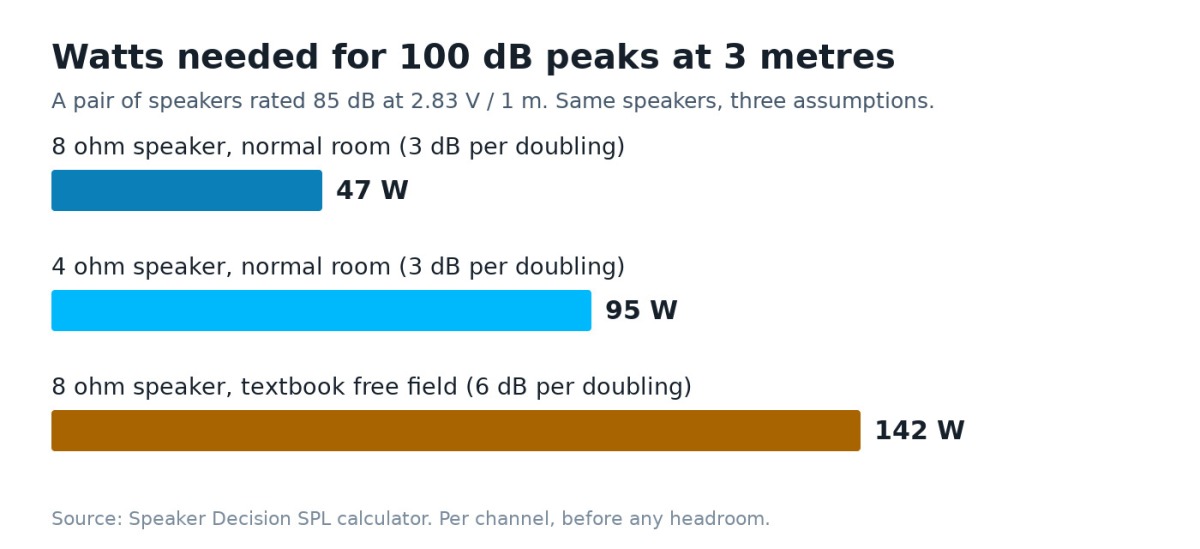 Watts needed for 100 dB peaks at 3 metres under three different assumptions
Here is what that means for one pair of 85 dB speakers. In a normal room you need about 47 watts for 100 dB peaks at 3 metres. If the same rating is on a 4 ohm speaker, you need about 95 watts. And a calculator that uses the textbook free-field rule says 142 watts, three times the honest answer for a living room.
Subwoofer Crossover Calculator. Where to set the crossover between your speakers and a subwoofer. A speaker’s published low limit is where it is already dropping, so the tool crosses a little above it. It also explains why 80 Hz is so common: below it, you cannot hear where the bass comes from.
A tool for setting up
Speaker Test Tones. Left and right check, polarity, a bass sweep, a full frequency sweep, fixed tones and a subwoofer range. Everything is made in your browser, so there is nothing to download. It starts at a low volume on purpose. Steady test tones are much harder on tweeters than music, so turn the amplifier down first.
What these tools cannot do
- They do not hear your room. Real rooms have doors, open plans and soft walls. The room tools tell you where to look, not what you will measure.
- They trust the published specs. The matcher and the SPL calculator use the sensitivity and impedance the maker publishes. A speaker sold as 8 ohms often dips lower, and some sensitivity figures are optimistic.
- The final step is always your ears. Every setup tool ends with the same advice: start here, then adjust by listening.
If you only try one, try the matcher. It answers the question I get asked most.
There is a feedback box at the bottom of the tools page, and I read every answer. So tell me: which calculator were you looking for that is not on the list yet?