What Hi-Fi has just marked its 50th birthday by putting two old BBC monitors back on the test bench, a museum pair of KEF LS3/5A and the Graham Audio LS5/9. You can read it here. It made me look at the Harbeth rows in our database, because Harbeth is the maker still building that idea today.
Same family, same cone material (Harbeth’s own RADIAL), same thin-walled cabinet idea from the BBC research days. The spread is in size, bass and price.
| FEATURE and SPECS COMPARISON | |  |  |  |  |  |
| Model | Harbeth P3ESR XD2 | Harbeth C7ES-3 XD2 | Harbeth M30.3 XD2 | Harbeth SHL5plus XD2 | Harbeth M40.5 XD2 |
| Speaker Type | Passive Bookshelf | Passive Bookshelf | Passive Bookshelf | Passive Bookshelf | Passive Bookshelf |
| Enclosure Type | Ported | Ported | Ported | Ported | Ported |
| Driver Setup | 2-way | 2-way | 2-way | 3-way | 3-way |
| Tweeter | 0.75" Dome Tweeter | 1" Dome Tweeter | 1" Dome Tweeter | 1" Dome Tweeter | 1" Dome Tweeter |
| Mid-Range | - | - | - | - | 8" Midrange |
| Woofer | 1 x 4.5" RADIAL Woofer | 1 x 8" RADIAL Woofer | 1 x 8" RADIAL Woofer | 1 x 8" RADIAL Woofer | 1 x 12" RADIAL Woofer |
| Frequency Range / Low | 75Hz | 45Hz | 50Hz | 40Hz | 35Hz |
| Frequency Range / High | 20kHz | 20kHz | 20kHz | 20kHz | 20kHz |
| Impedance Nominal | 6Ω | 6Ω | 6Ω | 6Ω | 6Ω |
| Sensitivity | 83dB | 86dB | 85dB | 86dB | 86dB |
| Max Power (RMS) | 50w | 150w | 150w | 150w | 650w |
| Grille | Yes | Yes | Yes | Yes | Yes |
| Height | 306.0mm | 520.0mm | 460.0mm | 635.0mm | 750.0mm |
| Width | 190.0mm | 272.0mm | 277.0mm | 322.0mm | 432.0mm |
| Depth | 184.0mm | 305.0mm | 275.0mm | 300.0mm | 388.0mm |
| Weight | 6.10kg | 13.20kg | 11.60kg | 15.80kg | 38.00kg |
| MSRP(pair) | 3790USD | 5290USD | 6290USD | 7990USD | 21990USD |
| Check Current Price | Amazon | Amazon | Amazon | Amazon | Amazon |
Two things stand out. First, bass extension goes down in steady steps: 75 Hz, then 45, 50, 40 and 35 Hz. Second, the numbers are out of price order in one place. I come back to that below, because it is the most useful thing in this post if you are choosing between the two middle models.
Size: the speakers grow, the stands shrink
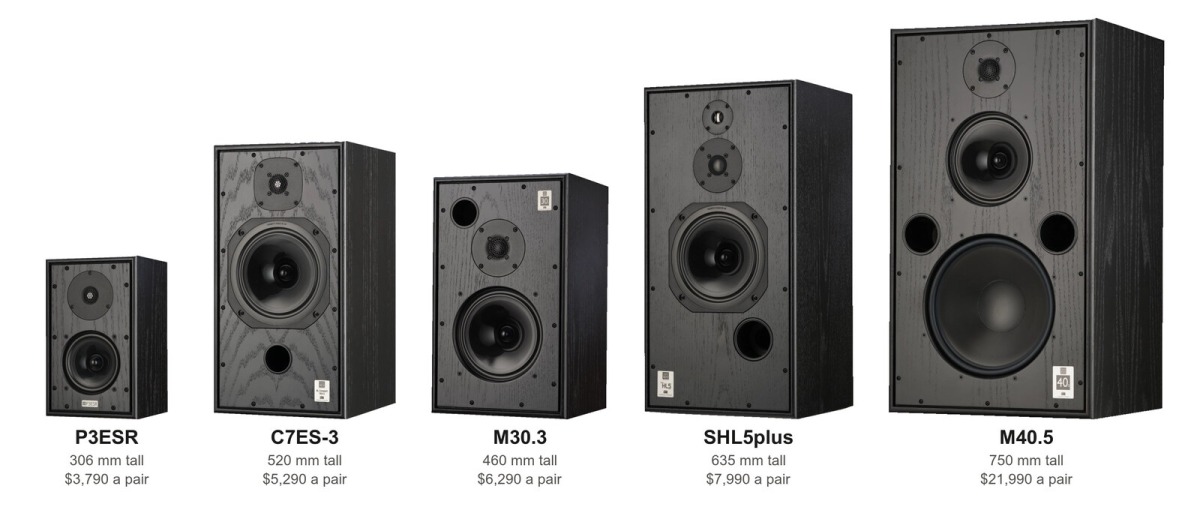 Harbeth XD2 range to scale with height and price per pair
The drawing above is to scale. The P3ESR is 306 mm tall. The M40.5 is 750 mm and weighs 38 kg each. Harbeth still calls the M40.5 a stand-mount, and they mean it. It wants a low, solid stand, not the floor.
That is the part people miss. The bigger the speaker, the shorter the stand. Harbeth publishes how high the tweeter sits above the base of each cabinet. Harbeth also sells its own stand for the P3ESR, and that stand puts the tweeter 970 mm off the floor. So 970 mm is a fair target for a seated ear. Take the tweeter height away from it and you get the stand you need:
| Model | Tweeter above base | Stand for a 970 mm ear |
|---|
| P3ESR XD2 | 230 mm | about 740 mm |
| M30.3 XD2 | 320 mm | about 650 mm |
| C7ES-3 XD2 | 440 mm | about 530 mm |
| SHL5plus XD2 | 475 mm | about 495 mm |
| M40.5 XD2 | 660 mm | about 310 mm |
Measure your own ear height sitting down before you buy stands. A low sofa can easily be 100 mm lower than a dining chair. Our speaker placement calculator does the rest of the geometry.
Here is the most compared pair, the smallest against the M30.3, drawn to scale. You can turn it round:
Size, drawn to scale
Both speakers and both views share one scale, so everything here is directly comparable. Hover a box for its dimensions.
One scale for both, standing on the same surface and pushed back to the same wall, so the deeper one visibly sticks out further.
Harbeth M30.3 XD2 needs about 118% more floor or shelf area. Harbeth M30.3 XD2 is 91mm deeper, so it stands that much further out from the wall. Harbeth M30.3 XD2 is 154mm taller.
C7ES-3 or M30.3? The spec sheet says the cheaper one
This is the odd pair in the range, and it is worth being straight about it.
The C7ES-3 and M30.3 use the same 200 mm RADIAL bass unit and the same 25 mm tweeter. Harbeth gives both the same 25 to 150 W power range. But the C7ES-3 is:
- $1,000 a pair cheaper ($5,290 against $6,290)
- Deeper in the bass on Harbeth’s own figures (45 Hz against 50 Hz)
- 1 dB more sensitive (86 dB against 85 dB)
- Bigger, at 520 mm tall against 460 mm
So what does the extra $1,000 buy? Not anything a spec sheet can show. The M30 carries Harbeth’s “Monitor” name, as the M40 does, and it is a speaker people choose by ear. That is a fair reason. But it is a listening decision, not a numbers decision. If you cannot hear both, the C7ES-3 is the better buy on paper, and by a clear margin.
One practical point. The M30.3 is the shorter cabinet but has the lower tweeter, so it needs a taller stand (about 650 mm against 530 mm). If you already own stands, check them before you pick.
What amplifier each one really needs
Harbeth says every XD2 speaker is “easy to drive”. Our own review page for the P3ESR calls it difficult to drive. Both are true, and the difference is worth understanding.
Impedance is the easy part. All five are a steady 6 ohms, which almost any decent amplifier handles without strain. Sensitivity is the hard part. At 83 dB, the P3ESR turns watts into volume less well than nearly every other bookshelf speaker we list. So it is easy to drive, but it needs a lot of watts to get loud.
I ran all five through our amp and speaker matcher. It works out the power each pair needs to hit 95 dB peaks at your seat, which is loud but normal for music with real dynamics:
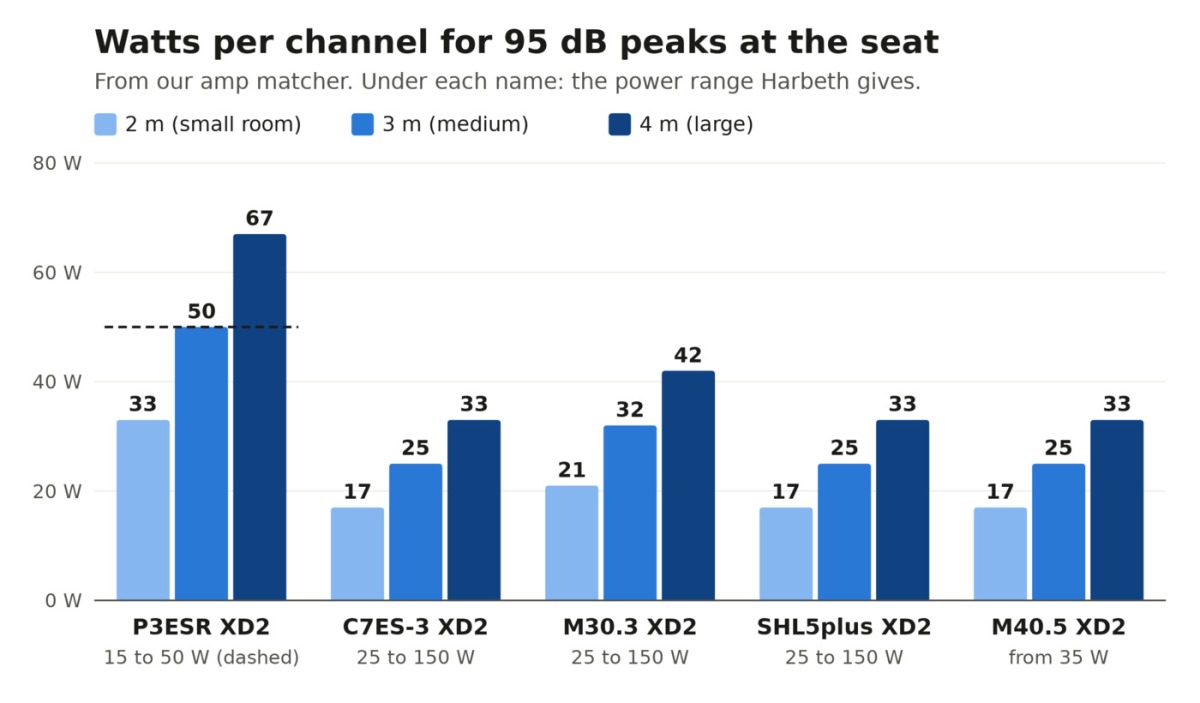 Watts per channel each Harbeth XD2 needs for 95 dB peaks
The four bigger models all land in the same place. Around 25 W a channel covers a medium room, and 35 to 40 W covers a large one. Harbeth’s own suggested minimums (25 W for the C7ES-3, M30.3 and SHL5plus, 35 W for the M40.5) say much the same thing. You do not need a big amplifier for any of them. A good 50 to 100 W integrated amplifier is plenty, and more watts than that buy you nothing you can hear.
You can run the numbers for your own room and seat: C7ES-3, M30.3, SHL5plus, M40.5. The matcher also lists amplifiers from our database that fit.
The weak point: the P3ESR in a bigger room
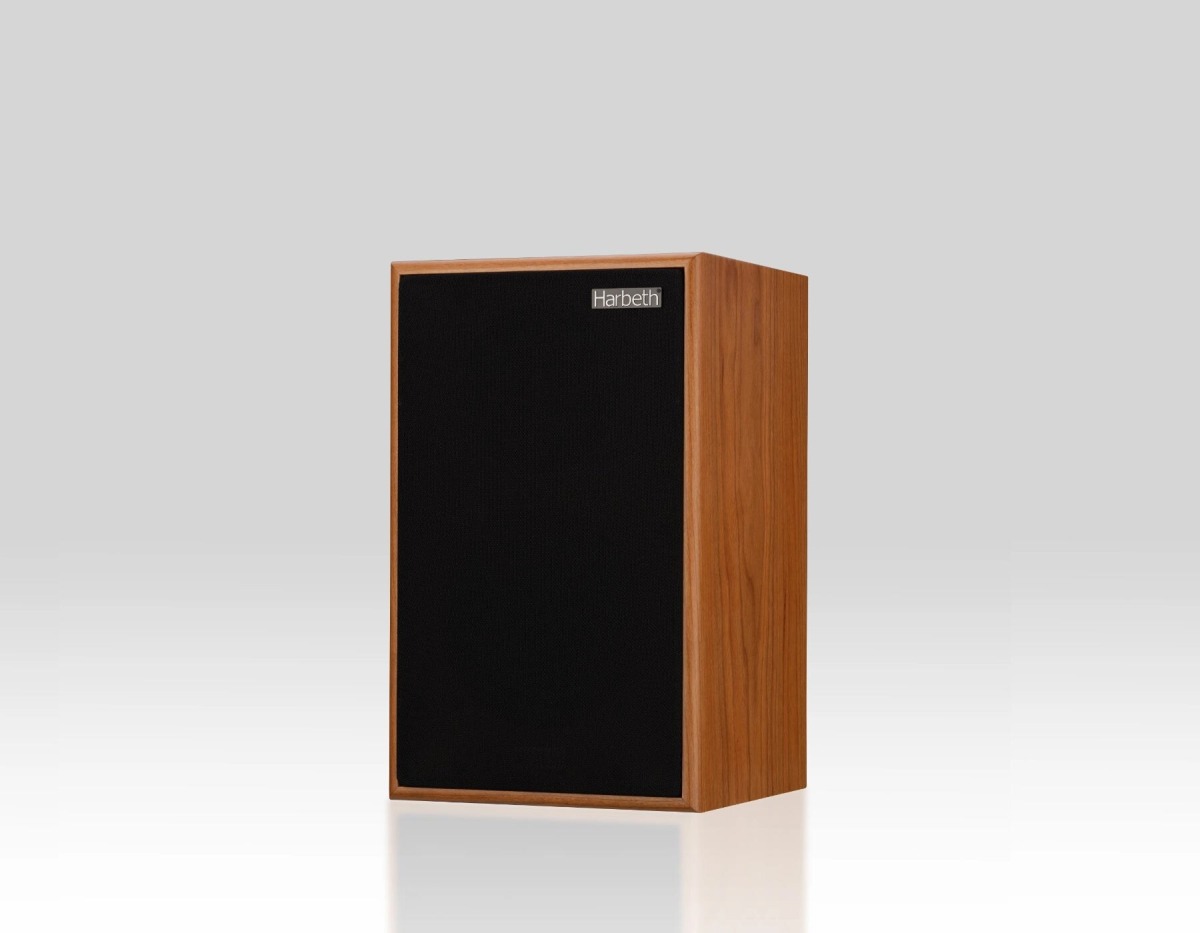 Harbeth P3ESR XD2 in cherry with grille
The P3ESR is the one people come to Harbeth for. It is the LS3/5A idea, and Stereophile has called it the best take on that idea from anyone. I have no reason to argue. But look at the first group of bars in the chart again.
At 2 m it needs 33 W a channel for 95 dB peaks. At 3 m it needs 50 W, which is exactly as much as Harbeth rates it to take. At 4 m it needs 67 W, which it cannot take at all. Try it in the matcher and it says plainly that no amplifier will get you there.
Then there is the bass. The P3ESR stops at 75 Hz. That is fine for voices and small groups. It is not fine for a pipe organ or a film. For the same $3,790 a pair or less, we list 131 passive bookshelf speakers that reach 50 Hz or lower.
Harbeth’s own answer is the Nelson, a stand with a powered bass unit built in that fills in 35 to 75 Hz under the P3ESR. It works on paper. But it is £2,735 a pair in the UK, I could not find a US price, and it is not in our database. So the full fix nearly doubles the cost.
Who does this rule out? Anyone sitting 3 m or more from the speakers who likes to play loud, and anyone who wants real bass without a subwoofer. For a desk, a small study, or a near-field seat at 2 m or less, none of this matters, and the P3ESR is still the one to hear.
What people compare them with
When readers put a Harbeth against another brand, the KEF R3 comes up most. That makes sense as a question and less sense as a match. The R3 is a bigger three-way with a 6.5 inch bass unit, 87 dB sensitive, and goes down to 52 Hz. It was $2,200 a pair, and KEF has since replaced it with the R3 Meta.
| FEATURE and SPECS COMPARISON | | |  |
| Model | Harbeth P3ESR XD2 | KEF R3 |
| Speaker Type | Passive Bookshelf | Passive Bookshelf |
| Enclosure Type | Ported | Ported |
| Driver Setup | 2-way | 3-way |
| Tweeter | 0.75" Dome Tweeter | 1" Dome Tweeter |
| Mid-Range | - | 5" aluminum Midrange |
| Woofer | 1 x 4.5" RADIAL Woofer | 1 x 6.5" Hybrid aluminum Woofer |
| Frequency Range / Low | 75Hz | 52Hz |
| Frequency Range / High | 20kHz | 28kHz |
| Impedance Nominal | 6Ω | 8Ω |
| Sensitivity | 83dB | 87dB |
| Max Power (RMS) | 50w | 180w |
| Grille | Yes | Yes |
| Height | 306.0mm | 423.0mm |
| Width | 190.0mm | 199.0mm |
| Depth | 184.0mm | 337.0mm |
| Weight | 6.10kg | 13.55kg |
| MSRP(pair) | 3790USD | 2200USD |
| Check Current Price | Amazon | Amazon |
Against the P3ESR, the R3 goes 23 Hz deeper, plays 4 dB louder from the same watts, and costs less. What it does not do is sound like a Harbeth, and it is not trying to. If size is not a problem, compare them side by side and be honest with yourself about what you are paying for.
The next cross-brand pair after the two KEF ones is the M30.3 against the JBL L82 Classic MKII. The L82 Classic MKII is $2,900 a pair, 88 dB sensitive, and reaches 44 Hz. Those two could hardly come from further apart in design thinking, which is probably why people want to see them next to each other.
Which one for which room
- P3ESR XD2 ($3,790): desk, small study, or any seat within about 2 m. Small rooms only, unless you add a subwoofer.
- C7ES-3 XD2 ($5,290): the sensible middle of the range. Deeper and cheaper than the M30.3, and fine in a medium room from 25 W.
- M30.3 XD2 ($6,290): buy it because you heard it and preferred it. The specs alone do not make the case.
- SHL5plus XD2 ($7,990): the first three-way, with a supertweeter, and 40 Hz bass. The one for a bigger room without going to the M40.5.
- M40.5 XD2 ($21,990): 35 Hz and a 300 mm bass unit, in a box that still wants a stand. Nearly three times the SHL5plus money for about 5 Hz more bass and a lot more scale.
What we do not list
Harbeth also makes two powered speakers, the NLE-1 (£2,995 a pair in the UK) and the NLE-3 system (£22,995). We do not list either yet. We also do not list the LS3/5A or LS5/9 from the What Hi-Fi piece. If you want another maker from the same BBC school, we list 17 Spendor speakers, including the Classic range. Every Harbeth we hold is on the Harbeth page.
If you own a Harbeth, which one is it, and what size is the room you use it in?
FIND THIS INTERESTING? SHARE IT WITH YOUR FRIENDS!