The speakers in your room are not the same as the speakers in the review. The room is half the sound. So is where you sit.
Most people upgrade before they have finished setting up. Below is the whole list of things worth trying first, in a sensible order. The free ones come first, because the free ones usually win.
 A stereo pair and the title 30 Tips to Better Sound Before You Buy New Speakers
Quick facts from our database
- 461 of the 623 ported speakers we list that publish a port position fire that port backwards. Wall distance matters more than most people think.
- 221 of our 454 bookshelf speakers are rear ported, and those are the ones most likely to end up on a shelf.
- 110 speakers we list ship with foam port plugs in the box. Many owners never find them.
- 391 have twin terminals with jumpers, which is one of the most common loose connections in a system.
- 144 publish a recommended stand height. If yours does, use it.
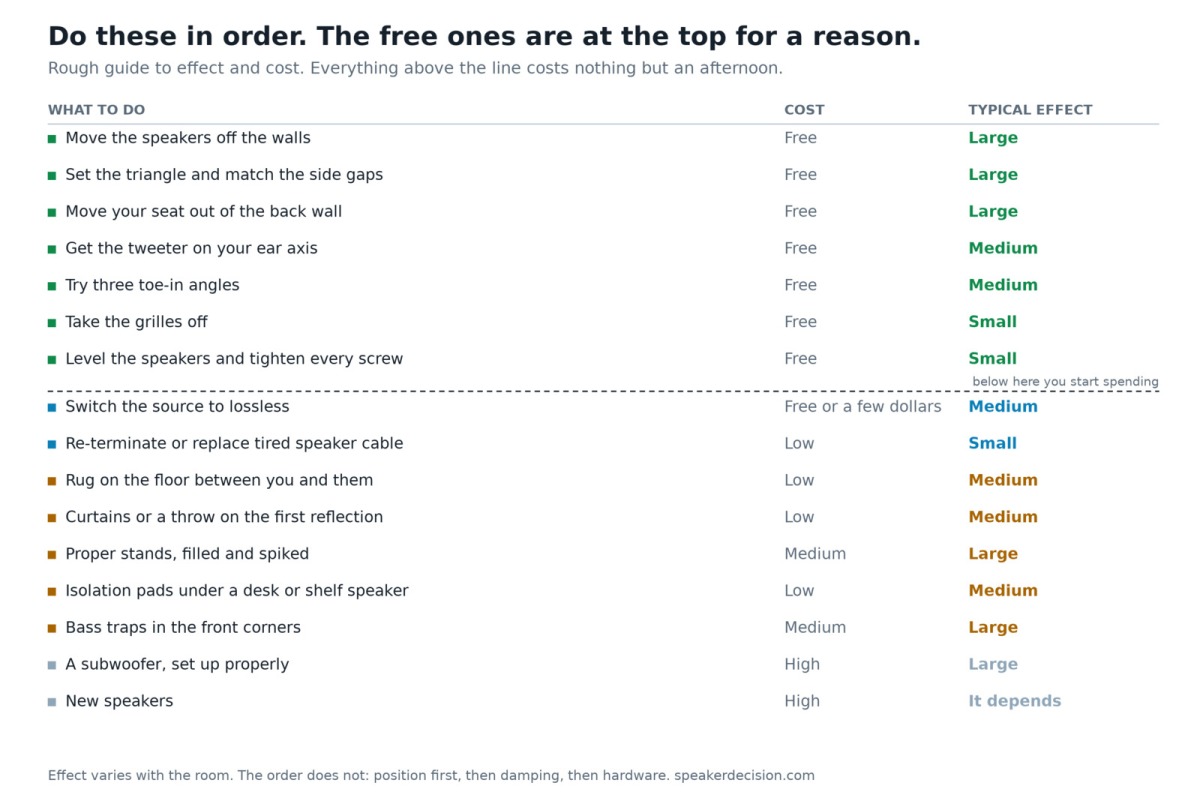 What to do first ordered by cost and effect
First, the five that matter
Do these before anything else. Change one thing at a time and listen to the same two tracks each time. If you change three things at once you will not know which one helped.
1. Pull the speakers away from the front wall. A wall behind a speaker adds bass, and it is rarely the bass you want. It adds a lump in one place and a hole in another. If your speakers are rear ported, start at 30 cm and work outwards. Even 10 cm of extra gap can clean up a boomy room.
2. Match the two side gaps. The distance from the left speaker to the left wall should be the same as the right to the right. When they are different, the room adds a different colour to each channel, and the singer stops sitting in the middle.
3. Make a triangle. As a starting point, the distance between the two speakers and the distance from each speaker to your head should be roughly the same. Then adjust. Our speaker placement calculator works this out from your room size, and we wrote about which placement rules are physics and which are just habit.
4. Get out of the back wall. If your head is against the rear wall you are sitting in the worst bass seat in the room. Pull the chair forward. Even 30 cm changes what you hear. This one costs nothing and people rarely try it.
5. Put the tweeter on your ear axis. Sitting down, not standing up.
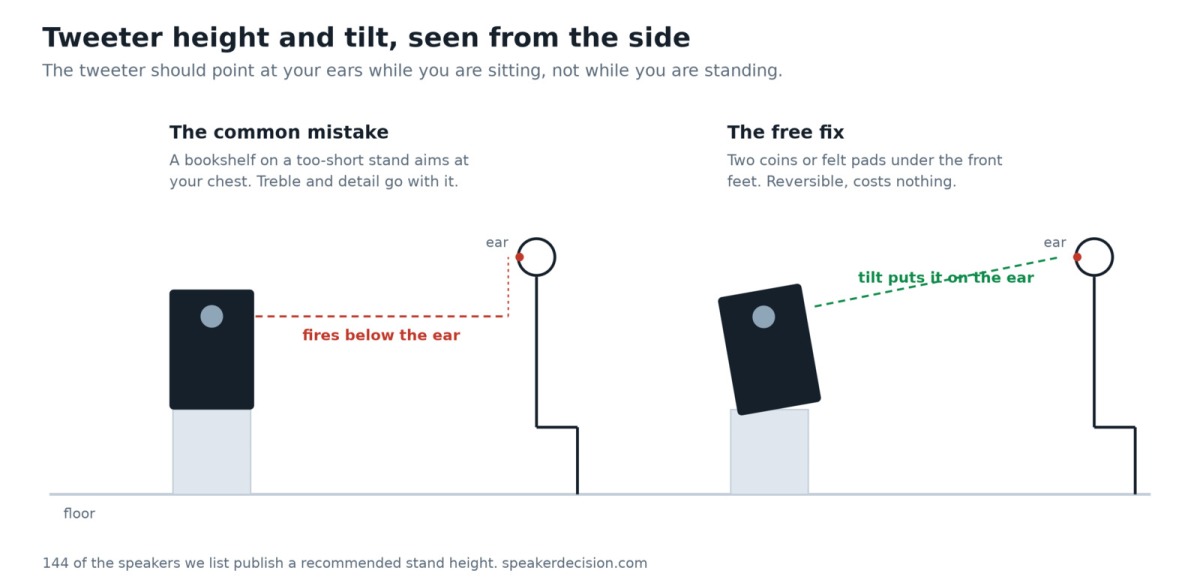 Tweeter height and tilt seen from the side
A bookshelf speaker on a short stand fires at your chest, and treble is directional in a way bass is not. If you cannot raise it, tilt it. Two coins or a pair of felt pads under the front feet cost nothing and are completely reversible.
Toe-in: the free tone control
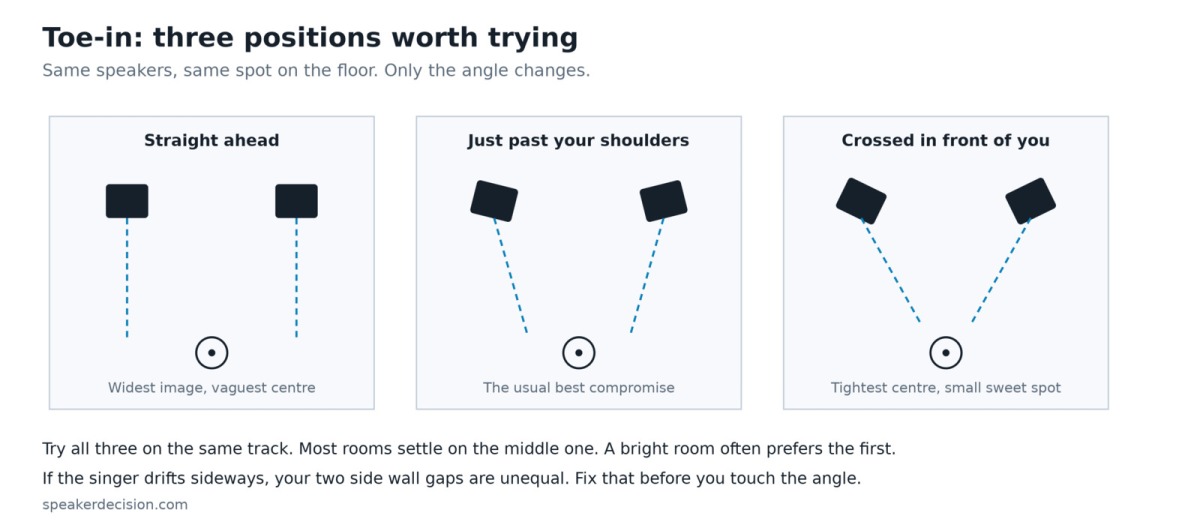 Three toe-in angles to try with the same track
6. Try three angles on the same track. Straight ahead, aimed just past your shoulders, and crossed in front of you. Angle changes the balance of direct sound and reflected sound, which changes how bright and how focused the system is.
7. If the room is bright, try less toe-in. Pointing the tweeters straight down the room sends more treble at the side walls and less at you.
8. If the centre image is vague, try more. Crossing the axes in front of your seat tightens the middle, at the cost of a narrower area where it works.
The room itself
9. Find your first reflection points with a mirror. Sit in your chair. Have someone slide a mirror along the side wall. Wherever you can see a tweeter in the mirror, that spot is sending you a delayed copy of the sound. That is the spot to treat, not the middle of the wall.
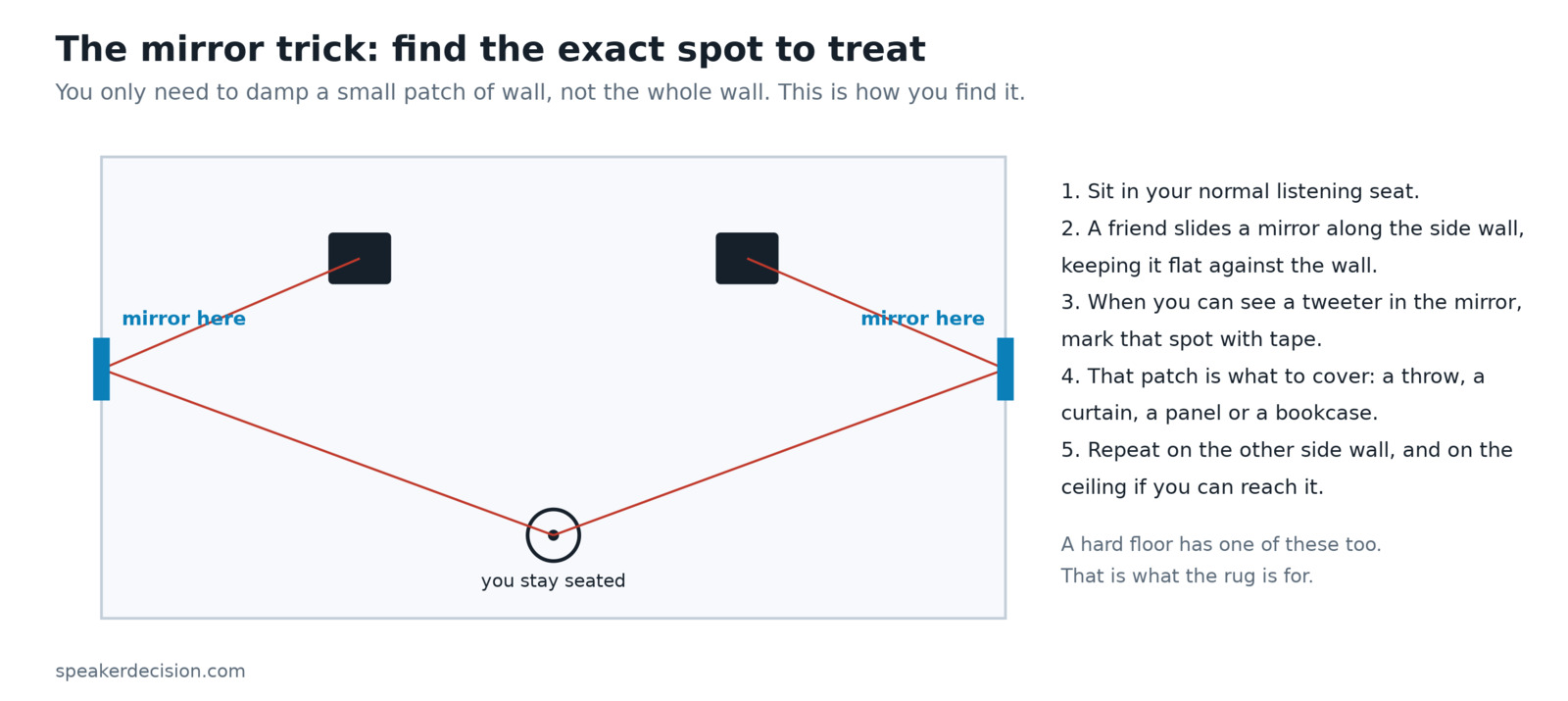 How to find your first reflection points with a mirror
10. Put a rug on the floor between you and the speakers. A hard floor is a first reflection point too, and a rug is the cheapest acoustic panel there is.
11. Close the curtains. Or hang a throw on the reflection point. Heavy fabric with air behind it works better than fabric flat against the wall.
12. Do not over-damp. Killing every reflection makes a room sound dead and small. You are aiming for a room that does not echo when you clap, not a recording booth.
13. Fill the corners. Bass collects in corners. Bookshelves, a stuffed armchair or a proper bass trap in the front corners all help. This is the single most effective piece of treatment in most rooms.
14. Break up the wall behind you. A bare wall directly behind your head sends sound straight back at you. A bookcase with books at different depths is a good diffuser and costs nothing if you already own one.
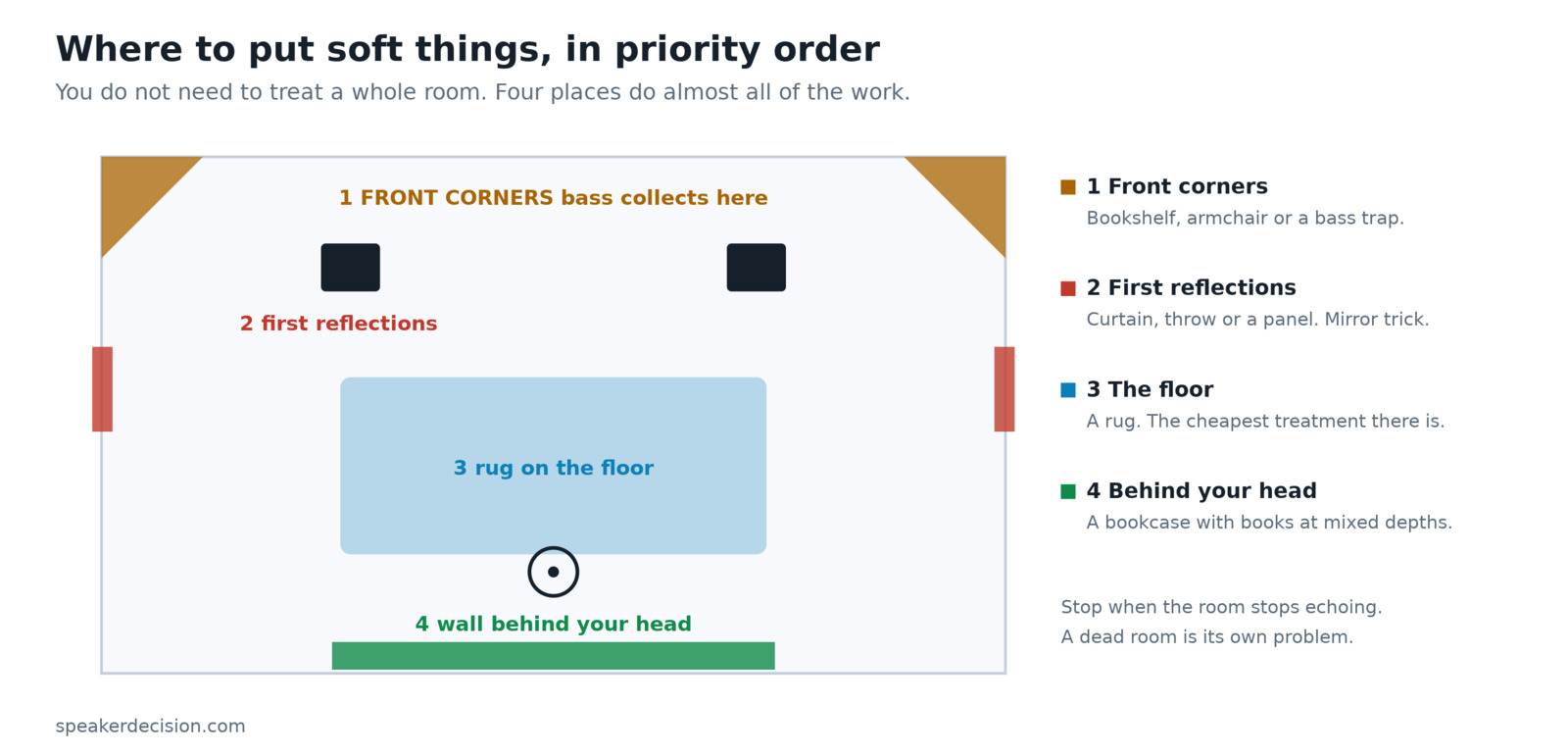 The four places worth treating first in priority order
15. Check your room modes. Room dimensions decide which bass notes are exaggerated and which vanish. Our room mode calculator tells you which frequencies your room will fight you on, and roughly where in the room they are worst.
16. Then hear them. Our test tone generator plays a sweep so you can walk around and hear where the bass piles up and where it disappears. Do this before buying any treatment.
Stands, feet and vibration
17. Use real stands, and fill them. A bookshelf speaker on a wobbly side table loses bass definition. Sand or kiln-dried filler in a hollow stand kills the ringing.
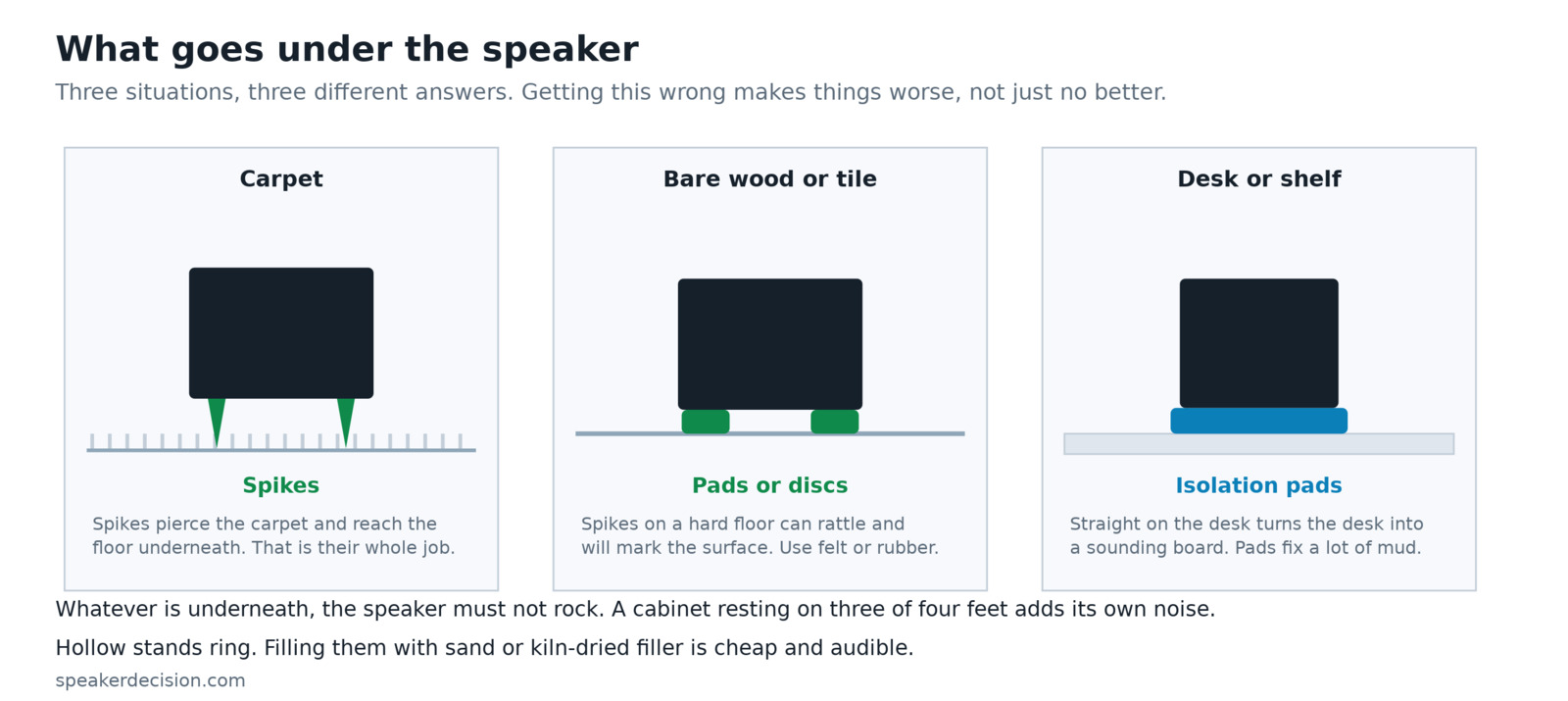 Spikes on carpet pads on hard floors and isolation pads on a desk
18. Spikes on carpet, pads on wood. Spikes exist to pierce carpet and reach the floor underneath. On a bare wooden floor they can make things worse and will certainly leave marks.
19. Level the speakers. A speaker rocking on three of its four feet is a speaker adding its own noise.
20. Decouple desk speakers. A desktop speaker sitting straight on the desk uses the whole desk as a sounding board. Foam pads or a small isolation stand fix a surprising amount of muddiness for very little money.
21. Tighten every screw. Driver bolts and terminal nuts loosen over years. A gentle turn on each, no force, is free.
Ports, grilles and small hardware
22. Look for the port plugs. 110 of the speakers we list ship with foam bungs. If a speaker has to go near a wall, a plug trades a little bass depth for a lot less boom. Try half-plugged too.
23. Take the grilles off. Most makers voice their speakers with the grille on, but a fabric grille on a frame still costs you some treble. Try it both ways. Only 291 of the 987 speakers we list with grilles use magnets, so on the rest you will be left looking at the peg holes, which is a fair reason to leave them on.
24. Check the jumpers. 391 speakers we list have two pairs of terminals bridged by small metal or wire jumpers. They come loose, and they corrode. Take them off, clean the contacts, put them back tight.
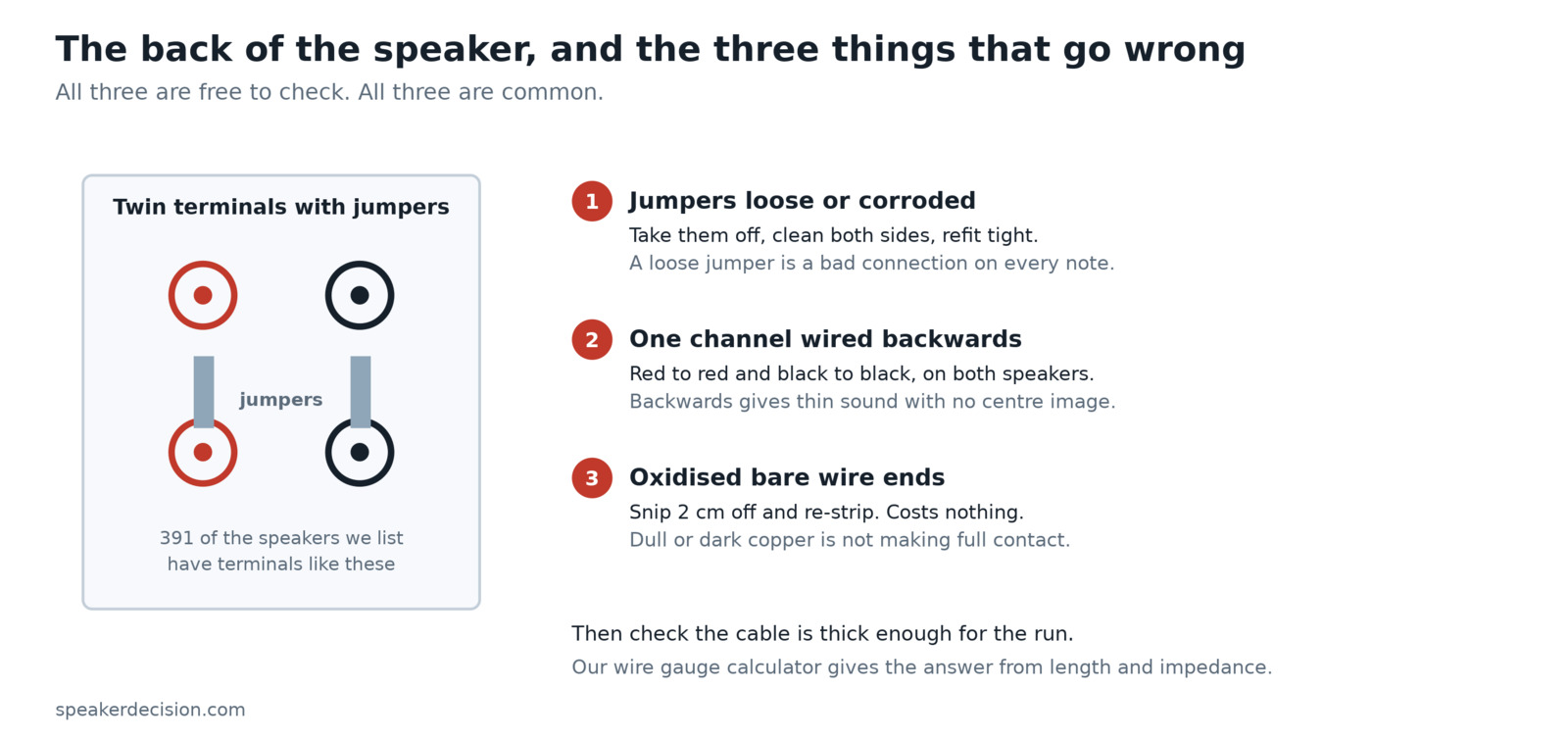 Twin speaker terminals and the three connection faults worth checking
25. Check polarity. Red to red, black to black, on both speakers. One channel wired backwards gives you thin, hollow sound with no centre image. It is more common than you would think, especially after moving house.
Cables and connections
26. Use thick enough cable. Cable gauge matters over distance, and it is one of the few cable questions with a real answer. Our wire gauge calculator gives you the right thickness for your run length and speaker impedance. If you are running two pairs from one amplifier, check the impedance calculator first.
27. Cut back tired bare wire. Copper oxidises. Snipping 2 cm off each end and re-stripping is free and takes five minutes.
28. Tighten the terminals properly. A loose binding post is a bad connection whatever the cable cost.
The source, which people skip
29. Check what your streaming service is actually sending. Most services default to a compressed setting on mobile data and never switch back. Find the quality setting and set it to the highest the app offers on wi-fi. This is free, it takes one minute, and on a revealing system it is more audible than most cable changes.
30. Match levels before you judge anything. Louder sounds better to everyone. If you compare two sources, two cables or two positions at different volumes, you will pick the louder one every time. Our SPL calculator helps you work out what level you are actually listening at.
And if you own a subwoofer, set it up rather than just switching it on. Crossover point, phase and position all matter, and the position that measures best is rarely next to the rack. Our subwoofer crossover tool works out where to hand over based on how low your main speakers actually go.
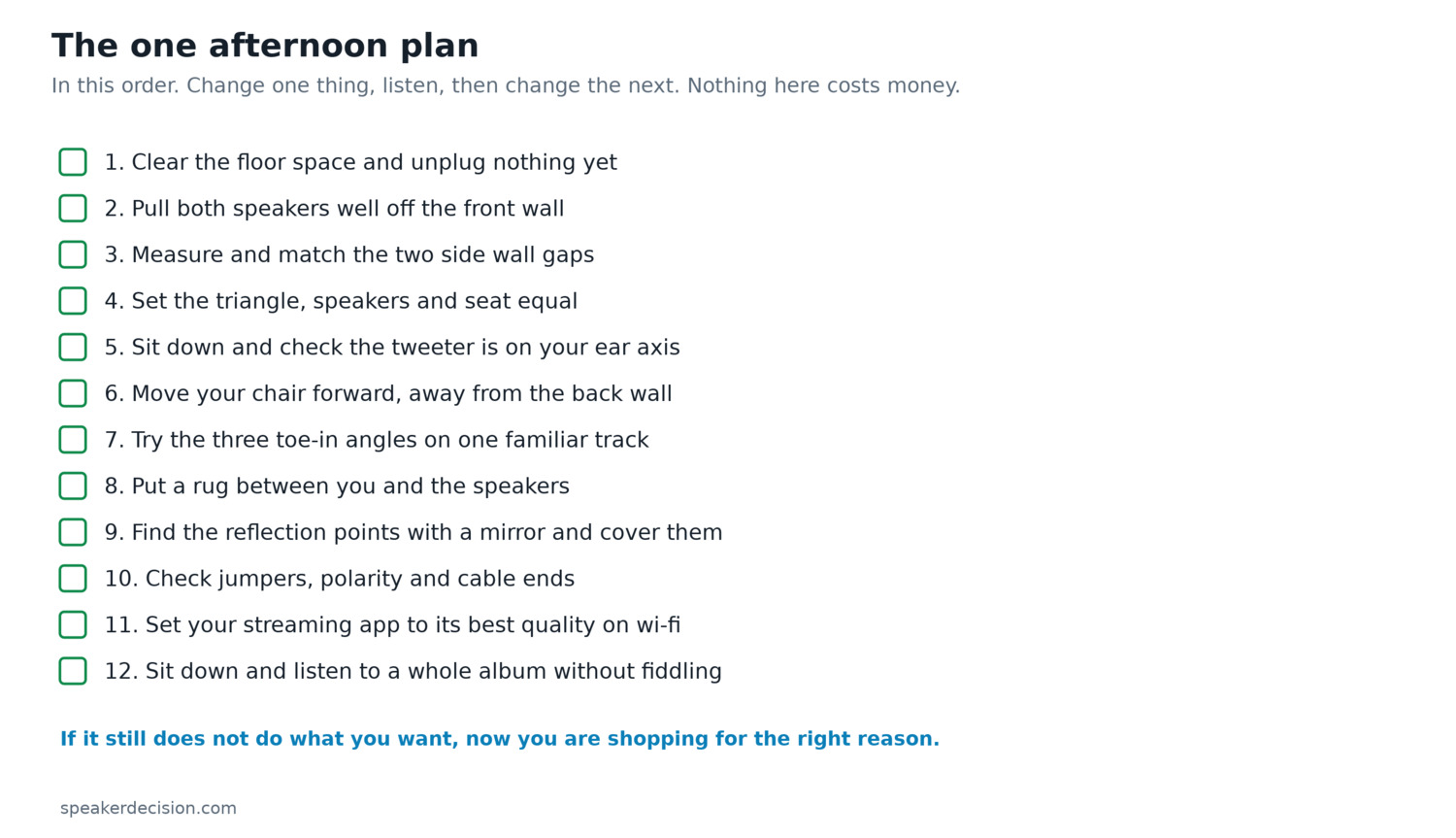 A printable order of work for one afternoon
What will not help much
This is the part that gets left out of lists like this, so here it is plainly.
Expensive cable is near the bottom of the list, not the top. Cable needs to be thick enough for the run and properly connected. Beyond that, the money is better spent on a rug and a pair of stands. We have never seen a cable change move a system as much as moving the speakers 20 cm.
Isolation products have limits. Pads under a desk speaker do real work. A set of feet under an amplifier sitting on a solid rack usually does not.
Room treatment cannot fix a bad position. If the speakers are in the wrong place, panels will not rescue them. Position first, always.
And some rooms genuinely need a different speaker. A big ported floorstander in a small, hard room may never settle down, and no amount of moving will change that. If you have worked through this list and the bass is still uncontrollable, a smaller sealed speaker may be the honest answer. That is a real outcome of doing this properly, not a failure.
One afternoon, in order
If you only have a few hours, do it like this. Clear the space. Pull both speakers well out from the wall and match the side gaps. Set the triangle. Sit down and check the tweeter height. Try the three toe-in angles. Move your chair forward. Put a rug down. Then stop, and listen to something you know well.
Everything in the first half of this list is free. If you work through it and the system still does not do what you want, at least you will be buying your next speakers for the right reason. Our tools page has the rest of the calculators, including the amp and speaker matcher if you are wondering whether your amplifier is the limit.
Which of these made the biggest difference in your room, and which one did nothing at all?