"Where should my speakers go?" is the question we get asked more than any other, and the usual answers are a mess. Someone tells you 38% of the room length. Someone else says equilateral triangle. Nobody tells you which of those you can actually calculate and which one is a rule of thumb that got repeated until it sounded like a law.
So we built a speaker placement calculator that does both. Type in your room, get a plan view, and drag things around.
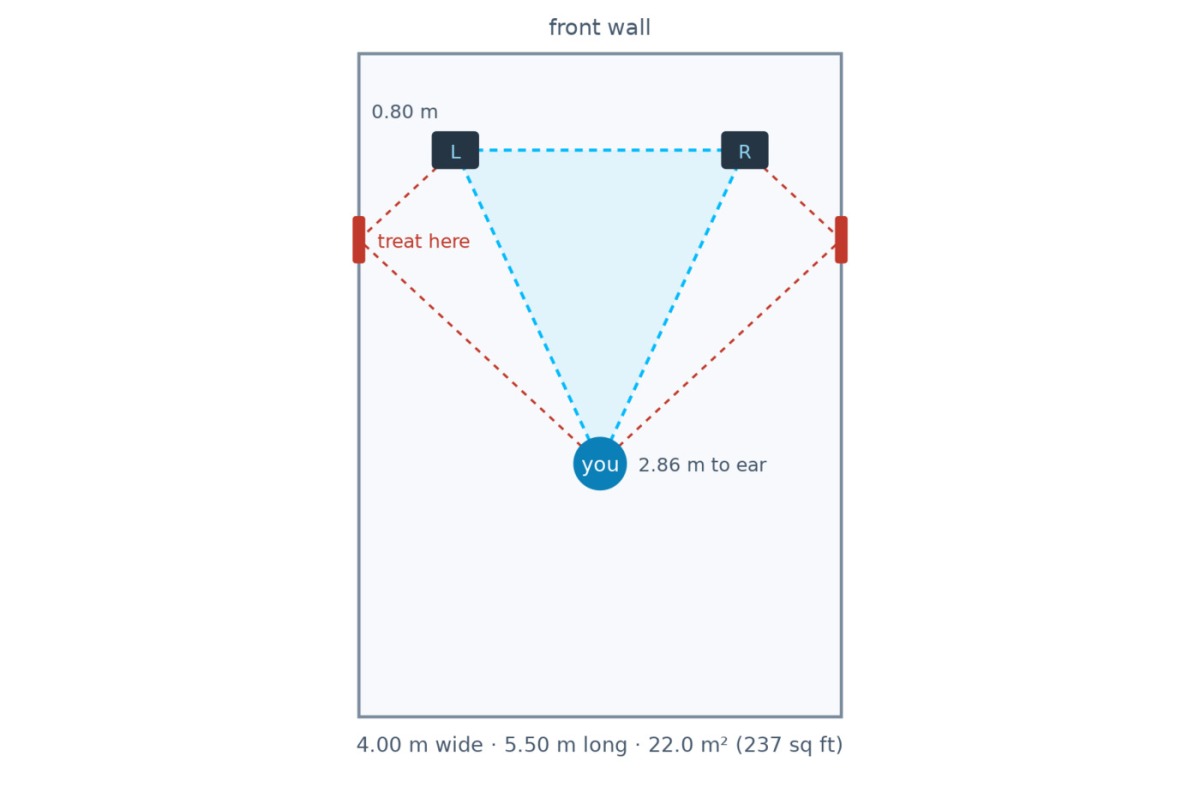 Speaker placement calculator plan view
Quick facts
- Room in, plan view out. Speaker spacing, wall distances, listening triangle, all drawn to scale.
- It marks the first reflection points on your side walls, which is where a panel does more than anywhere else in the room.
- It reports the bass cancellation frequency instead of pretending one wall distance is correct.
- Drag the speakers or your chair and everything recalculates as you move.
- Metres or feet, and it is free with nothing to sign up for.
The one number most people get wrong by accident
How far your speakers sit from the wall behind them is not a taste question. Sound that reaches you directly and sound that bounces off that wall arrive out of step, and at one particular frequency they cancel. The formula is short: speed of sound divided by four times the distance.
Here is what that means in a real room, straight out of the tool:
| Speakers from the front wall | Cancellation lands at |
|---|
| 0.3 m (about 1 ft) | 286 Hz |
| 0.5 m | 172 Hz |
| 0.8 m | 107 Hz |
| 1.0 m (about 3 ft) | 86 Hz |
Look at the top row. Push your speakers up against the wall and the notch lands at 286 Hz, which is right in the middle of male voices and the body of a cello. That is the "my speakers sound thin and I do not know why" setup, and no amount of new gear fixes it.
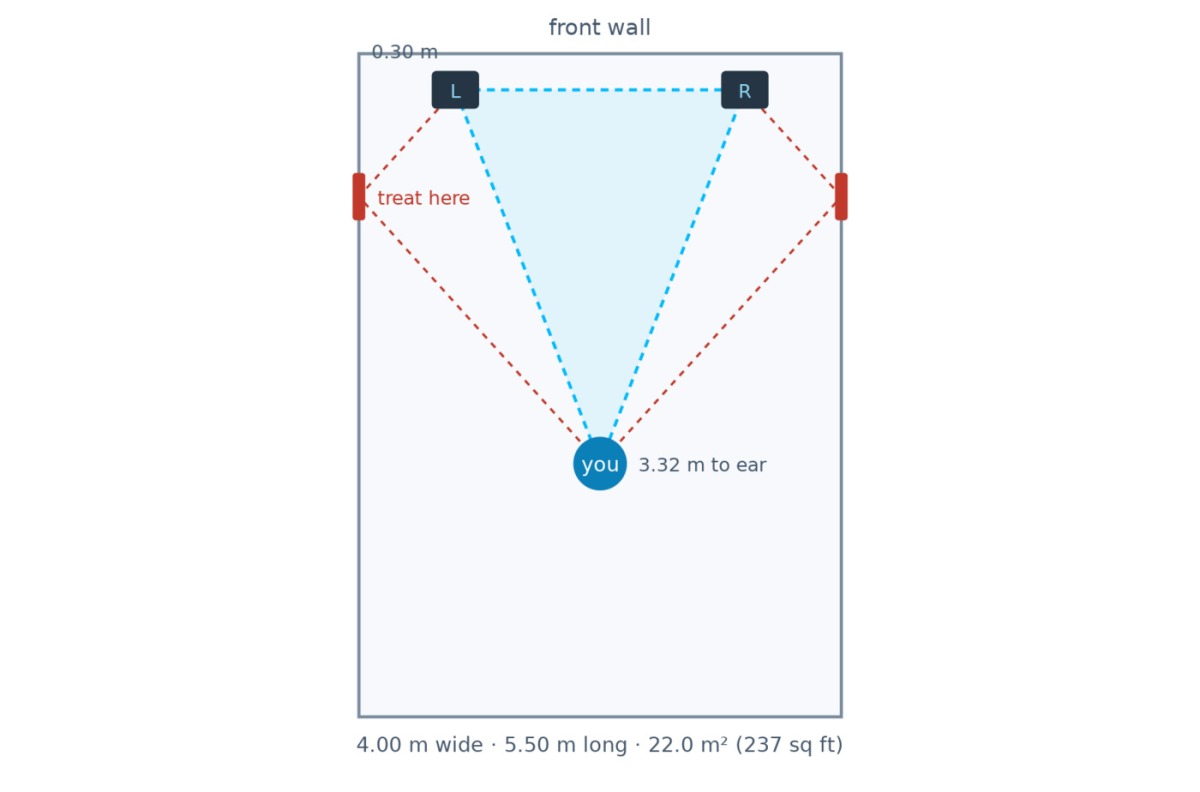 Speakers moved close to the front wall
The honest part is that you cannot escape this. Every position has a notch somewhere. You are only choosing where it lands, which is why the tool tells you the frequency rather than claiming one distance is right.
Which rules are real, and which are just habits
This is the bit we could not find anywhere else, so the tool spells it out.
Physics, and calculable: the boundary cancellation above. The first reflection points, which are pure geometry (mirror the speaker in the side wall, draw a line to your ears, treat where it crosses). And the fact that the middle of the room is the worst seat in it, because it sits on the null of every odd length mode.
Convention, and useful anyway: the equilateral triangle, the 38% seating rule, toe-in aimed behind your head, tweeters at ear height. These are good starting points. They are not laws, and a tool that presents them as laws is lying to you slightly.
Do it in this order
Move the seat first. Then the speakers. Then treat the reflection points. Then think about a subwoofer.
Every one of those costs less than new electronics and does more. Once the layout is settled, our room mode calculator shows what the room itself is doing to the bass, and the SPL calculator turns your new listening distance into a power figure so you can check your amplifier is up to it.
It is one of ten calculators we run, and it is free. Have a go with your own room and see where your notch is sitting right now.
What did the tool tell you about your current setup, and was any of it a surprise?