First, the honest bit: we do not list DACs. Speaker Decision covers speakers, subwoofers and amplifiers, and there is no AudioQuest product in our database at all.
We are writing this one anyway, because the DragonFly Copper is not really a headphone accessory. AudioQuest's own product page says it "drives headphones; feeds preamps, amps, and powered speakers", and it puts out 2.1 volts, which is above standard line level. It is a 57 mm stick that can be the source for a real system. That makes it our readers' business.
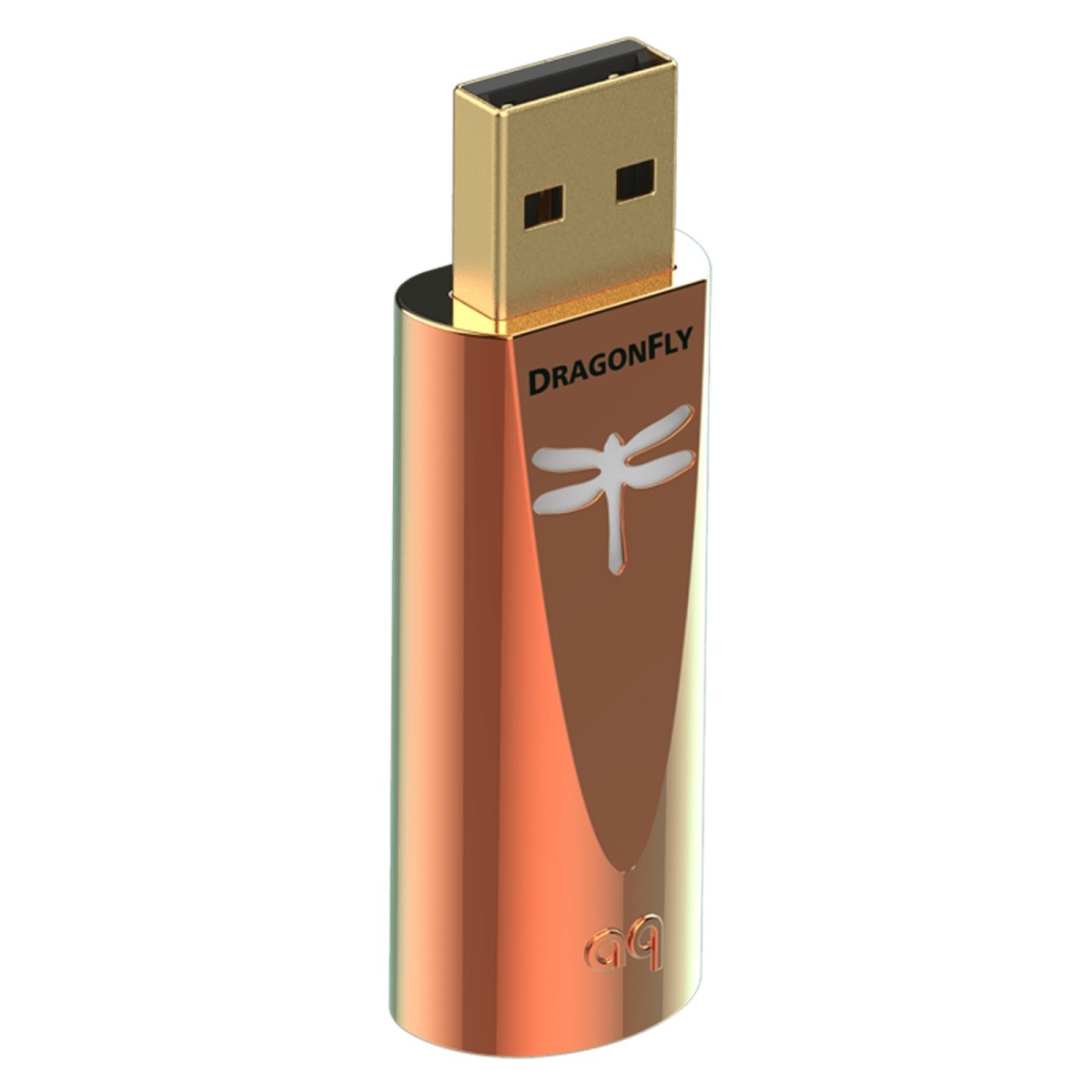 AudioQuest DragonFly Copper USB DAC and headphone amplifier
Quick facts
- 250 dollars, the sixth DragonFly since 2012. AudioQuest say over 300,000 have been sold.
- 32-bit ESS Sabre ES9218 DAC and headphone amp chip. Twice the output power of the Cobalt, 25 percent less current drawn.
- Still 24-bit / 96 kHz maximum, which is a deliberate choice and the most interesting thing about it.
- MQA is gone. So are 79 of the 107 parts in the original.
- 19 x 12 x 57 mm, no drivers needed, and the USB-C adapter is now in the box.
The 96 kHz ceiling, and what our data says about it
Every DragonFly has stopped at 24-bit 96 kHz, and the Copper does too. Designer Gordon Rankin defends that rather than apologising for it. His argument, in Stereophile, is that chip makers advertise 384 kHz and 768 kHz but publish their measurements at 48 kHz, because the parts measure worse as the rate goes up and the core gets hotter.
You can agree or disagree with that. What we can tell you is how lonely a position it is.
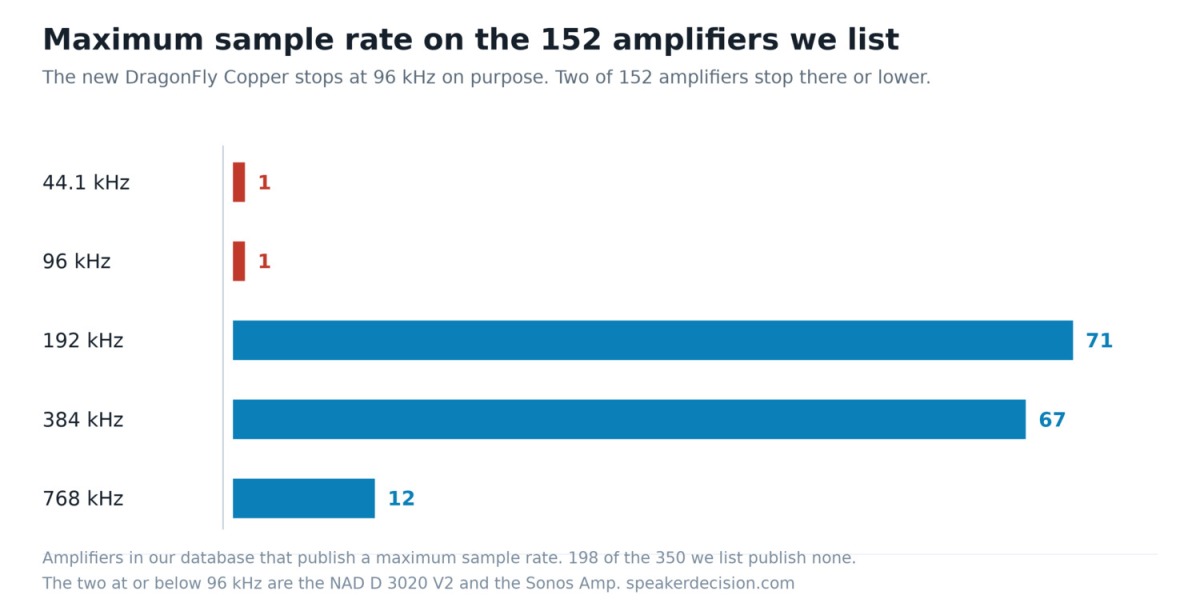 Maximum sample rate published by the amplifiers in our database
We list 350 amplifiers. Of those, 152 publish a maximum sample rate. 150 of the 152 go past 96 kHz. Seventy-one stop at 192 kHz, 67 at 384 kHz, and twelve claim 768 kHz.
Two do not. The NAD D 3020 V2 tops out at 24/96, exactly where the DragonFly does, and the Sonos Amp stops at 16-bit 44.1 kHz, which is CD.
So the DragonFly is not an outlier because 96 kHz is bad. It is an outlier because everyone else prints the biggest number their chip will accept. Whether that number does anything for you is a separate question, and one a spec table cannot settle.
The case for one in a speaker system
 The 3.5mm output on the DragonFly Copper, which feeds an amplifier as well as headphones
Here is where our data is actually useful. Two numbers.
Ninety-six of the amplifiers we list have no headphone socket at all. That is the count where the maker says so plainly, out of 251 amplifiers where we know either way. And it is not a budget problem. The Mark Levinson No.534 is 25,000 dollars with nowhere to plug headphones in. The Hegel H30A and the Devialet Astra are 20,000 dollars each, same story.
A hundred and one have no built-in DAC, again where the maker states it. If your amplifier is one of those and you want to play from a laptop or a phone, you need a converter somewhere, and a 250 dollar stick is a cheaper answer than a separate box.
On the powered speaker side the picture is different. Of the 129 powered speakers we list, 58 already take USB directly, so a DragonFly would be doing work the speaker already does. Sixty-nine have a 3.5mm analogue input, which is what you would use it with.
What actually changed, and what got dropped
The Copper uses a new 32-bit ESS Sabre ES9218 that does the conversion and drives the headphones in one chip. It puts out twice the power of the 2019 Cobalt while drawing 25 percent less current from your phone. The case is copper-plated, which AudioQuest say drains RF noise.
The part count went from 107 in the 2012 original to 28. Two reasons, and neither is the one you would guess.
The first is MQA. With MQA collapsed, AudioQuest no longer had to include the decoder. Rankin's point is not licensing, it is power: MQA "required a lot of power", and "more power equals more noise".
The second is supply chain. Ukraine supplies more than 80 percent of the world's acrylic, which goes into film capacitors, and the capacitors used in earlier DragonFlys stopped being available. The circuit was redesigned around that.
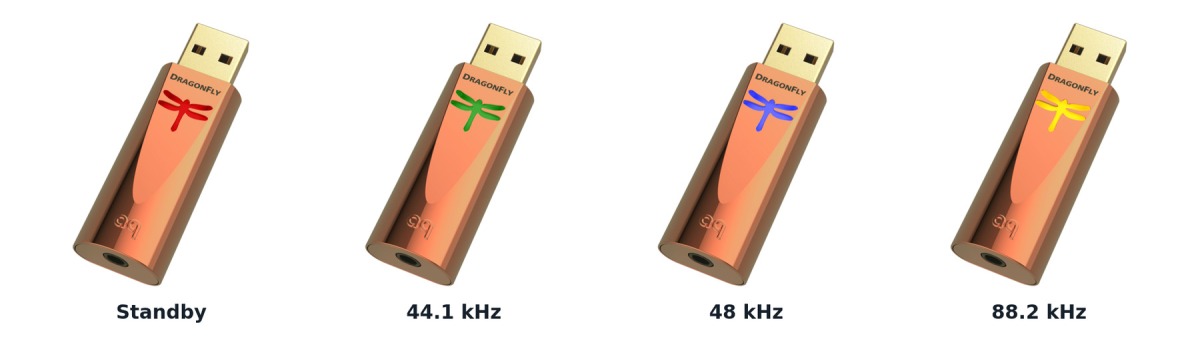 The DragonFly emblem changes colour to show the sample rate being played
One small thing that has always been good: the dragonfly emblem changes colour to tell you what is playing. Red is standby, green 44.1 kHz, blue 48 kHz, yellow 88.2 kHz, light blue 96 kHz. There are no buttons and no volume knob. Your phone or laptop controls the level, which Rankin argues is the right place for it.
The reasons not to buy one
Three, and we would rather say them than not.
The 96 kHz ceiling is real. The argument for it is good, but if your library has 24/192 files, this will not play them at their native rate. If that bothers you on principle, it will keep bothering you.
The old ones are cheaper and still on sale. AudioQuest currently list the DragonFly Black at 129.95 dollars and the Cobalt at 199.95. The Copper is more powerful and more efficient, but the Black already turns a USB port into a decent headphone output for half the money.
And we cannot tell you it sounds better. We publish specifications, and specifications cannot separate two competent DACs. Everything above is a design argument and a parts list. If your amplifier already has a DAC and a headphone socket, the honest answer is that you probably do not need this at all, and our amplifier list will tell you in about ten seconds which camp yours is in.
Does a 96 kHz limit put you off in 2026, or do you think Rankin has a point about the big numbers?