In this review, we will be comparing two different types of speakers by Emotiva. Emotiva Airmotiv C1+ is a Center Channel speaker whereas the Airmotiv B2+ is a Bookshelf speaker.
Let's have a brief look at the main features
of Emotiva Airmotiv C1+ and Emotiva Airmotiv B2+ first before getting into our more
detailed comparison.
| Key Specs | Emotiva Airmotiv C1+ | Emotiva Airmotiv B2+ |
|---|
| Brand | Emotiva
United States · founded 2003 | Emotiva
United States · founded 2003 |
|---|
| Design | 3-way | 2-way |
|---|
| Tweeter | 25×32 mm" folded ribbon | 25×32 mm" folded ribbon |
|---|
| Midrange | 3" | — |
|---|
| Woofer | 2 x 5.25" woven fiber cone | 6.25" woven fiber cone |
|---|
| Frequency response | 50 Hz – 28 kHz | 40-28k Hz |
|---|
| Sensitivity | 89 dB | 86 dB |
|---|
| Impedance | 4 ohms | 4 ohms |
|---|
| Power range | Up to 120 watts | Up to 125 watts |
|---|
| Weight | 8.45kg / 18.6lbs | 7.10kg / 15.6lbs |
|---|
| Dimensions (H x W x D) | 7-3/4" x 20-1/2" x 8-1/4"
197.0 x 521.0 x 210.0mm | 12-3/4" x 8-1/2" x 11-1/2"
324.0 x 216.0 x 293.0mm |
|---|
Airmotiv C1+ and Airmotiv B2+ are members of Emotiva's Airmotiv series of speakers. Below you can find the loudspeakers from this series.
Emotiva Airmotiv Series
History
What size room are the Emotiva Airmotiv C1+ and Emotiva Airmotiv B2+ speakers good for?
The size of the room in which you are planning to use these loudspeakers is an important decision
factor. Here we have compared their suitability to various sizes of environments considering their size
and max power parameters:
| Listening Environment* |
Emotiva Airmotiv C1+ |
Emotiva Airmotiv B2+ |
| Near-field |
Poor |
Average |
| Small Room |
Average |
Good |
| Mid-size Room |
Good |
Average |
| Large Room |
Average |
Poor |
| Very Large Room |
Poor |
Bad |
(* Approximate Room sizes: Small < 100sq. ft / 9 m2,
Mid-size: 100-220 sq. ft / 9-20 m2, Large 220-400 sq. ft / 20-36 m2, Very Large: >
400 sq. ft / 36 m2.
Average Floor Height: 9" / 2.7m. Typical room sizes differ from country to country, and the actual
listening experience changes depending on floor height, room shape, surface materials, listening
position, speaker locations, etc.)
The sections below take each area in turn: drivers, frequency response, physical size and what you get in the box.
Drivers
One of the fundamental differences between these two speakers is that Airmotiv C1+ is a 3-way design whereas the Airmotiv B2+ is a 2-way speaker. 3-way designs utilize a midrange driver in addition to the tweeter and woofer on 2-way designs. Designing a crossover for a 3-way speaker is a complicated process and generally increases the overall cost of the speaker.
Emotiva Airmotiv C1+Emotiva Airmotiv B2+
MidrangeWoofer
Front view, drawn to scale - cabinets and drivers share one scale, so sizes are directly comparable. Hover a driver for its size.
| Driver |
Emotiva Airmotiv C1+ |
Emotiva Airmotiv B2+ |
|
Driver Setup
|
3-way
|
2-way
|
|
Tweeter
|
25×32 mm-inch
|
25×32 mm-inch
|
|
Midrange
|
1 x 3-inch |
- |
|
Woofer
|
2 x 5.25-inch
|
1 x 6.25-inch
|
Airmotiv C1+ features a 25×32 mm" folded ribbon Tweeter, a 3" Midrange and 2 x 5.25" woven fiber cone Woofer with a Crossover frequency at 550 Hz and 2600Hz. On the other hand, the Airmotiv B2+ features a 25×32 mm" folded ribbon Tweeter and 1 x 6.25" woven fiber cone Woofer with a Crossover frequency at 2000Hz.
Frequency Response
Airmotiv C1+ has a frequency range of 50 Hz – 28 kHz whereas Airmotiv B2+ has a frequency range of 40-28k Hz. With a minimum frequency of 40Hz, the Airmotiv B2+ can go significantly deeper on the low side and provide stronger bass compared to the Airmotiv C1+'s min frequency of 50Hz.
The graph below depicts how these two speakers compare with the max, min and average Low Frequency values of other speakers in the Center Channel class in our database.
Low Frequency
Center Channel Speakers
Neither pair reaches down to 20Hz, the usual definition of full-range, which is normal for speakers of this size. If you want the bottom octave for movies or bass-heavy music, add a subwoofer to whichever you choose. Visit our Powered Subwoofers section to find out more about the available options.
Impedance and Sensitivity
Airmotiv C1+ and Airmotiv B2+ have the same Impedance of 4 ohms but where they differ is the sensitivity levels. Airmotiv C1+ sensitivity is rated at 89 dB and the Airmotiv B2+'s is at 86 dB. This 3 dB difference makes the Emotiva Airmotiv C1+ a more sensitive speaker compared to Emotiva Airmotiv B2+, hence will play louder with the same amount of watts.
One thing to keep in mind that the lower impedance speakers, especially the ones that are rated at 4 ohms may put more pressure on the amplifier unit comared to higher impedance speakers especially at high volume levels, so make sure the amp you pair with the Airmotiv C1+ and the Airmotiv C1+ can provide this impedance level.
Sensitivity
Center Channel Speakers
Power Range
Power
range is the range of input power in watts RMS that a loudspeaker is designed to handle. Staying
within that range gives nominal performance; driving the speaker beyond its maximum wattage can damage it.
Airmotiv B2+ can handle a max power of 125 watts RMS, whereas Airmotiv C1+ has a max power handling value of 120 watts RMS, 5 watts less than the Airmotiv B2+.
Note that higher power handling does not make a speaker louder: that depends mainly on
sensitivity and impedance. The calculator below shows how loud each of these actually plays
on a real amplifier.
Which plays louder on your amplifier?
Starting with a popular amplifier - change it to the one you own, or any you are
considering, and watch both numbers move.
Input Type and Bi-Amping / Bi-Wiring
Both Airmotiv C1+ and Airmotiv B2+ features dual binding post speaker terminals for bi-amping or bi-wiring.
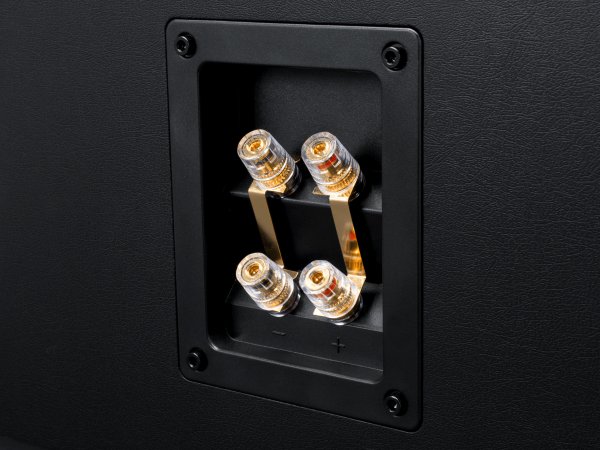 Emotiva Airmotiv C1+'s Binding post terminals allows Bi-amping or bi-wiring
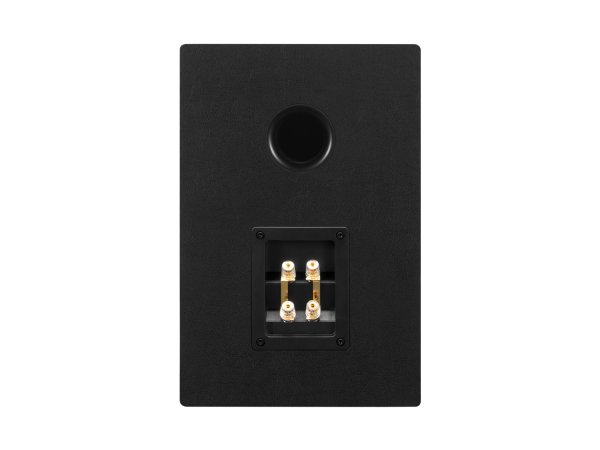 Emotiva Airmotiv B2+'s Binding post terminals allows Bi-amping or bi-wiring
Cabinet Type and Port Position
Both Airmotiv C1+ and Airmotiv B2+ have rear firing ports. Rear ported speakers generally need more room between the backside of the speaker and the wall compared to sealed and front/bottom ported speakers. Placing the speakers too close to the walls may cause the bass to sound boomy.
If you are limited in space and can't get the speakers away from the backwall, check our Speakers with Front Firing Ports page.
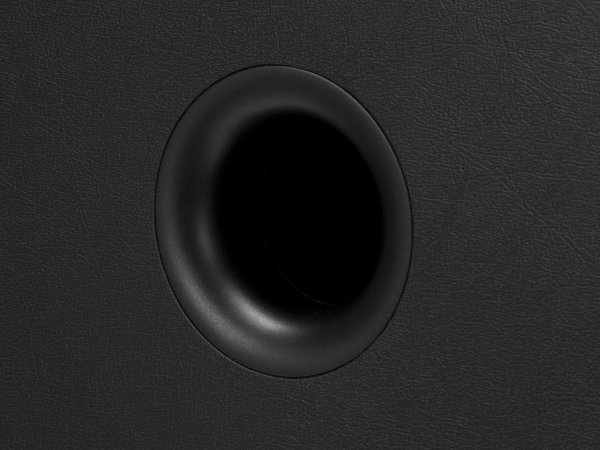 Emotiva Airmotiv B2+ Port
Physical Specs
The size of a speaker can sometimes be an important decision factor due to space constraints or in some cases purely for esthetic reasons. In this section, we are going to compare Emotiva Airmotiv C1+'s and Emotiva Airmotiv B2+'s external dimensions. Emotiva Airmotiv C1+ has external dimensions of 197.0 x 521.0 x 210.0mm (7-3/4 x 20-1/2 x 8-1/4inch) whereas Emotiva Airmotiv B2+ has external dimensions of 324.0 x 216.0 x 293.0mm (12-3/4-inch x 8-1/2-inch x 11-1/2-inch).
Emotiva Airmotiv C1+ is 127mm shorter and 83mm less deeper than Emotiva Airmotiv B2+ but it is also 305mm wider.
Size, drawn to scale
Both speakers and both views share one scale, so everything here is directly comparable. Hover a box for its dimensions.
One scale for both, standing on the same surface and pushed back to the same wall, so the deeper one visibly sticks out further.
Emotiva Airmotiv C1+ needs about 73% more floor or shelf area. Emotiva Airmotiv B2+ is 83mm deeper, so it stands that much further out from the wall. Emotiva Airmotiv B2+ is 127mm taller.
Base Surface Area Comparison
Base surface area of a loudspeaker may become a determining factor when the space in your room or desk is limited.
The base surface area of the Emotiva Airmotiv C1+ is approximately 1094.1cm2 / 169.6inch2 and base area of the Emotiva Airmotiv B2+ is approximately 632.9cm2 / 98.1inch2. The Airmotiv C1+ requires 73% more surface area than the Airmotiv B2+ which gives it a small disadvantage on placement in tight spaces.