In this review, we will be comparing Q550 and Q750, two Passive Floor-standing speakers by KEF.
Let's have a brief look at the main features
of KEF Q550 and KEF Q750 first before getting into our more
detailed comparison.
| Key Specs | KEF Q550 | KEF Q750 |
|---|
| Brand | KEF
United Kingdom · founded 1961 | KEF
United Kingdom · founded 1961 |
|---|
| Design | 2-way | 2-way |
|---|
| Uni-Q driver | 11th Generation Uni-Q | 11th Generation Uni-Q |
|---|
| Tweeter | 1" Dome | 1" Dome |
|---|
| Woofer | 2 x 5.25" Aluminum | 2 x 6.5" Aluminum |
|---|
| Frequency response | 58-28k Hz | 48-28k Hz |
|---|
| Sensitivity | 87 dB | 88 dB |
|---|
| Impedance | 8 ohms | 8 ohms |
|---|
| Power range | 15-130 watts | 15-150 watts |
|---|
| Weight | 14.55kg / 32lbs | 16.59kg / 36.5lbs |
|---|
| Dimensions (H x W x D) | 35-3/16" x 11-5/8" x 12-5/16"
894.0 x 296.0 x 313.0mm | 37-3/16" x 12-7/8" x 12-3/8"
945.0 x 328.0 x 315.0mm |
|---|
Q550 and Q750 are members of KEF's Q series of speakers. Below you can find the loudspeakers from this series.
What size room are the KEF Q550 and KEF Q750 speakers good for?
The size of the room in which you are planning to use these loudspeakers is an important decision
factor. Here we have compared their suitability to various sizes of environments considering their size
and max power parameters:
| Listening Environment* |
KEF Q550 |
KEF Q750 |
| Near-field |
Bad |
Bad |
| Small Room |
Poor |
Poor |
| Mid-size Room |
Good |
Good |
| Large Room |
Good |
Good |
| Very Large Room |
Poor |
Poor |
(* Approximate Room sizes: Small < 100sq. ft / 9 m2,
Mid-size: 100-220 sq. ft / 9-20 m2, Large 220-400 sq. ft / 20-36 m2, Very Large: >
400 sq. ft / 36 m2.
Average Floor Height: 9" / 2.7m. Typical room sizes differ from country to country, and the actual
listening experience changes depending on floor height, room shape, surface materials, listening
position, speaker locations, etc.)
The sections below take each area in turn: drivers, frequency response, physical size and what you get in the box.
Drivers
Both Q550 and Q750 are 2-way speakers.
KEF Q550KEF Q750
TweeterWoofer
Front view, drawn to scale - cabinets and drivers share one scale, so sizes are directly comparable. Hover a driver for its size.
| Driver |
KEF Q550 |
KEF Q750 |
|
Driver Setup
|
2-way
|
2-way
|
|
Tweeter
|
1-inch
|
1-inch
|
|
Midrange
|
- |
- |
|
Woofer
|
2 x 5.25-inch
|
2 x 6.5-inch
|
Q550 features a 1" vented aluminum Dome Tweeter and 2 x 5.25" Aluminum Woofer with a Crossover frequency at 2500Hz. On the other hand, the Q750 features a 1" vented aluminum Dome Tweeter and 2 x 6.5" Aluminum Woofer with a Crossover frequency at 2500Hz.
Frequency Response
Q550 has a frequency range of 58-28k Hz whereas Q750 has a frequency range of 48-28k Hz. With a minimum frequency of 48Hz, the Q750 can go significantly deeper on the low side and provide stronger bass compared to the Q550's min frequency of 58Hz.
The graph below depicts how these two speakers compare with the max, min and average Low Frequency values of other speakers in the Floor-standing class in our database.
Low Frequency
Floor-standing Speakers
Neither pair reaches down to 20Hz, the usual definition of full-range, which is normal for speakers of this size. If you want the bottom octave for movies or bass-heavy music, add a subwoofer to whichever you choose. Visit our Powered Subwoofers section to find out more about the available options.
Impedance and Sensitivity
Q550 and Q750 have the same Impedance of 8 ohms but where they differ is the sensitivity levels. Q550 sensitivity is rated at 87 dB and the Q750's is at 88 dB. This 1 dB difference makes the KEF Q750 a more sensitive speaker compared to KEF Q550, hence will play louder with the same amount of watts.
Sensitivity
Floor-standing Speakers
Power Range
Power
range is the range of input power in watts RMS that a loudspeaker is designed to handle. Staying
within that range gives nominal performance; driving the speaker beyond its maximum wattage can damage it.
Q750 can handle a max power of 150 watts RMS, whereas Q550 has a max power handling value of 130 watts RMS, 20 watts less than the Q750.
Note that higher power handling does not make a speaker louder: that depends mainly on
sensitivity and impedance. The calculator below shows how loud each of these actually plays
on a real amplifier.
Which plays louder on your amplifier?
Starting with a popular amplifier - change it to the one you own, or any you are
considering, and watch both numbers move.
Input Type and Bi-Amping / Bi-Wiring
Q550 features Binding post type posts and Q750 has a Binding post type posts. None of these speakers feature bi-amping/bi-wiring.
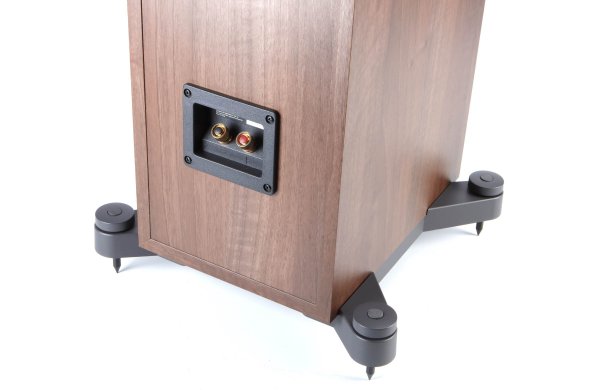 KEF Q750's Binding post terminals
Cabinet Type and Port Position
Both Q550 and Q750 have front firing ports. front ported speakers offers more flexibility in placement in regards to proximity to walls&surfaces compared to rear ported speakers.
Physical Specs
The size of a speaker can sometimes be an important decision factor due to space constraints or in some cases purely for esthetic reasons. In this section, we are going to compare KEF Q550's and KEF Q750's external dimensions. KEF Q550 has external dimensions of 894.0 x 296.0 x 313.0mm (35-3/16 x 11-5/8 x 12-5/16inch) whereas KEF Q750 has external dimensions of 945.0 x 328.0 x 315.0mm (37-3/16 x 12-7/8 x 12-3/8inch).
KEF Q750 is clearly the larger of the two speakers. Its body is 32mm wider, 51mm taller and 2mm deeper than KEF Q550.
Size, drawn to scale
Both speakers and both views share one scale, so everything here is directly comparable. Hover a box for its dimensions.
One scale for both, standing on the same surface and pushed back to the same wall, so the deeper one visibly sticks out further.
KEF Q750 needs about 12% more floor or shelf area. KEF Q750 is 51mm taller.
Base Surface Area Comparison
Base surface area of a loudspeaker may become a determining factor when the space in your room or desk is limited.
The base surface area of the KEF Q550 is approximately 926.5cm2 / 143.6inch2 and base area of the KEF Q750 is approximately 1033.2cm2 / 160.1inch2. The Q550 requires 10% less surface area than the Q750 which gives it a small advantage on placement in tight spaces.
Weight Comparison The weight of a loudspeaker can become an important factor if you need to move and reposition the unit often. Weight of a speaker can also "sometimes" be an indicator of the rigidity of the enclosure and the quality of the internal components used. The KEF Q550 weighs 14.55kg / 32lbs and the KEF Q750 weighs 16.59kg / 36.5lbs. This makes the Q750 14% heavier than the Q550.
Here is a comparison of how Q550 and Q750's weights compare with the average, max and min weights in Passive Floor-standing class.
Weight
All Floor-standing Speakers
What's in the Box of KEF Q550?
Here are the items that are included inside the box of Q550:
- Floorstanding loudspeaker
- 2 Outrigger feet
- 4 Spikes
- 6 Screws
- 6 Washers
- 4 Rubber inserts
- Hex-key
- Owners Manual
- Warranty Information
What's in the Box of KEF Q750?
Here are the items that come with the Q750:
- Floorstanding loudspeaker
- 2 Outrigger feet
- 4 Spikes
- 6 Screws
- 6 Washers
- 4 Rubber inserts
- Hex-key
- Owners Manual
- Warranty Information
 Height Height |
894mm
vs
945mm
|
Easier to fit in smaller spaces |
 Base Surface Area Base Surface Area |
926cm2
vs
1033cm2
|
Takes less floor space |
 Price per pair* Price per pair* |
1400USD
vs
1800USD
|
costs less (*prices may change depending on the seller, location and time) |
 Max Input Power Max Input Power |
150 watts
vs
130 watts
|
Handle more power from your amplifier |
 Sensitivity Sensitivity |
88 dB
vs
87 dB
|
Play louder with same amount of amplification power |
 Minimum Impedance Minimum Impedance |
3.8 ohms
vs
3.5 ohms
|
Very low impedance levels puts more pressure on amplifier |
 Woofer Size Woofer Size |
6.5 inches
vs
5.25 inches
|
Larger woofer |
|
Low Frequency Response |
48 Hz
vs
58 Hz
|
Generates deeper bass |
| General |
KEF Q550 |
KEF Q750 |
| Brand |
KEF |
KEF |
| Speaker Type |
Floor-standing speaker |
Floor-standing speaker |
| Power Range |
15-130 watts |
15-150 watts |
| Sensitivity |
87 dB |
88 dB |
| Impedance |
8 ohms |
8 ohms |
| Impedance |
3.5 ohms |
3.8 ohms |
| Frequency Response |
58-28k Hz |
48-28k Hz |
Drivers |
|
|
| Woofer Quantity |
2 |
2 |
| Woofer Size |
5.25" |
6.5" |
| Woofer Composition |
Aluminum |
Aluminum |
| Woofer Surround Material |
Rubber |
Rubber |
| Tweeter Size |
1" |
1" |
| Tweeter Type |
Dome |
Dome |
| Aimable Tweeter |
No |
No |
| Midrange Driver |
No |
No |
| Crossover Frequency |
2500Hz |
2500Hz |
| Firing Direction |
front |
front |
Physical Specs |
|
|
| Height |
894.0mm (35.2") |
945.0mm (37.2") |
| Width |
296.0mm (11.7") |
328.0mm (12.9") |
| Depth |
313.0mm (12.3") |
315.0mm (12.4") |
| Weight |
14.55kg (32lbs) |
16.59kg (36.5lbs) |
| Enclosure |
Passive Radiator |
Passive Radiator |
| Finish |
MDF/Wood-grain vinyl |
MDF/Wood-grain vinyl |
| Available Colors |
Walnut |
Walnut |
| Moisture Resistancy |
No |
No |
Connections |
|
|
| Biamp Inputs |
No |
No |
Other |
|
|
| Parts Warranty |
5 Years |
5 Years |
| Labor Warranty |
5 Years |
5 Years |
Siblings in KEF's Q series, so they share a family sound. It comes down to size, output and price.
| Area | Better | Why |
|---|
| Bass | B | KEF Q750 digs deeper - 48Hz against 58Hz. |
| Amplifier needs | evenly matched | Similar sensitivity (87dB vs 88dB) - both want much the same power. |
| Headroom | evenly matched | Similar power handling (130W vs 150W). |
| Size | depends | Similar cabinet size - neither is easier to fit. |
| Expandability | depends | KEF Q550: Atmos drivers; KEF Q750: Atmos drivers. |
| Price | A | KEF Q550 is cheaper - $1,400 against $1,800, about 22% less. |
A KEF Q550 B KEF Q750
depends neither is better in the abstract - it turns on your room, your system or how you will use them. Only specs published for both speakers are judged; anything missing on either side is left out rather than guessed.
Which should you choose?
The usual trade-off: KEF Q750 measures better, KEF Q550 costs about about 29% more% less. Whether that gap is worth the money is the call only you can make - and in a normal room it is often smaller than the numbers suggest. If a subwoofer is in your plans, the bass gap largely stops mattering - you would be crossing over above 58Hz anyway, which makes the cheaper KEF Q550 much easier to justify.
And remember what a spec sheet cannot show: how each looks in your room and whether the finish suits it, what dealer support and warranty are like where you live, and how they actually sound to you. If you can hear them first - ideally with your own music - that will tell you more than any number above.