In this review, we will be comparing SourcePoint V10 and ESL 9, two Passive Floor-standing speakers from MoFi and MartinLogan.
Let's have a brief look at the main features
of MoFi SourcePoint V10 and MartinLogan ESL 9 first before getting into our more
detailed comparison.
| Key Specs | MoFi SourcePoint V10 | MartinLogan ESL 9 |
|---|
| Brand | MoFi
United States · founded 2016 | MartinLogan
United States · founded 1982 |
|---|
| Design | 2-way | 2-way |
|---|
| Tweeter | 1.25" Soft-Dome | 9.2 x 44" curved electrostatic transducer |
|---|
| Woofer | 2 x 10" Paper Pulp | 2 x 8" high-excursion paper cone |
|---|
| Frequency response | 27-30k Hz | 34-23k Hz |
|---|
| Sensitivity | 91 dB | 90 dB |
|---|
| Impedance | 6 ohms | 4 ohms |
|---|
| Power range | up to 200 watts | 20-400 watts |
|---|
| Weight | 72.73kg / 160lbs | 35.45kg / 78lbs |
|---|
| Dimensions (H x W x D) | 48-13/16" x 15-9/16" x 19-15/16"
1240.0 x 396.0 x 507.0mm | 59-13/16" x 10-7/16" x 25-7/16"
1520.0 x 266.0 x 647.0mm |
|---|
The sections below take each area in turn: drivers, frequency response, physical size and what you get in the box.
Drivers
Both SourcePoint V10 and ESL 9 are 2-way speakers.
MoFi SourcePoint V10MartinLogan ESL 9
TweeterMidrangeWoofer
Front view, drawn to scale - cabinets and drivers share one scale, so sizes are directly comparable. Hover a driver for its size.
| Driver |
MoFi SourcePoint V10 |
MartinLogan ESL 9 |
|
Driver Setup
|
2-way
|
2-way
|
|
Tweeter
|
1.25-inch
|
9.2 x 44-inch
|
|
Midrange
|
- |
- |
|
Woofer
|
2 x 10-inch
|
2 x 8-inch
|
SourcePoint V10 features a 1.25" Soft-Dome Tweeter and 2 x 10" Paper Pulp Woofer. On the other hand, the ESL 9 features a 9.2 x 44" curved electrostatic transducer Tweeter and 2 x 8" high-excursion paper cone Woofer.
Frequency Response
SourcePoint V10 has a frequency range of 27-30k Hz whereas ESL 9 has a frequency range of 34-23k Hz. With a minimum frequency of 27Hz, the SourcePoint V10 can go significantly deeper on the low side and provide stronger bass compared to the ESL 9's min frequency of 34Hz.
The graph below depicts how these two speakers compare with the max, min and average Low Frequency values of other speakers in the Floor-standing class in our database.
Low Frequency
Floor-standing Speakers
Neither pair reaches down to 20Hz, the usual definition of full-range, which is normal for speakers of this size. If you want the bottom octave for movies or bass-heavy music, add a subwoofer to whichever you choose. Visit our Powered Subwoofers section to find out more about the available options.
Impedance and Sensitivity
SourcePoint V10 is a 6 ohms speaker compared to the ESL 9 which has a nominal impedance of 4 ohms. Lower impedance speakers, especially the ones that are rated at 4 ohms may put more pressure on the amplifier unit especially when played at high volume levels, so make sure the amp you pair with the ESL 9 can provide this impedance level.
These two speakers also have different sensitivity levels. SourcePoint V10 sensitivity is rated at 91 dB and the ESL 9's is rated at 90 dB. This 1 dB difference makes the MoFi SourcePoint V10 a more sensitive speaker compared to MartinLogan ESL 9, hence will play louder with the same amount of watts.
Sensitivity
Floor-standing Speakers
Power Range
Power
range is the range of input power in watts RMS that a loudspeaker is designed to handle. Staying
within that range gives nominal performance; driving the speaker beyond its maximum wattage can damage it.
ESL 9 can handle a max power of 400 watts RMS, whereas SourcePoint V10 has a max power handling value of 200 watts RMS, 200 watts less than the ESL 9.
Note that higher power handling does not make a speaker louder: that depends mainly on
sensitivity and impedance. The calculator below shows how loud each of these actually plays
on a real amplifier.
Which plays louder on your amplifier?
Starting with a popular amplifier - change it to the one you own, or any you are
considering, and watch both numbers move.
Input Type and Bi-Amping / Bi-Wiring
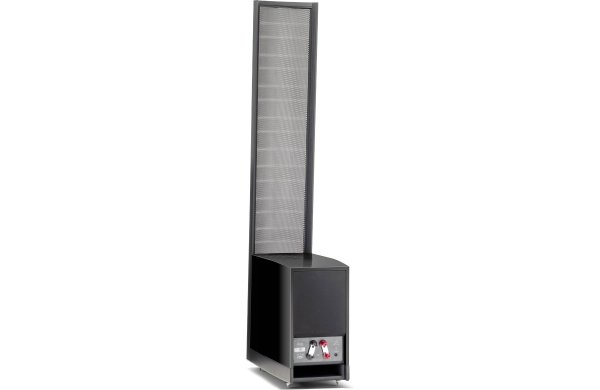
Both SourcePoint V10 and ESL 9 features dual binding post speaker terminals for bi-amping or bi-wiring.
 MartinLogan ESL 9's Binding post terminals allows Bi-amping or bi-wiring
New
Physical Specs
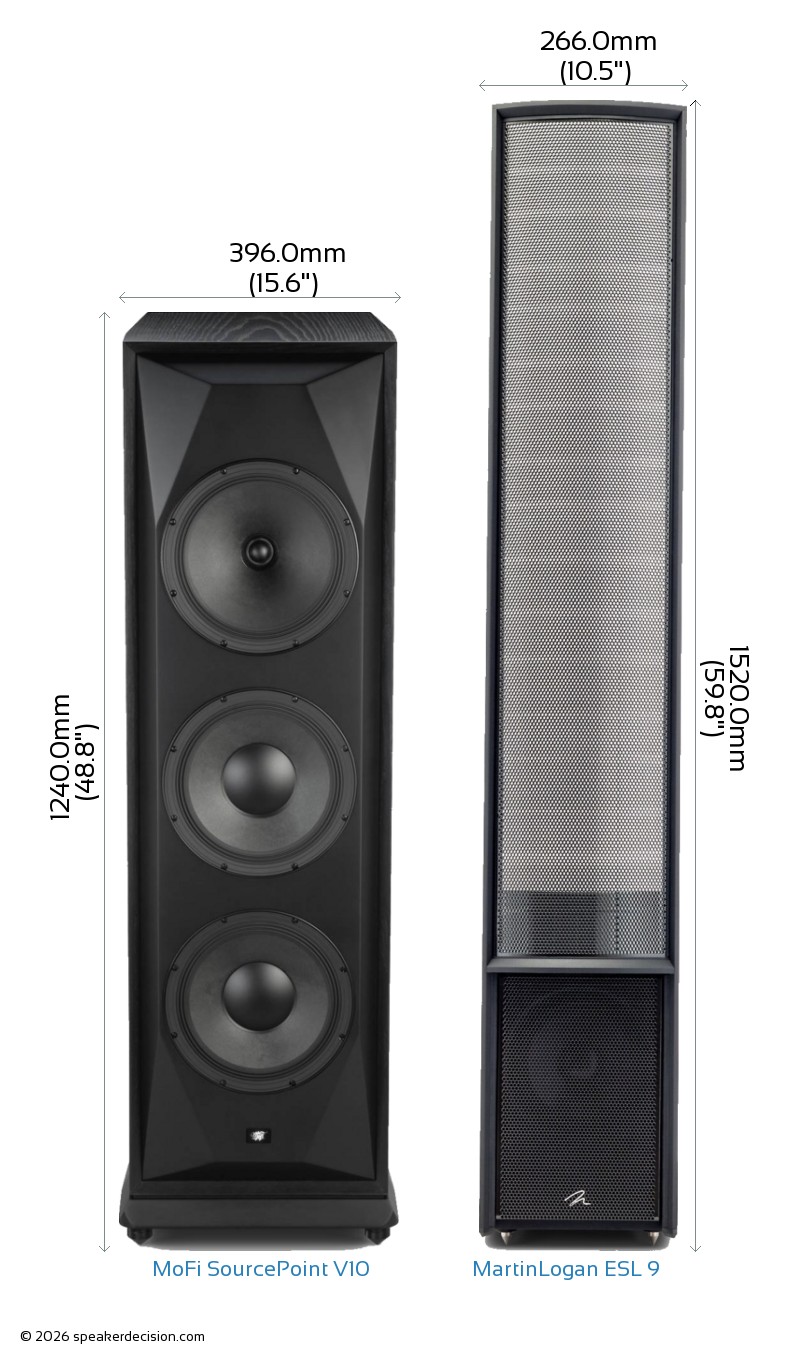
The size of a speaker can sometimes be an important decision factor due to space constraints or in some cases purely for esthetic reasons. In this section, we are going to compare MoFi SourcePoint V10's and MartinLogan ESL 9's external dimensions. MoFi SourcePoint V10 has external dimensions of 1240.0 x 396.0 x 507.0mm (48-13/16inch x 15-9/16inch x 19-15/16inch) whereas MartinLogan ESL 9 has external dimensions of 1520.0 x 266.0 x 647.0mm (59-13/16 x 10-7/16 x 25-7/16inch).
MoFi SourcePoint V10 is 280mm shorter and 140mm less deeper than MartinLogan ESL 9 but it is also 130mm wider.
Below you can see the front view size comparison of MoFi SourcePoint V10 and MartinLogan ESL 9 in scale.
 Comparison image of MoFi SourcePoint V10 and MartinLogan ESL 9 Size and External Dimensions
Base Surface Area Comparison
Base surface area of a loudspeaker may become a determining factor when the space in your room or desk is limited.
The base surface area of the MoFi SourcePoint V10 is approximately 2007.7cm2 / 311.2inch2 and base area of the MartinLogan ESL 9 is approximately 1721.0cm2 / 266.8inch2. The SourcePoint V10 requires 17% more surface area than the ESL 9 which gives it a small disadvantage on placement in tight spaces.
Weight Comparison The weight of a loudspeaker can become an important factor if you need to move and reposition the unit often. Weight of a speaker can also "sometimes" be an indicator of the rigidity of the enclosure and the quality of the internal components used. The MoFi SourcePoint V10 weighs 72.73kg / 160lbs and the MartinLogan ESL 9 weighs 35.45kg / 78lbs. This makes the SourcePoint V10 105% heavier than the ESL 9.
Here is a comparison of how SourcePoint V10 and ESL 9's weights compare with the average, max and min weights in Passive Floor-standing class.
Weight
All Floor-standing Speakers
What's in the Box of MoFi SourcePoint V10?
Here are the items that are included inside the box of SourcePoint V10:
- Floorstanding loudspeaker
- Grille
- 4 Isolation feet
- 4 Spike feet
- 4 Threaded-rods
- 4 Locking-rings
- 2 Jumper-plates (pre-installed)
- User Manual
What's in the Box of MartinLogan ESL 9?
Here are the items that come with the ESL 9:
- Floorstanding hybrid electrostatic loudspeaker
- AC power adapter (w/ attached 10-feet DC cord)
- Grille
- 4 Spike Feet
- Users Manual
- Product Registration Card
 Sensitivity |
91 dB
vs
90 dB
|
Play louder with same amount of amplification power |
 Nominal Impedance |
6 ohms
vs
4 ohms
|
Less selective with amplifiers |
 Woofer Size |
10 inches
vs
8 inches
|
Larger woofer |
|
Low Frequency Response |
27 Hz
vs
34 Hz
|
Generates deeper bass |
 High Frequency Response |
30k Hz
vs
23k Hz
|
Generates higher frequency |
 Height |
1240mm
vs
1520mm
|
Easier to fit in smaller spaces |
 Max Input Power |
400 watts
vs
200 watts
|
Handle more power from your amplifier |
 Base Surface Area |
1721cm2
vs
2007cm2
|
Takes less floor space |
 Price per pair* |
7500USD
vs
7994USD
|
costs less (*prices may change depending on the seller, location and time) |
| General |
MoFi SourcePoint V10 |
MartinLogan Masterpiece Classic ESL 9 |
| Brand |
MoFi |
MartinLogan |
| Speaker Type |
Floor-standing speaker |
Floor-standing speaker |
| Power Range |
up to 200 watts |
20-400 watts |
| Sensitivity |
91 dB |
90 dB |
| Impedance |
6 ohms |
4 ohms |
| Frequency Response |
27-30k Hz |
34-23k Hz |
Drivers |
|
|
| Woofer Quantity |
2 |
2 |
| Woofer Size |
10" |
8" |
| Woofer Composition |
Paper Pulp |
high-excursion paper cone |
| Woofer Surround Material |
Rubber |
Rubber |
| Tweeter Size |
1.25" |
9.2 x 44" |
| Tweeter Type |
Soft-Dome |
curved electrostatic transducer |
| Aimable Tweeter |
No |
No |
| Midrange Driver |
10" |
No |
Physical Specs |
|
|
| Height |
1240.0mm (48.8") |
1520.0mm (59.8") |
| Width |
396.0mm (15.6") |
266.0mm (10.5") |
| Depth |
507.0mm (20") |
647.0mm (25.5") |
| Weight |
72.73kg (160lbs) |
35.45kg (78lbs) |
| Enclosure |
|
Bass Reflex |
| Finish |
MDF/wood-veneer |
Composite |
| Available Colors |
Black |
Gloss Black |
| Grille |
n/a |
Yes |
| Moisture Resistancy |
No |
No |
Connections |
|
|
| Biamp Inputs |
Yes |
Yes |
Other |
|
|
| Parts Warranty |
5 Years |
5 Years w/ Registration |
| Labor Warranty |
5 Years |
5 Years w/ Registration |
A generation apart: MoFi SourcePoint V10 is the newer design, against a 2017 model. Newer is not automatically better, but the older one is more likely to be discounted or near run-out.
| Area | Better | Why |
|---|
| Bass | A | MoFi SourcePoint V10 digs deeper - 27Hz against 34Hz. A subwoofer would even that out. |
| Amplifier needs | evenly matched | Similar sensitivity (91dB vs 90dB) - both want much the same power. |
| Amplifier match | A | MoFi SourcePoint V10 is the easier load at 6 ohms; the other is 4 ohms and wants an amplifier rated for it. |
| Headroom | B | MartinLogan ESL 9 takes more power (400W vs 200W) - more in hand in a big room. |
| Size | depends | Similar cabinet size - neither is easier to fit. |
| Cabinet | depends | Passive Radiator vs Ported. |
| Expandability | depends | MoFi SourcePoint V10: bi-amping; MartinLogan ESL 9: bi-amping. MartinLogan ESL 9 sits in a wider range (7 models), so a matched surround system is easier later. |
| Price | evenly matched | Much the same money ($7,994 vs $7,500 a pair). |
A MoFi SourcePoint V10 B MartinLogan ESL 9
depends neither is better in the abstract - it turns on your room, your system or how you will use them. Only specs published for both speakers are judged; anything missing on either side is left out rather than guessed.
Which should you choose?
MoFi SourcePoint V10 has the edge on paper, though the margin is not large. The rows marked "depends" may matter more to you than the score does. If a subwoofer is in your plans, the bass gap largely stops mattering - you would be crossing over above 34Hz anyway, so judge these on the other rows instead. If your amplifier is modest, vintage or valve-based, MoFi SourcePoint V10 is the safer partner - the other will want more current or more watts to sound its best.
And remember what a spec sheet cannot show: how each looks in your room and whether the finish suits it, what dealer support and warranty are like where you live, and how they actually sound to you. If you can hear them first - ideally with your own music - that will tell you more than any number above.