In this review, we will be comparing LSX II and A5+, two Powered Bookshelf speakers from KEF and Audioengine. Being Powered speakers, they both have built-in amplifiers so you don't need an external power amp or an integrated amp to power them.
Let's have a brief look at the main features
of KEF LSX II and Audioengine A5+ first before getting into our more
detailed comparison.
| Key Specs | KEF LSX II | Audioengine A5+ |
|---|
| Brand | KEF
United Kingdom · founded 1961 | Audioengine
United States · founded 2005 |
|---|
| Design | 2-way | 2-way |
|---|
| Built-in amplifier | 200-watt RMS | 50-watt RMS (75-watt peak) |
|---|
| Uni-Q driver | 11th Generation Uni-Q | — |
|---|
| Tweeter | 0.75" Hard-Dome | 0.75" Soft-Dome |
|---|
| Woofer | 4.5" Magnesium/Aluminium alloy | 5" Kevlar |
|---|
| Frequency response | 54-28k Hz | 50-22k Hz |
|---|
| Max depth / sample rate | 24-bit / 384 kHz | — |
|---|
| Bluetooth | Built-in 4.2 | No |
|---|
| App control | Yes | — |
|---|
| Weight | 3.60kg / 7.9lbs | 4.40kg / 9.7lbs |
|---|
| Dimensions (H x W x D) | 9.5" x 6.1" x 7.1"
240 × 155 × 180 mm | 10.875" x 7.1888" x 9.75"
276.2 x 182.6 x 247.6mm |
|---|
The sections below take each area in turn: drivers, frequency response, physical size and what you get in the box.
Drivers
Both LSX II and A5+ are 2-way speakers.
KEF LSX IIAudioengine A5+
TweeterWoofer
Front view, drawn to scale - cabinets and drivers share one scale, so sizes are directly comparable. Hover a driver for its size.
| Driver |
KEF LSX II |
Audioengine A5+ |
|
Driver Setup
|
2-way
|
2-way
|
|
Tweeter
|
0.75-inch
|
0.75-inch
|
|
Midrange
|
- |
- |
|
Woofer
|
1 x 4.5-inch
|
1 x 5-inch
|
LSX II features a 0.75" Aluminum Hard-Dome Tweeter and 1 x 4.5" Magnesium/Aluminium alloy Woofer. On the other hand, the A5+ features a 0.75" Silk Soft-Dome Tweeter and 1 x 5" Kevlar Woofer.
Frequency Response
LSX II has a frequency range of 54-28k Hz whereas A5+ has a frequency range of 50-22k Hz. With a minimum frequency of 50Hz, the A5+ can go slightly deeper then the LSX II's min frequency of 54Hz.
The graph below depicts how these two speakers compare with the max, min and average Low Frequency values of other speakers in the Bookshelf class in our database.
Low Frequency
Bookshelf Speakers
Neither pair reaches down to 20Hz, the usual definition of full-range, which is normal for speakers of this size. If you want the bottom octave for movies or bass-heavy music, add a subwoofer to whichever you choose. Visit our Powered Subwoofers section to find out more about the available options.
Cabinet Type and Port Position
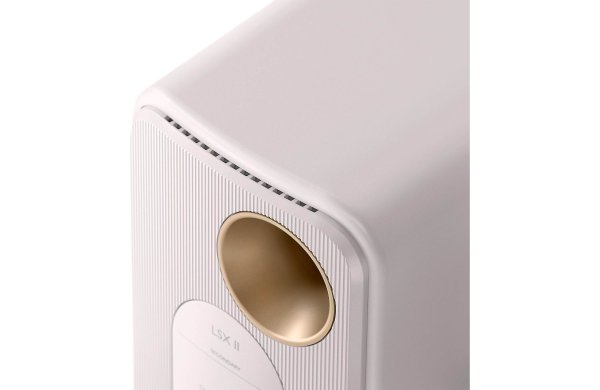
Both LSX II and A5+ have rear firing ports. Rear ported speakers generally need more room between the backside of the speaker and the wall compared to sealed and front/bottom ported speakers. Placing the speakers too close to the walls may cause the bass to sound boomy.
If you are limited in space and can't get the speakers away from the backwall, check our Speakers with Front Firing Ports page.
 KEF LSX II Port
Physical Specs
The size of a speaker can sometimes be an important decision factor due to space constraints or in some cases purely for esthetic reasons. In this section, we are going to compare KEF LSX II's and Audioengine A5+'s external dimensions. KEF LSX II has external dimensions of 240 × 155 × 180 mm (9.5 × 6.1 × 7.1 inch) whereas Audioengine A5+ has external dimensions of 276.2 x 182.6 x 247.6mm (10.875 x 7.1888 x 9.75inch).
Audioengine A5+ is clearly the larger of the two speakers. Its body is 27.6mm wider, 36.2mm taller and 67.6mm deeper than KEF LSX II.
Size, drawn to scale
Both speakers and both views share one scale, so everything here is directly comparable. Hover a box for its dimensions.
One scale for both, standing on the same surface and pushed back to the same wall, so the deeper one visibly sticks out further.
Audioengine A5+ needs about 62% more floor or shelf area. Audioengine A5+ is 68mm deeper, so it stands that much further out from the wall. Audioengine A5+ is 36mm taller.
Base Surface Area Comparison
Base surface area of a loudspeaker may become a determining factor when the space in your room or desk is limited.
The base surface area of the KEF LSX II is approximately 279.0cm2 / 43.2inch2 and base area of the Audioengine A5+ is approximately 452.1cm2 / 70.1inch2. The LSX II requires 38% less surface area than the A5+ which gives it a small advantage on placement in tight spaces.
Weight Comparison The weight of a loudspeaker can become an important factor if you need to move and reposition the unit often. Weight of a speaker can also "sometimes" be an indicator of the rigidity of the enclosure and the quality of the internal components used. The KEF LSX II weighs 3.60kg / 7.9lbs and the Audioengine A5+ weighs 4.40kg / 9.7lbs. This makes the A5+ 22% heavier than the LSX II.
Here is a comparison of how LSX II and A5+'s weights compare with the average, max and min weights in Powered Bookshelf class.
Weight
All Bookshelf Speakers
What's in the Box of KEF LSX II?
Here are the items that are included inside the box of LSX II:
- 2 Wireless powered speakers
- Two 6.5-feet AC power cords
- 10-feet Cat-6 interconnect speaker cable
- Remote control
- 2 AAA batteries
- Quick Start Guide
- Important Safety Information
- Warranty Information
- Maintenance Guide
What's in the Box of Audioengine A5+?
Here are the items that come with the A5+:
- Powered left speaker
- Passive right speaker
- 6-feet AC power cord
- Remote control (with installed CR2025 battery)
- 12.5-feet Length of 16 gauge speaker wire
- 6.5-feet Stereo mini-jack cable (3.5mm mini-jack on both ends)
- 6-feet Stereo RCA cable
- Cloth drawstring cable bag
- 2 Cloth drawstring speaker bags
- Setup guide
- Audioengine product brochure
 High Frequency Response High Frequency Response |
28k Hz
vs
22k Hz
|
Generates higher frequency |
 App-Based Control App-Based Control |
Apple iOS, Android
vs
None
|
Control the speaker via an app |
 Height Height |
240mm
vs
276mm
|
Easier to fit in smaller spaces |
 Base Surface Area Base Surface Area |
279cm2
vs
452cm2
|
Takes less floor space |
 Ethernet Connection Ethernet Connection |
Yes
vs
No
|
High quality streaming over Ethernet |
 USB Port USB Port |
USB-C (connects to your computer)
vs
No
|
USB port adds flexibility |
 Digital Input Digital Input |
Optical
vs
No
|
Connect digital inputs directly |
 HDMI Input HDMI Input |
ARC
vs
No
|
Connect HDMI sources directly |
 Woofer Size Woofer Size |
5 inches
vs
4.5 inches
|
Larger woofer |
|
Low Frequency Response |
50 Hz
vs
54 Hz
|
Generates deeper bass |
 Price per pair* Price per pair* |
399USD
vs
1299USD
|
costs less (*prices may change depending on the seller, location and time) |
 RCA Connection RCA Connection |
Yes
vs
No
|
Connection via RCA input |
| General |
KEF LSX II |
Audioengine A5+ |
| Brand |
KEF |
Audioengine |
| Speaker Type |
Powered Stereo Speakers |
Powered Stereo Speakers |
| Frequency Response |
54-28k Hz |
50-22k Hz |
Amplifier |
|
|
| Watts RMS (Continuous) |
200-watt RMS |
50-watt RMS |
| Watts Peak (Max) |
n/a |
75-watt RMS |
| Max Bit Depth |
24-bit |
n/a |
| Max Sample Rate |
384 kHz |
n/a |
Drivers |
|
|
| Woofer Quantity |
1 |
1 |
| Woofer Size |
4.5" |
5" |
| Woofer Composition |
Magnesium/Aluminium alloy |
Kevlar |
| Woofer Surround Material |
Rubber |
n/a |
| Tweeter Size |
0.75" |
0.75" |
| Tweeter Type |
Hard-Dome |
Soft-Dome |
| Aimable Tweeter |
No |
No |
| Midrange Driver |
No |
No |
| Firing Direction |
rear |
rear |
Physical Specs |
|
|
| Height |
240.0mm (9.4") |
276.2mm (10.9") |
| Width |
155.0mm (6.1") |
182.6mm (7.2") |
| Depth |
180.0mm (7.1") |
247.6mm (9.7") |
| Weight |
3.60kg (7.9lbs) |
4.40kg (9.7lbs) |
| Enclosure |
Bass Reflex |
Bass Reflex |
| Available Colors |
Carbon Black, Mineral White, Cobalt Blue, Lava Red, and Soundwave |
Black, Bamboo, White |
| Mounting Bracket |
No |
No |
| Moisture Resistancy |
No |
No |
Connections |
|
|
| Aux Inputs |
3.5mm |
3.5mm, RCA |
| USB Port |
USB-C (connects to your computer) |
Charge only |
| Phone Input |
No |
No |
| Subwoofer Output |
Wired |
Wired |
| Digital Input |
Optical |
No |
| HDMI Input |
ARC |
No |
| Headphone Jack |
No |
No |
| Ethernet Port |
Yes |
No |
Other |
|
|
| Parts Warranty |
1 Year |
3 Years |
| Labor Warranty |
1 Year |
3 Years |
These sit in different price classes - KEF LSX II costs roughly 3.3x what Audioengine A5+ does. Expect it to lead on paper; the question is whether the gap is audible enough in your room to be worth it.
| Area | Better | Why |
|---|
| Bass | B | Audioengine A5+ digs deeper - 50Hz against 54Hz. A subwoofer would even that out. |
| Built-in power | A | KEF LSX II has the bigger amplifier (200W vs 50W RMS). |
| Connections | A | KEF LSX II adds Bluetooth, Wi-Fi, streaming, HDMI and digital inputs. |
| Size | depends | KEF LSX II is easier to place; Audioengine A5+ is bigger, which usually goes with fuller bass. Your room decides. |
| Expandability | depends | KEF LSX II: a sub output; Audioengine A5+: a sub output. KEF LSX II sits in a wider range (10 models), so a matched surround system is easier later. |
| Price | B | Audioengine A5+ is cheaper - $399 against $1,299, about 69% less; arguably a different class. |
A KEF LSX II B Audioengine A5+
depends neither is better in the abstract - it turns on your room, your system or how you will use them. Only specs published for both speakers are judged; anything missing on either side is left out rather than guessed.
Which should you choose?
KEF LSX II is ahead, but only on 1 of the measured areas, and it costs about 3.3x the price. That is a lot of money for a narrow margin on paper - Audioengine A5+ looks like the sensible buy unless something else about the KEF LSX II appeals to you. In a large or open-plan room, Audioengine A5+ has the cabinet volume to fill it more easily; in a small room, near a wall or at desk distance, KEF LSX II is the easier speaker to get right. Think about the whole system, not just the speakers: the roughly $900 saved by taking the cheaper pair would buy a subwoofer or a better amplifier, and either usually does more for the sound than the difference between these two.
And remember what a spec sheet cannot show: how each looks in your room and whether the finish suits it, what dealer support and warranty are like where you live, and how they actually sound to you. If you can hear them first - ideally with your own music - that will tell you more than any number above.