In this review, we will be comparing Elite ES10 and ForceField 3, two Powered Subwoofer speakers from Polk Audio and GoldenEar. Being Powered subwoofers, they both have built-in amplifiers so you don't need an external power amp or an integrated amp to power them. Let's have a brief look at the main features of Polk Signature Elite ES10 and GoldenEar ForceField 3 first before getting into our more detailed comparison.
The sections below take each area in turn: driver and amplifier, frequency response, physical size and connectivity.
Drivers
The efficiency of a subwoofer is directly proportional to the total radiating are squared hence the woofer quantity and diameter.Both Polk Signature Elite ES10and GoldenEar ForceField 3 have a single woofer setup however the Polk Signature Elite ES10's woofer is 10-inch whereas the GoldenEar ForceField 3 features a 8-inch woofer.
Frequency Response
Elite ES10 has a frequency range of 28-250 Hz whereas ForceField 3 has a frequency range of 18-250 Hz. With a minimum frequency of 18Hz, the ForceField 3 can go significantly deeper on the low side and provide stronger bass compared to the Elite ES10's min frequency of 28Hz.
Below graphs depict how these two speakers compare with the max, min and average values of the Min and Max Frequencies of other speakers in the Subwoofer class in our database.
Low Frequency
Subwoofer Speakers
Polk Signature Elite ES10
High Frequency
Subwoofer Speakers
Polk Signature Elite ES10
Cabinet Type
The Polk Signature Elite ES10 has a Bass Reflex type cabinet. Bass Reflex type subwoofers (aka Ported, Vented or Reflex Port) have enclosures that uses a port, hole or vent cut into the cabinet. Ported designs are generally more efficient than the Sealed designs. On the other hand the GoldenEar ForceField 3 have Passive Radiator type enclosure. Passive Radiator type subwoofers sports a non-powered cone that moves in response to the main woofer to move air out in order to generate stronger bass in a smaller body compared to ported or sealed designs.
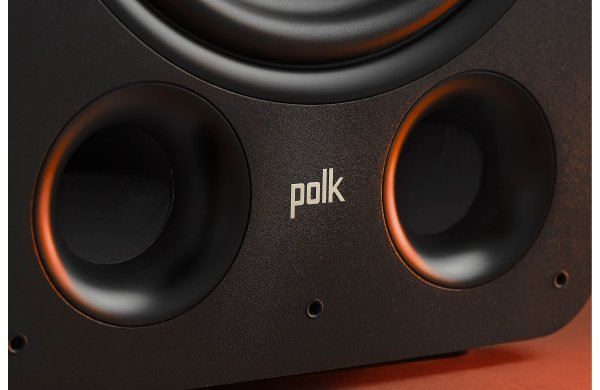 Polk Signature Elite ES10 double Port
Physical Specs
The size of a speaker can sometimes be an important decision factor due to space constraints or in some cases purely for esthetic reasons. In this section, we are going to compare Polk Signature Elite ES10's and GoldenEar ForceField 3's external dimensions. Polk Signature Elite ES10 has external dimensions of 439.0 x 332.0 x 469.0mm (17-1/4inch x 13-1/16inch x 18-7/16inch) whereas GoldenEar ForceField 3 has external dimensions of 288.0 x 293.0 x 432.0mm (11-5/16inch x 11-1/2inch x 17inch).
Polk Signature Elite ES10 is clearly the larger of the two speakers. Its body is 39mm wider, 151mm taller and 37mm deeper than GoldenEar ForceField 3.
Size, drawn to scale
Both speakers and both views share one scale, so everything here is directly comparable. Hover a box for its dimensions.
One scale for both, standing on the same surface and pushed back to the same wall, so the deeper one visibly sticks out further.
Polk Signature Elite ES10 needs about 23% more floor or shelf area. Polk Signature Elite ES10 is 37mm deeper, so it stands that much further out from the wall. Polk Signature Elite ES10 is 151mm taller.
Base Surface Area Comparison
Base surface area of a loudspeaker may become a determining factor when the space in your room or desk is limited.
The base surface area of the Polk Signature Elite ES10 is approximately 1557.1cm2 / 241.4inch2 and base area of the GoldenEar ForceField 3 is approximately 1265.8cm2 / 196.2inch2. The Elite ES10 requires 23% more surface area than the ForceField 3 which gives it a small disadvantage on placement in tight spaces.
Weight Comparison The weight of a subwoofer may become an important factor if you need to move and reposition the unit often to find the optimal positioning, also known as 'Subwoofer Crawling'. The Polk Signature Elite ES10 weighs 17.73kg / 39lbs and the GoldenEar ForceField 3 weighs 11.82kg / 26lbs. This makes the Elite ES10 50% heavier than the ForceField 3.
Here is a comparison of how Elite ES10 and ForceField 3's weights compare with the average, max and min weights in Powered Subwoofer class.
Weight
All Subwoofer Speakers
Polk Signature Elite ES10
What's in the Box of Polk Signature Elite ES10?
Here are the items that are included inside the box of Elite ES10:
- Powered subwoofer
- Grille
- 6-feet AC power cord
- Owners Manual
- Online Product Registration sheet
What's in the Box of GoldenEar ForceField 3?
Here are the items that come with the ForceField 3:
- Powered Subwoofer
- 10-feet AC power cord
- Owners Manual
 Woofer Size Woofer Size |
10 inches
vs
8 inches
|
Larger woofer |
| Low Frequency Response |
18 Hz
vs
28 Hz
|
Generates deeper bass |
 Height Height |
288mm
vs
439mm
|
Easier to fit in smaller spaces |
 Base Surface Area Base Surface Area |
1265cm2
vs
1557cm2
|
Takes less floor space |
 Price per pair* Price per pair* |
599USD
vs
649USD
|
costs less (*prices may change depending on the seller, location and time) |
Size, drawn to scale
Both subwoofers and both views share one scale, so everything here is directly comparable. Hover a box for its dimensions.
One scale for both, standing on the same floor and pushed back to the same wall, so the bigger one visibly takes more of the room.
Polk Signature Elite ES10 needs about 23% more floor area. Polk Signature Elite ES10 stands 37mm further into the room. Polk Signature Elite ES10 is 151mm taller.
| General |
Polk Signature Elite ES10 |
GoldenEar ForceField 3 |
| Brand |
Polk Audio |
GoldenEar |
| Speaker Type |
Powered Subwoofer |
Powered Subwoofer |
| Max Amplifier Output |
200 watts |
1000 watts |
| Frequency Response |
28-250 Hz |
18-250 Hz |
Amplifier |
|
|
| Watts RMS (Continuous) |
200-watt RMS |
1000-watt RMS |
Drivers |
|
|
| Woofer Quantity |
1 |
1 |
| Woofer Size |
10" |
8" |
| Woofer Composition |
Mineral-filled polypropylene |
Polypropylene |
| Tweeter Size |
- |
- |
| Aimable Tweeter |
No |
No |
| Midrange Driver |
No |
No |
| Firing Direction |
front |
front |
Physical Specs |
|
|
| Height |
439.0mm (17.3") |
288.0mm (11.3") |
| Width |
332.0mm (13.1") |
293.0mm (11.5") |
| Depth |
469.0mm (18.5") |
432.0mm (17") |
| Weight |
17.73kg (39lbs) |
11.82kg (26lbs) |
| Enclosure |
Bass Reflex |
Passive Radiator |
| Grille |
Yes |
n/a |
| Moisture Resistancy |
No |
No |
Connections |
|
|
Other |
|
|
| Parts Warranty |
3 Years |
3 Years |
| Labor Warranty |
3 Years |
3 Years |
A ported subwoofer against a passive radiator one. That is the most consequential line on this page: it decides how the bass rolls off, how it behaves in a small room, and how much output you get for the size of the box.
| Area | Better | Why |
|---|
| Bass depth | B | GoldenEar ForceField 3 goes deeper - 18Hz against 28Hz. Under 20Hz is felt more than heard - the bottom of a pipe organ and the bottom of a film mix. |
| Amplifier power | B | GoldenEar ForceField 3 has the bigger amplifier - 1000W against 200W RMS, about 7dB more on tap. In a large room that is headroom before the DSP starts limiting. |
| Driver area | A | Polk Signature Elite ES10 moves more air: 10" against 8" is 1.56x the cone area, not the 1.25x the diameters suggest. More area means the same output with less excursion, and less distortion with it. |
| Enclosure | depends | Polk Signature Elite ES10 is ported - a ported box gives more output low down for its size, at the cost of a steeper roll-off below tuning; GoldenEar ForceField 3 is passive radiator - a passive radiator behaves like a port without the pipe noise, and suits a slim cabinet. Neither is better in the abstract; ported tends to suit films and sealed tends to suit music, and both generalisations have exceptions. |
| Speaker-level inputs | B | GoldenEar ForceField 3 takes a speaker-level connection as well as line level. That is what lets it work with an integrated amplifier or a vintage receiver that has no subwoofer output at all. |
| Phase control | A | Polk Signature Elite ES10 has a phase control. Without one, the only way to fix a cancellation at the crossover is to move the box. |
| Cabinet size | depends | GoldenEar ForceField 3 is about 47% smaller by volume. In a subwoofer that is a real trade rather than a preference: box volume is how you get output low down without a bigger amplifier. |
| Price | B | GoldenEar ForceField 3 costs less - $599 against $649, about 8% less. |
A Polk Signature Elite ES10 B GoldenEar ForceField 3
depends neither is better in the abstract - it turns on your room, your system or how you will use them. Only specs published for both subwoofers are judged; anything missing on either side is left out rather than guessed.
Which should you choose?
GoldenEar ForceField 3 has the edge on paper, though not by much. The "depends" rows are more likely to decide this than the score is. Check your amplifier first: if it has no subwoofer or preamp output, GoldenEar ForceField 3 is the only one of these two you can connect at all. If placement is the constraint - a corner, behind a sofa, under a desk - GoldenEar ForceField 3 is the one that will actually go there, and a well-placed small subwoofer beats a badly-placed big one every time.
One thing outweighs everything above: where the subwoofer stands. Room modes can add or remove 10dB or more at a given seat, which is far larger than any difference on this page. Before spending more, try the sub in two or three positions - the crawl test, where you put it in the listening seat and crawl the room to find where the bass sounds best, costs nothing and usually beats an upgrade.