In this review, we will be comparing ForceField 4 and Descend DN15, two Powered Subwoofer speakers from GoldenEar and Definitive Technology. Being Powered subwoofers, they both have built-in amplifiers so you don't need an external power amp or an integrated amp to power them. Let's have a brief look at the main features of GoldenEar ForceField 4 and Definitive DN15 first before getting into our more detailed comparison.
In the following sections, we will get into details in order to better understand how the GoldenEar ForceField 4 and Definitive DN15 compare and hopefully end up with enough arguments to decide which one of these subwoofers is the better choice for you.
**This post contains affiliate links, and I will be compensated if you make a purchase after clicking through my links. As an Amazon Associate I earn from qualifying purchases.
Drivers
The efficiency of a subwoofer is directly proportional to the total radiating are squared hence the woofer quantity and diameter.Both GoldenEar ForceField 4and Definitive DN15 have a single woofer setup however the GoldenEar ForceField 4's woofer is 10-inch whereas the Definitive DN15 features a 15-inch woofer.
Frequency Response
ForceField 4 has a frequency range of 14-250 Hz whereas Descend DN15 has a frequency range of 20-150 Hz. With a minimum frequency of 14Hz, the ForceField 4 can go significantly deeper on the low side and provide stronger bass compared to the Descend DN15's min frequency of 20Hz.
Below graphs depict how these two speakers compare with the max, min and average values of the Min and Max Frequencies of other speakers in the Subwoofer class in our database.
Low Frequency
Subwoofer Speakers
High Frequency
Subwoofer Speakers
Cabinet Type
Both GoldenEar ForceField 4 and Definitive DN15 have Passive Radiator type cabinets. Passive Radiator type subwoofers sports a non-powered cone that moves in response to the main woofer to move air out in order to generate stronger bass in a smaller body compared to ported or sealed designs.
Physical Specs
Size of a speaker can sometimes become an important decision factor due to space constraints or in some cases purely for esthetic reasons. In this section, we are going to compare GoldenEar ForceField 4's and Definitive DN15's external dimensions. GoldenEar ForceField 4 has external dimensions of 331.0 x 340.0 x 482.0mm ( 13inch x 13-3/8inch x 18-15/16inch ) whereas Definitive DN15 has external dimensions of 634.0 x 596.0 x 640.0mm ( 24-15/16inch x 23-7/16inch x 25-3/16inch ) .
Definitive DN15 is clearly the larger of the two speakers. Its body is 256mm wider, 303mm taller and 158mm deeper than GoldenEar ForceField 4.
Below you can see the front view size comparison of GoldenEar ForceField 4 and Definitive DN15 in scale.
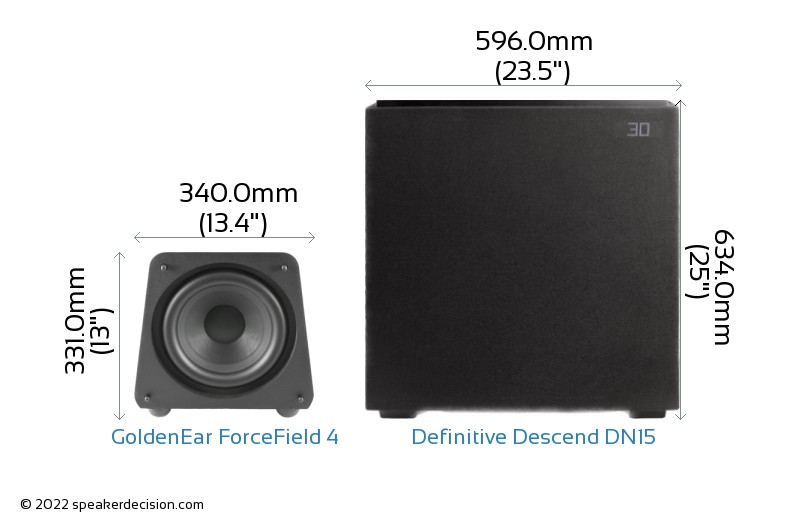 Comparison image of GoldenEar ForceField 4 and Definitive DN15 Size and External Dimensions
Base Surface Area Comparison
Base surface area of a loudspeaker may become a determining factor when the space in your room or desk is limited.
The base surface area of the GoldenEar ForceField 4 is approximately 1638.8cm2 / 254.0inch2 and base area of the Definitive DN15 is approximately 3814.4cm2 / 591.2inch2. The ForceField 4 requires 57% less surface area than the Descend DN15 which gives it a small advantage on placement in tight spaces.
Weight Comparison The weight of a subwoofer may become an important factor if you need to move and reposition the unit often to find the optimal positioning, also known as 'Subwoofer Crawling'. The GoldenEar ForceField 4 weighs 14.55kg / 32lbs and the Definitive DN15 weighs 52.09kg / 114.6lbs. This makes the Descend DN15 258% heavier than the ForceField 4.
Here is a comparison of how ForceField 4 and Descend DN15's weights compare with the average, max and min weights in Powered Subwoofer class.
Weight
All Subwoofer Speakers
What's in the Box of GoldenEar ForceField 4?
Here are the items that are included inside the box of ForceField 4:
Powered Subwoofer10-feet AC power cordOwners Manual
What's in the Box of Definitive DN15?
Here are the items that come with the Descend DN15:
Powered subwoofer6-feet AC power cordRemote controlCR2032 3V battery (pre-installed in remote)Owners Manual
 Low Frequency Response Low Frequency Response |
14 Hz
vs
20 Hz
|
Generates deeper bass |
 High Frequency Response High Frequency Response |
250k Hz
vs
150k Hz
|
Generates higher frequency |
 Height Height |
331mm
vs
634mm
|
Easier to fit in smaller spaces |
 Base Surface Area Base Surface Area |
1638cm2
vs
3814cm2
|
Takes less floor space |
 Price per pair* Price per pair* |
799USD
vs
1799USD
|
costs less (*prices may change depending on the seller, location and time) |
| Woofer Size |
15 inches
vs
10 inches
|
Larger woofer |
 Passive Radiator Passive Radiator |
2 x 15-inch
vs
None
|
Increases the bass performance |
| General |
GoldenEar ForceField 4 |
Definitive Technology Descend DN15 |
| Brand |
GoldenEar |
Definitive Technology |
| Speaker Type |
Powered Subwoofer |
Powered Subwoofer |
| Max Amplifier Output |
1200 watts |
500 watts |
| Frequency Response |
14-250 Hz |
20-150 Hz |
Amplifier |
|
|
| Watts RMS (Continuous) |
1200-watt RMS |
500-watt RMS |
Drivers |
|
|
| Woofer Quantity |
1 |
1 |
| Woofer Size |
10" |
15" |
| Woofer Composition |
Polypropylene |
Polypropylene |
| Tweeter Size |
- |
- |
| Aimable Tweeter |
No |
No |
| Midrange Driver |
No |
No |
| Firing Direction |
front |
front |
Physical Specs |
|
|
| Height |
331.0mm (13") |
634.0mm (25") |
| Width |
340.0mm (13.4") |
596.0mm (23.5") |
| Depth |
482.0mm (19") |
640.0mm (25.2") |
| Weight |
14.55kg (32lbs) |
52.09kg (114.6lbs) |
| Enclosure |
Passive Radiator |
Passive Radiator |
| Moisture Resistancy |
No |
No |
Connections |
|
|
Other |
|
|
| Parts Warranty |
3 Years |
3 Years |
| Labor Warranty |
3 Years |
3 Years |