In this review, we will be comparing Omada No.3 and Theva No2, two Passive Floor-standing speakers by Focal
Let's have a brief look at the main features
of Focal Omada No.3 and Focal Theva No2 first before getting into our more
detailed comparison.
Focal Omada No.3 Key Specs
- 3-way Design
- 1" Inverted Hard-Dome Tweeter
- 6.5" Midrange
- 3 x 6.5" Carbon Fiber + Polymer Woofer
- 42-30k Hz Frequency Response
- 91.5 dB Sensitivity
- Impedance: 8ohms
- Power Range:40-300watts
- Weight:26.55kg
- Dimensions (H x W x D): 1128.0" x 10-1/8" x 13-11/16"( 1128.0 x 258.0 x 348.0mm )
Focal Theva No2 Key Specs
- 2-way Design
- 1" inverted dome Tweeter
- 6.5" Midrange
- 2 x 6.5" Slatefiber Woofer
- 6.5" Midrange
- 53-28kHz Frequency Response
- 90 dB Sensitivity
- Impedance: 8ohms
- Power Range:40-200watts
- Weight:16.82kg
- Dimensions (H x W x D): 931.0" x 7-1/2" x 13-7/8"( 931.0 x 191.0 x 353.0mm )
In the following sections, we will get into more detail in order to better understand how the Focal Omada No.3 and Focal Theva No2 compare and hopefully end up with enough arguments to decide which one of these loudspeakers is the better choice for you.
**This post contains affiliate links, and I will be compensated if you make a purchase after clicking
through my links. As an Amazon Associate I earn from qualifying purchases.
Drivers
One of the fundamental differences between these two speakers is that Omada No.3 is a 3-way design whereas the Theva No2 is a 2-way speaker. 3-way designs utilize a midrange driver in addition to the tweeter and woofer on 2-way designs. Designing a crossover for a 3-way speaker is a complicated process and generally increases the overall cost of the speaker.
| Driver |
Focal Omada No.3 |
Focal Theva No2 |
|
Driver Setup
|
3-way
|
2-way
|
|
Tweeter
|
1-inch
|
1-inch
|
|
Midrange
|
1 x 6.5-inch |
1 x 6.5-inch |
|
Woofer
|
3 x 6.5-inch
|
2 x 6.5-inch
|
Omada No.3 features a 1" Al/Mg Inverted Hard-Dome Tweeter , a 6.5" Midrange and 3 x 6.5" Carbon Fiber + Polymer Woofer . On the other hand, the Theva No2 features a 1" TNF Al/Mg inverted dome Tweeter , a 6.5" Midrange and 2 x 6.5" Slatefiber Woofer with a Crossover frequency at 280 Hz - 2900 Hz.
Frequency Response
Omada No.3 has a frequency range of 42-30k Hz whereas Theva No2 has a frequency range of 53-28kHz. With a minimum frequency of 42Hz, the Omada No.3 can go significantly deeper on the low side and provide stronger bass compared to the Theva No2's min frequency of 53Hz.
Below graphs depict how these two speakers compare with the max, min and average values of the Min and Max Frequencies of other speakers in the Floor-standing class in our database.
Low Frequency
Floor-standing Speakers
High Frequency
Floor-standing Speakers
None of these speakers achieves full range experience which is commonly agreed as 20Hz-20kHz. In order to achieve lower lows / deeper bass, we recommend you pair these with a subwoofer. Visit our Powered Subwoofers section to find out more about the available options.
Impedance and Sensitivity
Omada No.3 and Theva No2 have the same Impedance of 8 ohms but where they differ is the sensitivity levels. Omada No.3 sensitivity is rated at 91.5 dB and the Theva No2's is at 90 dB. This 2 dB difference makes the Focal Omada No.3 a more sensitive speaker compared to Focal Theva No2, hence will play louder with the same amount of watts.
Sensitivity
Floor-standing Speakers
Power Range
Power
range is the range of input power in watts RMS that a loudspeaker is designed to handle. While using
an amplifier within this range ensures the nominal performance , inputting a power that is higher than the
max wattage can result in a damaged speaker.
Omada No.3 can handle a max power of 300 watts RMS from the amp the whereas Theva No2 has a max power handling value of 200 watts RMS, 100 watts less than the Omada No.3.
Keep in mind that a higher max power handling value doesn't necessarily make that a louder speaker
compared to a lower max handling speaker. Loudness or the sound level is also impacted by parameters
such as Impedance, sensitivity and system efficiencies.
Input Type and Bi-Amping / Bi-Wiring
Omada No.3 features Binding post type posts and Theva No2 has a Binding post type posts. None of these speakers feature bi-amping/bi-wiring.
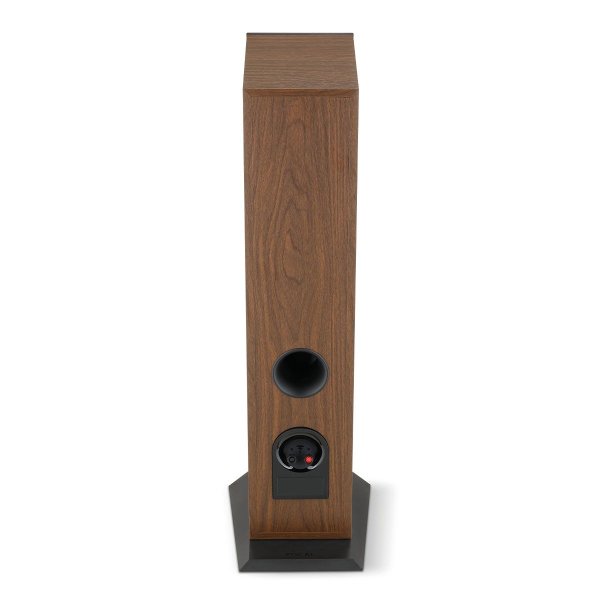 Focal Theva No2's Binding post terminals
Cabinet Type and Port Position
Omada No.3 has a front firing port whereas Theva No2 has a rear firing ports. Focal Omada No.3's front-firing port gives more flexibility in placement in regards to proximity to walls compared to Focal Theva No2 with its rear-firing port.
Physical Specs
Size of a speaker can sometimes become an important decision factor due to space constraints or in some cases purely for esthetic reasons. In this section, we are going to compare Focal Omada No.3's and Focal Theva No2's external dimensions. Focal Omada No.3 has external dimensions of 1128.0 x 258.0 x 348.0mm ( 44-3/8inch x 10-1/8inch x 13-11/16inch ) whereas Focal Theva No2 has external dimensions of 931.0 x 191.0 x 353.0mm ( 365/8 x 71/2 x 137/8) .
Focal Theva No2 is 67mm narrower and 197mm shorter than Focal Omada No.3 but it is also 5mm deeper.
Base Surface Area Comparison
Base surface area of a loudspeaker may become a determining factor when the space in your room or desk is limited.
The base surface area of the Focal Omada No.3 is approximately 897.8cm2 / 139.2inch2 and base area of the Focal Theva No2 is approximately 674.2cm2 / 104.5inch2. The Omada No.3 requires 33% more surface area than the Theva No2 which gives it a small disadvantage on placement in tight spaces.