In this review, we will be comparing DBR62 and Q150, two Passive Bookshelf speakers from ELAC and KEF.
Let's have a brief look at the main features
of ELAC Debut Ref DBR62 and KEF Q150 first before getting into our more
detailed comparison.
| Key Specs | ELAC Debut Ref DBR62 | KEF Q150 |
|---|
| Brand | ELAC
Germany · founded 1926 | KEF
United Kingdom · founded 1961 |
|---|
| Design | 2-way | 2-way |
|---|
| Uni-Q driver | — | 11th Generation Uni-Q |
|---|
| Tweeter | 1" Soft-Dome | 1" Dome |
|---|
| Woofer | 6.5" Aramid fiber | 5.25" Aluminum |
|---|
| Frequency response | 44-35k Hz | 51-28k Hz |
|---|
| Sensitivity | 86 dB | 86 dB |
|---|
| Impedance | 6 ohms | 8 ohms |
|---|
| Power range | up to 120 watts | 10-100 watts |
|---|
| Weight | 8.23kg / 18.1lbs | 5.60kg / 12.3lbs |
|---|
| Dimensions (H x W x D) | 14-1/4" x 8-1/4" x 10-7/8"
362.0 x 210.0 x 277.0mm | 11.9" x 7.0" x 10.9"
303.0 x 180.0 x 278.0mm |
|---|
What size room are the ELAC Debut Ref DBR62 and KEF Q150 speakers good for?
The size of the room in which you are planning to use these loudspeakers is an important decision
factor. Here we have compared their suitability to various sizes of environments considering their size
and max power parameters:
| Listening Environment* |
ELAC Debut Ref DBR62 |
KEF Q150 |
| Near-field |
Poor |
Average |
| Small Room |
Average |
Good |
| Mid-size Room |
Good |
Average |
| Large Room |
Average |
Poor |
| Very Large Room |
Poor |
Bad |
(* Approximate Room sizes: Small < 100sq. ft / 9 m2,
Mid-size: 100-220 sq. ft / 9-20 m2, Large 220-400 sq. ft / 20-36 m2, Very Large: >
400 sq. ft / 36 m2.
Average Floor Height: 9" / 2.7m. Typical room sizes differ from country to country, and the actual
listening experience changes depending on floor height, room shape, surface materials, listening
position, speaker locations, etc.)
The sections below take each area in turn: drivers, frequency response, physical size and what you get in the box.
Drivers
Both DBR62 and Q150 are 2-way speakers.
ELAC Debut Ref DBR62KEF Q150
TweeterWoofer
Front view, drawn to scale - cabinets and drivers share one scale, so sizes are directly comparable. Hover a driver for its size.
| Driver |
ELAC Debut Ref DBR62 |
KEF Q150 |
|
Driver Setup
|
2-way
|
2-way
|
|
Tweeter
|
1-inch
|
1-inch
|
|
Midrange
|
- |
- |
|
Woofer
|
1 x 6.5-inch
|
1 x 5.25-inch
|
DBR62 features a 1" Soft-Dome Tweeter and 1 x 6.5" Aramid fiber Woofer. On the other hand, the Q150 features a 1" vented aluminum Dome Tweeter and 1 x 5.25" Aluminum Woofer with a Crossover frequency at 2500Hz.
Frequency Response
DBR62 has a frequency range of 44-35k Hz whereas Q150 has a frequency range of 51-28k Hz. With a minimum frequency of 44Hz, the DBR62 can go significantly deeper on the low side and provide stronger bass compared to the Q150's min frequency of 51Hz.
The graph below depicts how these two speakers compare with the max, min and average Low Frequency values of other speakers in the Bookshelf class in our database.
Low Frequency
Bookshelf Speakers
Neither pair reaches down to 20Hz, the usual definition of full-range, which is normal for speakers of this size. If you want the bottom octave for movies or bass-heavy music, add a subwoofer to whichever you choose. Visit our Powered Subwoofers section to find out more about the available options.
Impedance and Sensitivity
DBR62 is a 6 ohms speaker compared to the Q150 which has a nominal impedance of 8 ohms.
On the other hand, they have the same sensitivity of 86 dBdB.
Sensitivity
Bookshelf Speakers
Power Range
Power
range is the range of input power in watts RMS that a loudspeaker is designed to handle. Staying
within that range gives nominal performance; driving the speaker beyond its maximum wattage can damage it.
DBR62 can handle a max power of 120 watts RMS, whereas Q150 has a max power handling value of 100 watts RMS, 20 watts less than the DBR62.
Note that higher power handling does not make a speaker louder: that depends mainly on
sensitivity and impedance. The calculator below shows how loud each of these actually plays
on a real amplifier.
Which plays louder on your amplifier?
Starting with a popular amplifier - change it to the one you own, or any you are
considering, and watch both numbers move.
Input Type and Bi-Amping / Bi-Wiring
DBR62 features Post type posts and Q150 has a Post type posts. None of these speakers feature bi-amping/bi-wiring.
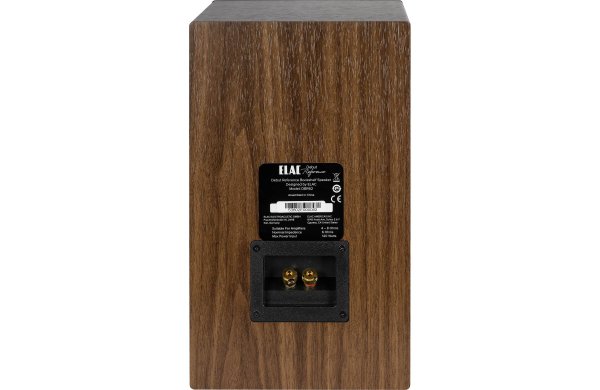 ELAC Debut Ref DBR62's 5-way post terminals
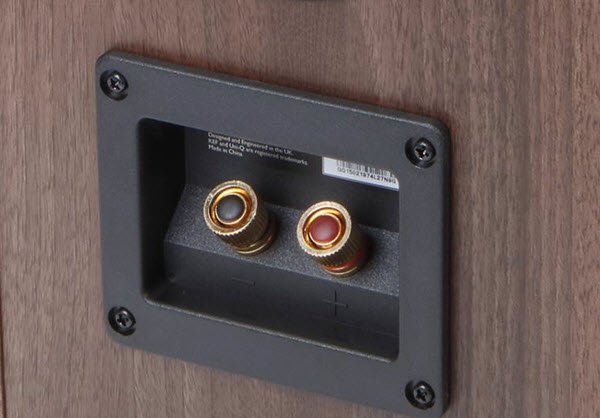 KEF Q150's Post terminals
Cabinet Type and Port Position
DBR62 has a front firing port whereas Q150 has a rear firing ports. ELAC Debut Ref DBR62's front-firing port gives more flexibility in placement in regards to proximity to walls compared to KEF Q150 with its rear-firing port.
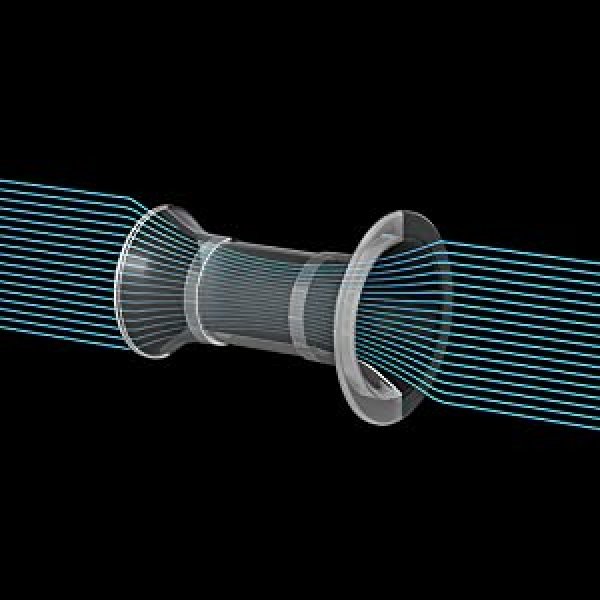 KEF Q150 Port
Physical Specs
The size of a speaker can sometimes be an important decision factor due to space constraints or in some cases purely for esthetic reasons. In this section, we are going to compare ELAC Debut Ref DBR62's and KEF Q150's external dimensions. ELAC Debut Ref DBR62 has external dimensions of 362.0 x 210.0 x 277.0mm (14-1/4 x 8-1/4 x 10-7/8inch) whereas KEF Q150 has external dimensions of 303.0 x 180.0 x 278.0mm (11.9 x 7.0 x 10.9inch).
KEF Q150 is 30mm narrower and 59mm shorter than ELAC Debut Ref DBR62 but it is also 1mm deeper.
Below you can see the front view size comparison of ELAC Debut Ref DBR62 and KEF Q150 in scale.
 Comparison image of ELAC Debut Ref DBR62 and KEF Q150 Size and External Dimensions
Base Surface Area Comparison
Base surface area of a loudspeaker may become a determining factor when the space in your room or desk is limited.
The base surface area of the ELAC Debut Ref DBR62 is approximately 581.7cm2 / 90.2inch2 and base area of the KEF Q150 is approximately 500.4cm2 / 77.6inch2. The DBR62 requires 16% more surface area than the Q150 which gives it a small disadvantage on placement in tight spaces.
Here is another comparison that shows both speakers on a BDI Octave Media Cabinet, next to a standard size amplifier and turntable in scale:
 Size Comparison image of ELAC Debut Ref DBR62 and KEF Q150 on a Media Console
Weight Comparison The weight of a loudspeaker can become an important factor if you need to move and reposition the unit often. Weight of a speaker can also "sometimes" be an indicator of the rigidity of the enclosure and the quality of the internal components used. The ELAC Debut Ref DBR62 weighs 8.23kg / 18.1lbs and the KEF Q150 weighs 5.60kg / 12.3lbs. This makes the DBR62 47% heavier than the Q150.
Here is a comparison of how DBR62 and Q150's weights compare with the average, max and min weights in Passive Bookshelf class.
Weight
All Bookshelf Speakers
What's in the Box of ELAC Debut Ref DBR62?
Here are the items that are included inside the box of DBR62:
- 2 Bookshelf loudspeakers
- 2 Grilles
- Operating Instructions
What's in the Box of KEF Q150?
Here are the items that come with the Q150:
- 2 Bookshelf loudspeakers
- 2 Foam port plugs
- 8 Self-adhesive rubber feet
- Owner's Manual
- Warranty Registration Card
 Max Input Power |
120 watts
vs
100 watts
|
Handle more power from your amplifier |
 Woofer Size |
6.5 inches
vs
5.25 inches
|
Larger woofer |
|
Low Frequency Response |
44 Hz
vs
51 Hz
|
Generates deeper bass |
 High Frequency Response |
35k Hz
vs
28k Hz
|
Generates higher frequency |
 Port Position |
Front
vs
Rear
|
Gives more flexibility placing close to walls |
 Nominal Impedance |
8 ohms
vs
6 ohms
|
Less selective with amplifiers |
 Height |
303mm
vs
362mm
|
Easier to fit in smaller spaces |
 Base Surface Area |
500cm2
vs
581cm2
|
Takes less floor space |
 Price per pair* |
600USD
vs
799USD
|
costs less (*prices may change depending on the seller, location and time) |
| General |
ELAC Debut Reference DBR62 |
KEF Q150 |
| Brand |
ELAC |
KEF |
| Speaker Type |
Bookshelf speakers |
Bookshelf speakers |
| Power Range |
up to 120 watts |
10-100 watts |
| Sensitivity |
86 dB |
86 dB |
| Impedance |
6 ohms |
8 ohms |
| Impedance |
n/a |
3.7 ohms |
| Frequency Response |
44-35k Hz |
51-28k Hz |
Drivers |
|
|
| Woofer Quantity |
1 |
1 |
| Woofer Size |
6.5" |
5.25" |
| Woofer Composition |
Aramid fiber |
Aluminum |
| Woofer Surround Material |
Rubber |
Rubber |
| Tweeter Size |
1" |
1" |
| Tweeter Type |
Soft-Dome |
Dome |
| Aimable Tweeter |
No |
No |
| Midrange Driver |
No |
No |
| Crossover Frequency |
n/a |
2500Hz |
| Firing Direction |
front |
rear |
Physical Specs |
|
|
| Height |
362.0mm (14.3") |
303.0mm (11.9") |
| Width |
210.0mm (8.3") |
180.0mm (7.1") |
| Depth |
277.0mm (10.9") |
278.0mm (10.9") |
| Weight |
8.23kg (18.1lbs) |
5.60kg (12.3lbs) |
| Enclosure |
Bass reflex |
Bass Reflex |
| Finish |
MDF/Wood-grain vinyl |
MDF/Vinyl-wrapped |
| Available Colors |
White Baffle / Oak Cabinet, Black Baffle / Walnut Cabinet |
Black, Walnut, White |
| Mounting Bracket |
No |
No |
| Recommended Stand Height |
24-26" |
18-24" |
| Grille |
Yes |
Yes |
| Moisture Resistancy |
No |
No |
Connections |
|
|
| Biamp Inputs |
No |
No |
Other |
|
|
| Parts Warranty |
3 Years |
5 Years |
| Labor Warranty |
3 Years |
5 Years |
No single best speaker here - they are built to different priorities, and the right one depends on your room, your amplifier and what you listen to.
| Area | Better | Why |
|---|
| Bass | A | ELAC Debut Ref DBR62 digs deeper - 44Hz against 51Hz. A subwoofer would even that out. |
| Amplifier needs | evenly matched | Similar sensitivity (86dB vs 86dB) - both want much the same power. |
| Amplifier match | B | KEF Q150 is the easier load at 8 ohms. |
| Headroom | evenly matched | Similar power handling (120W vs 100W). |
| Size | depends | KEF Q150 is easier to place; ELAC Debut Ref DBR62 is bigger, which usually goes with fuller bass. Your room decides. |
| Expandability | depends | Neither adds bi-amping, a sub output or height drivers. KEF Q150 sits in a wider range (7 models), so a matched surround system is easier later. |
| Price | B | KEF Q150 is cheaper - $600 against $799, about 25% less. |
A ELAC Debut Ref DBR62 B KEF Q150
depends neither is better in the abstract - it turns on your room, your system or how you will use them. Only specs published for both speakers are judged; anything missing on either side is left out rather than guessed.
Which should you choose?
Neither runs away with it - they trade advantages. Let the "depends" rows and your own room settle it. If a subwoofer is in your plans, the bass gap largely stops mattering - you would be crossing over above 51Hz anyway, which makes the cheaper KEF Q150 much easier to justify. Match it to your room: we rate ELAC Debut Ref DBR62 the better fit for a mid-size room and a large room, and KEF Q150 for near-field listening and a small room.
And remember what a spec sheet cannot show: how each looks in your room and whether the finish suits it, what dealer support and warranty are like where you live, and how they actually sound to you. If you can hear them first - ideally with your own music - that will tell you more than any number above.