In this review, we will be comparing LSX II and R-41PM, two Powered Bookshelf speakers from KEF and Klipsch. Being Powered speakers, they both have built-in amplifiers so you don't need an external power amp or an integrated amp to power them.
Let's have a brief look at the main features
of KEF LSX II and Klipsch R-41PM first before getting into our more
detailed comparison.
KEF LSX II Key Specs
- 2-way Design
- 200-watt RMS Integrated Amplifier
- 11th Generation Uni-Q Driver
- 0.75" Hard-Dome Tweeter
- 4.5" Magnesium/Aluminium alloy Woofer
- 54-28k Hz Frequency Response
- 24-bit Max Depth / 384 kHz Max Sample Rate
- Built-in 4.2 Bluetooth
- App Control Feature
- Weight:3.60kg
- Dimensions (H x W x D): 240.0" x 6.1" x 7.1"( 240 × 155 × 180 mm )
Klipsch R-41PM Key Specs
- 2-way Design
- 70-watt RMS( 140-watt Peak) Integrated Amplifier
- 1.0" Tractrix Horn Tweeter
- 4.0" Copper-spun IMG Woofer
- 76-21k Hz Frequency Response
- 24-bit Max Depth / 96 kHz Max Sample Rate
- Built-in 3.0 Bluetooth
- Weight:3.70kg
- Dimensions (H x W x D): 281.0" x 5.8125" x 9.5"( 281.0 x 147.6 x 241.3mm )
In the following sections, we will get into more detail in order to better understand how the KEF LSX II and Klipsch R-41PM compare and hopefully end up with enough arguments to decide which one of these loudspeakers is the better choice for you.
**This post contains affiliate links, and I will be compensated if you make a purchase after clicking
through my links. As an Amazon Associate I earn from qualifying purchases.
Drivers
Both LSX II and R-41PM are 2-way speakers.
| Driver |
KEF LSX II |
Klipsch R-41PM |
|
Driver Setup
|
2-way
|
2-way
|
|
Tweeter
|
0.75-inch
|
1.0-inch
|
|
Midrange
|
- |
- |
|
Woofer
|
1 x 4.5-inch
|
1 x 4.0-inch
|
LSX II features a 0.75" Aluminum Hard-Dome Tweeter and 1 x 4.5" Magnesium/Aluminium alloy Woofer . On the other hand, the R-41PM features a 1.0" Aluminum LTS Tractrix Horn Tweeter and 1 x 4.0" Copper-spun IMG Woofer with a Crossover frequency at 1770Hz.
Frequency Response
LSX II has a frequency range of 54-28k Hz whereas R-41PM has a frequency range of 76-21k Hz. With a minimum frequency of 54Hz, the LSX II can go significantly deeper on the low side and provide stronger bass compared to the R-41PM's min frequency of 76Hz.
Below graphs depict how these two speakers compare with the max, min and average values of the Min and Max Frequencies of other speakers in the Bookshelf class in our database.
Low Frequency
Bookshelf Speakers
High Frequency
Bookshelf Speakers
None of these speakers achieves full range experience which is commonly agreed as 20Hz-20kHz. In order to achieve lower lows / deeper bass, we recommend you pair these with a subwoofer. Visit our Powered Subwoofers section to find out more about the available options.
Cabinet Type and Port Position
Both LSX II and R-41PM have rear firing ports. Rear ported speakers generally need more room between the backside of the speaker and the wall compared to sealed and front/bottom ported speakers. Placing the speakers too close to the walls may cause the bass to sound boomy.
If you are limited in space and can't get the speakers away from the backwall, check our Speakers with Front Firing Ports page.
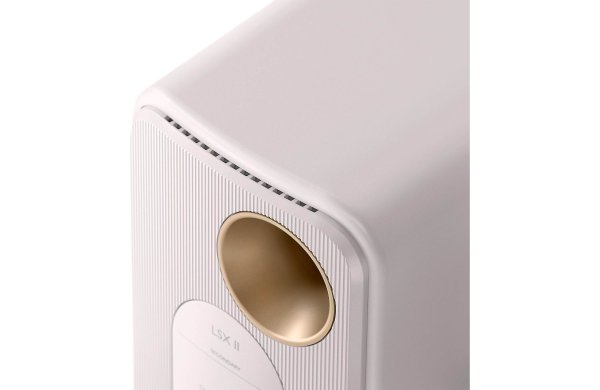 KEF LSX II Port
Physical Specs
Size of a speaker can sometimes become an important decision factor due to space constraints or in some cases purely for esthetic reasons. In this section, we are going to compare KEF LSX II's and Klipsch R-41PM's external dimensions. KEF LSX II has external dimensions of 240 × 155 × 180 mm ( 9.5 × 6.1 × 7.1 inch) whereas Klipsch R-41PM has external dimensions of 281.0 x 147.6 x 241.3mm ( 11.0625 x 5.8125 x 9.5inch) .
KEF LSX II is 41mm shorter and 61.3mm less deeper than Klipsch R-41PM but it is also 7.4mm wider.
Base Surface Area Comparison
Base surface area of a loudspeaker may become a determining factor when the space in your room or desk is limited.
The base surface area of the KEF LSX II is approximately 279.0cm2 / 43.2inch2 and base area of the Klipsch R-41PM is approximately 356.2cm2 / 55.2inch2. The LSX II requires 22% less surface area than the R-41PM which gives it a small advantage on placement in tight spaces.